
A pink ginger flower grows up between the boldly-ribbed leaves of a joey palm at Hawaii Tropical Botanical Garden.
For more information about Hawaii Tropical Botanical Garden, go to htbg.com.

A pink ginger flower grows up between the boldly-ribbed leaves of a joey palm at Hawaii Tropical Botanical Garden.
For more information about Hawaii Tropical Botanical Garden, go to htbg.com.

I posted here about the current flow from Kilauea Volcano entering the sea, in a dramatic, firehose-like outpouring. In that post, I mentioned that the day after my visit, a cliff collapse caused the firehose to disappear from view. Things have settled down again and the firehose is once more visible, though another large crack not far back from the cliff is expected to cause another collapse soon.
From the Kalapana side, it’s about four miles to the viewing area and a thriving trade in bike rentals has sprung up. When I was down that way last July there were a few bikes available for rent. Now there are maybe 200 or 300 available from a large number of vendors in the parking lot. At the viewing area, bikes were piled alongside the road, and locked in clumps.
I preferred to walk, seeing the towering column of smoke and steam getting gradually larger on the way out, and enjoying a star-studded night sky on my return.
For more information about Kilauea Volcano and it current eruption, go to hvo.wr.usgs.gov/activity/kilaueastatus.php.
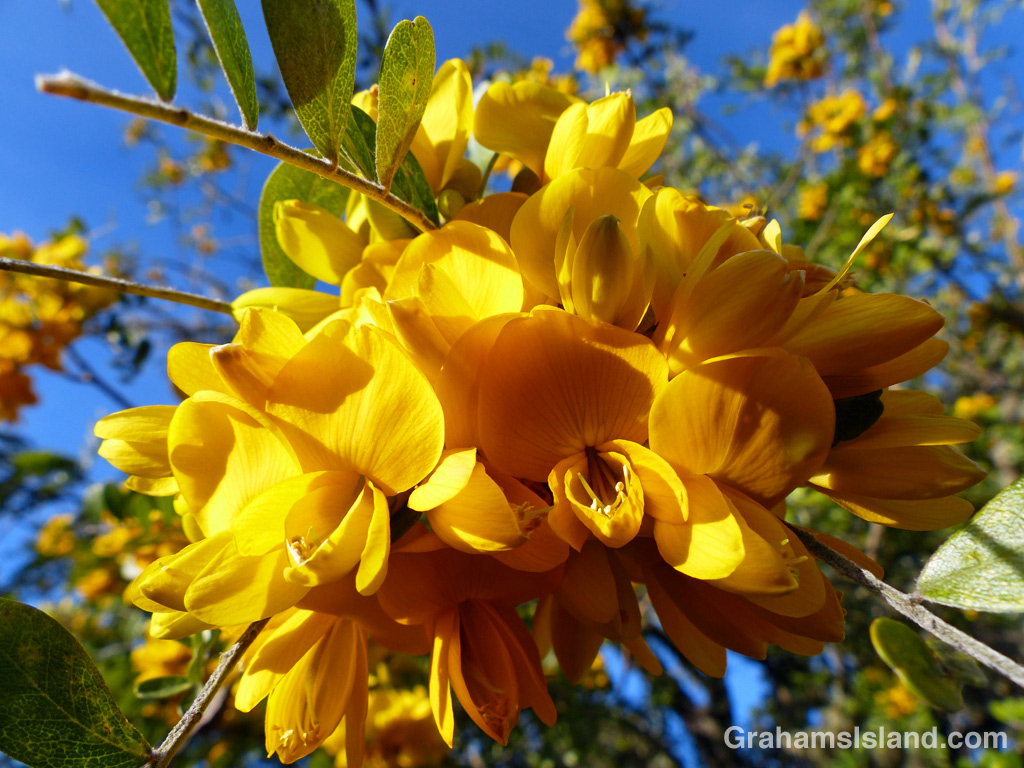
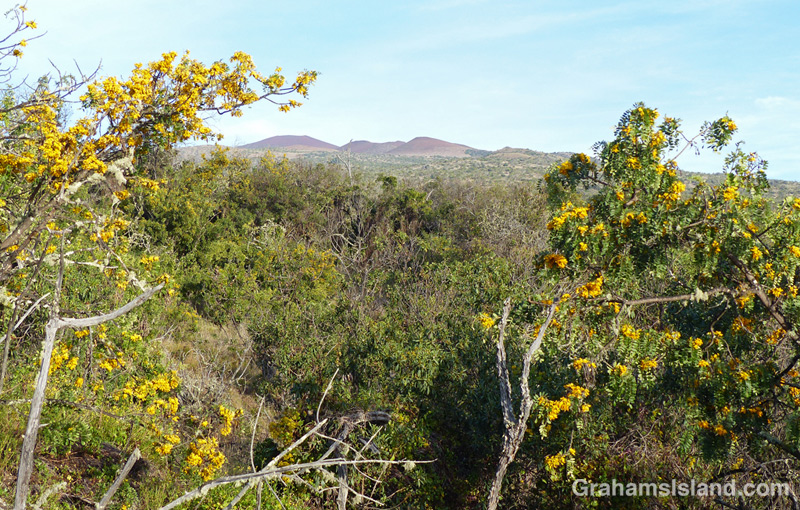
Māmane (Sophora chrysophylla) is an endemic Hawaiian tree which grows in the dry forest on the sides of Mauna Kea. These māmane are in the recently-opened Palila Forest Discovery Trail at an elevation of around 7,000 feet.
Māmane is an important plant for several endemic Hawaiian birds including the endangered palila, which is found only in this area. Palila depend on māmane trees for 90% of their food, the most important item being immature māmane seeds. These seeds are poisonous to other wildlife, but not palila.
Palila Forest Discovery Trail is part of an ongoing effort to reestablish the high-elevation dry forest on Mauna Kea, which has been greatly impacted by non-native goats, sheep, and cattle.
For more information about Palila Forest Discovery Trail, go to dlnr.hawaii.gov/restoremaunakea/palila-forest-discovery-trail/.
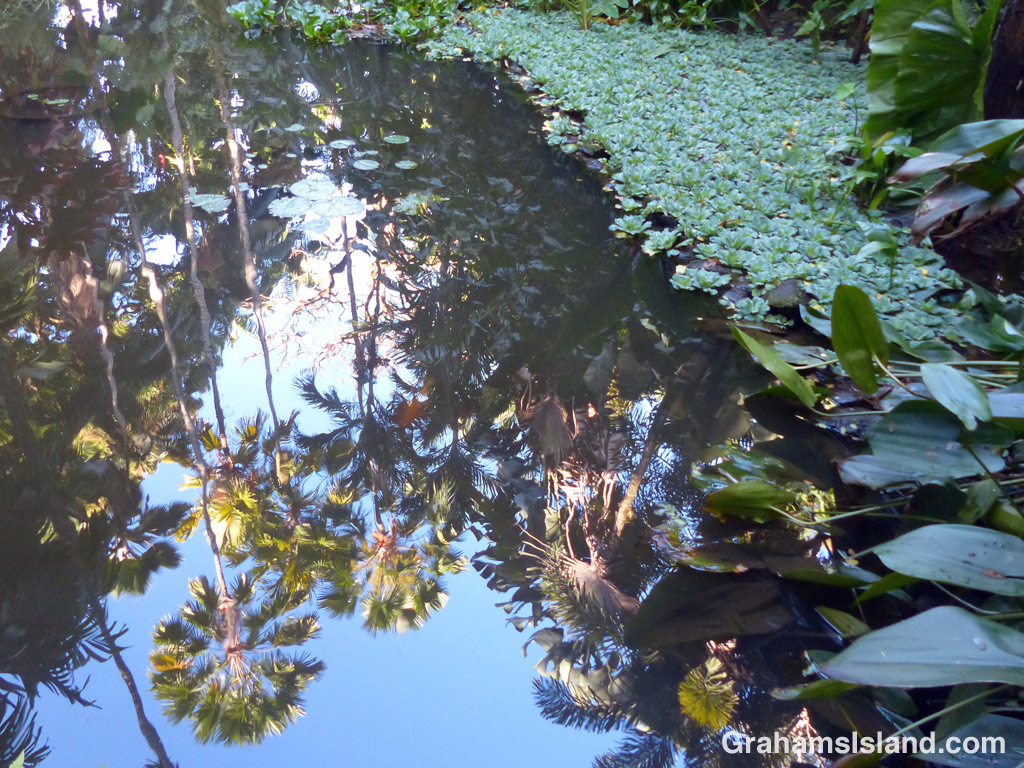
Palm trees and tropical foliage cast a reflection on Lily Lake at Hawaii Tropical Botanical Garden.
For more information about Hawaii Tropical Botanical Garden, go to htbg.com.
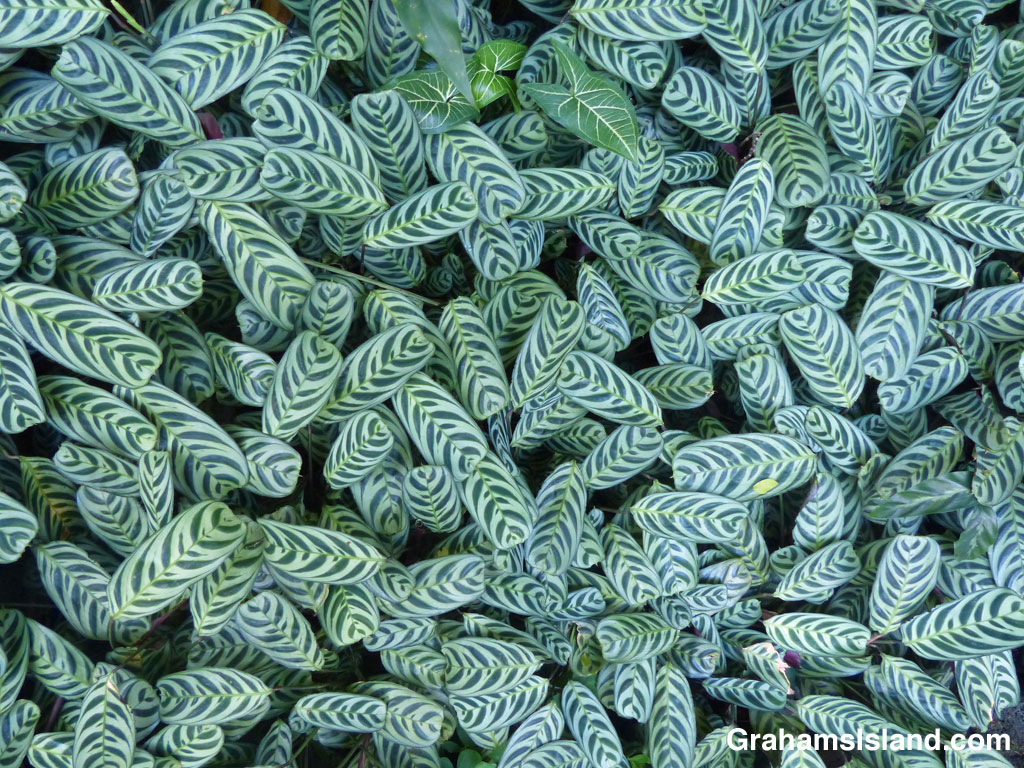
I liked the strong patterns of these Ctenanthe burle-marxii leaves at Hawaii Tropical Botanical Garden. Luckily there’s no audio here so I don’t have to try to pronounce the name of the plant.
For more information about Hawaii Tropical Botanical Garden, go to htbg.com.
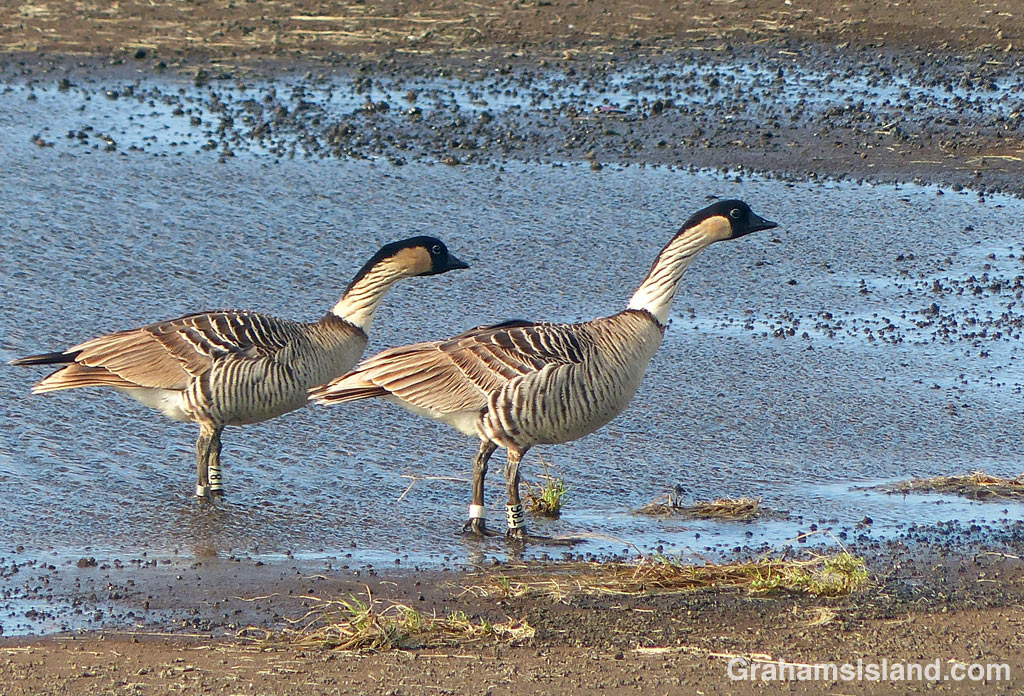
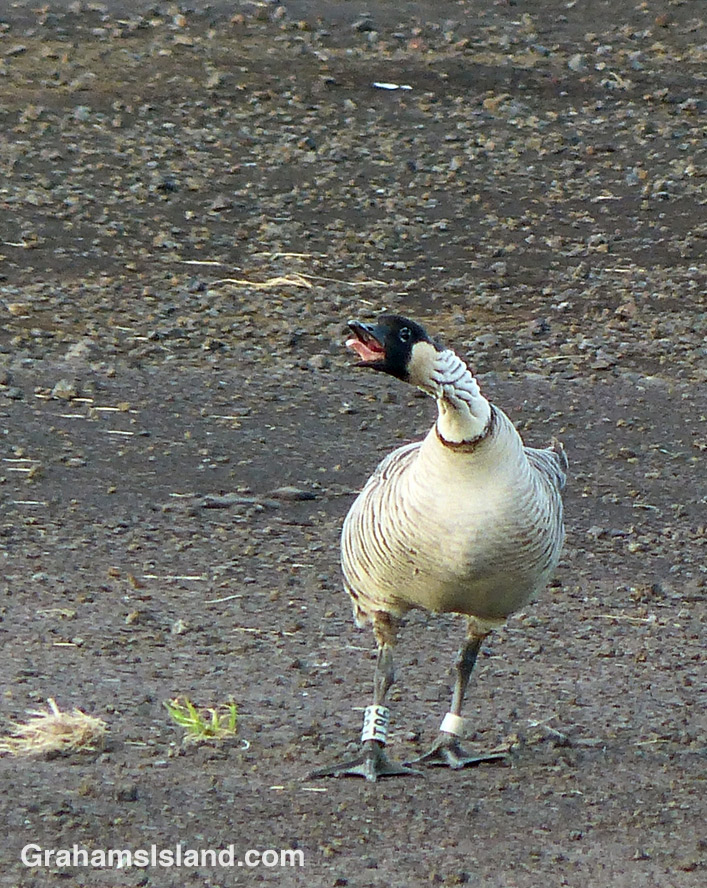
When it rains, large puddles form off to the side of the runway at Upolu Airport. These puddles are popular with a variety of birds, including these two nene, which were in fine voice.
The nene, or Hawaiian goose, is the official state bird and endemic to the islands. It’s also an endangered species and people are encouraged to report sightings to help track the birds. Here on the Big Island, nene sightings are reported to Hawaii’s Division of Forestry and Wildlife. The person I contacted there, Raymond B. McGuire, gave me this information about the birds:
“All of the nene that have the gray bands (like these) are part of a Governor’s Proclamation to move nene from Kaua’i (where they were nesting in a golf course near the airport) to the Big Island and Maui. In total, the Big Island received 598 nene in a 5-year period (2011-2016), this more than doubled the resident population prior to the project. The bands not only tell us where the nene came from, but also the sex. There should be two bands on the nene. One is metal with a U.S. Fish and Wildlife Service number (really tiny and hard to see) and the other is made of colored plastic and much easier to read the ID numbers (though the gray bands are not always easy to see on a gray legged bird). These gray-banded birds were banded by sex: males will have their plastic bands on the right and females will have the plastic bands on the left. These two particular nene, T86 and T87 were brought to the Big Island in 2014 and according to my records T86 is a male, and T87 is a female. They were brought as a breeding pair with 4 offspring. The translocated birds have been exploring the island more than the local birds have been. Although most of the introduced nene have been mixing with local nene and frequenting already established nene areas, we also now have nene frequenting areas that historically have not seen them or used to see them very infrequently, such as in Pahala, Punalu’u, Hawi (including Upolu), Waimea, and Kukuihaele!”
For more information about Nene and other native Hawaiian birds, go to state.hi.us/dlnr/consrvhi/forestbirds/.
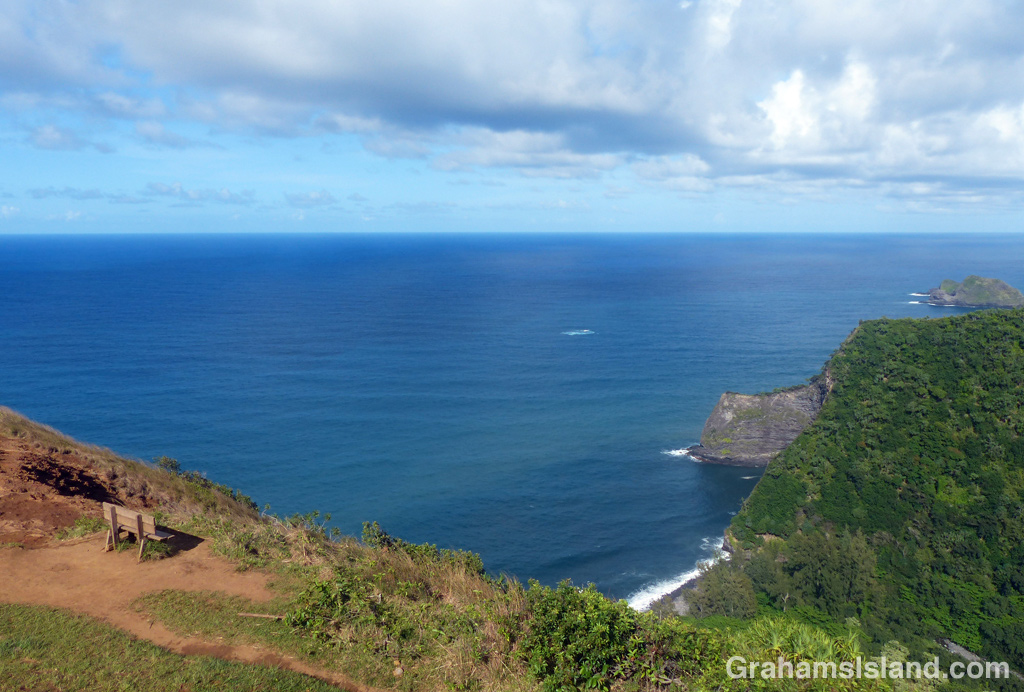
At the end of the highway in North Kohala is the Pololū Valley overlook. This is where most people park their cars (if they can find a space), snap a photo or three, and then climb back in and attempt to turn around and head back.
Quite a few people head down the steep, third-of-a-mile trail to the valley and beach below. Some walk the half-mile-long beach. Very few continue up the trail on the other side. There are good reasons for this. The trail is somewhat hidden. If it’s been raining, it can be even muddier and more treacherous than the trail down to the valley. If conditions are right, it can be alive with bugs. But for those that do press on for another a mile or so, this is the spot they will reach.
Overlooking Honokane Nui Valley, this bench is the perfect spot to experience some welcome solitude. Chances are it will be unoccupied. Chances are no one else will even pass by. I like to sit on the bench (rickety though it is currently) and enjoy the ocean stretching away on one side and the tropical jungle climbing the side of the Kohala Mountains on the other.
For more information about the trail go to bigislandhikes.com/pololu-valley/.
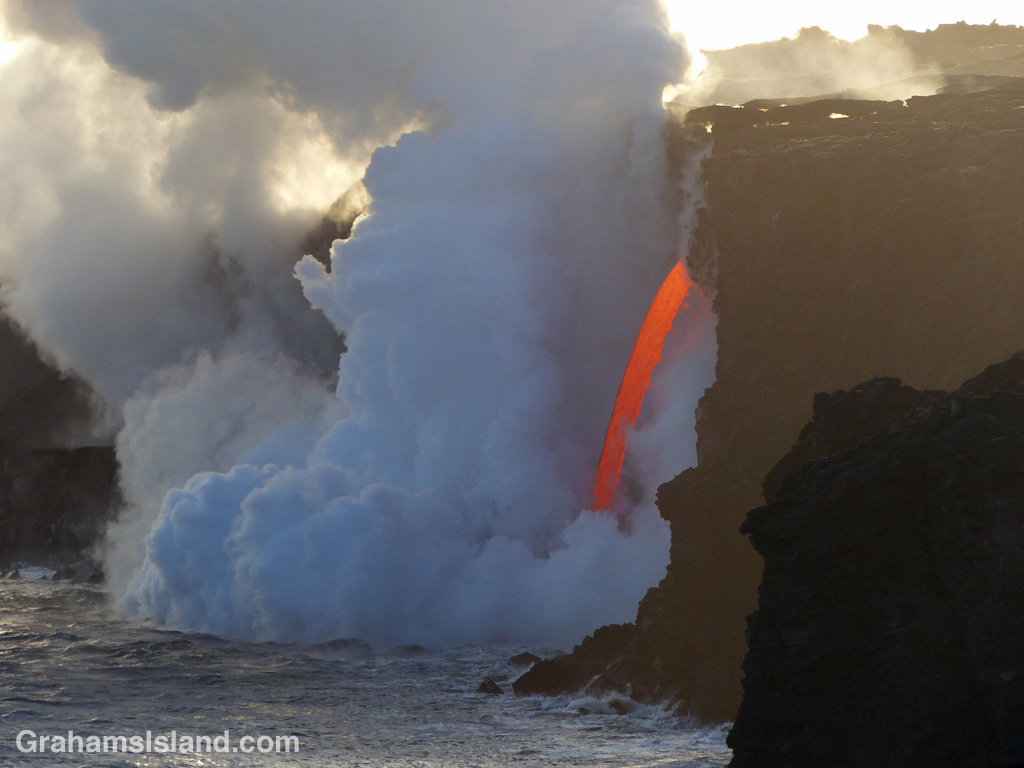

I’ve posted before (here, here, here and here) about trips I’ve made to see the current lava flow from Kilauea Volcano’s Pu’u O’o vent. Lava first reached the coast on July 26, 2016 and has been pouring into the ocean ever since. However, on New Year’s Eve, much of the newly formed delta collapsed into the ocean taking with it a chunk of the older cliff. As a result, the lava tube carrying the active flow was suddenly left exposed and lava gushed out into the ocean as if from a firehose.
I was aware this was going on, but hadn’t really appreciated what it meant until this past Wednesday. Then, I read a report about the phenomenon, saw some photos, and realized this was something I had to see. Since the weather was favorable and it was early enough, I set out the same day.
After a three-hour drive and brisk hike I got to the viewing area, from the Kalapana side, around 5 p.m. These photos are from that trip. The top photo shows the firehose, lava gushing into the ocean in a constant, unwavering stream. When it hit the water, it generated a series of explosive reactions. The second photo shows the Lava Ocean tour boat nudging in toward the action as one of these explosions occurred. Below is a closer look at the stream with chunks of hot lava being hurled out into the water.
I stuck around until it got dark and then headed home – another hour-long hike and long drive – but it was so worth the effort. This was emphasized when, the next day, another cliff collapse caused the firehose to disappear from view. It might return, since the whole area is unstable, but it might also be gone for good.
I guess timing really is everything and I feel very fortunate that I was able to experience this phenomenon before it was gone.
For more information about Kilauea Volcano and it current eruption, go to hvo.wr.usgs.gov/activity/kilaueastatus.php.

 Graham's Island