Category Archives: Places

Hawaiian monk seals

Two Hawaiian monk seals relax in a tide pool on the Big Island.Identifying tags on the tail flippers of a Hawaiian monk seal,
This photo is somewhat unusual, particularly for the Big Island. Outside of mothers with pups, it’s uncommon to see two monk seals together, much less relaxing in the same tide pool. One reason is the scarcity of seals. There are 1,000 or so in the remote northwest islands, but only about 200 around the main Hawaiian islands. Of those 200, there may be as few as 5 living around the Big Island.

One of those is IO5, a 7-year-old male, who I’ve posted about before (here, here, and here). He’s the seal I see most. In this photo, IO5 is in the foreground in what I can only describe as a characteristic pose. He’s resting, which is what monk seals do when they haul out on land.

The other seal was new to me so I was keen to identify it. There are two main means of identification. Many seals have a code bleached onto their sides. Such a mark is good for about a year until the seal molts when it sheds it’s skin. This new seal was not bleached.

The other prime method is red tags attached to the seal’s tail flippers. I moved around, trying to get a good view of the tail, but couldn’t see any tags. (I should mention here that the goal is never to disturb seals when they’re resting, so while they reclined in the tide pool, I was sneaking around on the cliff 30 feet away and another 10 to 20 feet up.) I watched for a while but this seal showed even less inclination to move than IO5. It was so still, I wondered if it was dead, but I did see a couple of twitches.

Over the next few days I saw the new seal three more times. The first time it was in a position where I couldn’t see the tail. The second time, I caught a tantalizing glimpse of red, but that told me nothing more than that the seal had been tagged. (IO5 has also been tagged, but has lost them over the years and now bears only a nubbin of one tag.) The third time I saw the new seal it was out in an open spot where I could get a great view without disturbing it. Again I could see part of the tag, but not enough to identify it. So I hung around for the best part of an hour. I got good photos both sides, of the head and tail, but still only a glimpse of a tag. During that time the seal’s only movement was a twitch of the tail, which covered the bit of tag I could see. The only good news about all this was that the seal looked in excellent shape. I didn’t see any wounds or other marks that might indicate a problem.

Finally, a full week after the first sighting, I went down to the same area again. At first, I didn’t see any seals, but I thought I’d check a low spot on the cliff for another view. About 15 feet away, stretched out on the rock, was the new seal. It was facing me but, eyes closed, remained unaware of my presence. I took a couple of photos, then climbed back up the cliff and around to where I could see the tail flippers. Eureka! The flippers were splayed in such a way that I could clearly see two tags, one in each flipper.

I sent the photos in to the NOAA Fisheries Marine Mammal Response Coordinator and a couple of days later I learned that the new seal is B00 (not sure why the other tag says B01). The seal is a 9-year-old female that was born on Kauai. In recent years she has also been seen on Molokai and Maui. I think is the first sighting for her on the Big Island. She had her first pup this year on Maui, but unfortunately it was stillborn. Perhaps her sojourn on the Big Island with IO5 will presage another pup sometime next year.

For more information about Hawaiian monk seals, go to www.pifsc.noaa.gov/hawaiian_monk_seal/ or www.marinemammalcenter.org/hawaii.

Brugmansia

A brugmansia grows beside the Kohala DitchA brugmansia flower
I grew a brugmansia at my old garden in Washington State. During the course of a summer, it grew to two or three feet high and bloomed. As I expected, the first serious dip in temperature reduced it to a sorry wilted remnant.

Here on the Big Island, such temperature dips aren’t a worry, so a brugmansia will grow to a very large shrub and carry its blooms a good while. This splendid specimen is growing next to the Kohala Ditch in North Kohala. The ditch was used to bring water from the Kohala Mountains to the sugar plantations. These days the water is mostly used for agricultural irrigation.

For more information about the history of the Kohala Ditch, go to fluminkohala.com/the-kohala-ditch.

Canada-France-Hawaii-Telescope on Mauna Kea

A view from the Canada-France- Hawaii Telescope on Mauna Kea
From the CFHT catwalk, some of the other telescopes atop Mauna Kea. From left: CalTech Submillimeter Telescope, James Clerk Maxwell Telescope, Smithsonian Submillimeter Array, Suburu Telescope, W. M. Keck Observatory (I and II), and the NASA Infrared Telescope Facility.
The interior of the Canada-France- Hawaii Telescope
The steel arms attached to the giant horseshoe, which enable the telescope to pivot. The telescope itself is in the vertical plane, with the mirror in the circular enclosure at the bottom, surrounded by instruments.
The interior of the Canada-France- Hawaii Telescope
The huge steel arms which support the telescope.
Doug Simons, Executive Director of the CFHT, explains details of the telescope’s control room. Note the analog instruments, above and to the left of his head, which register conditions outside the building, a reflection the telescope’s late 1970’s roots.

The Kama‘āina Observatory Experience was introduced by President Obama at the White House Astronomy Night in October 2015. The idea is for people who live on the Big Island and elsewhere in the state, to have an opportunity to visit the telescopes and learn a bit about what they do, as well as learn about the natural history and cultural significance of Mauna Kea.

Last weekend, I got the opportunity to take part and the Canada-France-Hawaii-Telescope (CFHT) was the first telescope visited. The telescope dates back to 1979 as is seen in the massive steel arms of the telescope and some of the instrumentation in the control room – love those analog weather instruments in the top row.

The age of the telescope doesn’t mean it’s unsuitable for the modern era. CHFT is a 3.6 meter optical/infrared telescope, but while the mirror and its housing is old school, the supporting instruments are the latest in high tech. And nowadays, like most of the telescopes on the mountain, no one needs to be there overnight; they’re operated remotely.

While a good deal of the information went over my head, and out toward the stars, it was a thoroughly worthwhile experience. I’d recommend it to anyone, but you have to be kama‘āina, a Hawaii resident.

For more information on the Canada-France-Hawaii-Telescope, go to cfht.hawaii.edu/
For more information on the Kama’āina Observatory Experience, go to kamaainaobservatory
experience.org/

Pueo

A Pueo, or Hawaiian short-eared owl, on the Big Island
I was driving home on the old Saddle Road late one afternoon when I saw that the light offered some photo opportunities. The area is one of rolling hills, pastures, and pu’us, which are old cinder cones. As I got my camera out I saw a pair of pueos, Hawaiian short-eared owls, flying toward me at a good clip. I tried and failed to get organized, almost strangling myself on the camera strap.

Luckily, one of the pueos settled in a field, not far from the road. I edged over to the fence and snapped a couple of photos. Then I eased down the fence line, trying not to fall in the hollow mounds of grass that bordered the fence. The pueo kept an eye on me while also scanning the surrounding area, it’s head swiveling around in that disconcerting way that owls have. Eventually, it decided I was too close, or too annoying, and flew off further into the field.

I’ve seen pueos several times in this area; the open pastures are a favorite habitat. Pueos, which are endemic to Hawaii, are active during the day. They usually hunt in the early morning or late afternoon, but they might be seen at any time during the day. Regardless of when I see one, a pueo sighting always leaves me feeling good about my day.

Sun sets behind Kaho’olawe

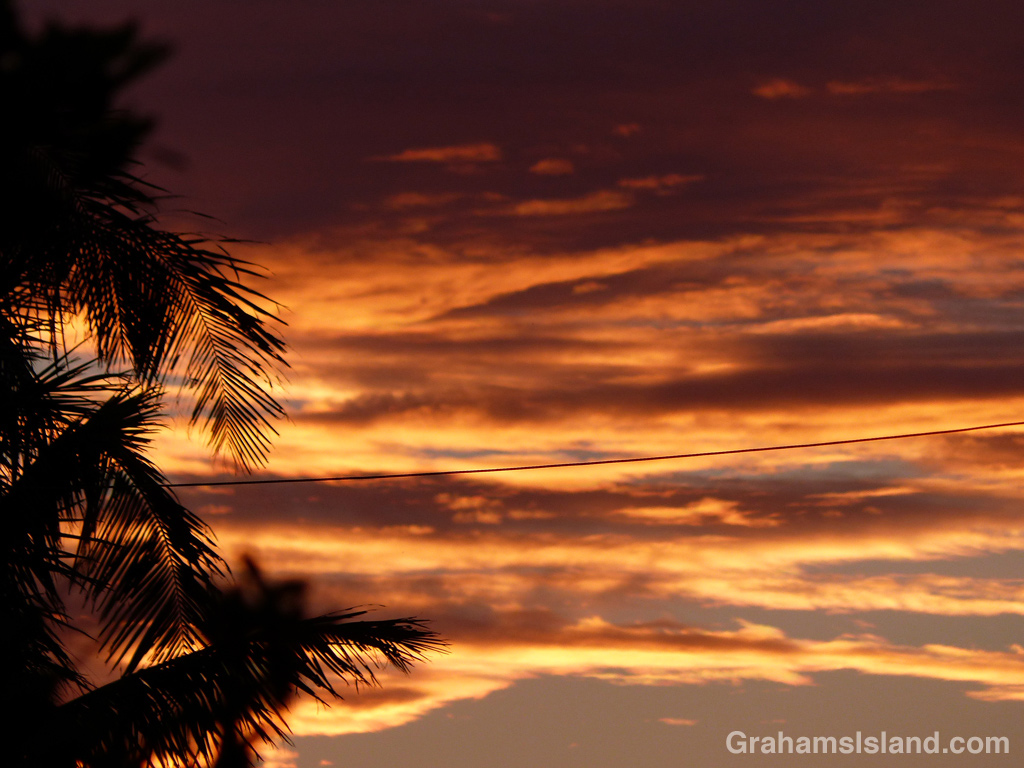
The sun sets behind Kahoolawe island
Kaho’olawe is the smallest of the eight main Hawaiian islands and lies about 7 miles southwest of Maui. After stints as a penal colony and ranching country (resulting in extensive erosion), the island became a Navy bombing range during World War II. It wasn’t until the 1990s that this ended and the island was transferred to the state of Hawaii. Several years of unexploded ordinance removal followed.

Not surprisingly, the island is uninhabited and today it’s managed by a commission with a view to continuing its restoration.

For more information about Kaho’olawe, go to kahoolawe.hawaii.gov/home.php.