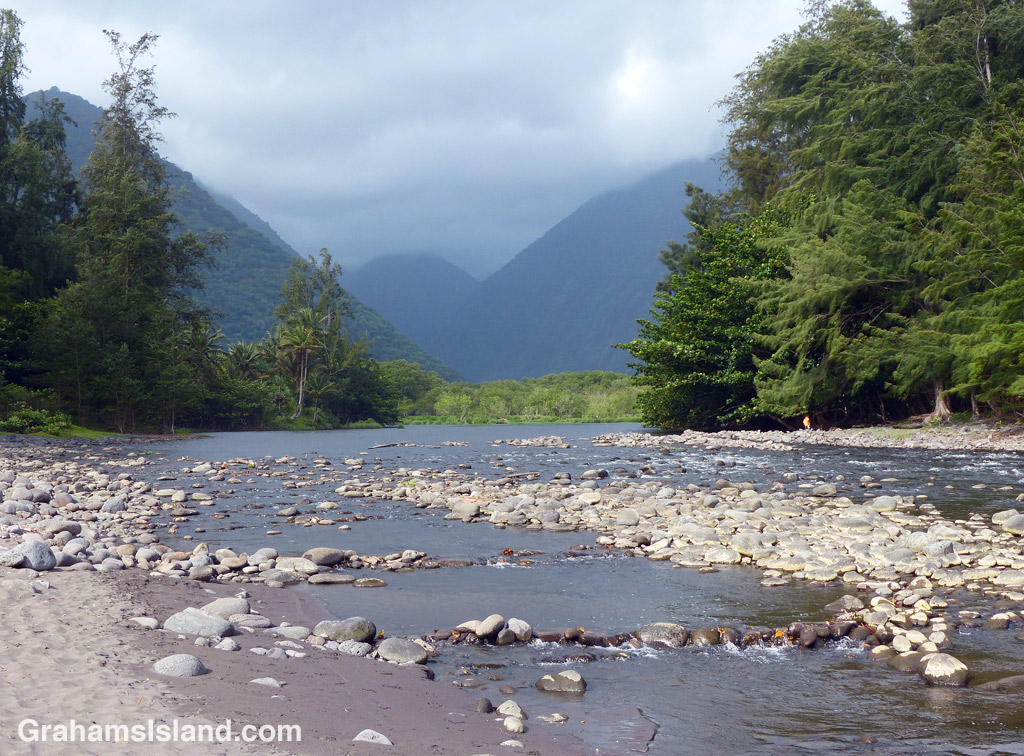
A view of Waipi’o Valley taken from the mouth of the river, with dark clouds hanging over the Kohala Mountains.

A view of Waipi’o Valley taken from the mouth of the river, with dark clouds hanging over the Kohala Mountains.

A raindrop on a passion flower vine.

While I always prefer to take smaller, winding roads, such roads taken are not without pitfalls.
The last mile of the journey to Mo’okini Heiau in North Kohala is an uneven dirt road studded with rocks. When the road is dry it can be navigated by almost all vehicles (I saw a smart car there once!). However, care is needed, particularly regarding clearance. Almost every time I walk the road, I see fresh scrapes on the rocks. With rainy weather, the road becomes the territory of 4-wheel drives and jacked-up suspensions.
On this day, the puddles that often form on the road had become lakes. This truck had passed me earlier and when I saw it returning I ducked behind a bank to do a little whale watching and avoid the wave of spray that would surely accompany anything driving through the lake. A few minutes passed. I realized I hadn’t registered the truck passing. It had gone very quiet. So I wandered out to the road again and saw the truck marooned. They’d made it through on the way out, but weren’t so lucky on the way back.
The truck was a 4×4 but not with extra clearance. I think their problem was that the lake was deeper at the far end (in the photo). On the way out, they’d no doubt barreled into the water and their momentum had carried them to shallower waters and out. On the way back, the same approach would have propelled them toward the deep end. I suspect a bow wave built up, slowed them, and allowed water to penetrate parts of the truck that responded unfavorably.
The two young local men seemed quite cheerful. They waded through the muddy water, tried to coax life into the truck. One was on the phone (a miracle to have service there). After they insisted they had everything under control, I walked past on the high bank alongside the road, then turned and took this photo. When I returned a half hour or more later, the truck and its occupants were gone.
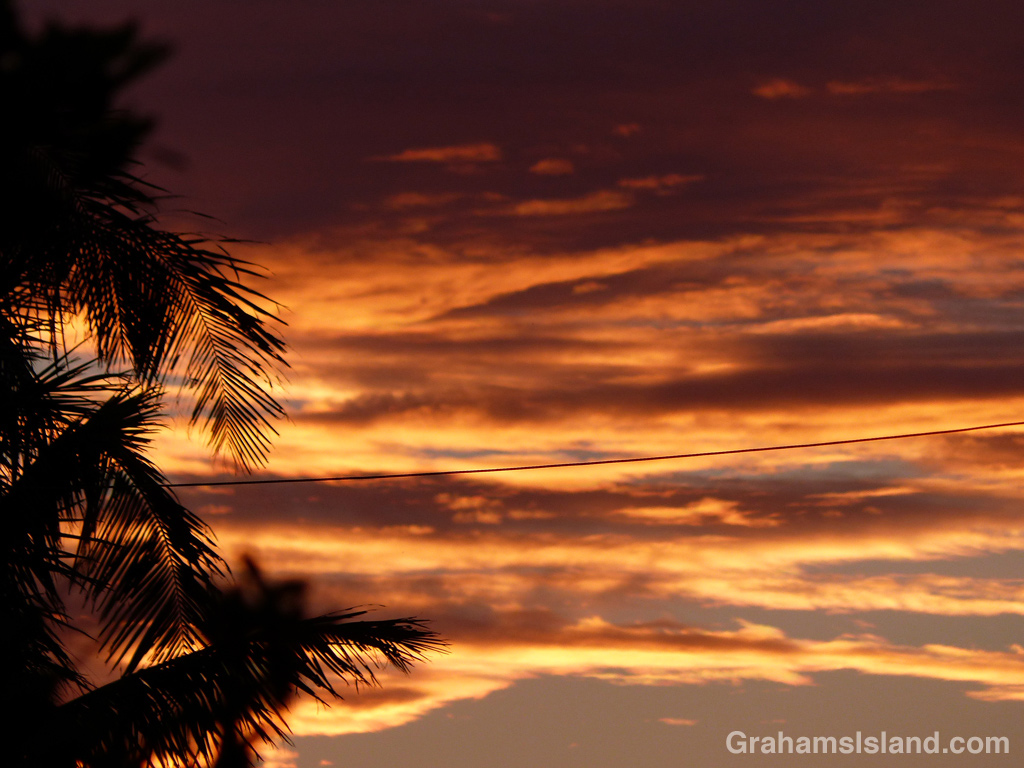
Palm trees silhouetted against a Kohala sunset.
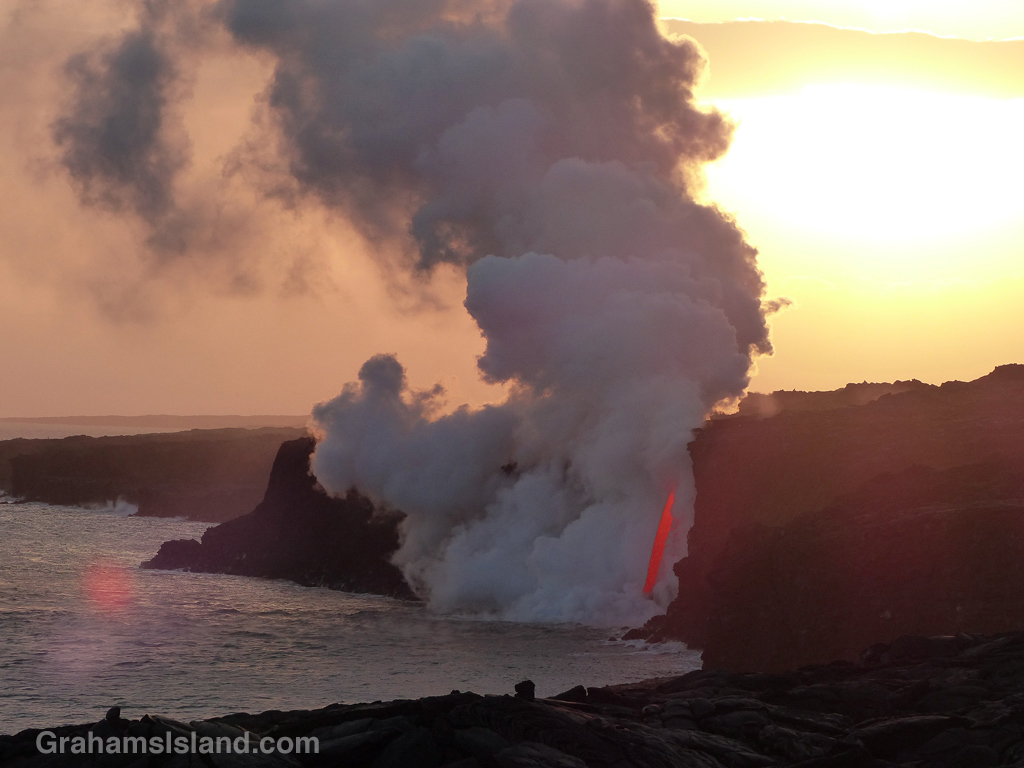
As the sun sinks slowly in the west, a firehose of lava from Kilauea Volcano gushes into the sea. More photos here. A good video of the firehose, since the cliff collapse, can be found here.
For more information about Kilauea Volcano and it current eruption, go to hvo.wr.usgs.gov/activity/kilaueastatus.php.
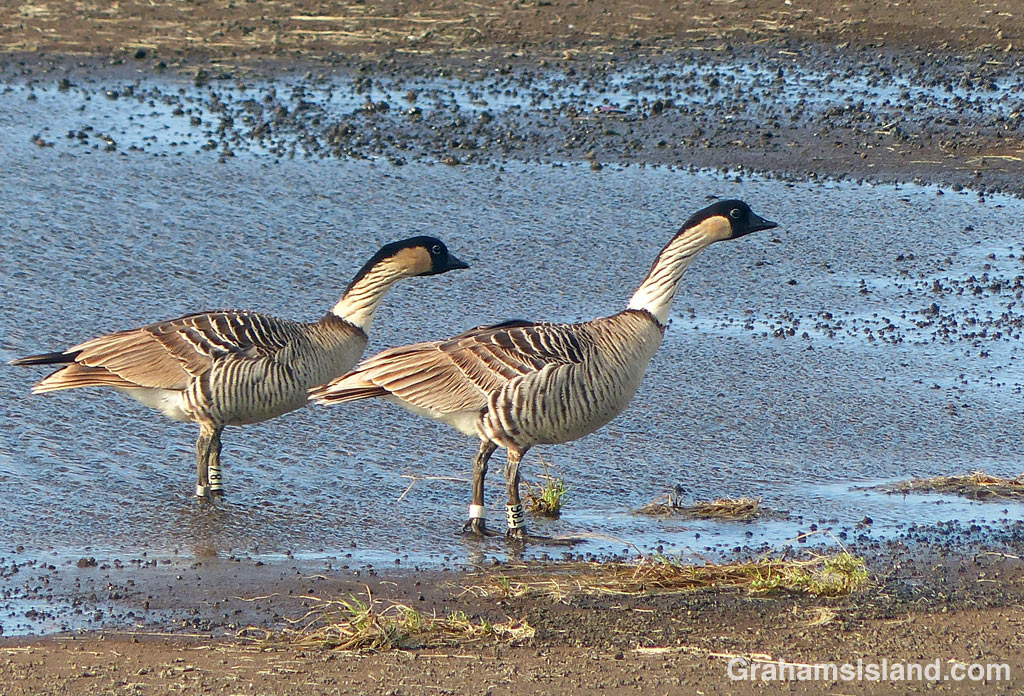
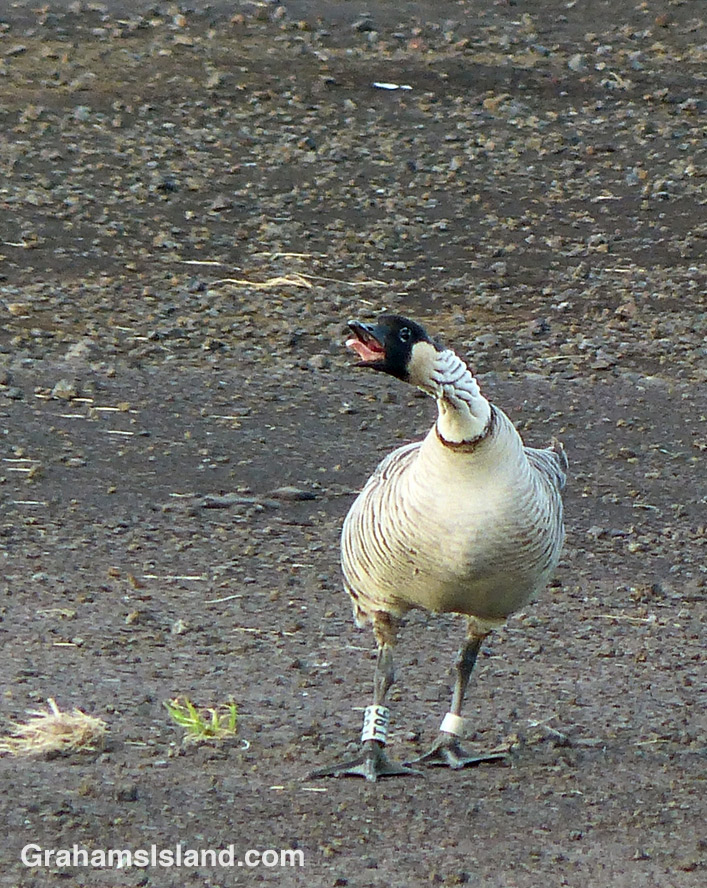
When it rains, large puddles form off to the side of the runway at Upolu Airport. These puddles are popular with a variety of birds, including these two nene, which were in fine voice.
The nene, or Hawaiian goose, is the official state bird and endemic to the islands. It’s also an endangered species and people are encouraged to report sightings to help track the birds. Here on the Big Island, nene sightings are reported to Hawaii’s Division of Forestry and Wildlife. The person I contacted there, Raymond B. McGuire, gave me this information about the birds:
“All of the nene that have the gray bands (like these) are part of a Governor’s Proclamation to move nene from Kaua’i (where they were nesting in a golf course near the airport) to the Big Island and Maui. In total, the Big Island received 598 nene in a 5-year period (2011-2016), this more than doubled the resident population prior to the project. The bands not only tell us where the nene came from, but also the sex. There should be two bands on the nene. One is metal with a U.S. Fish and Wildlife Service number (really tiny and hard to see) and the other is made of colored plastic and much easier to read the ID numbers (though the gray bands are not always easy to see on a gray legged bird). These gray-banded birds were banded by sex: males will have their plastic bands on the right and females will have the plastic bands on the left. These two particular nene, T86 and T87 were brought to the Big Island in 2014 and according to my records T86 is a male, and T87 is a female. They were brought as a breeding pair with 4 offspring. The translocated birds have been exploring the island more than the local birds have been. Although most of the introduced nene have been mixing with local nene and frequenting already established nene areas, we also now have nene frequenting areas that historically have not seen them or used to see them very infrequently, such as in Pahala, Punalu’u, Hawi (including Upolu), Waimea, and Kukuihaele!”
For more information about Nene and other native Hawaiian birds, go to state.hi.us/dlnr/consrvhi/forestbirds/.
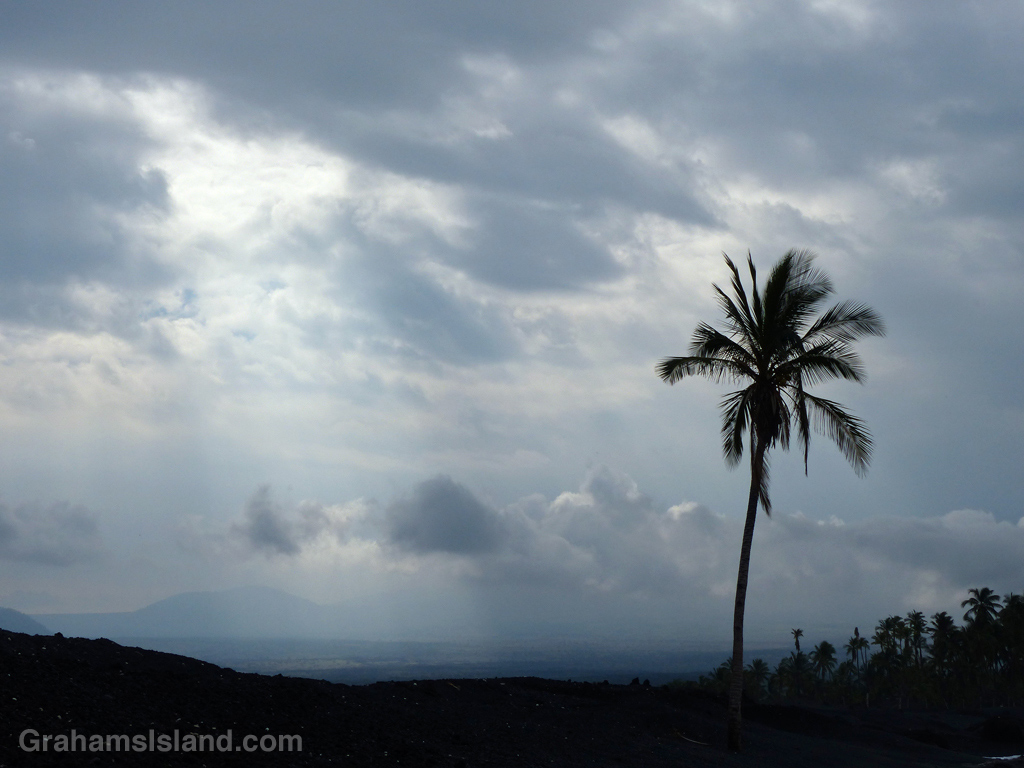
The lone palm at Keawaiki stands out against a cloudy sky.
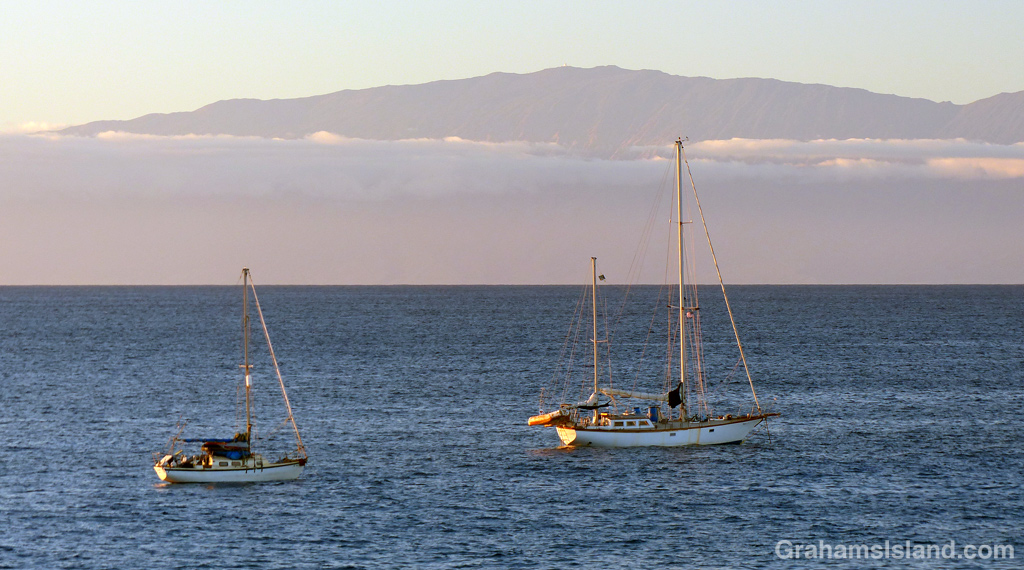
A pair of sailboats at anchor off the Big Island with Maui in the background.
 Graham's Island