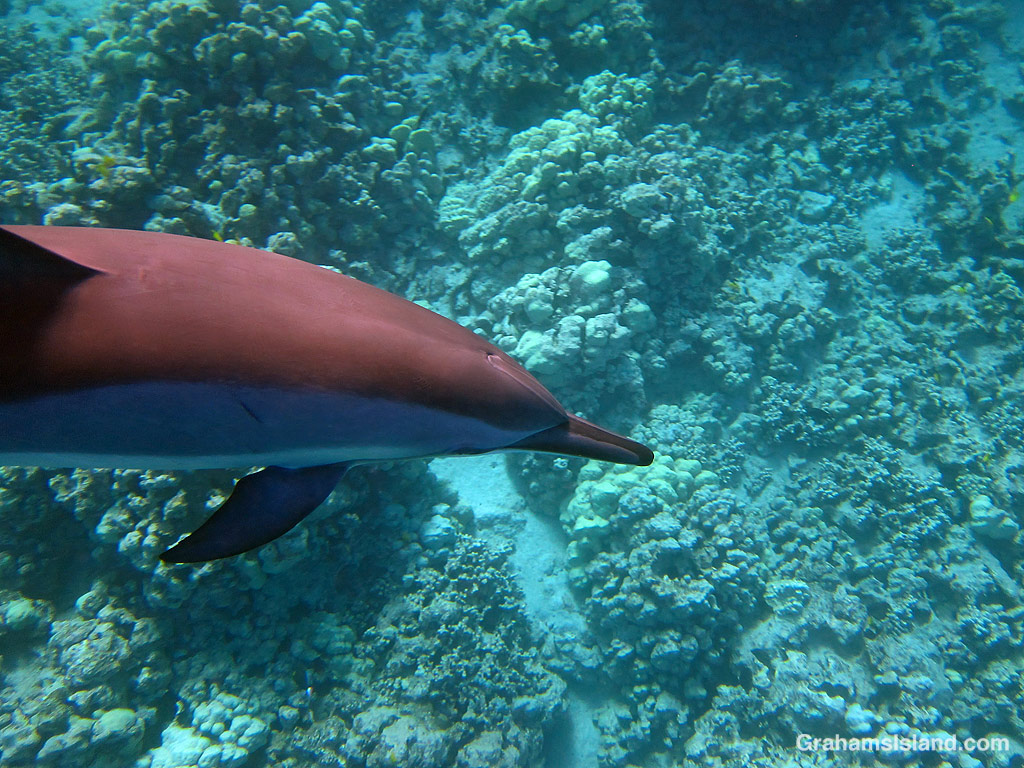
A couple of days ago, I was snorkeling when I saw this enormous fish. I snapped a quick photo, fearful that the fish would quickly disappear. But it stuck around for a minute or two, passing back and forth in front of me, before sliding away into deeper water.
I knew it was a jack, but not one I’d seen before. When I got home, I dove into my fish book and figured out this was a giant trevally. According to my fish book, the giant trevally is the largest of the jack family. The biggest recorded catch is one that weighed 191 pounds. That would be heavier than me! That’s a tad worrisome because my fish book also notes that these curious and fearless fish ‘have been known to grab and rip away divers’ bright snorkel tips and colorful fins.’
This one was smaller than that, probably somewhere between three and four feet long, but comfortably the largest jack I’ve ever seen and probably the largest fish I’ve seen of any kind other than rays and sharks.
Early one morning, I stopped to watch the setting full moon and liked how it illuminated this red buoy marking one side of the entrance channel to Kawaihae Harbor.
This week’s Sunday Stills challenge theme is ‘Fur and Feathers.’ See more responses here.
This bird is probably a red junglefowl (Gallus gallus) or Moa in Hawaii. I say probably, because some regular chickens (Gallus domesticus) can have a similar look and there is considerable interbreeding between the two species.
The red junglefowl is considered to be the first introduced bird species in Hawaii, since it was brought here by early Polynesian settlers.
Yesterday was Guy Fawkes Day in Britain and to celebrate I finally got to see some fireworks, albeit of a very different kind and in the wee hours of the morning instead of the traditional Bonfire Night. I got up just after 1 a.m., left the house around 2 a.m. and drove over to Hawaii Volcanoes National Park. I mostly had a beautiful starlit night for the drive except for about 15 minutes over the saddle between Mauna Kea and Mauna Loa when I was driving through cloud and not entirely sure whether there was any other traffic despite barreling along at 60 mph.
I made good time, arriving at the park around 4:30 a.m. and the viewing point about 15 minutes later. There were around 20 people already there, but a prime viewing spot was open so I set up my tripod and camera and began taking photos.
The viewing area was a place I’d stopped by during the previous eruption in December 2020. That spot only allowed a view of the glow of the eruption, which was lower in the crater. This time the eruption was higher up and the trail had been extended so that a good view could be had of both the eruption site and the crater floor the lava was flowing onto.
The eruption began on September 29, 2021 through a series of vents, but by October 4 this had settled down to two vents and by October 6 to the single vent in the west wall of Halemaʻumaʻu crater seen in these photos.
The eruption has added about 184 feet of lava to the previous lava lake level and though it appears to have slowed a tad lately, it still put on a good show with a good deal of spattering and some smaller fountains of lava. The active vent has formed its own cone with lava spilling into the lake through a gap in the cone. Recently, a bridge formed over that cone so that the lava spills out though a short tunnel as can be seen in these photos.
I stuck around until the sun rose high enough to illuminate the slopes of Mauna Loa and then headed back to the car. After a spot of hiking, the return drive and some shopping in Waimea. I got home around 2:30 p.m.. A long day, but well worth it in my book.
Barleria repens has a variety of names including Coral Creeper and Creeping Barleria. This gives some idea of the kind of plant, though it can also grow as a rounded shrub and a vine. What got my attention was the pale purple anthers standing out against the otherwise red flower.
After a late day at work, I was driving down a hill on the way home when I saw the sun setting behind a line of palm trees. There was nowhere to pull over, so I rolled the window down, angled the car across the center line, got this photo, and then got back on track. I hasten to add that this didn’t occur on the main highway, but on the way down to it, with no other traffic in sight. I’m not that irresponsible. I think.
This young goat was looking particularly bright-eyed and ready for action, as they tend to do. The myna bird, watching the kid, looked grumpy and unimpressed, as they tend to do.
My fish book notes that the large-spotted snake moray eel can be encountered both day and night, but is not often seen. That’s true in my experience. This is only the second one I’ve seen here and the first I’ve photographed.