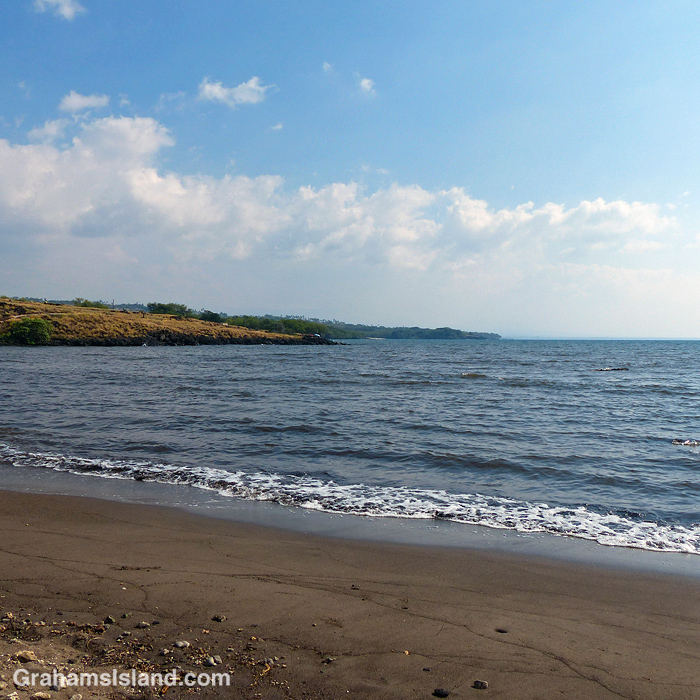
I took the top photo on my way to work one early morning. It’s a tranquil scene (the reason I go down there) shot from the beach below Pu’ukohala Heiau in Kawaihae. The second photo was shot on my way home in mid-afternoon. It was taken from the same beach in roughly the same place and looking in roughly the same direction.
Astute observers will see past the similarities in the photos and notice something is missing. Hualalai Volcano has disappeared. Now, it’s not unreasonable to think that those puffy white clouds in the second photo have something to do with this, but that’s not really the case. True, they might mask the upper reaches of the volcano, but the whole thing? No, the culprit is the fuzzy band between the clouds and the land – vog!
The latest eruption of Kilauea Volcano, which began on September 29th, is churning out vog, which forms when volcanic gases interact with sunlight, air, moisture, and dust. Two days later, when these photos were taken, it was having a visible effect. I’d noticed the vog drifting up the west side of the island during the morning and by afternoon visibility was greatly reduced. But it’s not just visibility that’s affected. Vog is especially troublesome for people with breathing difficulties, but can also irritate the eyes and skin of just about anyone.
Posted in response to Becky’s October Squares challenge theme of ‘Past Squares – Time.’ See more responses here.







 Graham's Island