This week’s Friendly Friday challenge theme is ‘The Color Pink.’ See more responses here.
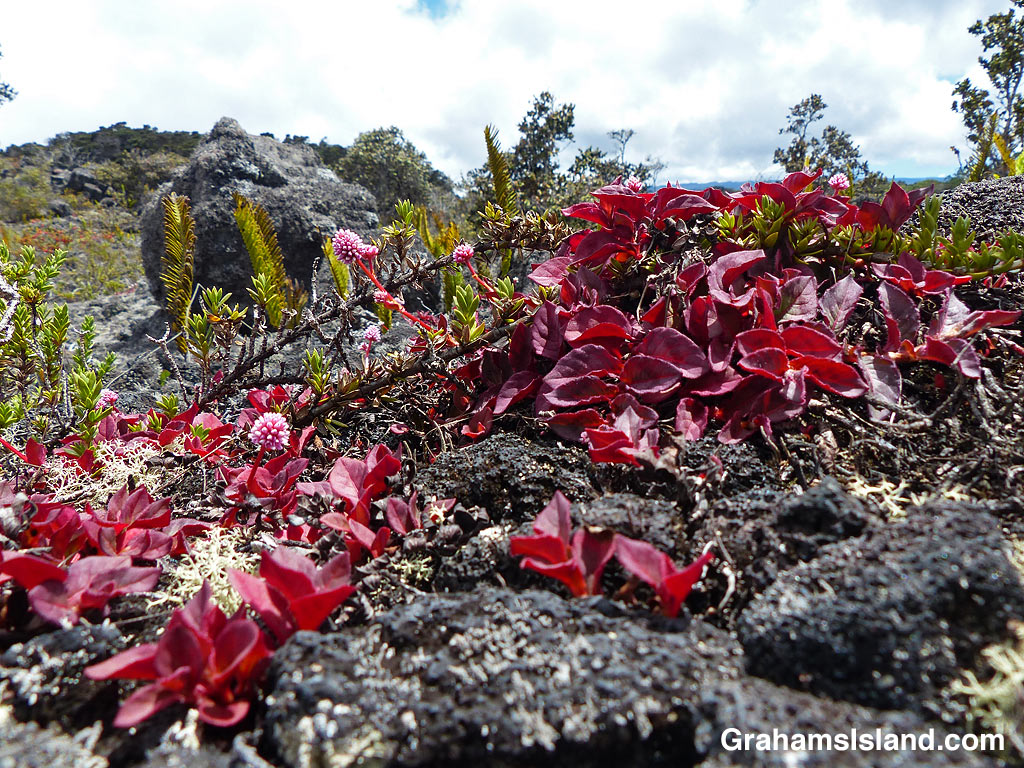
Pinkhead smartweed (Polygonum capitatum or Persicaria capitata) is a groundcover that hails from western China and the Himalayas. It’s variously known as pinkhead knotweed, pink knotweed, Japanese knotweed, pink-headed persicaria, or pink bubble persicaria. I use pinkhead smartweed for the very good reason that I like the name. It sounds like the name of someone pretentious, but slightly seedy, from the alleged upper crust of society.
In this bounty of names, a couple of elements stand out. One is ‘pink,’ the other is ‘weed.’ This is a very pink plant and, in Hawaii and elsewhere, an invasive weed. Drive eastbound over Saddle Road (officially Hawaii Route 200, the Daniel K. Inouye Highway) and, once you cross the saddle and begin your descent, this plant will become obvious very quickly. It lines the road on both sides for several miles with very little in the way of other plants competing for that space. This is because pinkhead smartweed will grow in poor ground and lava fields fit that description.
This is also a stretch of highway that, relatively recently, was converted from a narrow, winding road, that rental car companies routinely forbid their clients from driving on, to a wide, smooth thoroughfare, the only place on the island where you can legally go 60 mph, and where you can expect to receive a ticket if you go 80 mph like everybody else.
Redoing the road left verges of rock and gravel and very little else. Pinkhead smartweed was quick to move in and colonize this unpromising territory so that now the descent toward Hilo begins with pleasing pink borders.
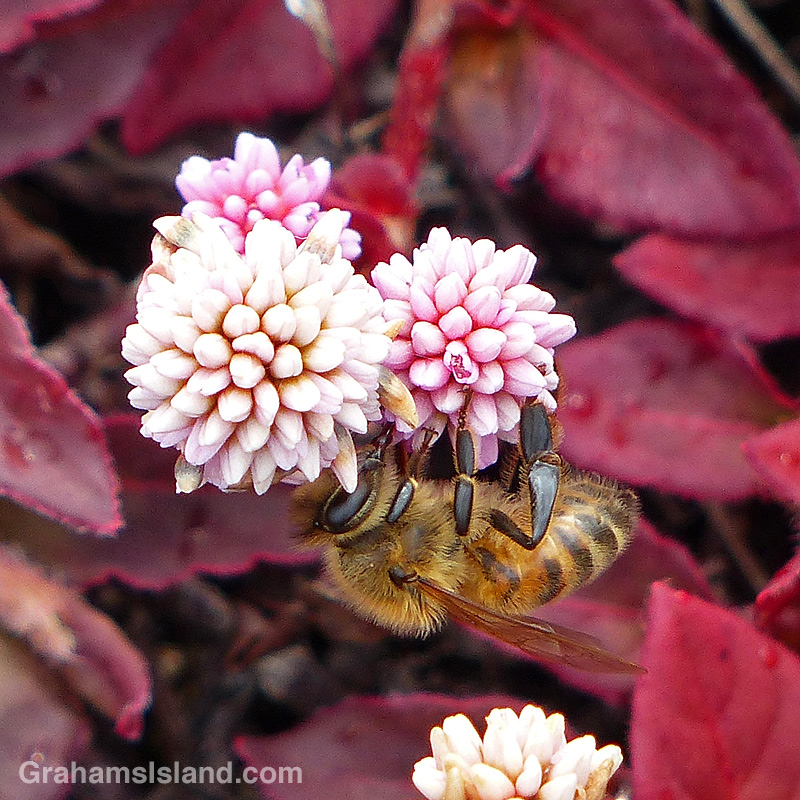
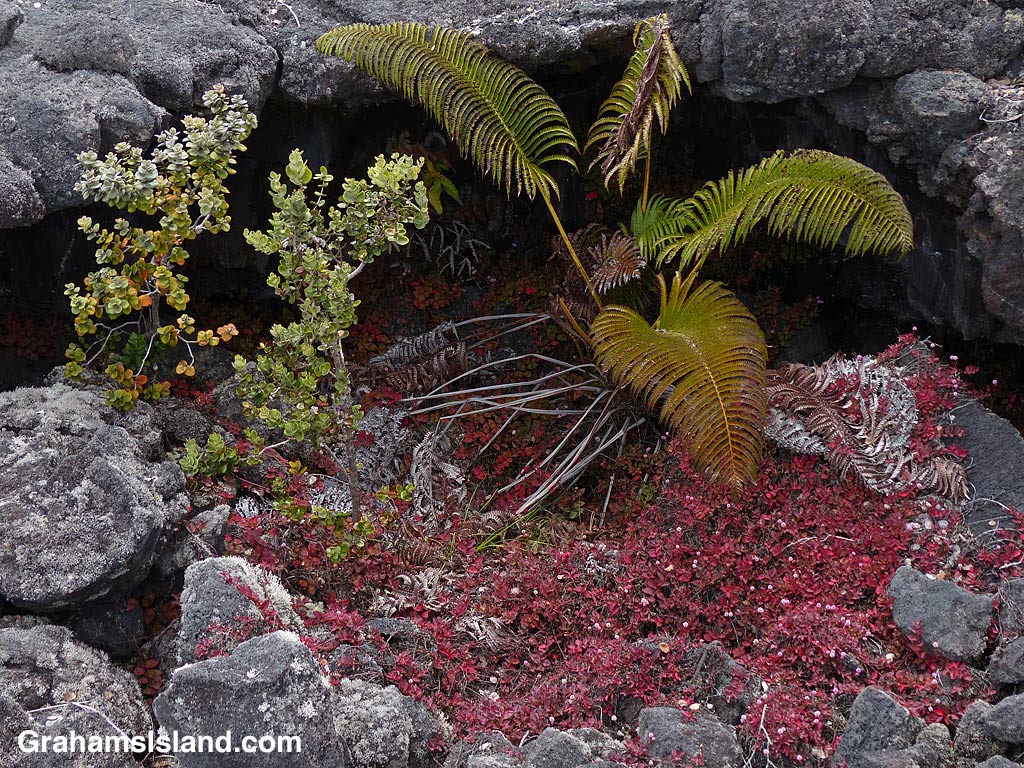
The top photo shows the rugged kind of ground pinkhead smartweed can grow in. To the right, bees appreciate the flowers of this plant growing at an elevation over 5,000 feet. Below, the collapse of a lava tube has left a shady hole where pinkhead smartweed, an endemic amaumau fern, and an ohia tree have established a good foothold.
This week’s Friendly Friday challenge theme is ‘Surprise.’ See more responses here.
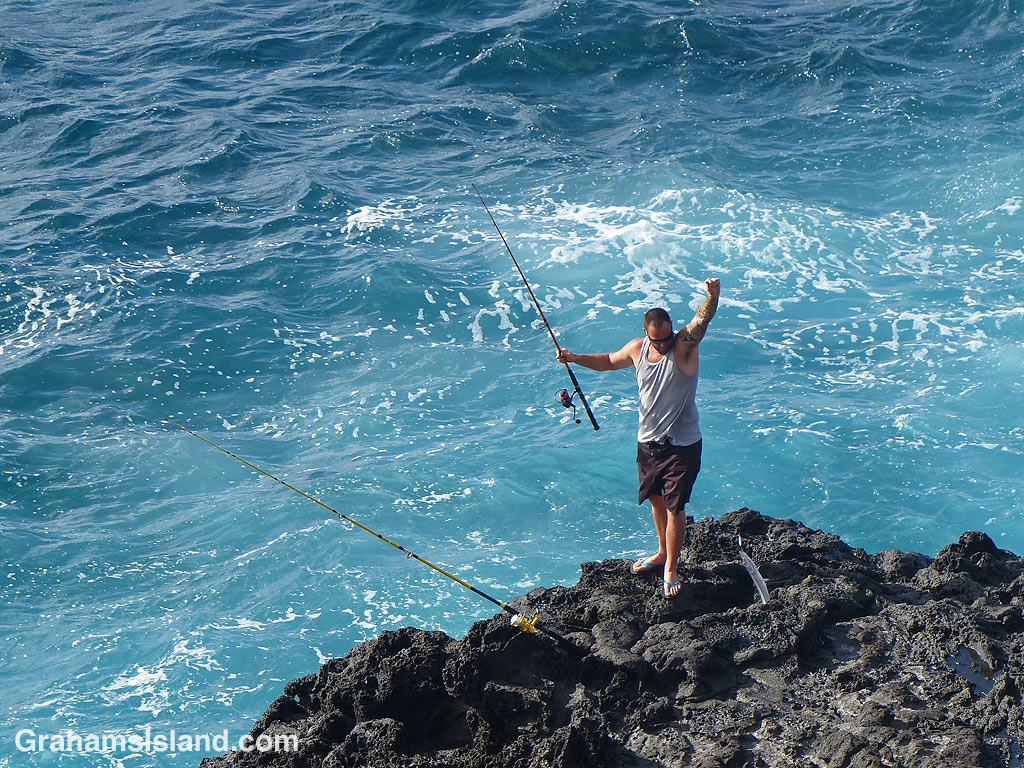
I see a lot of fishermen when I’m out walking and they undoubtedly catch fish, but I never see them doing so. I’m as good at getting photos of that moment as I am at catching fish myself.
When I first saw this fisherman he was reeling in an empty line, as per usual. I kept walking, but moments later I heard a cry, turned to look, and saw him winding away on his line. I nipped back to take photos, fully expecting it to be a false alarm – his line was snagged in the rocks or he’d hooked some debris. So I was surprised when he hauled this fish from the water. I don’t know what kind it was, but it was a decent size and probably destined to be that evening’s supper.
Two days ago, while driving home after my daily walk, I was thinking it must be almost a week since I actually took a photo (Never mind that when I got home I found that I’d taken a couple of photos earlier, during my walk!). Then I saw a patch of white in the grass beside the road, realized what it was, and thought that I should at least get a photo of that.
The nearest of the cows was some distance away, but this was the pasture of the local dairy and these cows are pretty mellow. I’ve seen other calves, seemingly abandoned, but actually just resting in a quiet spot while mom catches up with some grazing.
This was a marked contrast to my last cattle encounter, which was that almost-a-week-previous occasion of taking photos. I went for a hike up Pu’u Wa’awa’a. This is a public trail, but the land is also used for grazing so there can be cattle, horses, sheep, goats, and even a donkey or two sharing the area with hikers. Bear in mind that these cattle are being raised for beef so they’re big. Also, the cows among them are there to produce future beef cattle. They’re not giving milk to anyone other than their calves.
On this day, the first part of the trail, an old road, was littered with cattle of one kind or another, including several small calves. I grew up on a dairy farm and I’ve walked through many a field of cows and the occasional bull. I’m used to them, so this array of cattle didn’t bother me. As I walked up the trail, the herd thinned out. Soon all I saw in front of me were a couple of younger animals. These looked bigger and older than the calves lower down, perhaps yearlings. As I got closer I noticed a couple of full-grown animals grazing in a ditch on the other side of the road. They were mostly obscured by grass so I couldn’t see if they were cows or bulls. It seemed to make no difference as they appeared to ignore me as I passed.
I marched on up the road, and as I got closer to the two yearlings, I realized that one of the full-grown cattle (the large, black one in the photos below) had moved in my direction. This didn’t bother me. Often times cattle run towards me as I pass. Then they pull up and just look, or even turn and run away. I kept going. So did the large animal. I still couldn’t see whether it was male or female, but as it started snorting at me, I began to think female. I looked ahead to the two yearlings, then at the cow. She came closer, still snorting. I stopped. For the first time in my life, I thought I was probably going to get charged by a cow. This might seem silly, but people get killed by cows every year. A cow will charge, especially if someone comes between her and her calf.
By this time the cow was about 10 feet away. I decided this wasn’t the time to get a photo of a charging cow and instead clutched my metal water bottle with a view to swinging it at her snout. But the cow didn’t charge. Instead, she snorted one last time, glared at me as she stomped past, and headed up the road to what was clearly her calf. She was followed by the other large, brown cow.
Once the four were reunited, they just stood in the old roadway. I thought they might amble off, as cows will often do, but they stayed put. I didn’t feel like threading my way through them in case the two big ones were still riled up, so I marched into the scrubland to the side of the road and worked my way around them. The footing was uneven, but it wasn’t hard going and I soon came out on the other side. They’d watched my passage with more typically bovine expressions and once I regained the road surface they lost interest and meandered into the trees on the opposite side of the road.
I watched them go and figured I’d have a drink of water before continuing up the trail. I reached for my water bottle and pulled it out with a bloodstained hand … bloodstained hand? I couldn’t believe what I was seeing. Both hands were smeared with blood. My shorts had a giant patch of blood on one side. Just above my wrist, a small scratch continued to gush. Somewhere in my short trek through the underbrush I’d encountered something sharp without noticing, which is fairly typical for me.
I washed the blood off my hands and held a tissue to the cut. It quickly stopped flowing, so I carried on up the trail having rediscovered the wisdom of not getting between a mother and her offspring.
The top photo was my last of April and is posted in response to Bushboy’s Last on the Card photo challenge. See more responses here. Also posted in response to this week’s Friendly Friday challenge theme of ‘Covid Discoveries.’ See more responses here.
And if those four cattle ever get together and release a record, perhaps Music To Moooove To, I think the bottom photo would make a great album cover for them.
This week’s Friendly Friday challenge theme is ‘Working Together.’ See more responses here.
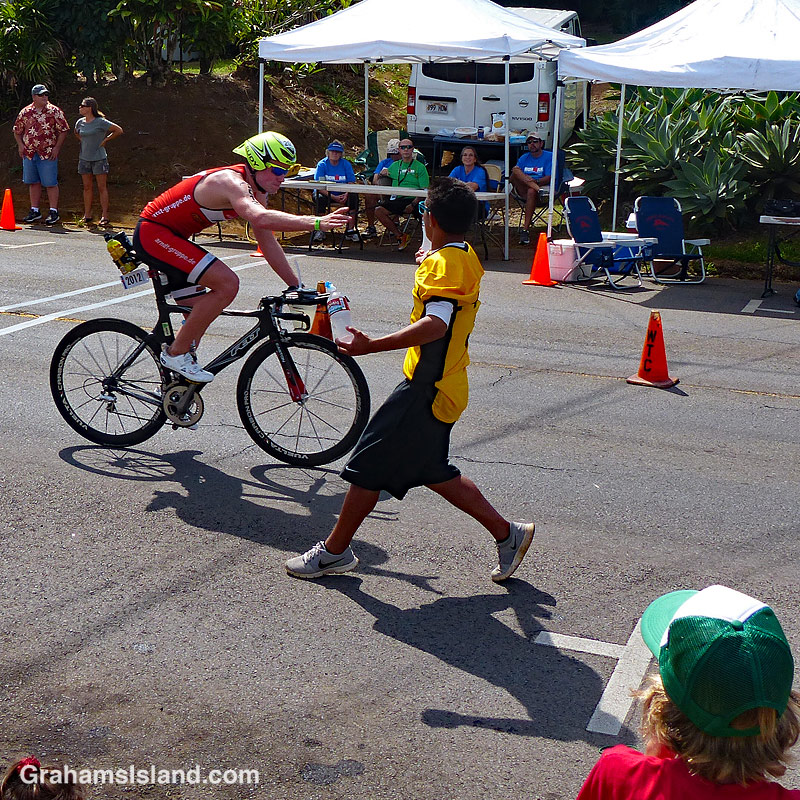
The Ironman World Championship race is held here every year in October. Last year, there were nearly 2,500 competitors so it’s a huge event. An army of volunteers helps make the race happen, involved in everything from setting up the course to numerous activities on race day to cleaning up afterwards.
This photo was taken at the turnaround in Hawi, roughly halfway into the 112 mile cycling course. It’s the top of the bike course with it being mostly downhill back to Kailua Kona. Of course, this being cycling, there’s a good chance the wind, which can be fierce here, will be in the cyclists’ faces on the way up and on the way back down.
At this turnaround, volunteers hand out water and food to the competitors. It’s a tricky business making the handoff since the cyclists keep moving and there’s a steady stream of them. In this photo, I like the movement of the volunteer handing off the water as well as the echo of the action in the strong shadows.
Also posted in response to Becky’s April Squares challenge theme of ‘Top.’ See more responses here.
This week’s Friendly Friday challenge theme is ‘Something Good.’ See more responses here.
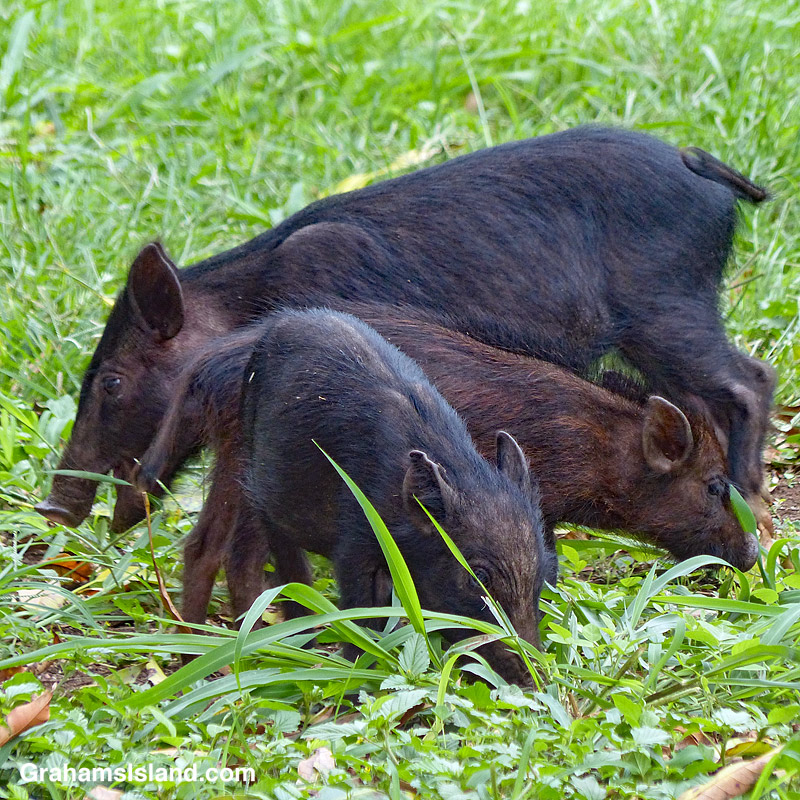
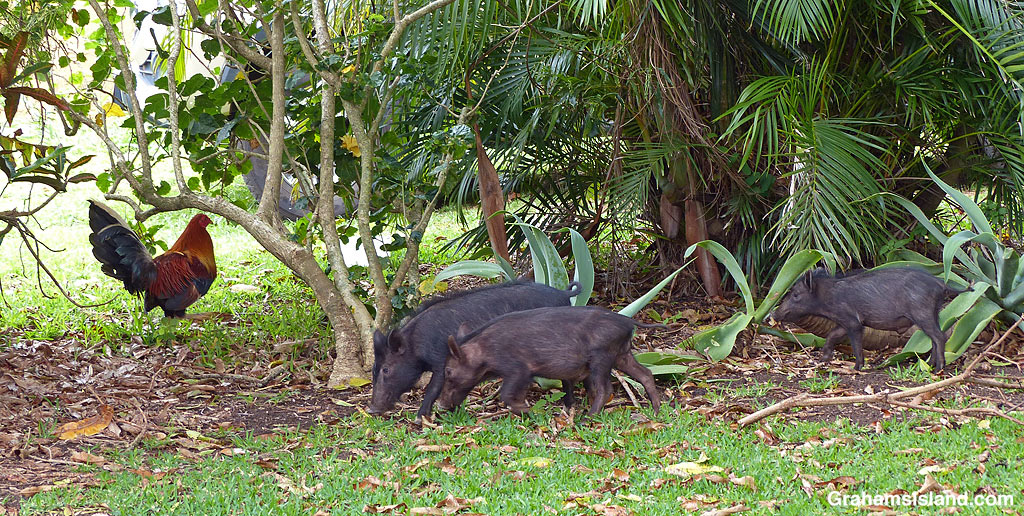
These three little pigs have been my top source of entertainment over the last couple of weeks. They’ve been regular visitors, looking for fallen mangoes and tangerines, or just foraging for worms and the like in the grass. The littlest pig seems the most adept at finding things and, when it does, the others try and get a piece of the action. Usually the littlest pig runs off with its trophy and the others chase it.
A couple of days ago they met Hopalong, a rooster thinking about making the yard his territory. Usually, when a rooster does that, I make a point of ushering it away every time it shows up and eventually it gives up. But Hopalong has a bad foot and doesn’t get around well, so he’s reluctant to move on. He wasn’t sure what to make of these pigs trotting toward him, so he retreated into the neighbor’s yard, looking affronted.
The three little pigs are easily spooked, scooting into the cane grass at the least disturbance. I think that’s where they live. I ventured in there one day and saw three little houses, one made of straw, another of sticks, and a third of bricks. I was going to investigate more, but I heard a low growling noise followed by some huffing and puffing, so thought better of it.
Also posted in response to Becky’s April Squares challenge theme of ‘Top.’ See more responses here.
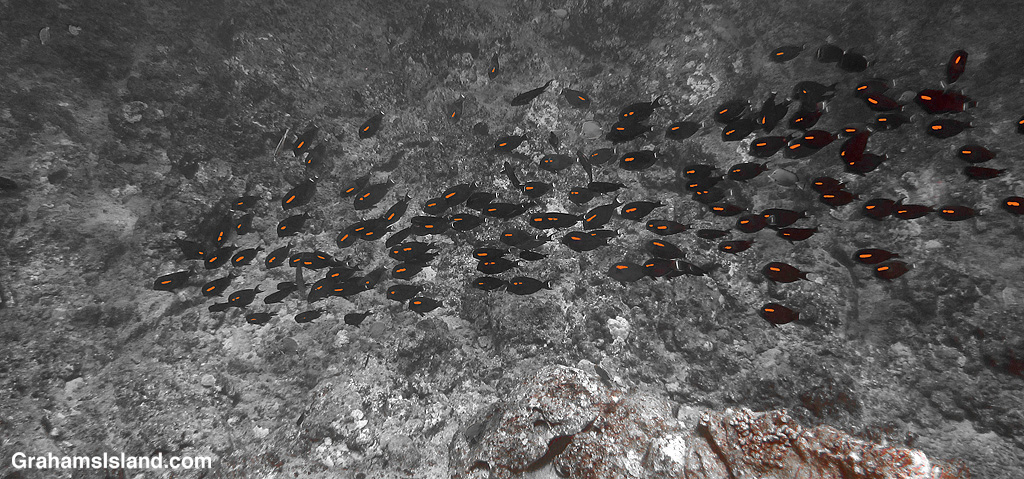
This week’s Friendly Friday challenge theme is ‘Re-imagine Orange.’ See more responses here.
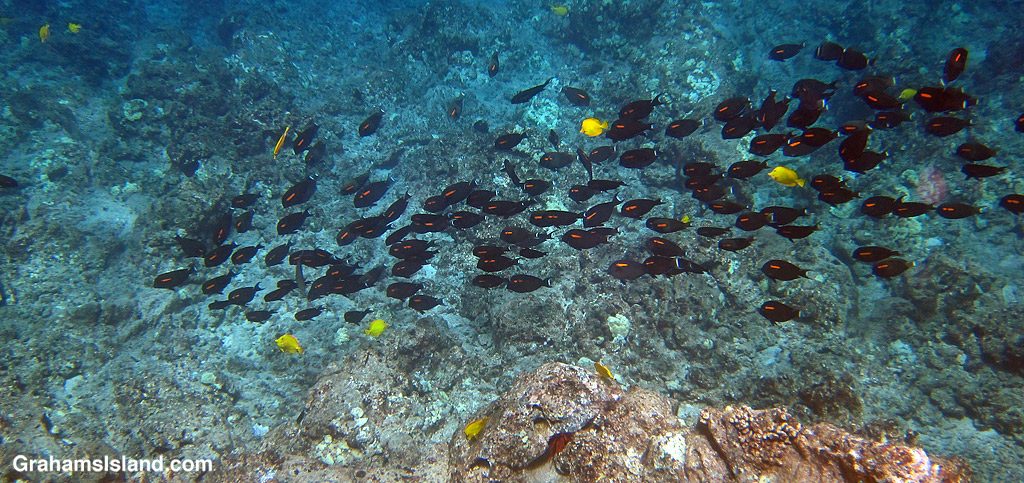
A shoal of orangeband surgeonfish is fun to see with their orange bands making them easy to identify and follow. For the purpose of this challenge, I took the photo below, desaturated the other colors, then boosted the orange to emphasize their defining feature. These changes virtually eliminated the other fish, particularly the yellow tang which went from bright focal points to almost invisible.
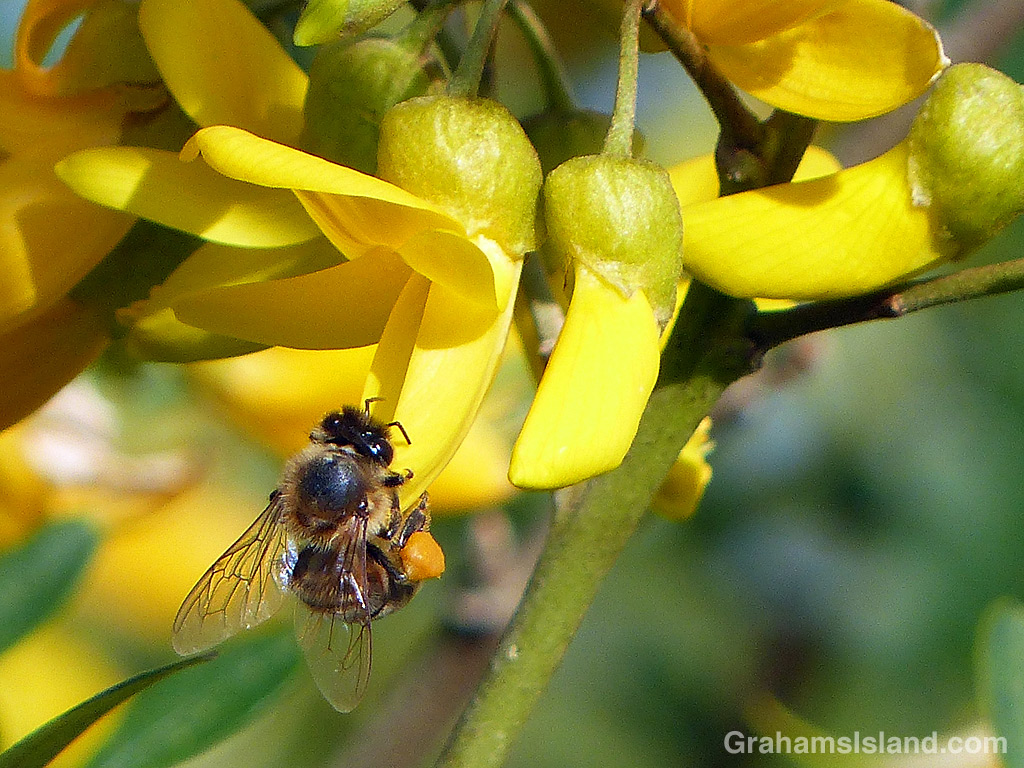
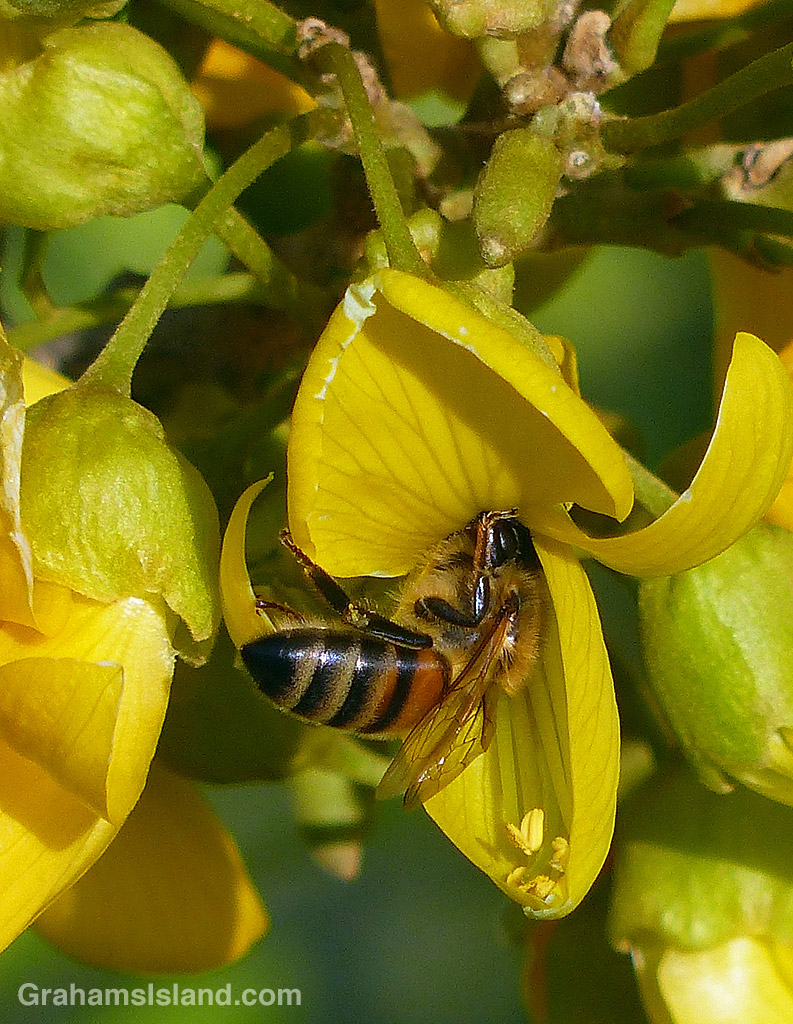
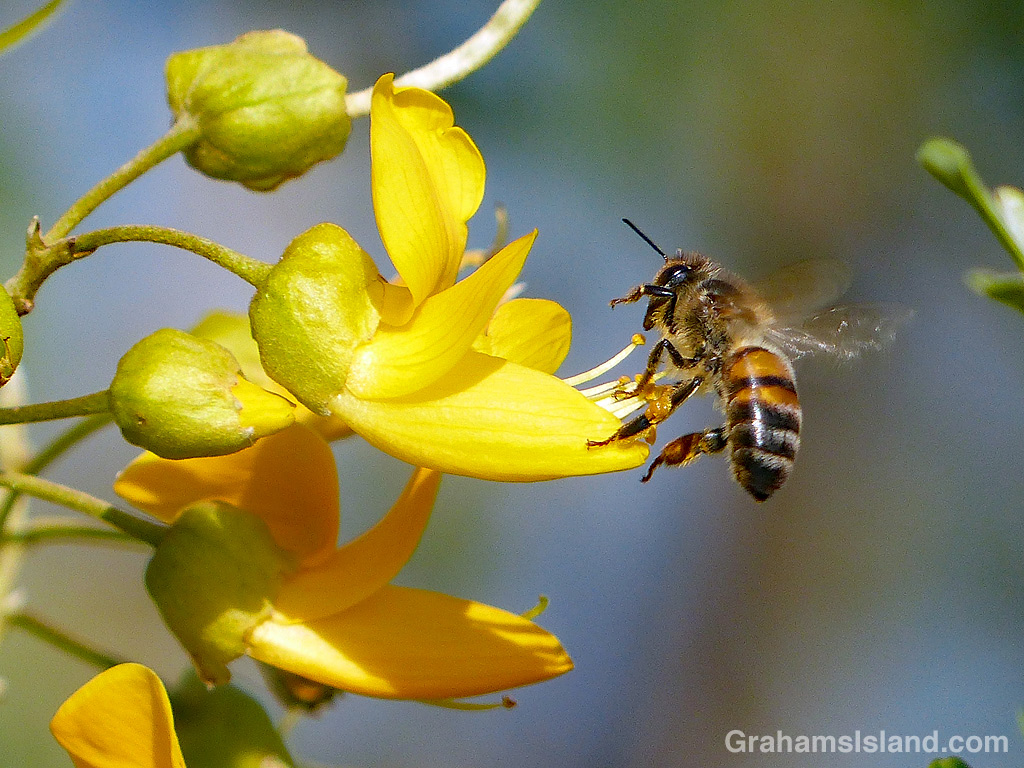
This week’s Friendly Friday challenge theme is ‘Yellow.’ See more responses here.
This is a good excuse to post more photos of bees foraging on bright yellow māmane flowers. Māmane (Sophora chrysophylla) is endemic to Hawaii, but while its flowers attract many insects, the seeds are highly toxic. The endangered palila, one of the last endemic Hawaiian honeycreepers, is a bird that feeds mostly on the māmane’s immature seed pods without any ill effect.



 Graham's Island