Tag Archives: Hawaii Volcanoes National Park

The Nāpau Trail – Over the lava

A surface lava flow on Napau trail.
An early part of the trail follows a surface flow down the side of a hill with a small ohia tree toughing it out in the lava.
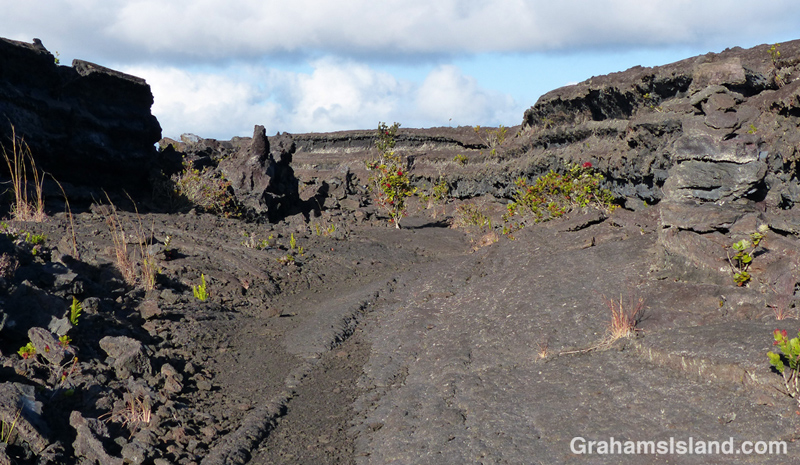
A lava channel on Napau trail.
In a couple of places the trail goes through sunken areas that channeled the lava.

The Nāpau Trail in Hawaii Volcanoes National Park, is a 13-mile round trip. It passes over extensive lava fields, plunges into dense forest, and ends at the Nāpau Crater overlook. The overlook offers a terrific view (weather permitting) of Puʻu ʻŌʻō, one of two active vents on Kilauea Volcano. In today’s post I’m going to cover the lava fields portion of the hike with the second part coming tomorrow.

From the Mauna Ulu parking area, the first mile or so is a well-trodden trail to Pu’u Huluhulu (hairy hill) cinder cone. The foot of Pu’u Huluhulu is where the Nāpau Trail branches off across the lava. It’s a stark landscape, but with lots of interest. The trail passes over surface flows and through channels where lava rivers ran.

The Park’s website notes that the Nāpau Trail “follows the path that magma takes as it makes its way underground from its source at the summit to the point where it comes to the surface near Puʻu ʻŌʻō.” The many steam vents around Mauna Ulu are testament to this.

And in this hostile landscape, nature is at work. The lava fields are dotted with tenacious plants establishing a toehold.  Ohia trees and ferns are most frequently seen, but grasses and other plants lend color to this sea of gray and black.

It’s 2.2 miles of unbroken lava from the Pu’u Huluhulu junction to the rim of Makaopuhi Crater, but at that point the trail changes in an almost surreal way. I’ll post that section tomorrow.

For more information about this, and other hikes on the Big Island, go to bigislandhikes.com.
For more information about Hawaii Volcanoes National Park, go to nps.gov/havo/.
For more information about Kilauea Volcano and it’s eruptions, go to hvo.wr.usgs.gov/kilauea/history/main.html.

Steam vents on the eastern side of Mauna Ulu.
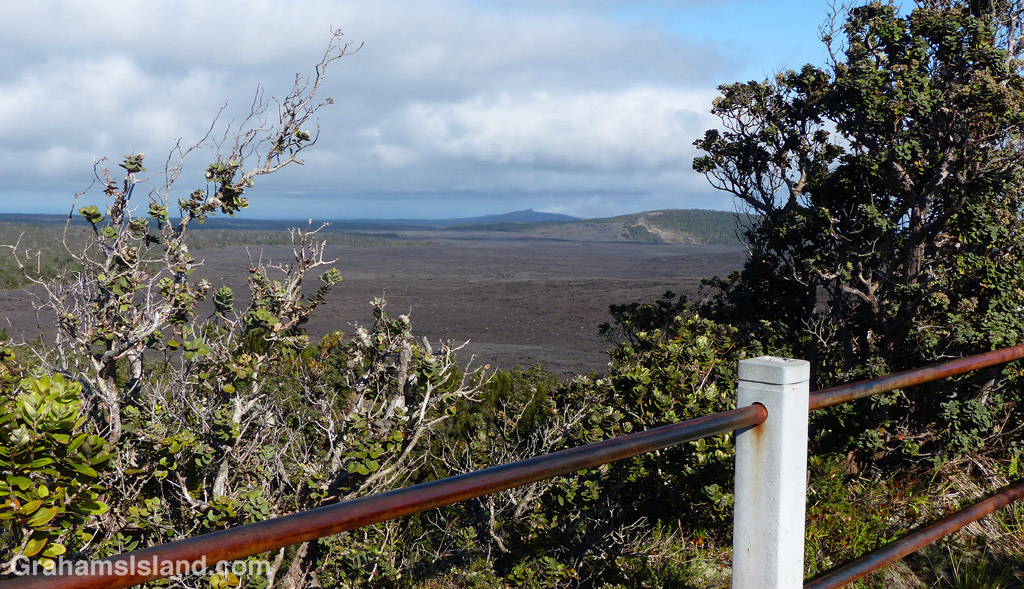
Cairns mark the route across an ocean of lava toward Makaopuhi Crater.
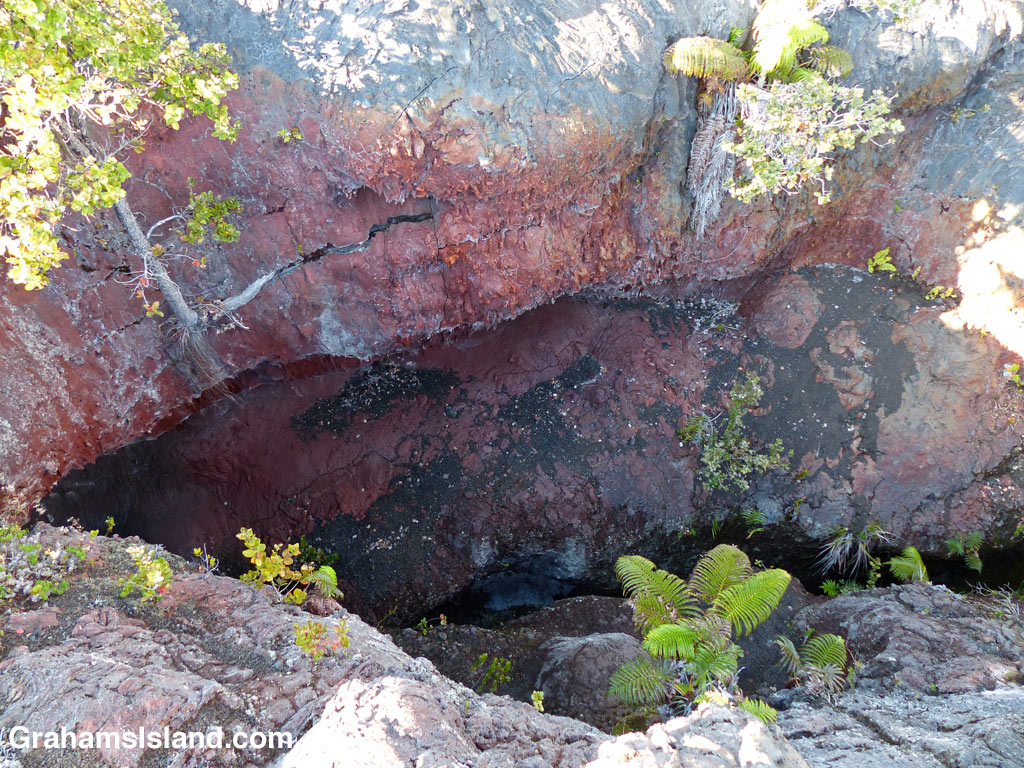
Looking down into Makaopuhi Crater.
Looking down into Makaopuhi Crater, which most recently erupted in 1972.

Firehose of lava at sunset

As the sun sinks slowly in the west, a firehose of lava from Kilauea Volcano gushes into the sea.
As the sun sinks slowly in the west, a firehose of lava from Kilauea Volcano gushes into the sea. More photos here. A good video of the firehose, since the cliff collapse, can be found here.

For more information about Kilauea Volcano and it current eruption, go to hvo.wr.usgs.gov/activity/kilaueastatus.php.

Going to the flow

Cyclists head to the Kilauea lava flow where it enters the sea.
I posted here about the current flow from Kilauea Volcano entering the sea, in a dramatic, firehose-like outpouring. In that post, I mentioned that the day after my visit, a cliff collapse caused the firehose to disappear from view. Things have settled down again and the firehose is once more visible, though another large crack not far back from the cliff is expected to cause another collapse soon.

From the Kalapana side, it’s about four miles to the viewing area and a thriving trade in bike rentals has sprung up. When I was down that way last July there were a few bikes available for rent. Now there are maybe 200 or 300 available from a large number of vendors in the parking lot. At the viewing area, bikes were piled alongside the road, and locked in clumps.

I preferred to walk, seeing the towering column of smoke and steam getting gradually larger on the way out, and enjoying a star-studded night sky on my return.

For more information about Kilauea Volcano and it current eruption, go to hvo.wr.usgs.gov/activity/kilaueastatus.php.

Growth in the lava

Vegetation has reclaimed a section of the original 1969 fissure of the Mauna Ulu eruption of 1969.
In May of 1969, a series of earthquakes opened a large fissure alongside Chain of Craters Road in Hawaii Volcanoes National Park. This was the beginning of what is known as the Mauna Ulu eruption. For five years, lava poured forth in a series of eruptions. Chain of Craters Road, completed only a few years earlier, was buried for several miles. Landmarks along the road were destroyed or irrevocably altered. A swathe of forest disappeared in flame.

When the eruptions finally ceased, life soon began to reappear on the barren lava landscape. In this photo, vegetation has reclaimed a section of the original 1969 fissure. Roots are anchored in cool, moist cracks in the lava. The tree on the left is particularly striking. Having started out in a crack on a vertical face, it has reached up to the light and is going strong. I like to think it shows how resilient nature can be.

For more information about Hawaii Volcanoes National Park, go to nps.gov/havo/. For more information about Kilauea Volcano and it’s eruptions, go to hvo.wr.usgs.gov/kilauea/history/main.html.

Kilauea Volcano’s Pu’u O’o vent

Pu'u O'o vent on Kilauea Volcano
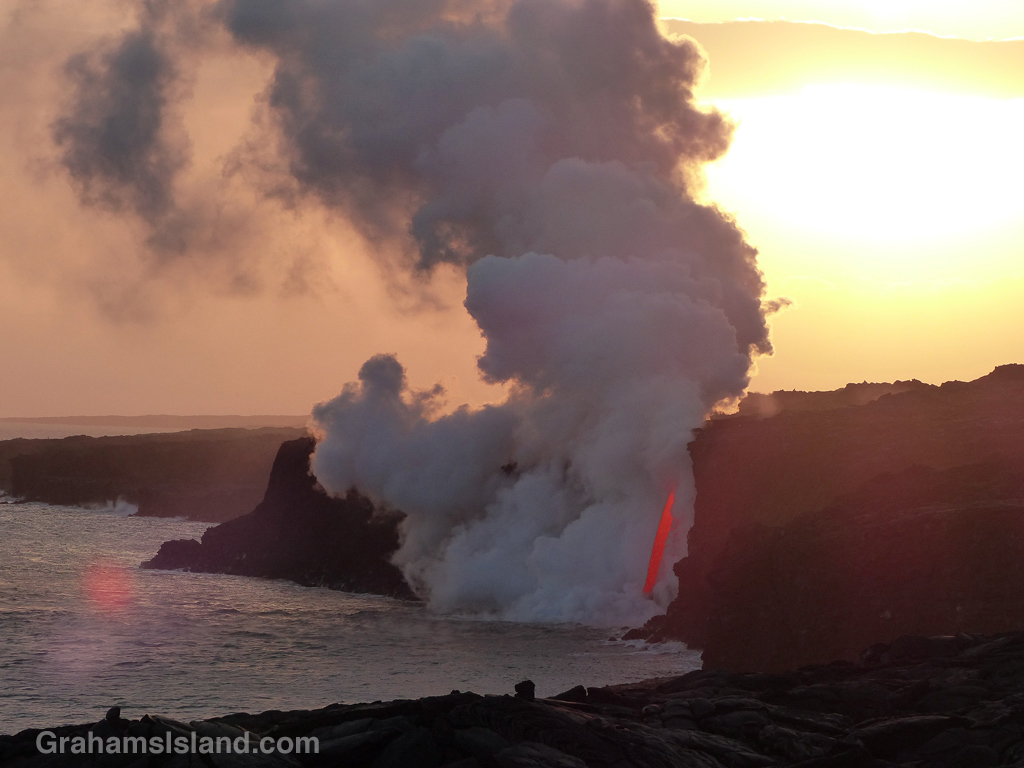
Pu’u O’o is one of two active vents on Kilauea Volcano. It sits on the eastern border of Hawaii Volcanoes National Park. Continuously active since 1983, Pu’u O’o is currently pouring lava into the ocean around Kamokuna on the south-eastern coast of the Big Island. These views of the vent were taken from Pu’u Huluhulu cinder cone.

For more information about Hawaii Volcanoes National Park, go to nps.gov/havo/. For more information about Kilauea Volcano and it’s eruptions, go to hvo.wr.usgs.gov/kilauea/history/main.html.
Pu'u O'o vent on Kilauea Volcano

The path to Thurston Lava Tube

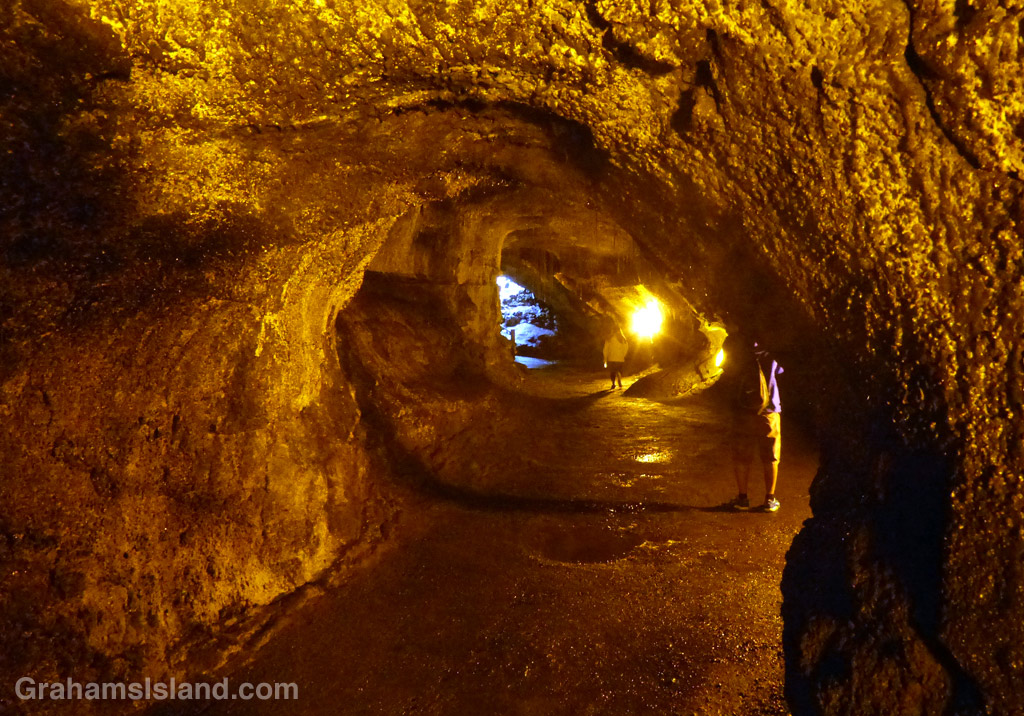
The interior of Thurston Lava Tube at Hawaii Volcanoes National Park.The path to Thurston Lava Tube at Hawaii Volcanoes National Park.
Thurston Lava Tube is one of the more visited spots in Hawaii Volcanoes National Park. It might not be as compelling as Puapoo Lava Tube, but it’s not far from the road and easily accessed. I tend to visit it whenever I’m in the park.

One thing I like about Thurston is the path to and through the tube. It starts with a drop into dense tropical forest, features a bridge leading to the maw of the tube, and then wiggles through the damp and the eerily lit interior until reaching the light at the other end.
The entrance to Thurston Lava Tube at Hawaii Volcanoes National Park.

Hapu‘u fern

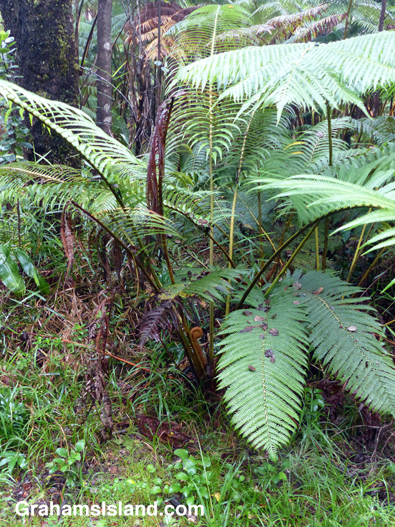
A hapuu fern on the Big Island
Hapu‘u ferns are endemic to Hawaii and can grow to 25 feet high, depending on the type. I like how the fronds uncurl, gradually revealing more details. The golden brown hair is called pulu. I found these in Hawaii Volcanoes National Park, which is one of the places where the fern grows best.

For more information about hapu‘u ferns, go to instanthawaii.com/cgi-bin/hawaii?Plants.hapuu.

A hapuu fern on the Big Island