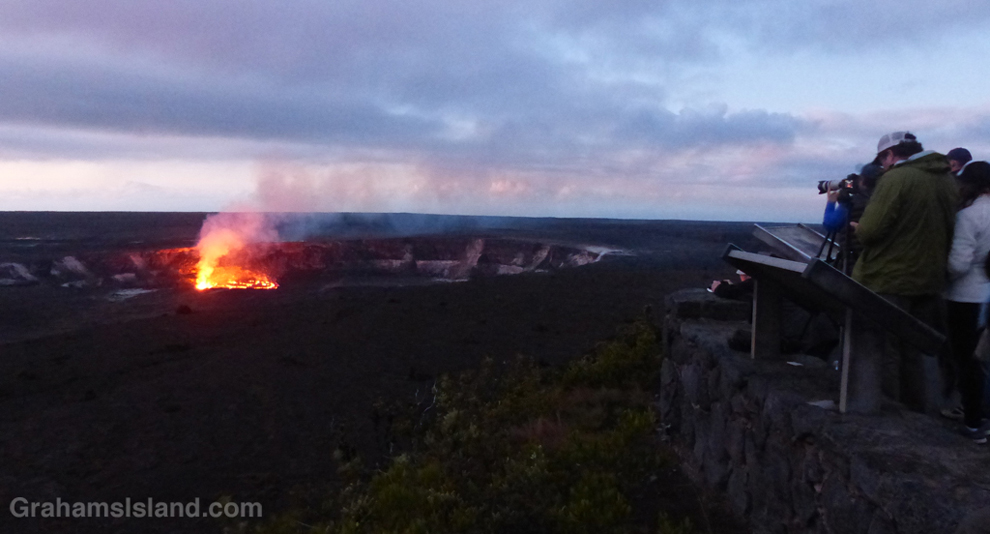
Tag Archives: Hawaii Volcanoes National Park

Kahuku hike

Hiking in KahukuHiking in Kahuku
Kahuku is part of Hawaii Volcanoes National Park. Its 116,000 acres was added to the park in 2003, an estate purchase of former ranch land. This purchase almost doubled the size of the park.

Not far from the southern tip of the Big Island, the entrance to Kahuku is about an hour’s drive from the main park entrance, but the two areas are contiguous, joined at the summit of Mauna Loa.

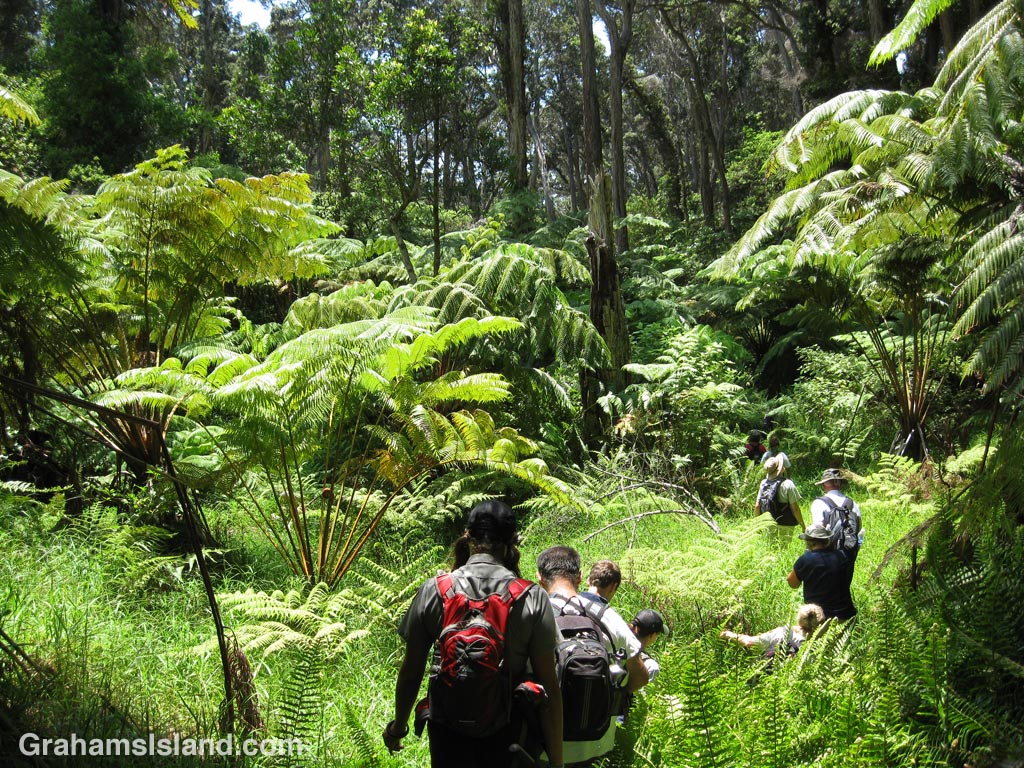
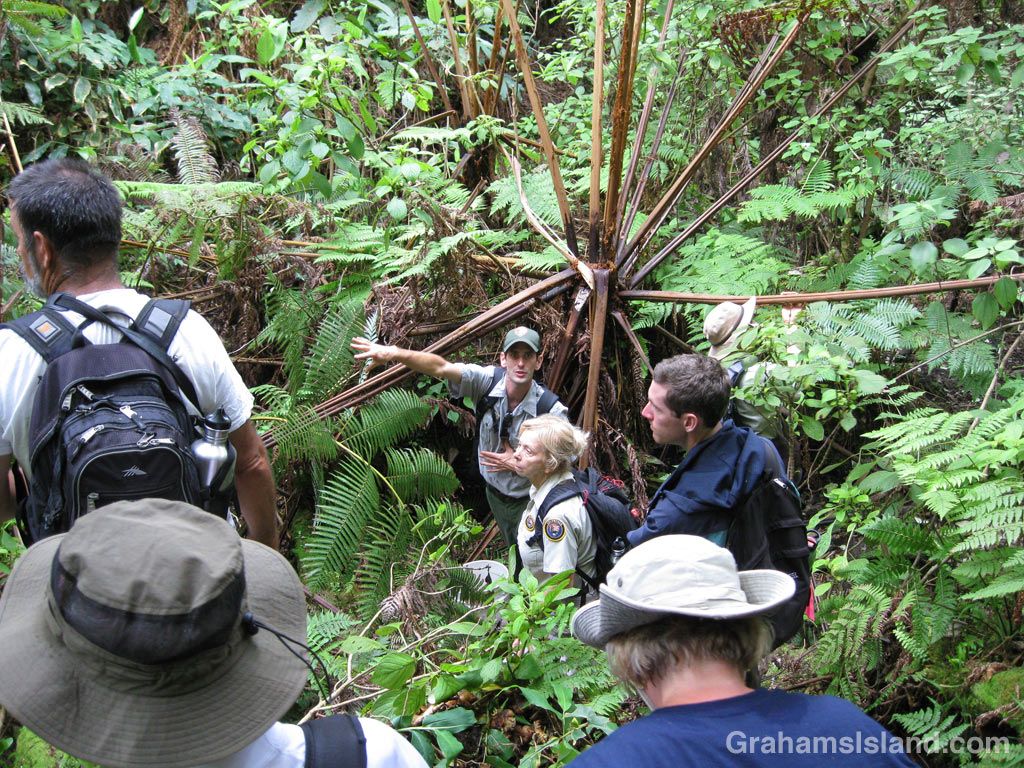
These photos are from a guided hike in Kahuku that I did a while back. The hike went through fairly dense old growth Hawaiian forest that had been spared because it was in a steep gully and thus not suitable for clearing for pasture. There was no real trail.

Currently this part of the park is closed because trees with Rapid ‘Ōhi’a Death (ROD) have been found in the lower part of the park and the goal is to prevent it spreading to other areas.

For more information on the Kahuku Unit of Hawaii Volcanoes National Park, go to nps.gov/havo/planyourvisit/kahuku-hikes.htm or bigislandhawaiitravelguide.com/places/puu-o-kahuku-at-hawaii-volcanoes-national-park.html

Hiking in Kahuku

Puapo’o lava tube tour

The entrance to Puapo'o Lava Tube
The way in. No elevator here.
Ohia roots hang in the Puapo'o Lava Tube
Ohia trees on the surface send roots down into lava tubes. These roots take in water from the tube’s cool, moist air. In return they offer one of the few sources of organic material and are home to a kind of cricket.
Lava formations in the PUapo'o lava tube
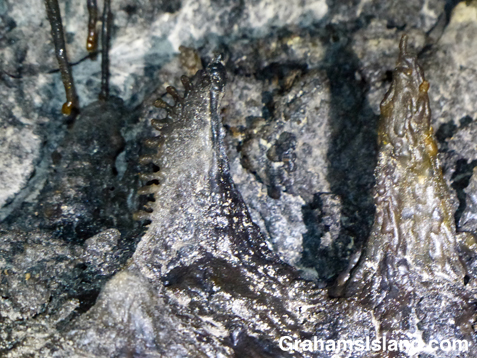
A puapo’o (literally ‘flower head’) lava formation. There’s still uncertainty about how these are formed. To the left are lava-sicles, the lava tube equivalent of stalactites.
A low section of Puapo'o lava tube
Mind your head. There’s a 25-foot-long low section.

As part of the National Park Service centennial celebration, Hawaii Volcanoes National Park has been offering a guided tour of Puapo’o lava tube. This tour has been offered in the past, but not for several years.

Puapo’o is a pristine lava tube meaning that its rock formations are intact and life in the tube is largely undisturbed. Contrast this with the park’s popular Thurston lava tube, where all the finer lava details have long since been broken off by visitors.

There’s a hike to the tube, which is deep within a forest rich in tree ferns.

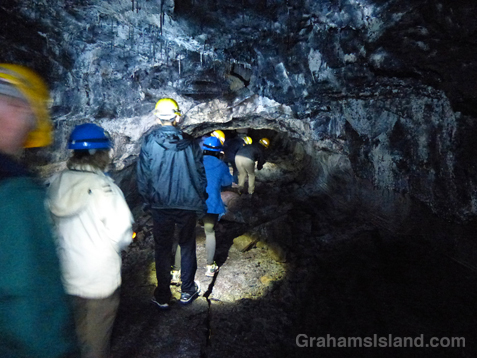
The tube entrance is accessed by a ladder and then it’s on into the dark. Whereas Thurston lava tube is well lit and has a mostly flat floor for easy walking, Puapo’o, which is about a mile long, was lit only by our headlamps and rocks littered the tube floor. It’s not a tour for the claustrophobic or nervous.

The exit from Puapo'o lava tube
The way out. Heading for the light.

Those rocks on the floor match recesses in the tube ceiling show where rock falls have happened. A month before, one of our rangers had been leading a tour when there was an earthquake, a common occurrence in the park. The group left the tube, but the next visit found a new rock fall.

We scrambled over rocks, and sat in the dark in a large, amphitheater-like part of the tube. As we progressed, the rangers pointed out different lava formations from lava-sicles to bathtub rings to puapo’os for which the tube is named. And even in this pitch dark place, there is life – moths, crickets, and spiders, one a huntsman and the other a tiny, near invisible thing that builds gossamer webs. Also, living on the tube walls, are unique microbial colonies, which are being studied for medical uses.

Eventually, we scrambled up a rocky slope and out through a narrow opening, back into the forest.

For more information about the Puapo’o lava tube tour, go to nps.gov/havo/planyourvisit/lava-tube-tour.htm.

Bathtub rings on the walls of Puapo'o lava tube
Ranger Dean points out bathtub rings on the tube wall. These indicate the level of the flow through the tube at different times.

Hike to Kilauea’s lava flow

The Lava Ocean tour boat edges up to the new bench in the ocean, created by the flow from Kilauea volcano.

The Lava Ocean tour boat edges up to the new bench in the ocean, created by the flow.
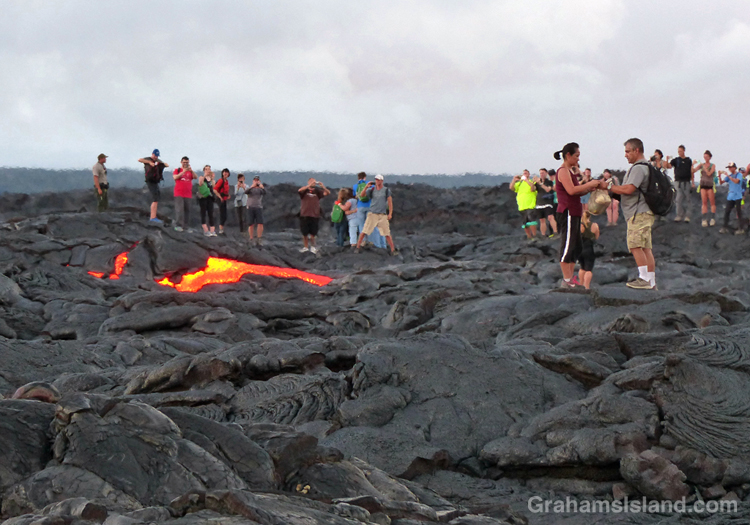
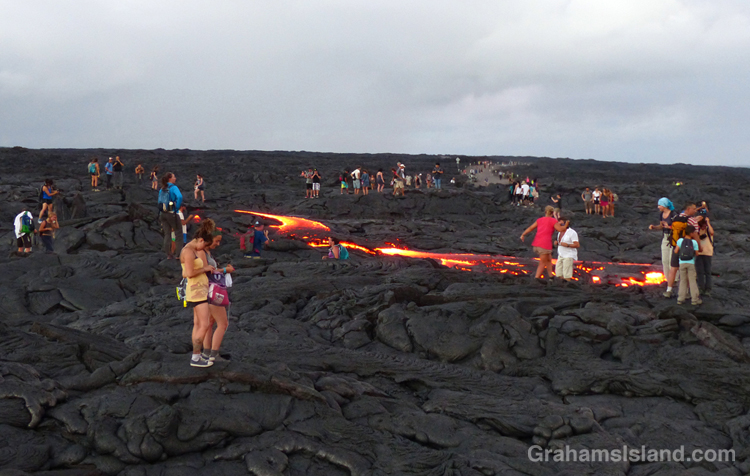
A lava breakout from the Kilauea lava flow.

This photo was taken within a few seconds of this lava breakout beginning. The couple on the right hadn’t yet noticed it.
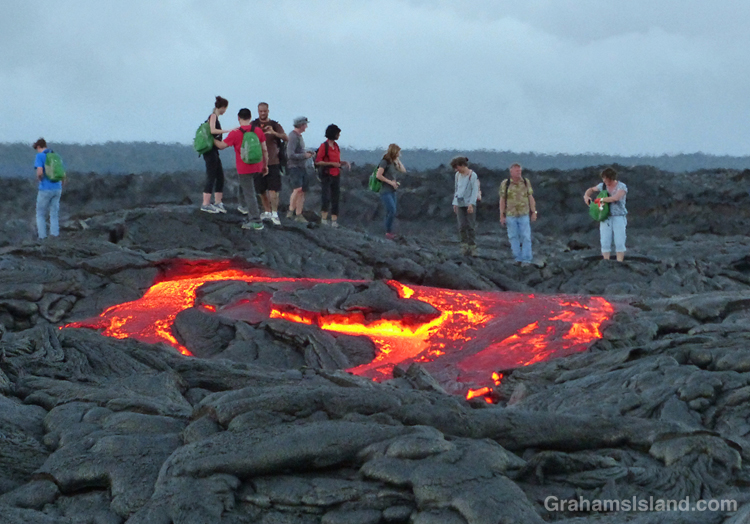
A lava breakout from the Kilauea lava flow.

The breakout spreads …

A lava breakout from the Kilauea lava flow.

… and extends toward the water. This was about as far as it got while I was there. All these people are standing on the active flow.

Last week, I posted twice (here and here) about a boat trip to see lava entering the ocean from Kilauea Volcano’s Pu’u O’o vent. Since then the ocean entry widened dramatically to more than 700 feet. With all that activity, I thought another hike to the flow was in order. This time, instead of hiking from the viewing area at Kalapana, I decided to go through Hawaii Volcanoes National Park.

The hike starts on the coast, at the end of Chain of Craters Road. It’s about an 8.5 mile round trip, and follows the emergency gravel road constructed in 2014. While the whole area is a stark covering of old lava flows, I liked seeing ferns and the occasional shrub getting a toe hold in cracks and under ledges. And then, with late afternoon light slanting from behind and rain showers approaching from ahead, a brilliant rainbow lit up the sky.

Regarding the current flow, the USGS website notes that “the entire area presents a significant hazard to visitors.” It goes on to list dangers from toxic gasses, explosive events, and unstable ground. So it was with some surprise that when I arrived, I found the flow crawling with people. This wasn’t because it had suddenly stopped and cooled. At the edge, where it crossed the road, the red glow of active lava could be seen. I talked to one of the park rangers keeping an eye on things. He said all they could do was post signs and try and make people understand the dangers. They had roped off some areas and people just stepped over the ropes. It gave me a warm glow to know that, if someone was injured here, that person would understand it was their own fault and wouldn’t turn around and try to sue the park service for millions.

I wandered down the edge of the flow to the cliff where the new bench being formed by the lava could be seen. Then back to the road and I figured, if everyone else is doing it, it must be safe, right? Ha, ha. The thing is, standing next to the flow, the heat was significant, and stepping on to it, it got hotter still. My feet got distinctly toasty, so I took a couple of photos and turned around. A few minutes later, I happened to be looking in the direction of one of the clumps of people standing on a lump of lava. Suddenly, a river a red burst from near the base of the lump. A breakout, and a decent-sized one at that.

Naturally, the people nearest to the breakout quickly moved away from the danger. Ha, just kidding. People rushed toward the lava because, though the surface was obviously unstable and could turn to deadly, molten liquid at any moment, it probably wasn’t going to happen to the lump they stood on. Frankly, it was all a bit surreal.

Later, I saw the ranger I’d talked to earlier doing a brisk trade in fixing the detached soles of shoes – flat tires, he called them – where heat from the flow had melted the glue. As the light dimmed, numerous glowing red patches of lava showed up, speckled with white and yellow flashlights as people meandered through the dark.

It was time to go before someone out there misstepped. I had a three hour drive ahead of me and I didn’t want their screams ringing in my ears.

For more information about Kilauea Volcano and it current eruption, go to hvo.wr.usgs.gov/activity/kilaueastatus.php.
For more information about boat trips to see the lava, go to lavaocean.com.

A rainbow rises over the road to the flow from Kilauea Volcano.

A rainbow rises over the road to the flow.

Mauna Loa silverswords bloom and die

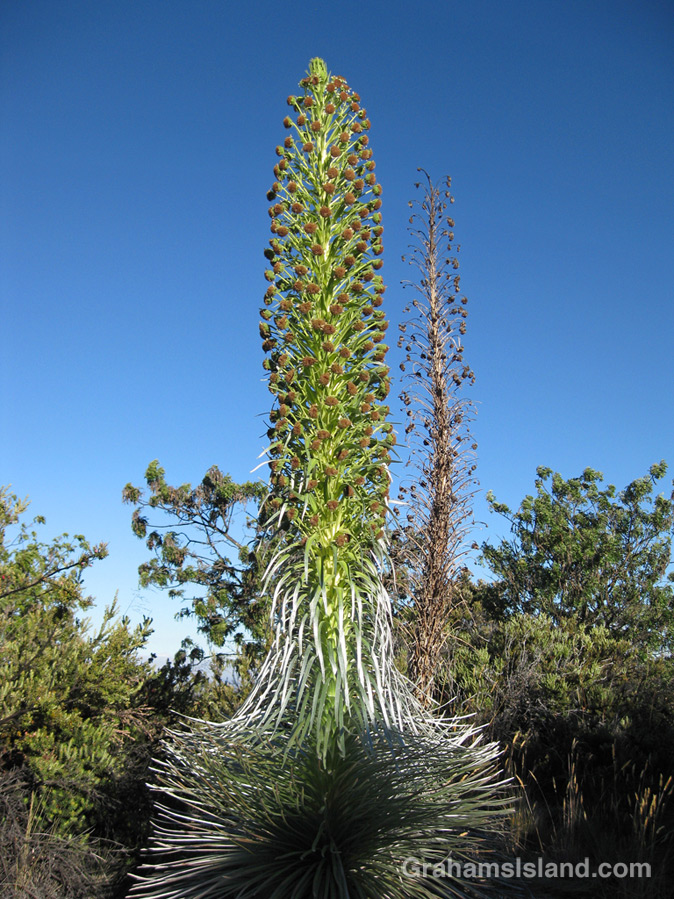
A silversword blooms on Mauna Loa.

This is the time of year when silverswords bloom. These plants, members of the sunflower family, are endemic to Hawaii. There are slightly different silverswords growing on Mauna Loa, Mauna Kea and Haleakala on Maui. The plants are very susceptible to root disturbance and the activities of goats, pigs and humans has led to their decline. They’re making a comeback now thanks to fenced enclosures and careful management.

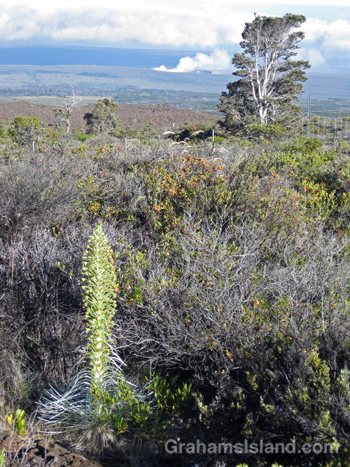
These photos were taken on Mauna Loa a few years back. The flower stalks were about 6 to 8 feet tall. The plants live for up to 30 years, but once they bloom, they die (like the one in the background of the top photo).

In the second photo, the ongoing eruption of Kilauea’s Pu’u O’o vent can be seen.

For more information about Mauna Loa silverswords, go to nps.gov/havo/learn/nature/endangered_ahinahina.htm.

A silversword blooming on Mauna Loa with Pu'u O'o vent erupting in the background.

Lava rises at Kilauea volcano

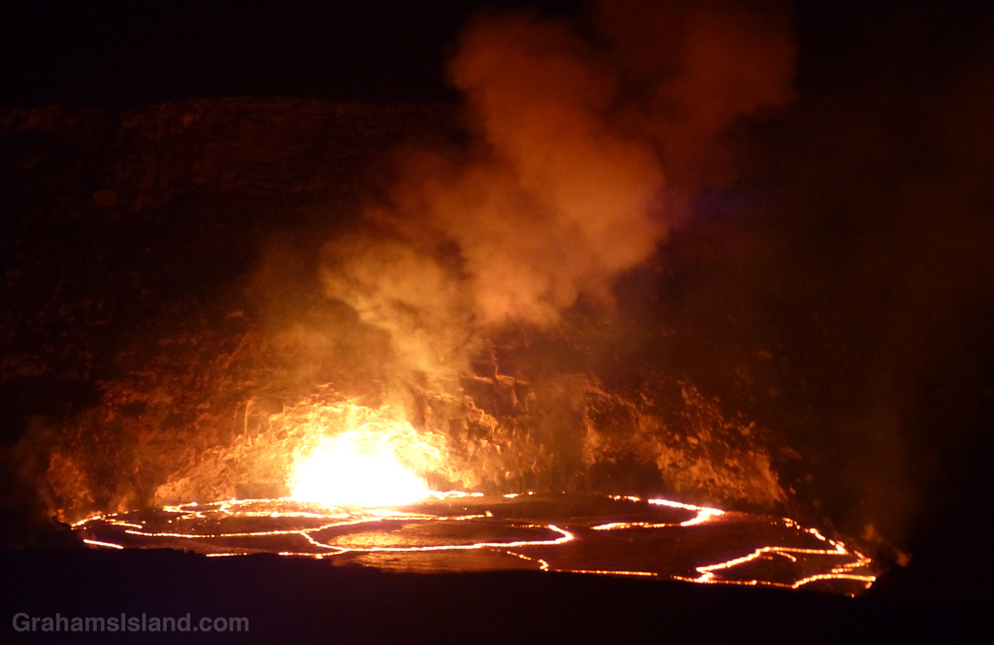
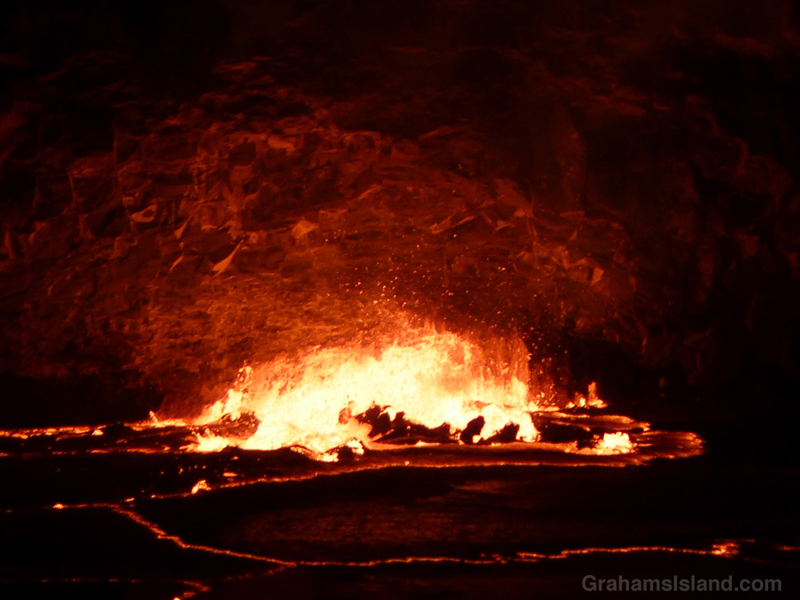
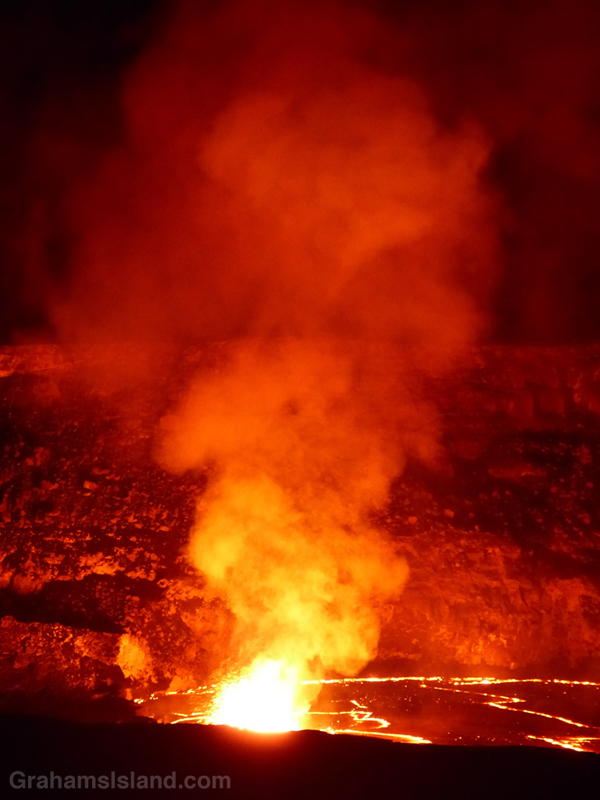
The lava lake in the Overlook vent at Halema’uma’u Crater.
Kilauea lava crust bubbles and cracks
The slightly cooler surface is broken up by bubbling lava.
A hotspot illuminates the crater wall at Kilauea
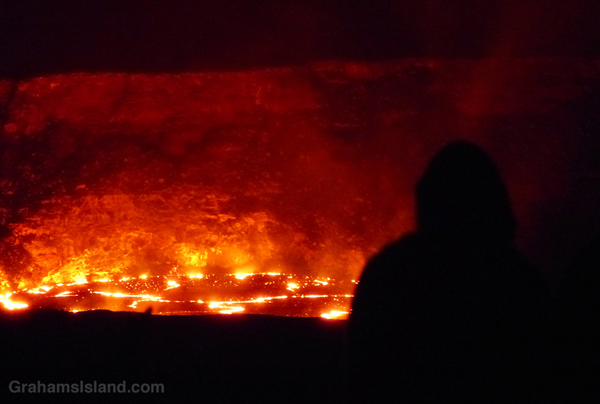
A hotspot illuminates the crater wall.
Onlookers at Kilauea
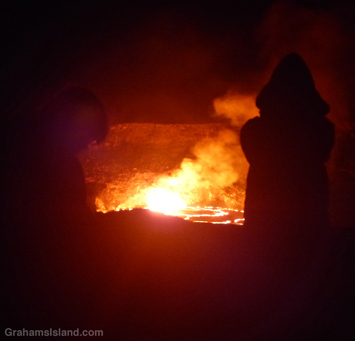
The quiet group reverently looking on had the appearance of a cult at times …
Cult-like gathering at Kilauea volcano.
… Gathered around the mystical ring of fire.

Today marks the anniversary of a trip my wife and I made to Hawaii Volcanoes National Park. That’s where Kilauea Volcano, active since 1983, has two vents spewing lava. Flows from Pu’u O’o vent have, over the last few years, reached to the ocean and threatened to take out the town of Pahoa.

The other vent is in Halema’uma’u Crater. It’s known as the Overlook vent since it’s below an old viewing overlook. Since it became active in 2008, it’s been a bubbling pool of lava, varying from 60 to 400 feet below the floor of the crater. By night the lava glow was visible. By day, mostly what could be seen was steam and smoke.

In early April of last year, the lava lake started rising. It rose so much that the lava became visible from the Jaggar Museum, which gives a good view of the main crater. It was time to check it out. The problem was that the spectacle of active lava visible from an accessible spot led to a crush of visitors. The park warned that large crowds were showing up and advised visiting at off peak times.

Lava viewing is more vivid at night, but the scene in daylight is also interesting, so there were two options. Showing up in the afternoon and staying through sunset would be iffy because it was guaranteed to be crowded. The alternative was to arrive before sunrise and stay until it got light. The only snag? We live 100 miles away.

The day before the trip, we turned in early and I set my alarm for 12:01 a.m. We got up and were on the road by 12:35. Driving in the wee hours was actually pretty nice. The stars were out and the roads mostly empty. In Hilo, we stopped at Ken’s House of Pancakes, the Big Island’s only open-24-hours restaurant, and had breakfast at 2:45 a.m., a slightly surreal experience. Then back on the road before pulling into the viewing area parking lot at the Jaggar Museum a little before 4 a.m.

It was cold with the wind making it feel cooler and we weren’t really dressed for the occasion. But there weren’t too many people there, the night sky was gorgeous, and the lava very visible and active. We watched it bubble and spatter, often vigorously. Daylight crept in. As it did so the scene changed and more people began to show up. By 6 a.m. it was light so we left, getting home just after 8:30. It was strange to think that at that relatively early hour we had driven to the farthest side of the island, watched the volcano for a couple of hours, and driven back. Usually at the time the most I can claim is that I’ve made coffee.

First light silhouettes the onlookers.
As darkness dissipates, lava shoots into the air.
As darkness dissipates, lava bubbles in the crater.

Soon after our visit, part of the crater wall collapsed into the lava causing a big explosion. The lava lake also reached the rim of the Overlook vent and began to spill out onto the main crater floor. We thought these developments were worth making the same trek again. And then the lava went into retreat. It fell back below the rim of the vent. Within days, the lava lake in the vent disappeared from sight and sank back to its former levels, which is where it remains, currently more than 100 feet below the Halema’uma’u Crater floor. (For scale, the active vent opening measures about 500 feet by 700 feet and the distance from the main Halemaumau Crater floor to the rim is about 270 feet.)

For more information about Hawaii Volcanoes National Park, go to nps.gov/havo/. For more information about Kilauea Volcano and it’s eruptions, go to hvo.wr.usgs.gov/kilauea/history/main.html.

Daybreak reveals the onlookers gathered at the Jaggar Museum viewing point.