This week’s Sunday Stills challenge theme is ‘Straight.’ See more offerings here.
Last week, I revisited the Powerline Trail off of Saddle Road. This trail, when combined with the Pu’u O’o Trail, makes a good long loop hike. I like hiking the Pu’u O’o Trail because it passes through several kipukas (patches of old forest that have been spared by lava flows) and those kipukas have lots of birds living in them.
The Powerline Trail is a bit less interesting. There are fewer kipukas and it’s a long, exposed hike in a straight line across the lava. The reason for this can be found in the name. It follows an old 4-wheel drive road that serviced a power line that ran across the lava fields. The line is gone, but the sawn-off stumps of power poles can be seen alongside the trail (to the right of the trail in the top photo, to the left in the bottom photo).
One advantage the Powerline Trail has over the Pu’u O’o Trail can be seen in the bottom photo. This was near the end of my hike in the mid-afternoon as clouds closed in. It’s not unusual for this part of the saddle to be shrouded in thick fog and, if you happen to be out hiking in those conditions, the straight and clear Powerline Trail is much easier to follow than the Pu’u O’o Trail which, crossing the lava fields, can be hard to follow when you can’t see the cairns that mark its route.
The trail, of course, isn’t perfectly straight (though I suspect the power line was). It bumps around lava upwellings and collapsed tubes. But most of the time, one just needs to look up to see, straight ahead in the distance, the faint pale thread of the trail topping a hill or emerging from a dip in the landscape.
Pu’uanahulu is a small community midway between Kailua Kona and Waimea, on the upper road between those two communities. I don’t drive that highway much, except when I go to hike up Pu’u Wa’awa’a. Last time I did this, driving through Pu’uanahulu, I noticed that the jacaranda trees were in bloom alongside the road. What I hadn’t realized is just how many jacaranda trees there are in this area.
These photos are taken from the northern slopes of Pu’u Wa’awa’a. The bottom photo shows the general area with the purple jacaranda flowers of Pu’uanahulu clearly visible. The top photo shows a closer view of part of the community and the abundance of flowering jacaranda trees.
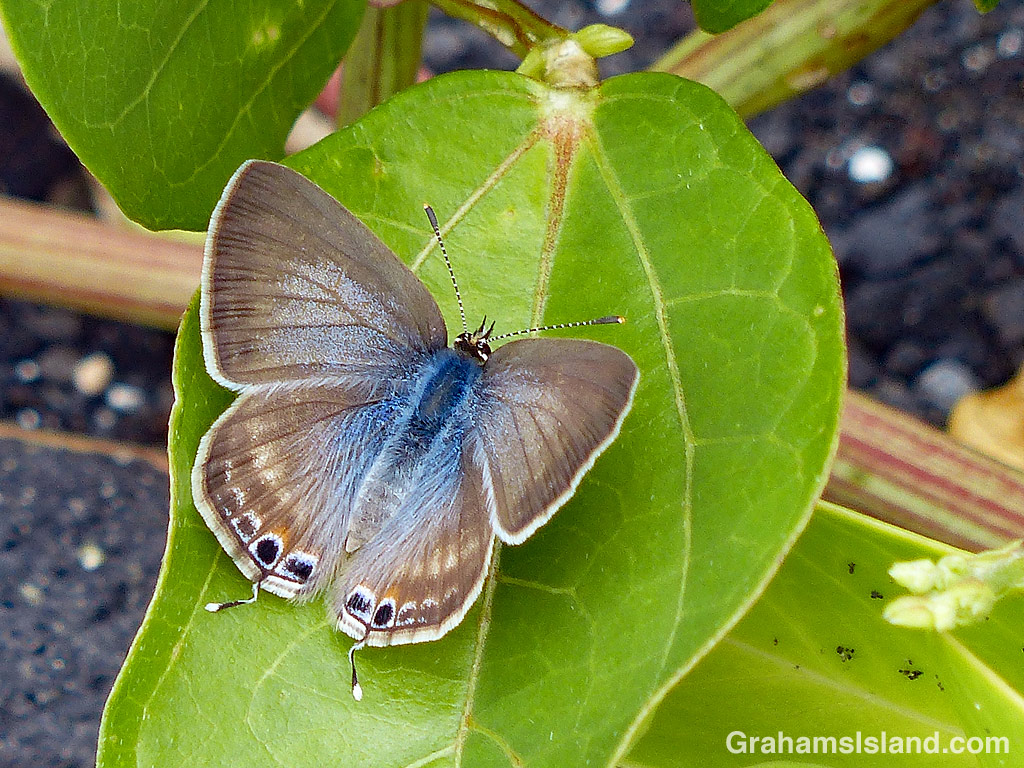
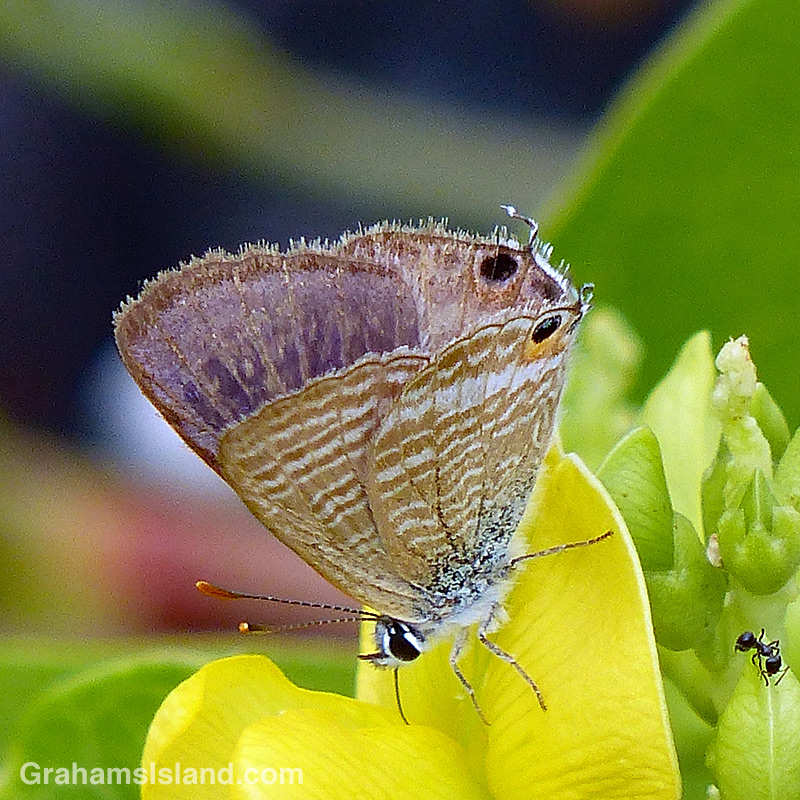
The long-tailed blue butterfly (Lampides boeticus) is believed to have been accidentally introduced to Hawaii in the 1880s. Accidental or not, it wasn’t a good thing. Its common name, bean butterfly, gives a clue as to the problem. It damages a wide variety of bean and pea plants, both domestic and commercial.
These photos were taken on the Puna Coast Trail in Hawaii Volcanoes National Park. The plant is Vigna marina or beach pea, an indigenous plant that grows well in the harsh, exposed coastal area that the trail passes through.
Two days ago, while driving home after my daily walk, I was thinking it must be almost a week since I actually took a photo (Never mind that when I got home I found that I’d taken a couple of photos earlier, during my walk!). Then I saw a patch of white in the grass beside the road, realized what it was, and thought that I should at least get a photo of that.
The nearest of the cows was some distance away, but this was the pasture of the local dairy and these cows are pretty mellow. I’ve seen other calves, seemingly abandoned, but actually just resting in a quiet spot while mom catches up with some grazing.
This was a marked contrast to my last cattle encounter, which was that almost-a-week-previous occasion of taking photos. I went for a hike up Pu’u Wa’awa’a. This is a public trail, but the land is also used for grazing so there can be cattle, horses, sheep, goats, and even a donkey or two sharing the area with hikers. Bear in mind that these cattle are being raised for beef so they’re big. Also, the cows among them are there to produce future beef cattle. They’re not giving milk to anyone other than their calves.
On this day, the first part of the trail, an old road, was littered with cattle of one kind or another, including several small calves. I grew up on a dairy farm and I’ve walked through many a field of cows and the occasional bull. I’m used to them, so this array of cattle didn’t bother me. As I walked up the trail, the herd thinned out. Soon all I saw in front of me were a couple of younger animals. These looked bigger and older than the calves lower down, perhaps yearlings. As I got closer I noticed a couple of full-grown animals grazing in a ditch on the other side of the road. They were mostly obscured by grass so I couldn’t see if they were cows or bulls. It seemed to make no difference as they appeared to ignore me as I passed.
I marched on up the road, and as I got closer to the two yearlings, I realized that one of the full-grown cattle (the large, black one in the photos below) had moved in my direction. This didn’t bother me. Often times cattle run towards me as I pass. Then they pull up and just look, or even turn and run away. I kept going. So did the large animal. I still couldn’t see whether it was male or female, but as it started snorting at me, I began to think female. I looked ahead to the two yearlings, then at the cow. She came closer, still snorting. I stopped. For the first time in my life, I thought I was probably going to get charged by a cow. This might seem silly, but people get killed by cows every year. A cow will charge, especially if someone comes between her and her calf.
By this time the cow was about 10 feet away. I decided this wasn’t the time to get a photo of a charging cow and instead clutched my metal water bottle with a view to swinging it at her snout. But the cow didn’t charge. Instead, she snorted one last time, glared at me as she stomped past, and headed up the road to what was clearly her calf. She was followed by the other large, brown cow.
Once the four were reunited, they just stood in the old roadway. I thought they might amble off, as cows will often do, but they stayed put. I didn’t feel like threading my way through them in case the two big ones were still riled up, so I marched into the scrubland to the side of the road and worked my way around them. The footing was uneven, but it wasn’t hard going and I soon came out on the other side. They’d watched my passage with more typically bovine expressions and once I regained the road surface they lost interest and meandered into the trees on the opposite side of the road.
I watched them go and figured I’d have a drink of water before continuing up the trail. I reached for my water bottle and pulled it out with a bloodstained hand … bloodstained hand? I couldn’t believe what I was seeing. Both hands were smeared with blood. My shorts had a giant patch of blood on one side. Just above my wrist, a small scratch continued to gush. Somewhere in my short trek through the underbrush I’d encountered something sharp without noticing, which is fairly typical for me.
I washed the blood off my hands and held a tissue to the cut. It quickly stopped flowing, so I carried on up the trail having rediscovered the wisdom of not getting between a mother and her offspring.
The top photo was my last of April and is posted in response to Bushboy’s Last on the Card photo challenge. See more responses here. Also posted in response to this week’s Friendly Friday challenge theme of ‘Covid Discoveries.’ See more responses here.
And if those four cattle ever get together and release a record, perhaps Music To Moooove To, I think the bottom photo would make a great album cover for them.
This is the third and final part of a three-part description of a hike along the Puna Coast Trail in Hawaii Volcanoes National Park (See part 1 here, part 2 here).
The last part of the trail before ʻĀpua Point crosses over the only stretch of ʻaʻā lava on the trail which, as can be seen in the second photo, is markedly more rough and jagged than pahoehoe lava. This ʻaʻā is part of a 1969 flow from the same eruption at Mana Ulu that produced the pahoehoe lava that most of the trail passes over. The Mauna Ulu eruption lasted from 1969 to 1974.
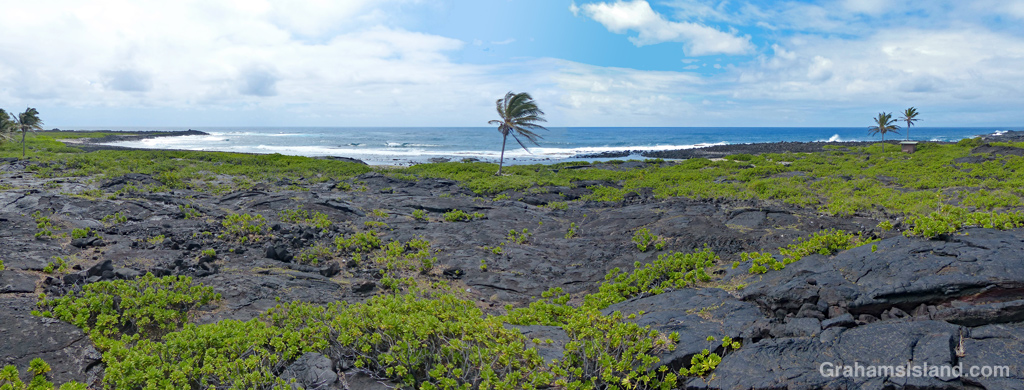
ʻĀpua Point is like a little oasis in a bleak landscape. Flows from the Mauna Ulu eruption reached the ocean on either side of the point, but the point itself was spared. The top photo is a panoramic view of the coast, stitched together (not well) from two photos, to show the view from ʻĀpua Point’s outhouse – actually a composting toilet. This toilet also represents the sum total of the facilities for anyone thinking of camping there.
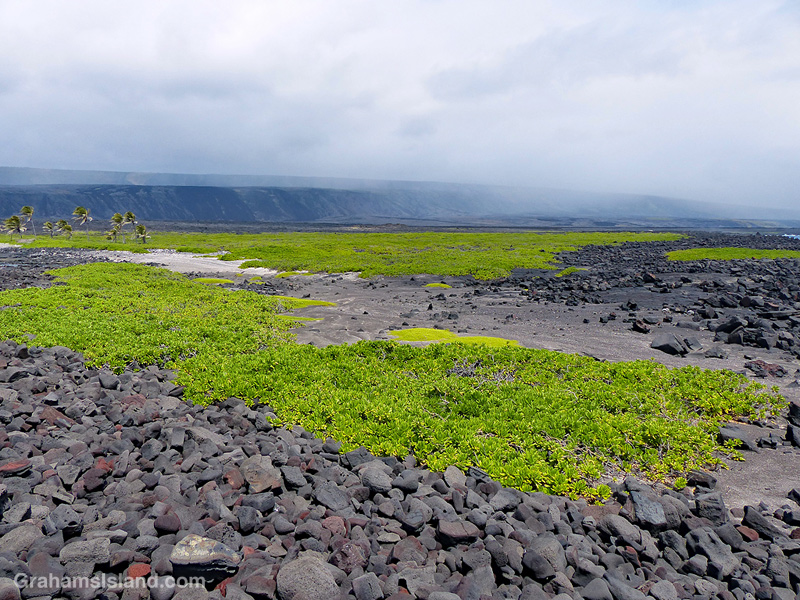
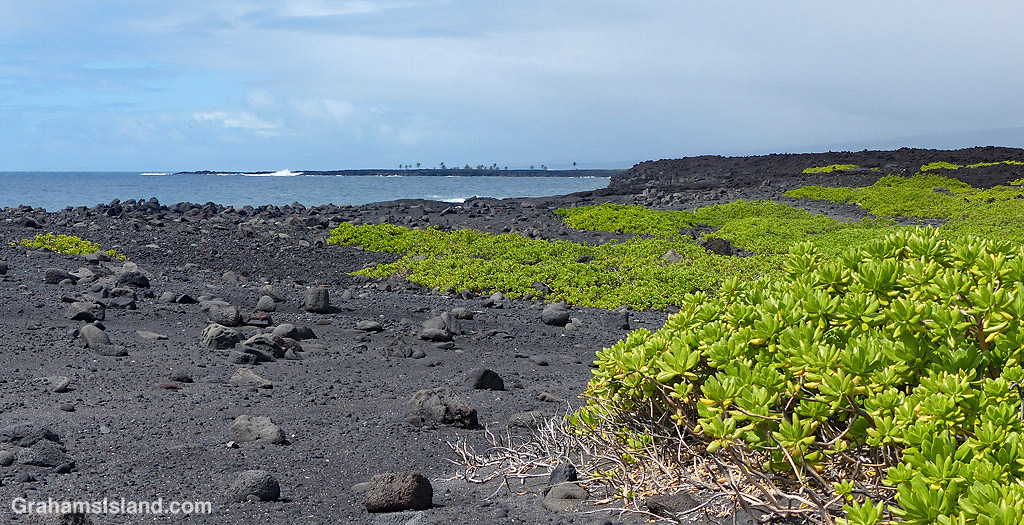
ʻĀpua Point itself is a rocky coastline jutting into the ocean. But behind this wall of rock, a sandier area hosts fields of naupaka, sea purslane, and other plant life, as seen in the third photo. Also in the background of this photo, a passing shower runs along Hōlei Pali. As I mentioned in part one of this description, the trail can be hot, wet, and windy, but for my hike, I saw moderate breezes, some overcast skies, and just a few spritzing showers.
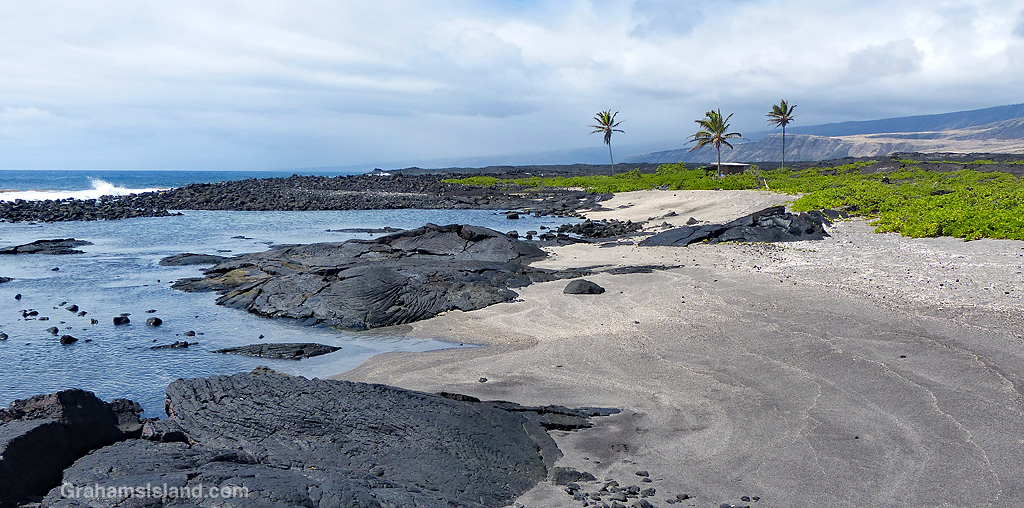
Swimming in the ocean along this coast is very dangerous because of high surf and strong currents. But at ʻĀpua Point there are shallow pools, suitable for soaking, that are protected from the surf by a border of rocks. There are also a few small sandy beaches such as the ones in the photo below.
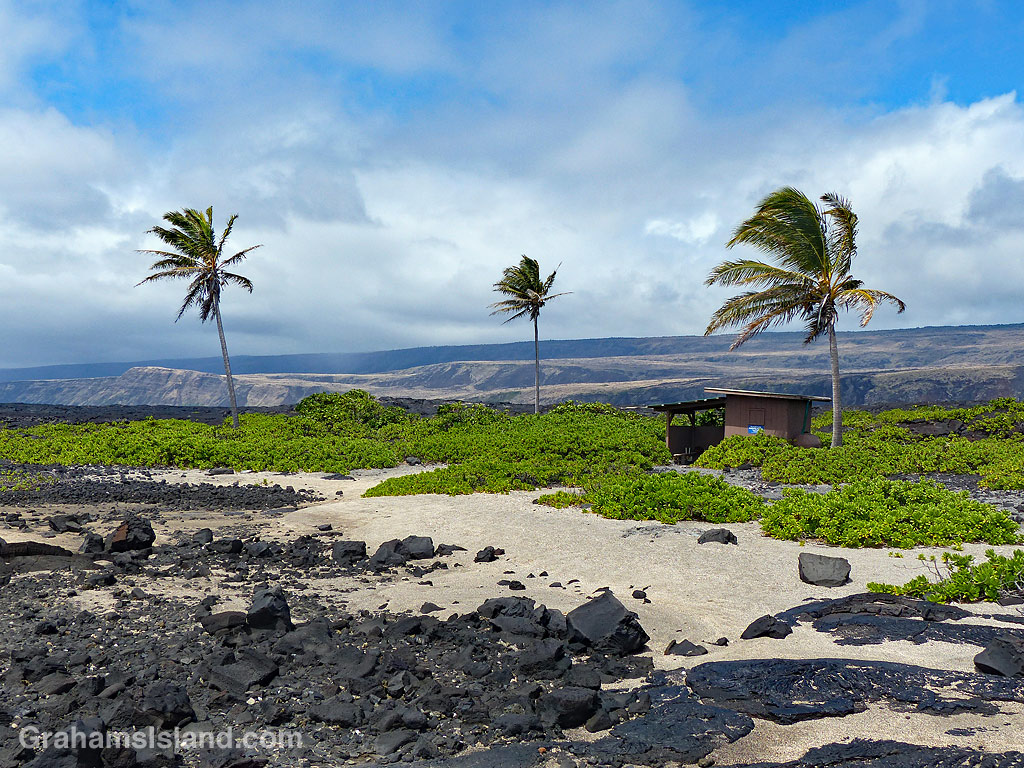
Besides the composting toilet, there is one other structure on ʻĀpua Point. It’s a small shed with an open covered area beside it, surrounded by naupaka and a few palm trees. This covered area represents pretty much the only shade to be found on the entire hike. The shed is used by the Hawksbill Sea Turtle Recovery Project, which monitors and protects endangered hawksbill turtles which use this area for nesting. I believe the nesting season runs from May to September, so I might have to return sometime after that.
And speaking of returning, from here it was time to turn around and hike the 6.6 miles back to the car. The hike took me about 3 hours each way with, of course, numerous stops for photography and just to enjoy the views.
This is the second part of a three-part description of a hike along the Puna Coast Trail in Hawaii Volcanoes National Park (See part 1 here).
As the trail reaches the coast, it passes over an older flow that has a fair amount of vegetation on it. The third photo shows the trail cutting through a swathe of naupaka, sourbush, and assorted grasses.
This area was, despite the threat of volcanic activity, well occupied by early Hawaiian people. Along the trail are several reminders of that including the structures below. The photo, below middle, shows the amazing abilities of plants to grow in even the most daunting locations. The roots are somewhere deep in the lava, from which the trunk of this noni snakes upward. The large, nobbly fruit can be seen on this plant. This fruit, when ripe, has a pungent aroma which supposedly smells like vomit!
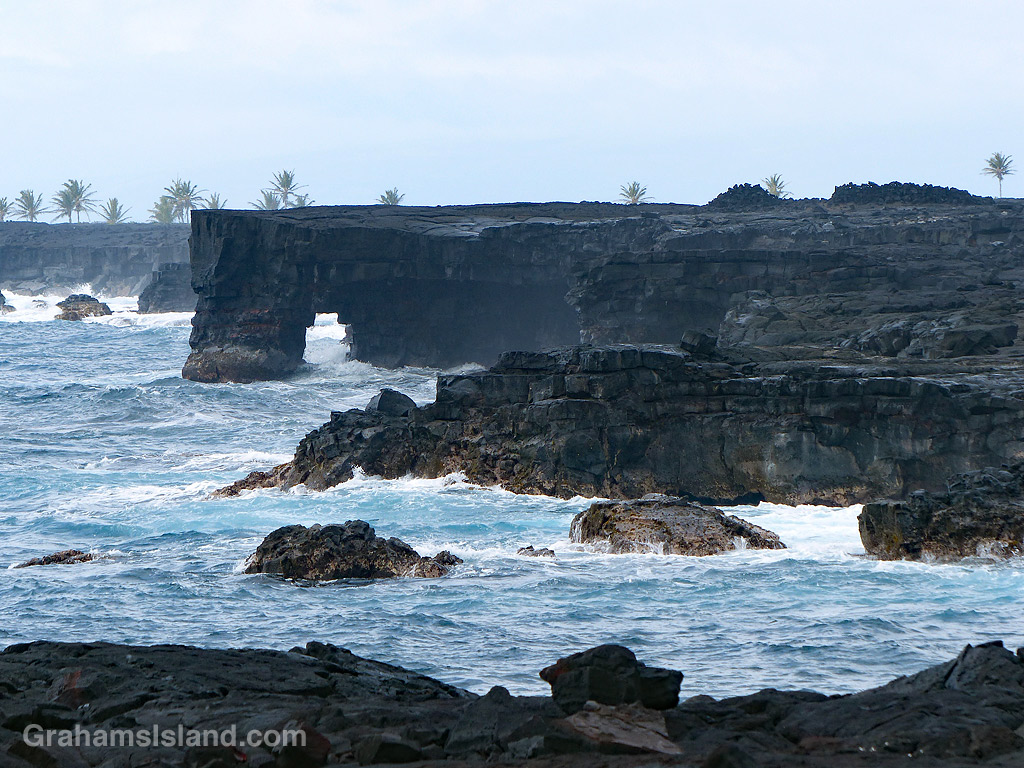
The bottom photo shows an area of rocks and black sand on the coast, backed by an extensive field of naupaka. Beyond that, the trail passes close to a pair of sea arches seen in the top photo and the one at top right. This is a rugged coastline and, when the weather is rough, huge waves can crash up and over the lava. It’s also an unstable coast with rocks and sections of cliff liable to tumble into the ocean.
In the background of the top and bottom photos are the palm trees of ʻĀpua Point, which will be the focus of the third and final post about this trail, tomorrow.
Last month, I posted photos of colorful lava (here) that I saw on a hike I’d just done. In that post, I noted that ‘I’ll do a post about the trail once I’ve gone through the way-too-many photos I took that day!’ With all that’s been going on in the interim, processing those photos took a long time, but now I’m done. So here’s the first of three posts about the trail, not that you can follow in my footsteps right now because Hawaii Volcanoes National Park is currently closed.
As the name indicates, the Puna Coast Trail travels along the coast of the park, but it starts about a mile inland, across Chain of Craters Road from the Pu’u Loa Petroglyphs trailhead. The trail is 11.3 miles long and ends at Halapē campground, but I only hiked as far as ʻĀpua Point, 6.6 miles along the trail. This rugged trail can be hot, windy, and wet so sturdy shoes or boots, a hat, sunscreen, and raingear are a must. There’s no fresh water on the trail so take plenty, as well as enough to eat.
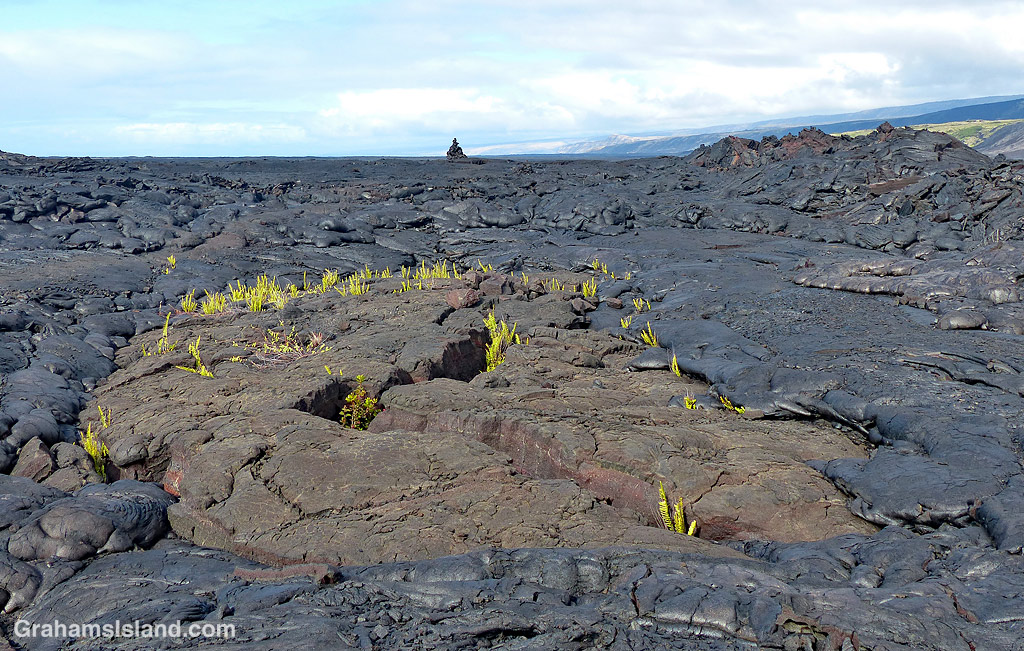
The trail starts by crossing the 1972 flow from an eruption at Mana Ulu. In the top photo, lava from this flow surrounds a small area of older lava. The ferns growing in the cracks are Polypodium pellucidum, an endemic fern known in Hawaii as ae (pronounced Ah Ay). These ferns are among the first plants to grow in new lava fields. The faint outline of the trail can be seen extending from the middle left of the photo to the cairn on the horizon.
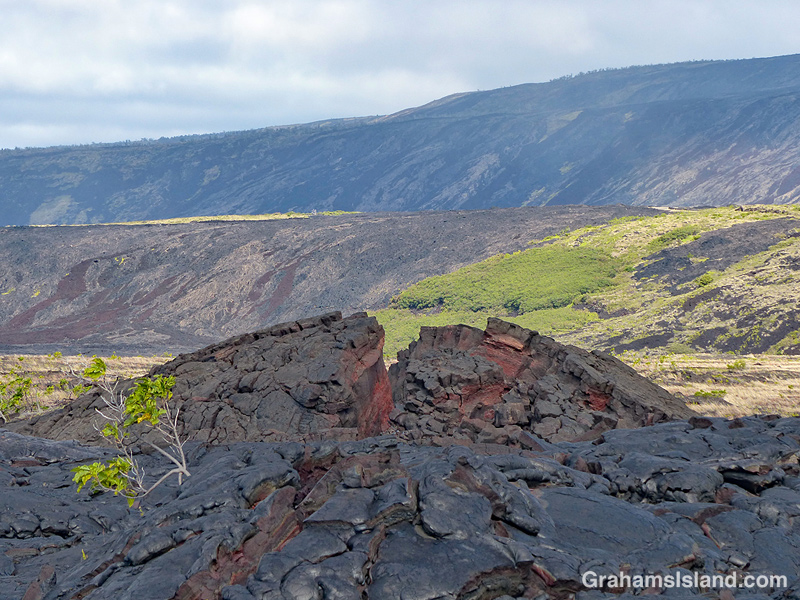
Second photo: An upwelling in an old lava flow has cracked open to reveal a variety of colors within. In the background is Hōlei Pali. A pali is a steep slope or cliff. When a flow goes over a pali, it can often be seen, safely, from a distance away.
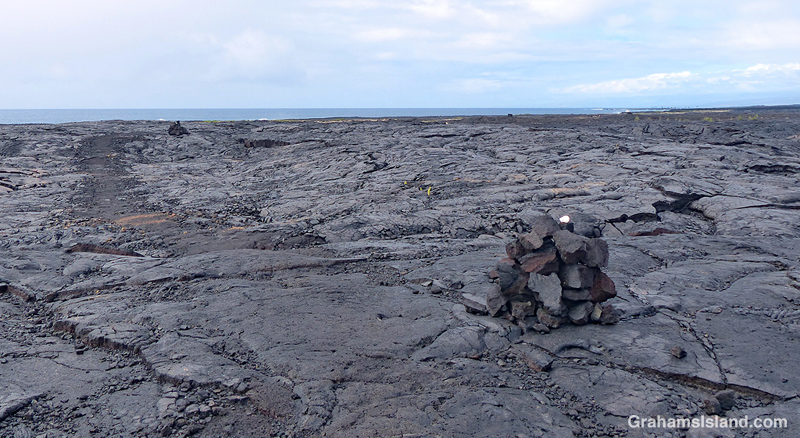
Third photo: A trail-marking cairn on a section of older lava that has been somewhat revegetated. The noni (Morinda citrifolia) shrub beside the cairn is another early colonizer of lava flows being tolerant of the harsh conditions found there. Noni is a ‘canoe plant,’ having been introduced to Hawaii by the first Polynesians who arrived in their ocean going canoes.
Fourth photo: Cairns mark the trail across the expanse of lava from the 1971 flow, where very little vegetation can be found. This first part of the trail angles down toward the ocean, which can be seen in the distance.
Below: Colorful smooth pahoehoe lava lies on top of ropey pahoehoe lava, from the same 1971 flow. The kind of lava can change quite quickly as conditions change in the flow itself and the terrain it travels through. This also shows the colors in different layers of lava as well as an ae fern getting a toehold.
Bottom: A little hill of pahoehoe lava showing its different forms all jumbled up. I almost included this photo in the earlier post since its colors, textures, and swirls were unexpected art for me.
Tomorrow, part two follows the hike along the coast itself.
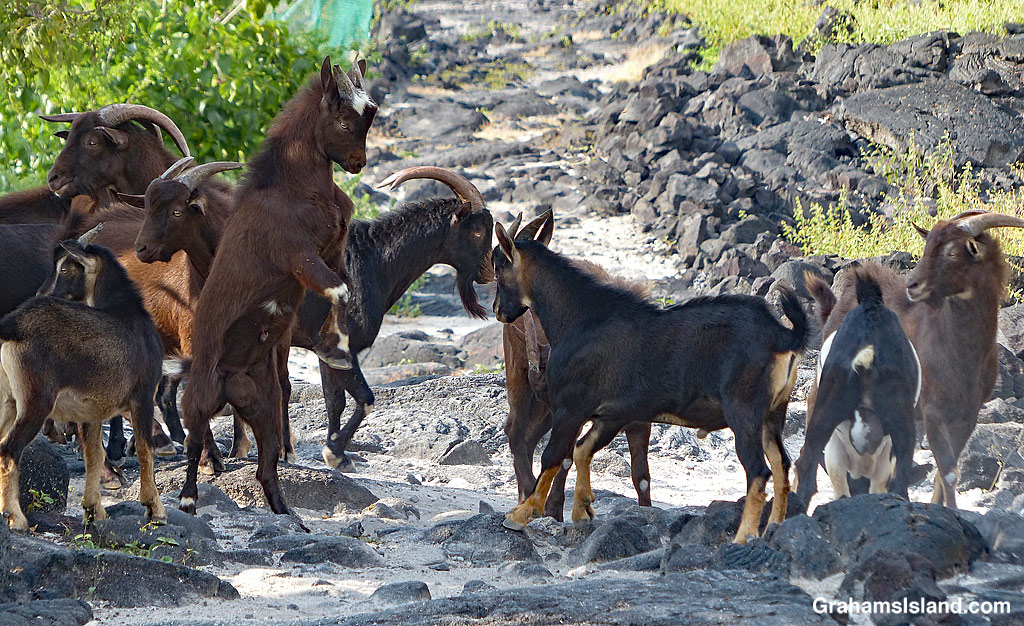
A herd of goats mill about on a trail in South Kona. In any sizable gathering of goats I usually see younger ones butting heads as they tussle with each other. This is practice for when they’re older and the jousts become a more serious contest for position within the group.











 Graham's Island