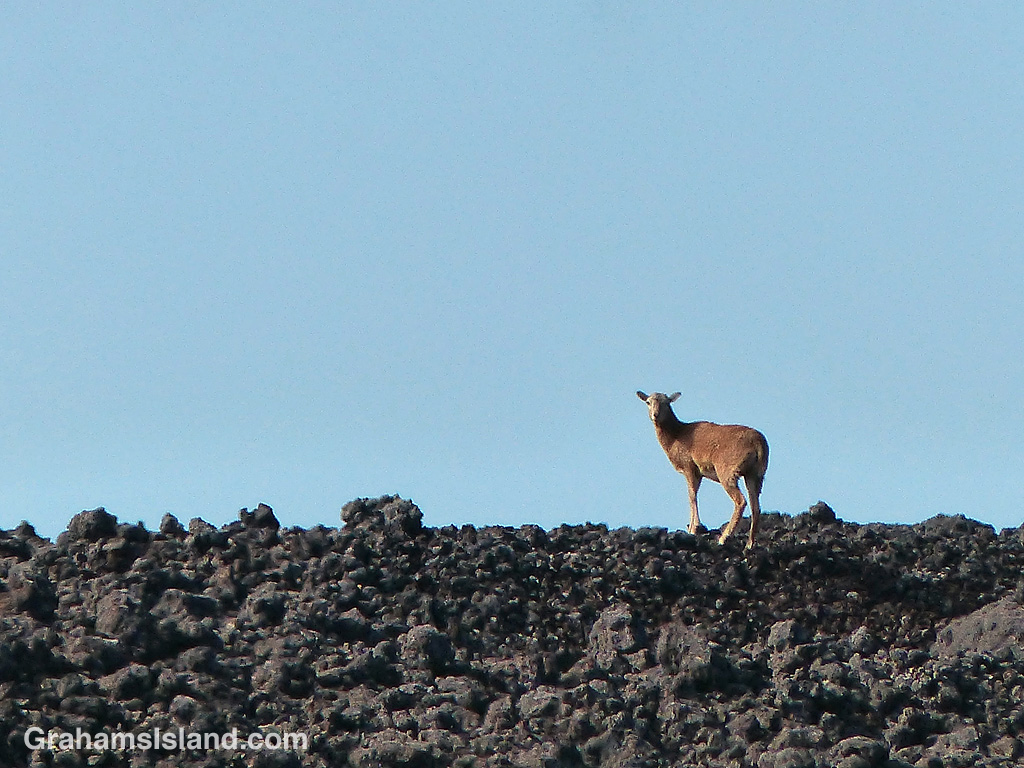
A goat scrambles over the lava alongside the Pu’u O’o trail. Here, it’s probably transiting between kipukas, where there’s a good deal of forage growing, but goats seem to do fine in even the most inhospitable places on the island.

A goat scrambles over the lava alongside the Pu’u O’o trail. Here, it’s probably transiting between kipukas, where there’s a good deal of forage growing, but goats seem to do fine in even the most inhospitable places on the island.

On a recent hike, I came on several of these passion flowers. I don’t know what kind they are; it’s often very hard to identify passion flowers. The flowers hung down, so this is a view from below. Not only did it have an exotic look to it, but it had a most wonderful fragrance.

Last May, I posted here about the hike from the end of Highway 270 down to the beach at Pololū and up on to the ridge on the other side. There, a bench awaits the hardy hiker, as well as wonderful views along the coast and into Honokane Nui Valley. I’m happy to report that the bench, which was in bad shape last time I was there, has been replaced by one with a plastic frame. While this might be aesthetically less pleasing, it should last a good deal longer.
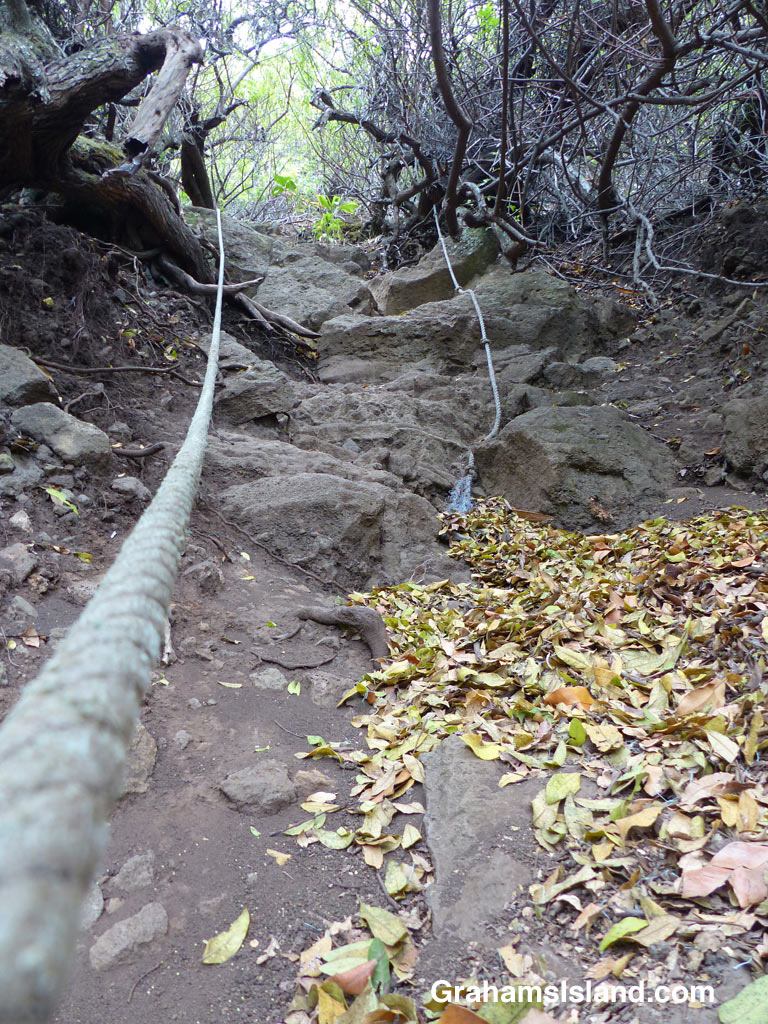
I also mentioned that not far beyond this point, the trail into Honokane Nui Valley got wiped out by a landslide in the earthquake of 2006. Now, instead of switch-backing down to the valley floor, the trail goes straight down. The precipitous drop is made passable by a series of ropes, to hang on to on the way down, and to haul on on the way up. It’s a great workout though not necessarily the safest one around. If a rope gives way, it could be a long and nasty fall. Let the user beware.
The top photo shows what the entry into this section of trail looks like. This part is steep, then it drops off out of view. The second photo shows a steeper section with two ropes to hang on to.
For more information about the Pololū hike, go to bigislandhikes.com/pololu-valley/.

During a recent hike on the Nāpau Trail in Hawaii Volcanoes National Park, one accompaniment was the throb of helicopter engines. The active flow from Pu’u O’o vent, and its ultimate outpouring into the ocean, is a great attraction for visitors and locals alike.
One way of seeing these events is on a helicopter tour and, as I sat at the Nāpau overlook, I noticed there was a clear order to those helicopter visits. A pair would arrive from the west, one a bit behind the other. One would circle the vent, the other visit the ocean entry. Then they’d switch. After 10 or 15 minutes, the two helicopters would head off to the northeast and soon after, the next pair would arrive.
For more information about Hawaii Volcanoes National Park, go to nps.gov/havo/. For more information about Kilauea Volcano and it’s eruptions, go to hvo.wr.usgs.gov/kilauea/history/main.html.


I saw this male Kalij pheasant, with two others, alongside the Powerline Trail, off Saddle Road. I hadn’t noticed them while walking through the trees on the dead-straight trail, but I became aware of a slight but steady clucking sound and stopped to locate it. The birds were picking their way through some dense undergrowth and seemed not the least bit bothered by my presence. Perhaps they were aware it wasn’t one of the days when archery hunting is permitted.
For more information about the Powerline Trail, go to bigislandhikes.com/puu-oo-trail/.
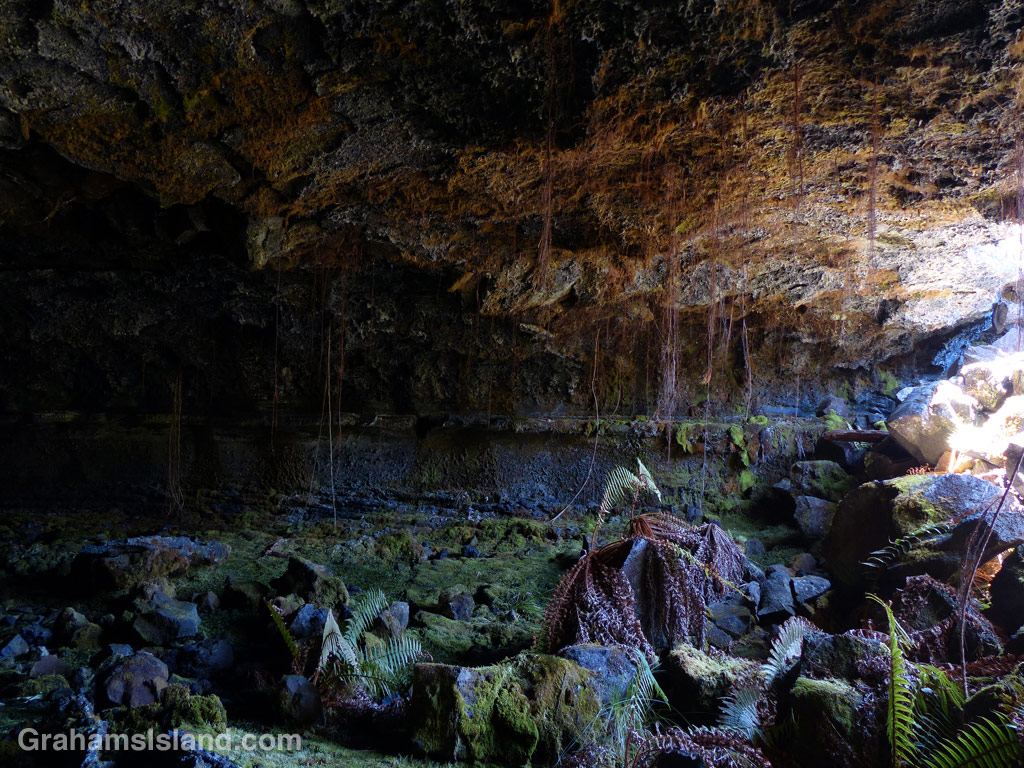
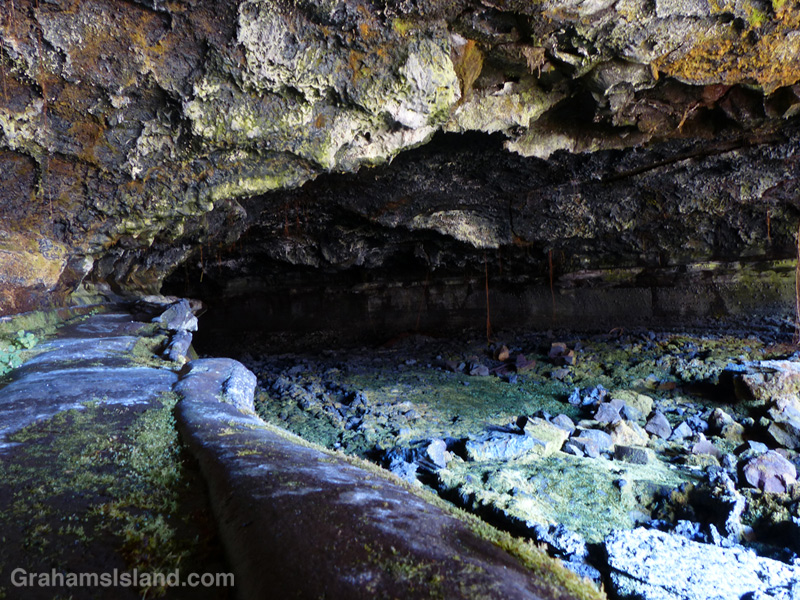
One of the things to look out for on the Powerline Trail, off of Saddle Road, is Emesine lava tube. There’s a sign right next to the trail, though it could be missed if you happened to be looking the other way while walking that stretch. Bear in mind that if you want to explore the lave tube, the sign indicates that you should first get a permit from the State Department of Land and Natural Resources (Division of Forestry and Wildlife).
These photos are from the entrance of the eastern part of the tube, which is the most accessible. The ceiling here is about 4 feet so it’s not for the claustrophobic. Not sure whether it opens up further along, but be sure to take plenty of good lights.
For more information about Emesine lava tube, go to darkerview.com/wordpress/?p=3781.
For more information about the Powerline Trail, go to bigislandhikes.com/puu-oo-trail/.

The Powerline Trail heads south off of Saddle Road around the 22 mile marker. This trail used to be, as the name suggests, where power lines ran, but only the stumps of poles remain. It’s a very straight trail, which used to run all the way to Kilauea until lava flows disrupted it.
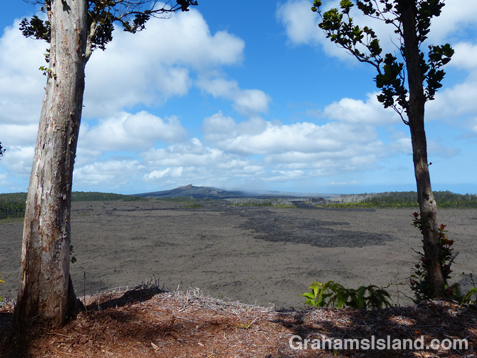
This trail is about 3.5 miles long to the point where it meets the Pu’u O’o trail. The southern part of the trail is dotted with kipukas and is shady and alive with birds. However, the northern two miles or so are exposed as the photo shows. The main feature of interest in this stretch is the Emesine Lava Tube about which, more tomorrow.
For more information about this, and other hikes on the Big Island, go to bigislandhikes.com.


Yesterday, I posted about the first part of the Nāpau Trail in Hawaii Volcanoes National Park, which crosses extensive lava fields. Today’s post picks up from there, on the rim of Makaopuhi Crater, where the trail slips into dense forest on its way to the Nāpau Crater overlook.
It’s a remarkable contrast between the stark lava and thriving forest. Birdsong is continuous. Ferns of every kind grow in abundance. Bamboo orchids pop out here and there. And above it all, tall Ohia trees provide the backbone of the forest. This forested trail is clear, but somewhat overgrown. I was hiking in shorts and, at the end of the day, my legs were generously scratched.
Early on in this section, it’s possible to get views of Makaopuhi Crater. Also in this area is the junction with the Nāulu Trail, which starts out at the Kealakomo Overlook, farther down Chain of Craters Road.
The forested part of the trail is about 2.5 miles and towards the end of it is an old Pulu factory. The sign there reads: “Between 1851 and 1884 great quantities of pulu, the soft, reddish-brown fiber covering the coiled fronds of the tree fern (hāpuʻu), were harvested on Hawaii. Much of it was processed within these walls, later to be shipped from Keauhou Landing to foreign markets for use as stuffing in pillows and mattresses.” Unfortunately, in drier climates, pulu quickly breaks down so the industry collapsed.
A little farther along is another junction. To the left is the very basic Nāpau campsite, a few open flat areas and an outhouse. To the right, the trail continues to the overlook, where I was lucky enough to have a wonderful, clear view of Puʻu ʻŌʻō, busily pumping out sulphur dioxide and other gases, and of course, million upon millions of gallons of lava, currently entering the ocean on the southeast coast.
Picking the right day for the hike is not always obvious and weather changes quickly around here. At the visitor center, on the way in, it was completely overcast and drizzling, but by the time I got to the trailhead the sun was out and a nice breeze blew. The wind direction is also important. On this day, the northeast trades were blowing and the vog trailed away to the southwest, which is fine for this hike. But if the wind blows more easterly or south of east, then this trail would be downwind of emissions from the volcano, which could potentially be a dangerous situation.
For more information about this, and other hikes on the Big Island, go to bigislandhikes.com.
For more information about Hawaii Volcanoes National Park, go to nps.gov/havo/.
For more information about Kilauea Volcano and it’s eruptions, go to hvo.wr.usgs.gov/kilauea/history/main.html.

