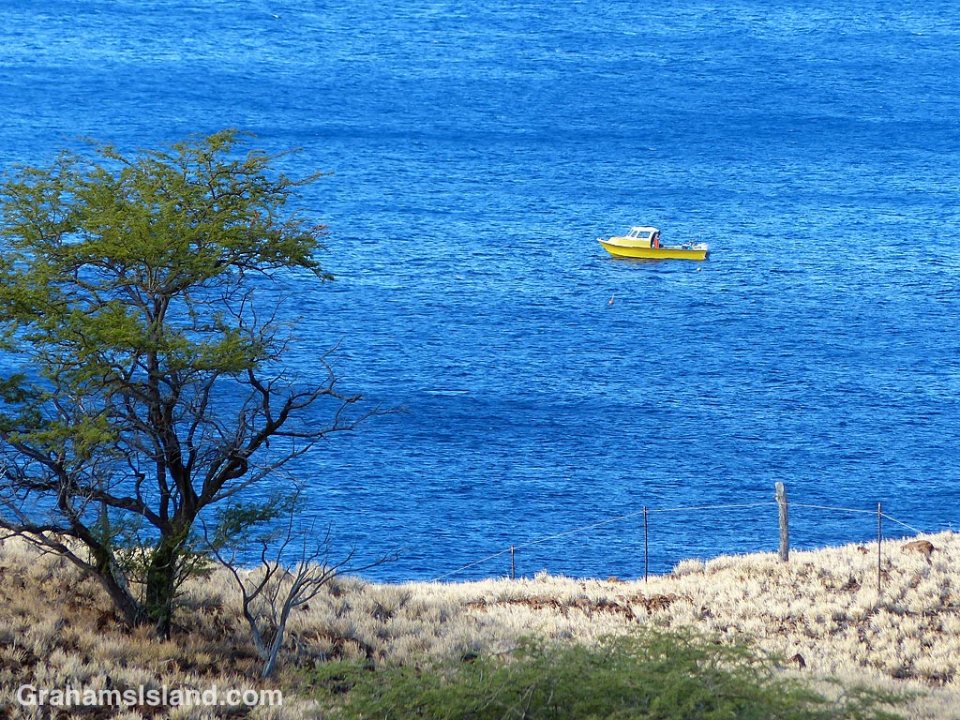
A small fishing boat works the blue waters off the Kohala coast.

A small fishing boat works the blue waters off the Kohala coast.
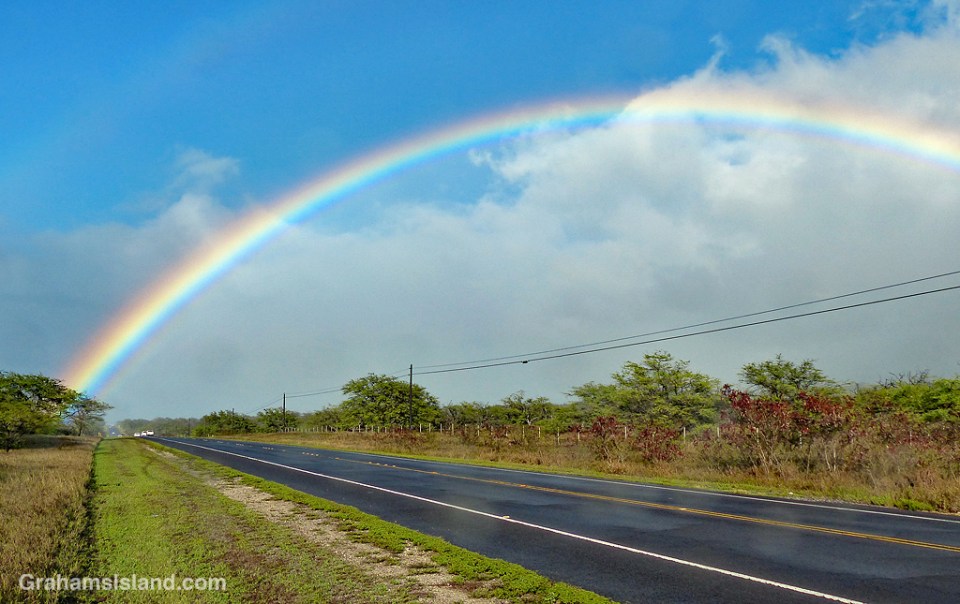
 Today marks the start of the fourth year for this blog. Post number one was of a rainbow over the northern coast, so I thought I’d post another one on the anniversary.
This rainbow occurred just last week over the road leading up to Hawi. Hawi gets around 60 inches of rain a year. A few miles south, the rainfall drops off to less than 20 inches, and it’s usually dry and sunny there. One byproduct of this climatic contrast is that there are frequent rainbows.
This one occurred in the late afternoon as I was heading home and, even though I see a lot of rainbows, I felt moved to pull over and snap a few photos before heading up into the clouds and rain over Hawi.
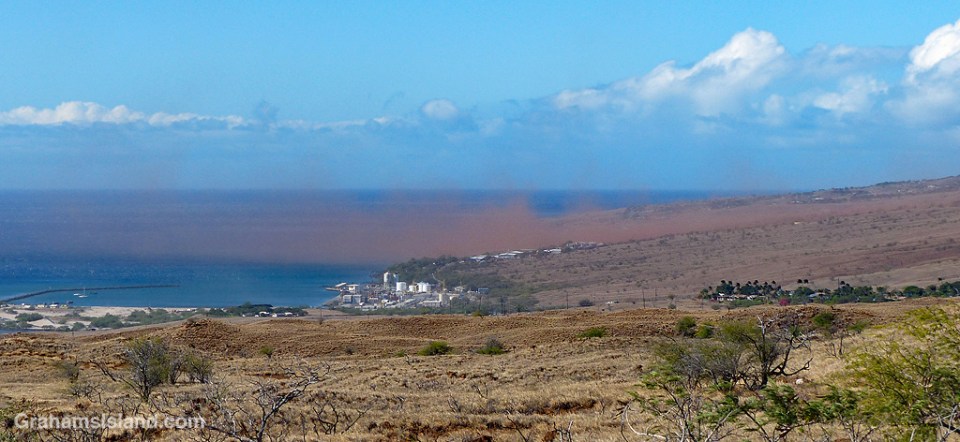
The winds were blowing here last week, 30+ mph on a consistent basis. But one afternoon the winds picked up even more and triggered dirt storms off the hills above Kawaihae.
The wind whistled down the slope from Kohala Mountain and dry dirt was gathered up, whirled around, and blasted down the slope toward the ocean. This happened for an hour or so. Sometimes, white sand from the beach in Kawaihae harbor was similarly stirred up.
The unfortunate aspect of this display was that it visibly demonstrated the problems with erosion when the ground is dry. If it’s not the wind, then any rainfall washes the soil down gullies and into the ocean. All this dirt being deposited in the relatively shallow waters off the coast degrades the water quality and can have a seriously adverse effect on corals in the area.

This is the lobby of the Westin Hapuna Beach Resort on the Kohala coast. Each of the Kohala resort hotels has a version of this look at this time of year.
To be honest, the tree decorations are a little over the top for my taste, not surprising considering I don’t have any decorations or a tree. However, these are minor details. Quibbling about festive decorations misses the point when there’s such a killer view, through the palm trees, over the white sand beach, to the blue Pacific.
Posted in response to this week’s Sunday Stills challenge on the theme of ‘Festive.’ See more offerings here.

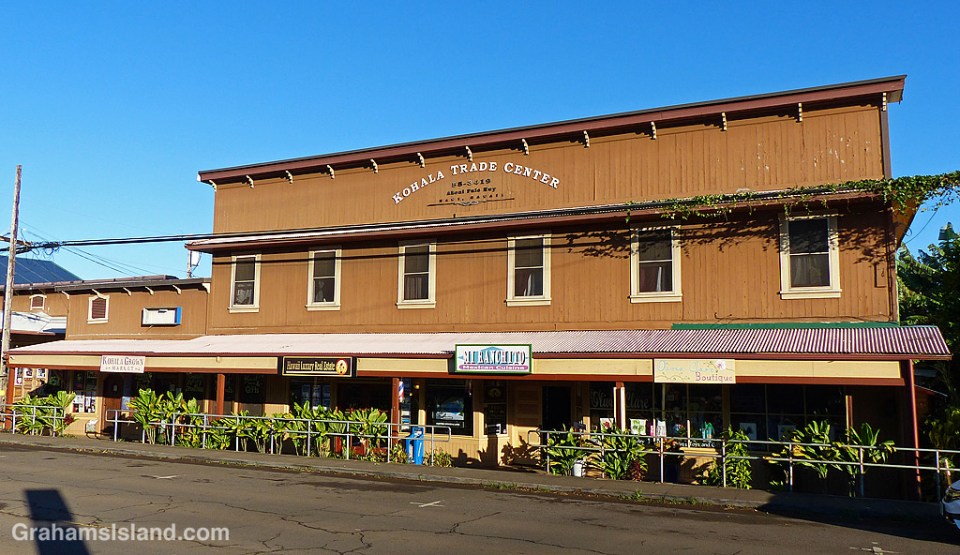
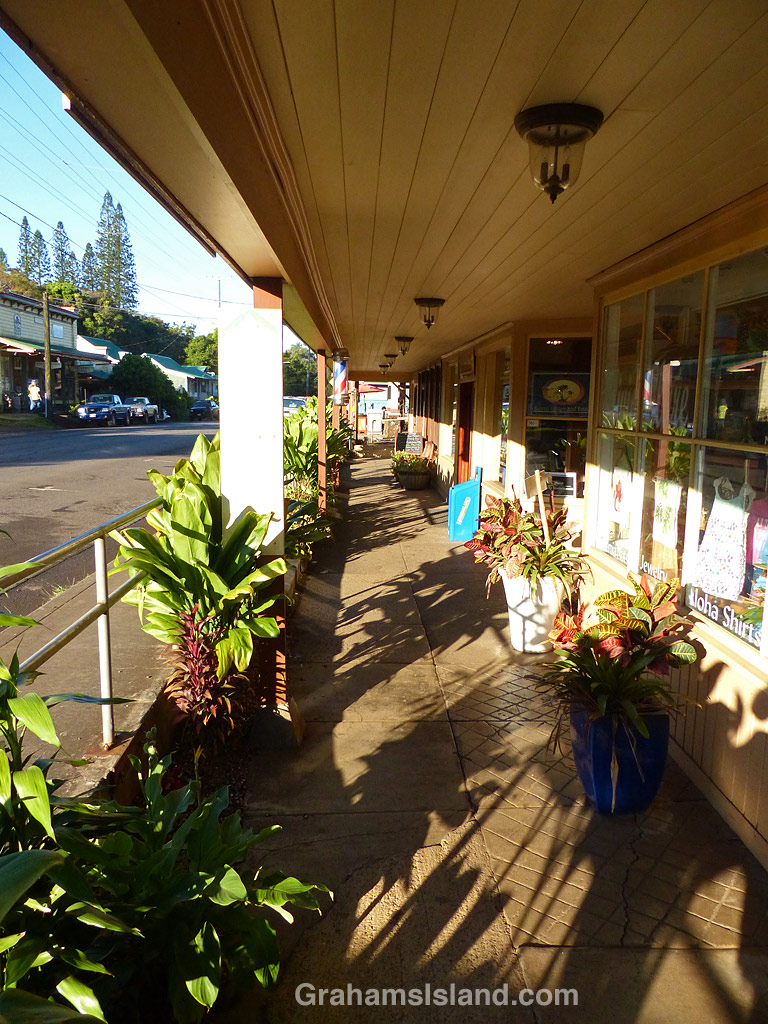 Hawi is the northernmost town on the Big Island. Together with Kapa’au, two miles to the east, it’s the main population center in North Kohala. This area was a center of sugar production from the mid 1800s to the early 1900s. Today, it’s geared towards tourism and agriculture.
Hawi’s population of around 1,000 is mostly located in areas above or below Akoni Pule Highway, which is the main road through town. The highway itself is where commercial activities are found, as seen in these photos.
In the top photo, the blue building houses the Bamboo Restaurant. This was the former home of K. Takata Store, the area’s main grocery store, which now occupies a newer building midway between Hawi and Kapaau. On the right of this photo is a vine climbing up a pole and along the power lines. I’m not sure what this vine is, but it’s everywhere, and periodically workers from the power or phone company pass through and hack at the lower reaches of it, killing off the higher parts engulfing the wires – at least until it (very quickly) grows back.
The Kohala Trade Center building is home to several smaller businesses and features the covered walkway at right which passes by the storefronts lining the street, but slightly below street level.
For its size, Hawi is quite a bustling place, popular with tourists and with a strong local community. But it’s also the kind of place where a person can ride a horse through town and not be considered unusual or out of place, and I like that quite a bit.
Posted in response to this week’s Sunday Stills challenge on the theme of ‘In Your Town.’ See more responses here.

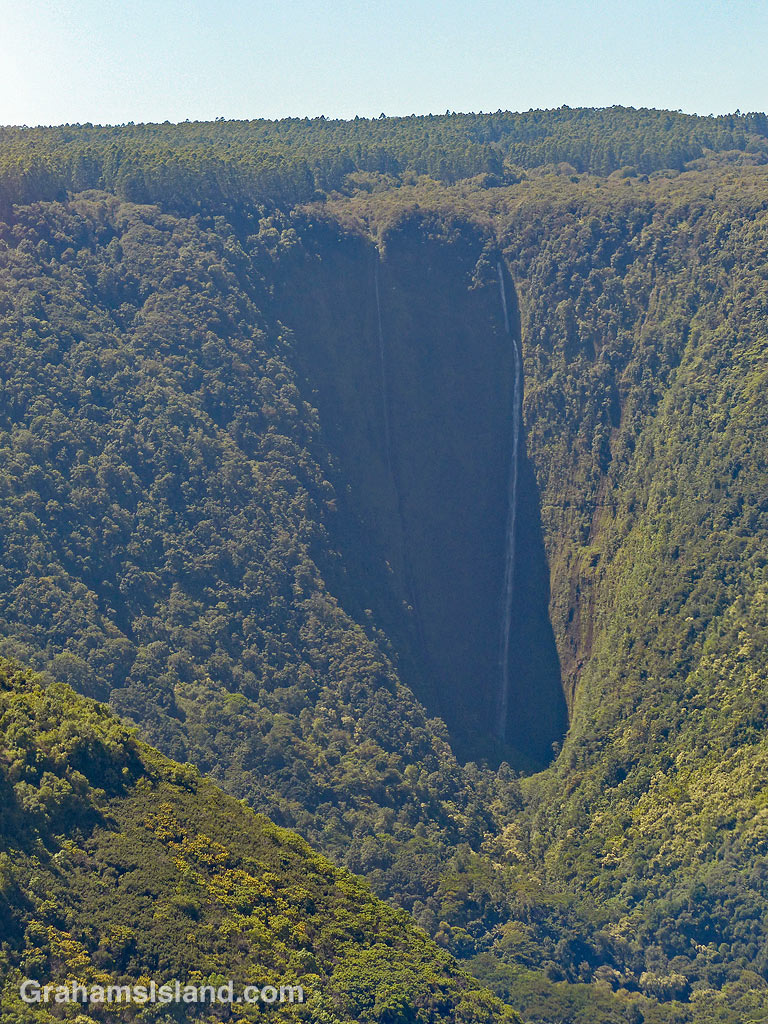 This week’s Sunday Stills challenge theme is ‘Bucket List Images.’ (See more responses here.) Since I don’t have a bucket list that posed something of a problem for me, so I plumped for this image of Waipi’o Valley, since I might never see this view again.
Waipi’o is a valley on the northeastern slopes of Kohala Mountain. The valley is about one mile wide at the mouth and about six miles deep with walls that are around 2,000 feet high. It’s accessed by a steep, one-lane road that’s for four-wheel-drive vehicles only. On the left of the top photo, and in the second photo, is Hi’ilawe Falls which tumbles almost 1,500 feet into the valley.
Waipi’o means ‘curved water’ in Hawaiian and the valley is known as the “Valley of Kings.” It was the home of Hawaiian royalty until the 15th century and was a stronghold of King Kamehameha, who united the Hawaiian islands under one leader. In its heyday, the valley was home to somewhere between 4,000 and 10,000 people.
Those numbers dropped over time, but the valley remained well-populated until 1946 when a magnitude 8.6 earthquake in the Aleutian Islands triggered a massive Pacific-wide tsunami with waves ranging from 45–130 ft. high. Waipi’o Valley was hit by this tsunami, and though no-one was killed, most of the structures in the valley were destroyed. Today, the population is around 50 residents, though many more visit on a daily basis.

During last month’s Ironman race, these cyclists had committed some sort of misdemeanor, probably following too close, on their way to Hawi, and had been pulled over to serve a 5-minute penalty. But what I liked about this scene was the sign in the background reading ‘Exertion plus perspiration equals inspiration.’ I suspect many of the Ironman participants might have thought the sign should have read ‘Exertion plus perspiration equals pain.’
Incidentally, that bright neon sign was a source of great community consternation when it went up. Some locals thought it was OK. Others thought it was a blight on the community and a sign of the impending apocalypse. It’s been in place a few months now and the hubbub seems to have subsided. I have to say though that the neon colors are still as garish as they ever were.
 Graham's Island