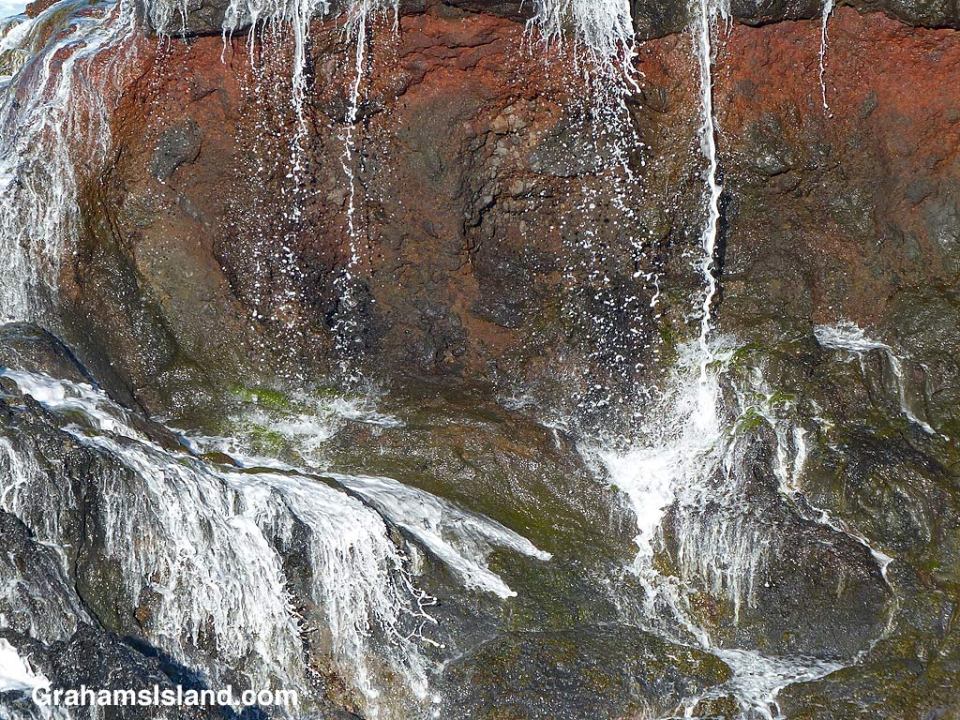
A breaking wave cascades down a colorful rock face on the coast.

A breaking wave cascades down a colorful rock face on the coast.
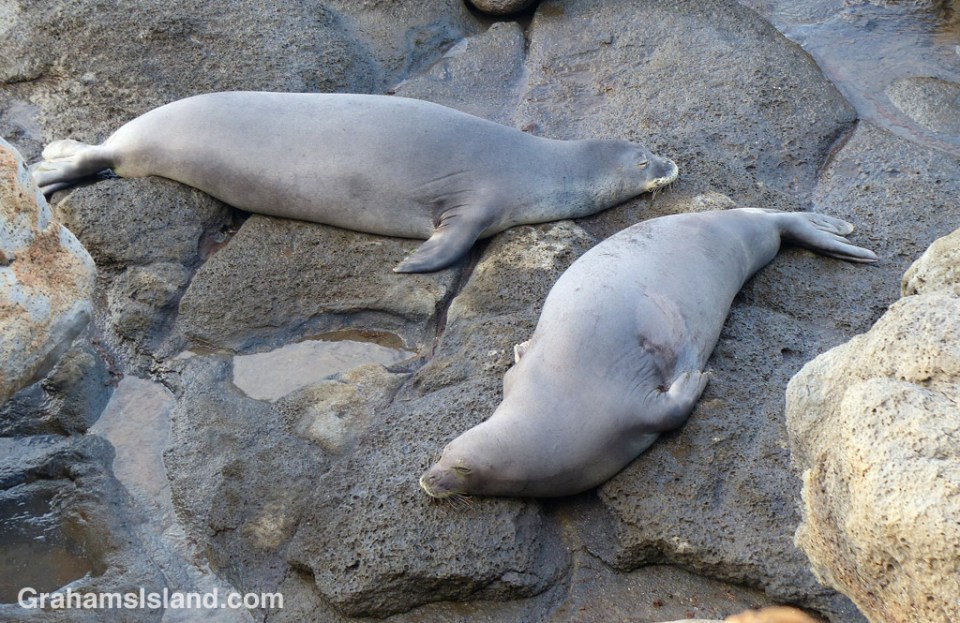
I’m posting this photo in response to this week’s Sunday Stills challenge on the theme of ‘Friend’ (see more responses here), though it would be equally suitable for next week’s ‘Lazy Days.’
Monk seals are solitary animals, the main exception being the six weeks or so a mother spends with her new pup, teaching it the tricks of the trade, before leaving it to fend for itself. But for a three month period in late 2016, these two monk seals spent a lot of time together.
The top seal is I05, a male, affectionately known as Igor. He’s a Big Island seal and appears to spend his time on the Kohala and Kona coast. The other is B00, a female, affectionately known as Boo. She was born in Kauai and had previously been seen on Molokai and Maui, but now appears to spend much of her time on the Kona coast. Whereas not too much had been known about B00, I05 was regularly seen and was a notorious loner. So his ongoing liaison was quite out of character.
They seemed very relaxed and content in each other’s company, and here are resting ashore, as monk seals do, before heading back into the water to feed.
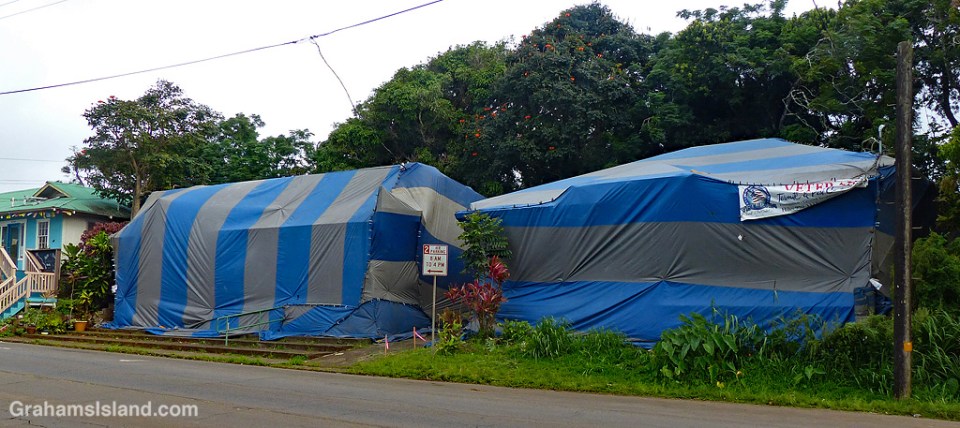
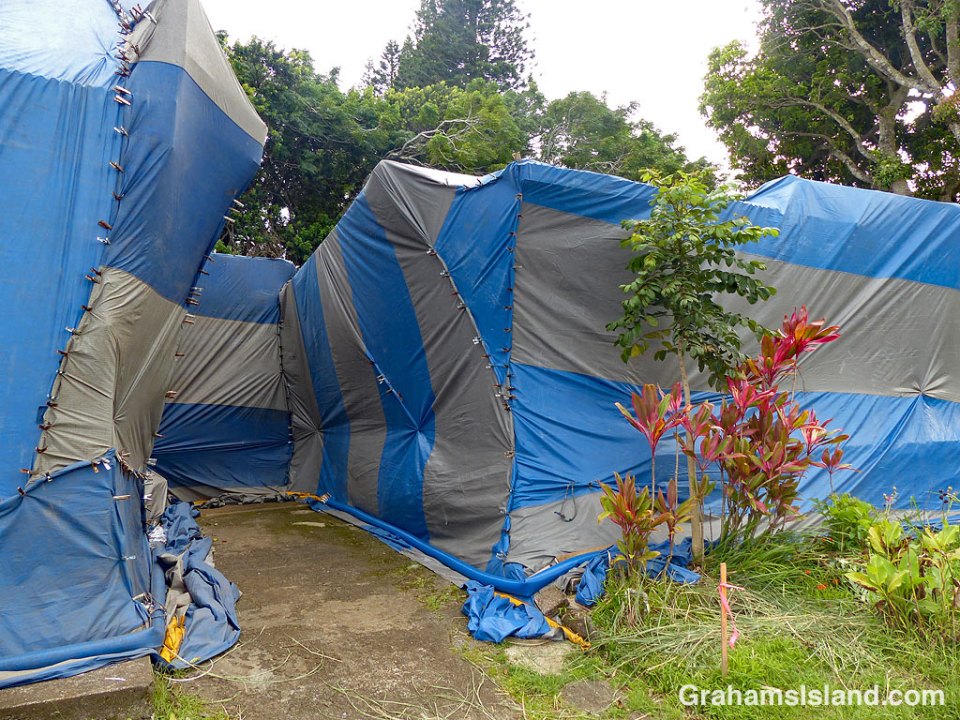
No, it’s not the circus come to town. These tents are for a more macabre purpose, the termination of termites.
As in most warm climates, termites are a problem here. Houses, especially older ones, are easily colonized. Without treatment, the occupying termites will consume wood from the inside, leaving a thin membrane as protection. Infested wood might look fine, but a gentle push on the surface will go right through two or three layers of paint to the termites’ cavern inside.
Besides leaning against a wall and going right through, a prime indicator of termites is small mounds of little round pellets below a pinprick hole in a wall or piece of furniture. These are termite fecal pellets, which the worker termites clear out of the nest from time to time.
Another indicator of the presence of termites is to turn a light on and find a horde of them flying around the room. Around here, May is the prime time for this activity. These flying termites are fertile males and females, leaving the nest they grew up in to find a place of their own and start a new colony.
As unpleasant as it is to find a room full of flying termites, it’s even worse to wake up and see countertops littered with discarded wings, a sure sign that these fertile termites have moved in to a new spot.
So tenting for termites is common practice here. The structure is covered with nylon sheeting until it is completely sealed and then a fumigant is pumped in. The tent usually remains on overnight. After the tent is removed, the house has to sit empty a while for the gas to dissipate. It’s not wise to go back in too early or one could find oneself joining the termites. Typically it can be two or three days before a home can be reoccupied.
Tenting for termites is effective but it has downsides. It works for drywood termites, but not subterranean termites since they live outside the house and just dine inside. There are also environmental concerns about the process. And while fumigation works, there’s no guarantee that a new colony of termites won’t move in just as soon as the gas has cleared.

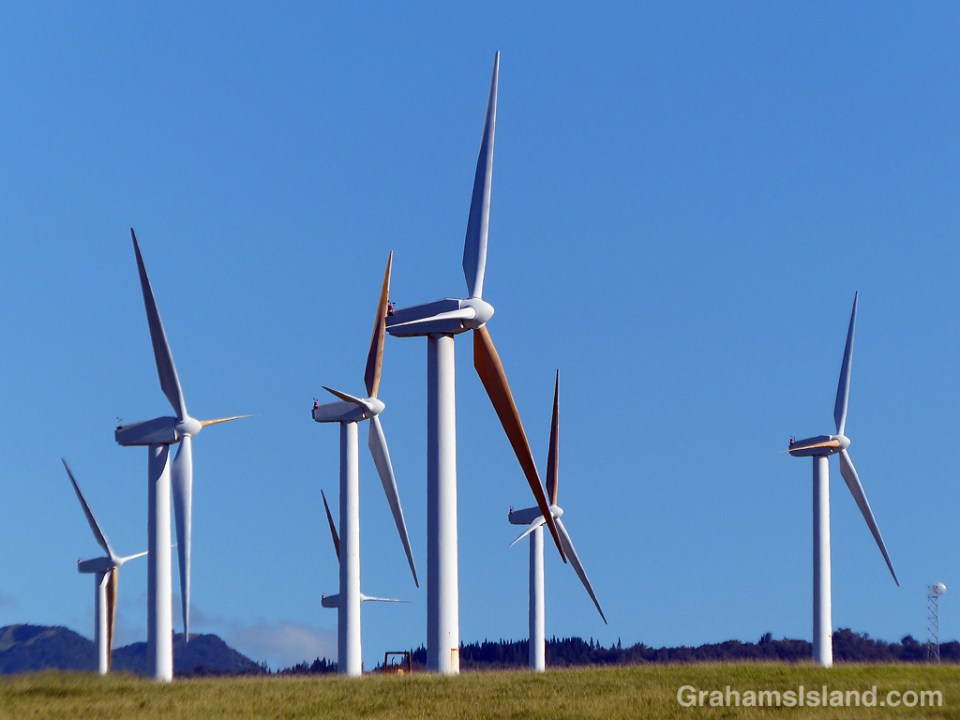
This week’s Sunday Stills challenge is ‘Drunk with .…’ I thought about a photo of my liquor cabinet, but settled instead for ‘Drunk with Power,’ a reasonable choice in these turbulent times.
Hawi Wind Farm began operations in 2006 and has 16 turbines churning out 10.56 MW. This power is supplied to Hawaii Electric Light Company, which runs the power grid on the island.
My interest in the wind farm is mostly visual. I like the patterns that the turbines make, and every once in a while the telescopes of Mauna Kea can be seen in the distance.
See more Sunday Stills responses here.

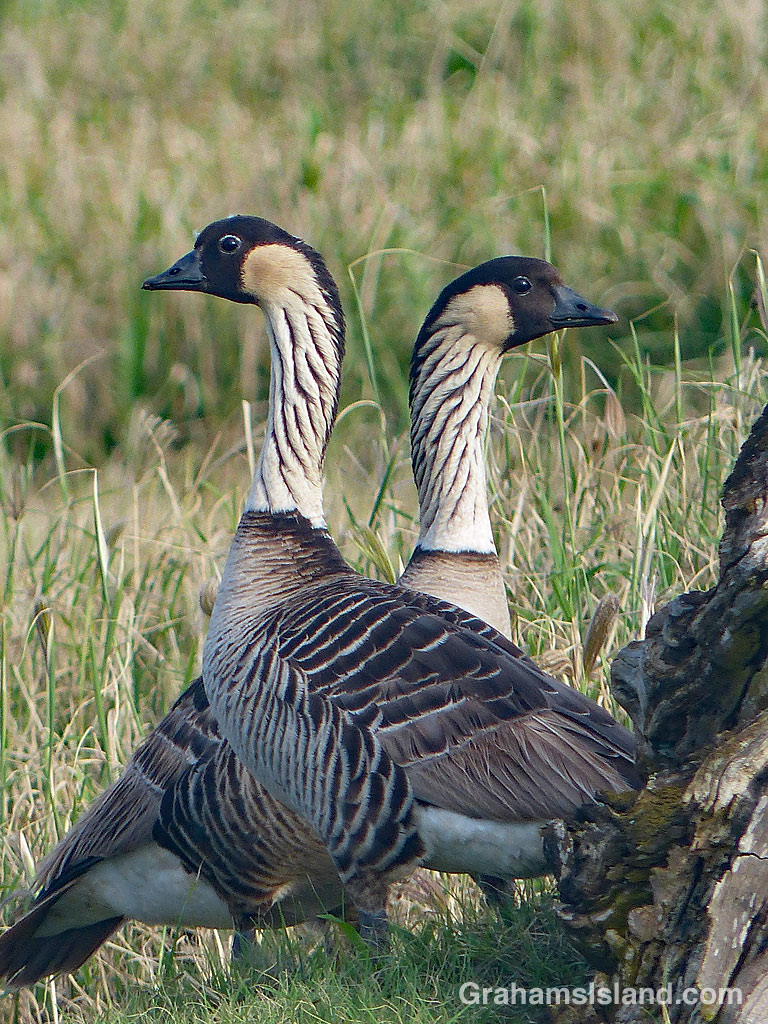 I came across this pair of nene, the Hawaiian goose, on one of my walks. They didn’t seem too bothered by my arrival in the vicinity and continued to graze.
And in a shameless bit of self-promotion, the second image is my Photo of the Week for this week (7-23-18 to 7-30-18). Check out my shop for more details here.
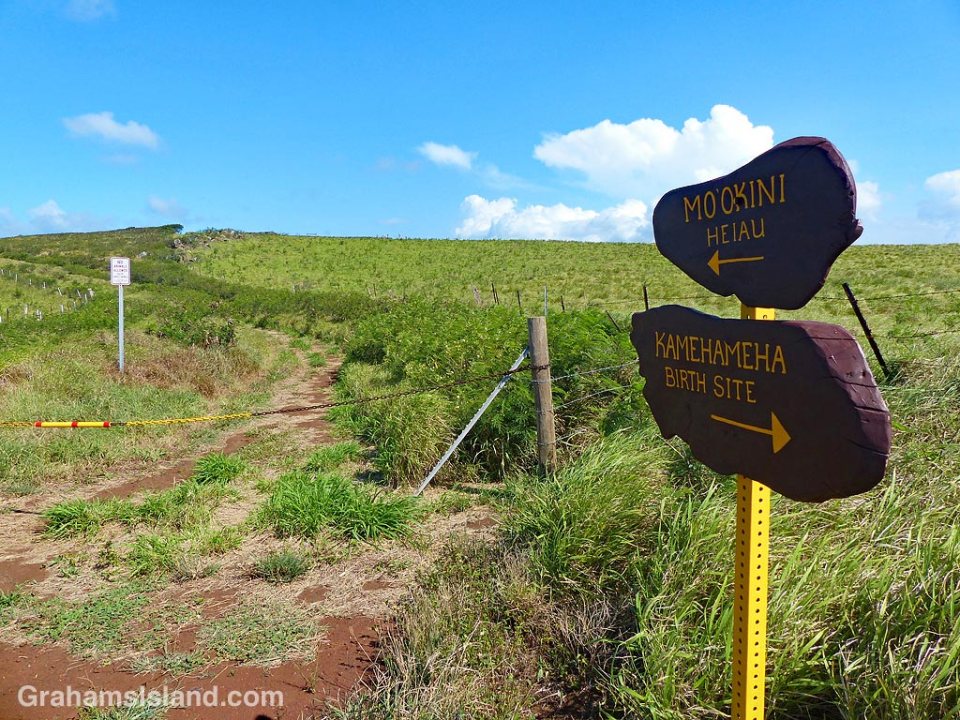
Mo’okini Heiau is located just off one of my regular walks. The old signs for the heiau and the Kamehameha birth site fell from their original spot, tacked on a fence, some years ago. Since then, the signs have been wedged into a barbed wire fence, from which they regularly fell into the grass.
When I noticed this, I’d root the signs out and wedge them back in the fence. I believe other people also did this. At some point, one of the signs split in two, so there were three pieces to try and arrange in some way that they wouldn’t immediately fall down again.
I kept thinking I should bring some wire and a drill and try and put the signs back together again, maybe attach them to a fence post, but I only remembered this good intention when I was picking the signs out of the grass.
The grounds of the heiau are maintained by staff presumably contracted by the county or state. However, the area in the vicinity of the signs never got much attention except when, a couple of years ago, a sign prohibiting animals (on the left of the photo) suddenly appeared. I have a fondness for that sign because the chance of anyone enforcing that regulation is right up there with me winning three different lotteries on the same day (and Hawaii doesn’t have lotteries).
So imagine my surprise the other day when I reached this point in my walk and saw this spiffy new sign. Two new boards attached to a brightly painted pole securely set in a rock. I was giddy with shock and excitement (yes, I don’t get out much). If an alien spaceship had landed I wouldn’t have been more surprised. Note too the red and yellow paint on the chain across the trail to the heiau, and the well-supported post that fell down about a year ago.
Folks, forget the volcano. You want to see something truly amazing on the Big Island, come up to North Kohala and check out these signs while they’re still standing.

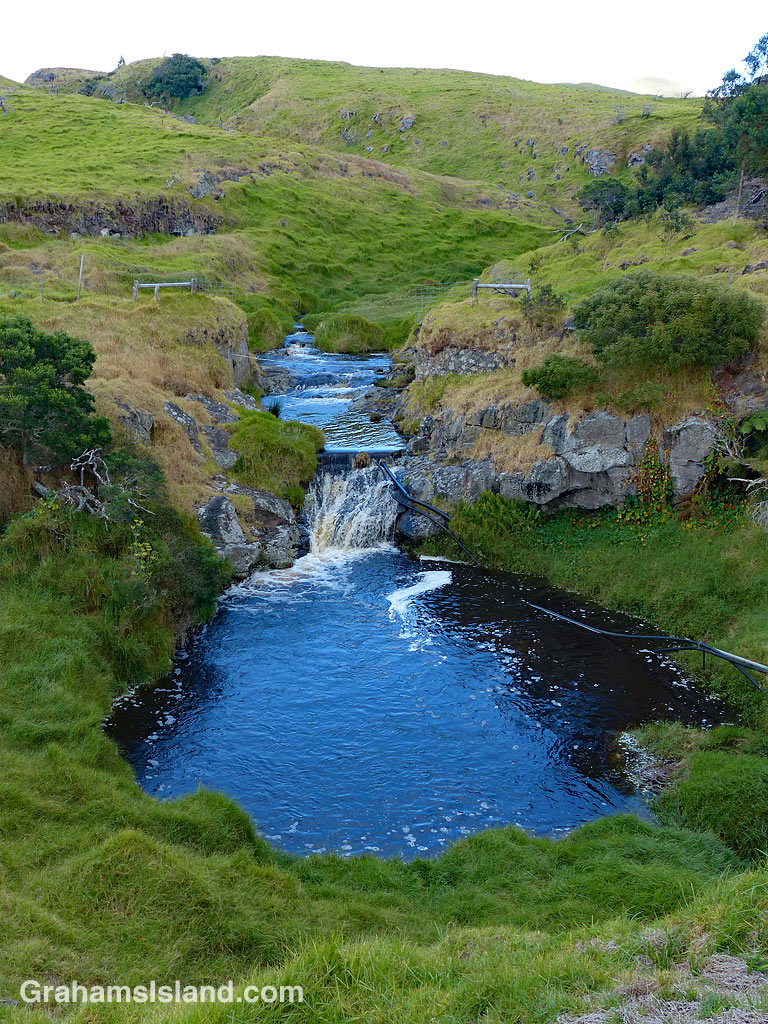 The Kohala Mountain Road passes over the dry southwest side of Kohala Mountain. There are several streams running down the side of the mountain toward Kawaihae and the Kohala Coast and they can run anything from dry to flash flood. It all depends on the rain.
This stream, just below the road’s high point around 3,500 feet, is running somewhere in the middle of the flow range. The top photo shows the stream tumbling through a series of pools on its way to the coast. And those black pipes? The photo to the left shows a small dam, built into the stream. Those pipes gather water from behind the dam and carry it to ponds where it’s stored for use during dry times.
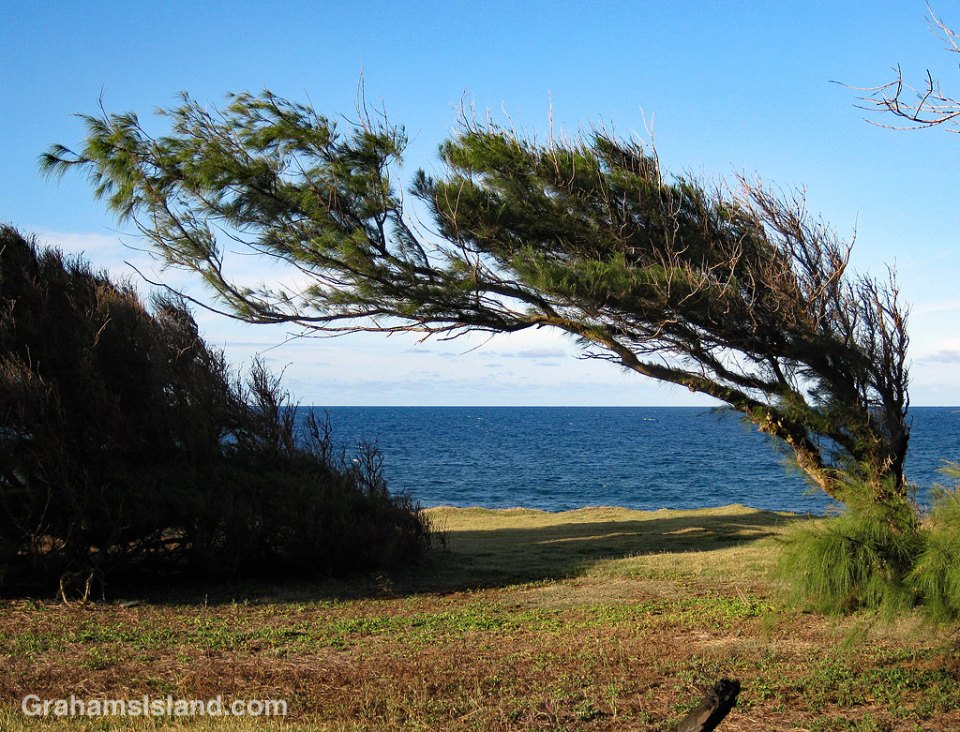
Northeast trade winds are Hawaii’s air conditioner, moderating what would otherwise be much hotter temperatures. The North Kohala coast is a spot where the winds whistle ashore. They can be very strong, but if you want to know how strong, the surest way is to ask a tree. This one is near the Kauhola Point light.
Posted in response to this week’s Sunday Stills challenge on the theme of ‘Wind.’ See more responses here.
 Graham's Island