Tag Archives: Mauna Kea

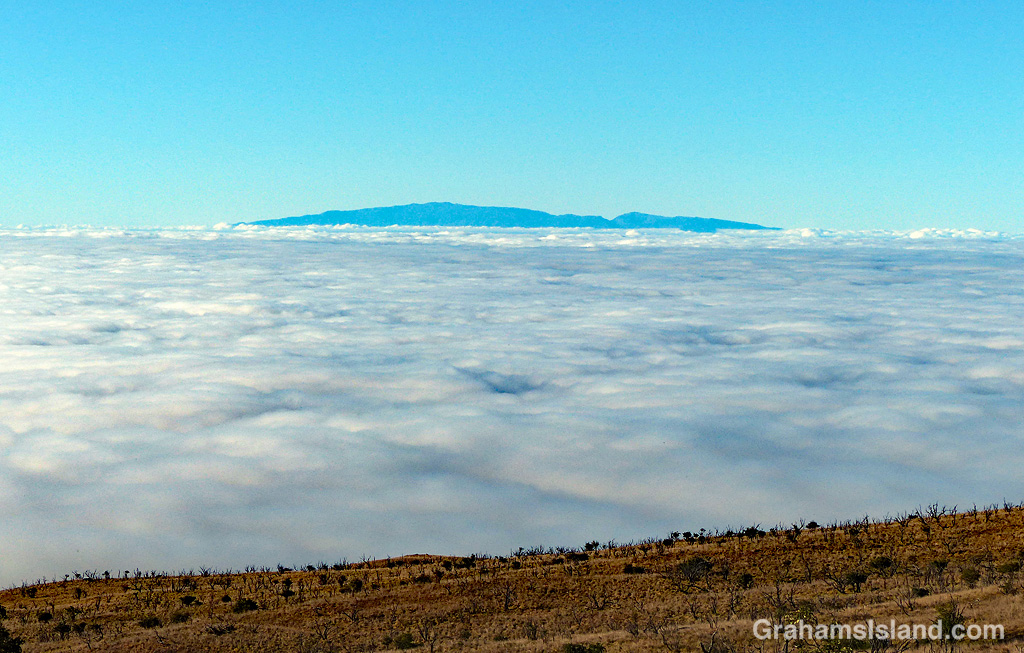
Hualalai and clouds

Hualalai and clouds

I’ve spent a fair amount of time in my life looking up at clouds, often as they poured water in my direction, so it’s nice to look down on them once in a while. Airplanes are probably the most common place to enjoy this view, but here on the Big Island, the upper reaches of Mauna Kea and Mauna Loa also offer this perspective.

In this case, the clouds were low enough that, when I was visiting the Palila Forest Discovery Trail at around 7,000 feet, the clouds blanketed the landscape below. Here, Hualalai pokes through the cloud layer in the late afternoon.

For more information about Palila Forest Discovery Trail, go to dlnr.hawaii.gov/restoremaunakea/palila-forest-discovery-trail/.

Palila feeding

palila

I’ve made a couple of recent visits to the Palila Forest Discovery Trail, on the slopes of Mauna Kea, in search of palilas, an endangered Hawaiian honeycreeper. On one of those visits I was lucky enough to see this bird.

I wrote here about the first time I saw palilas, in late 2017. Those birds were feeding on immature mamane seed pods, one of their main foods. But the bird in this photo has what I think is a naio flower in its grip. The fruits and flowers of naio, otherwise known as false sandalwood, are the other main foods of the palila.

For more information about palila and the Palila Forest Discovery Trail, go to dlnr.hawaii.gov/restoremaunakea/palila-forest-discovery-trail/.

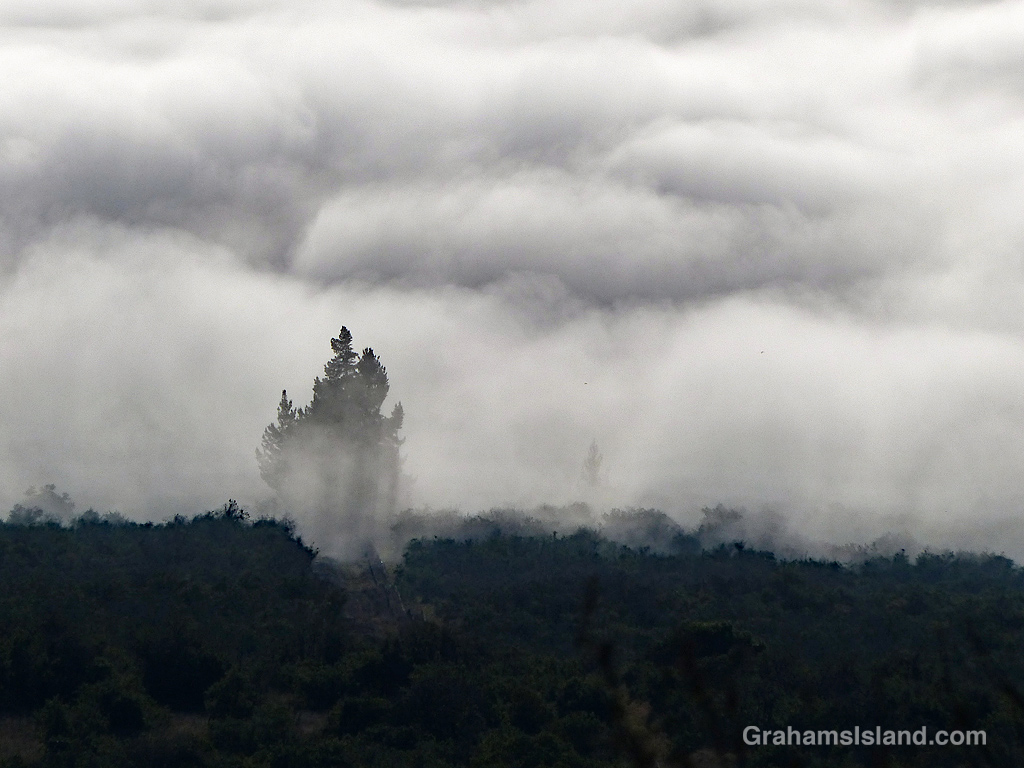
Ghostly tree

ghostly tree

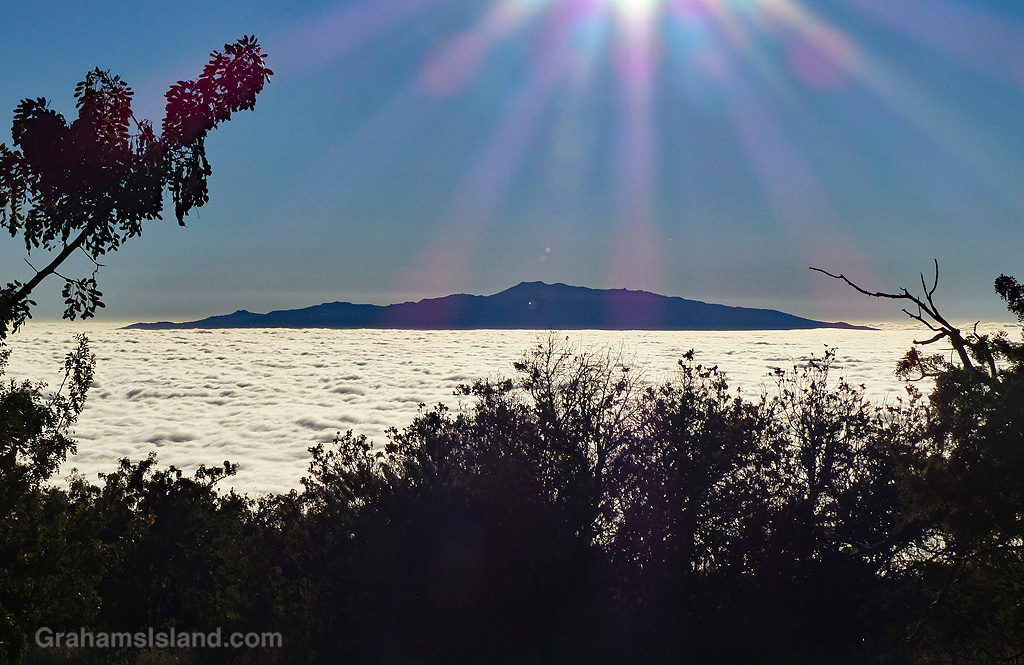
The last time I visited the Palila Forest Discovery Trail, on the southwest slopes of Mauna Kea, I didn’t see too many birds, but did enjoy looking down on the cloud layer covering the lowlands between Mauna Kea and Hualalai.

This tree sat on the slope of Mauna Kea at the point where the top of the clouds swirled around it, giving it a very ghostly appearance.

Pu’us

Pu'us on Mauna Kea

In Hawaii, one meaning of the word ‘pu’u’ is ‘a protuberance of some kind.’ This can be anything from a pimple to a hill, but ‘hill’ is the most common usage I encounter, as a general reference or in place names.

Pu’u O’o is the cinder cone that is home to the vent on Kilauea Volcano that was active from 1983 until earlier this year. Pu’u Wa’awa’a is an old cinder cone that is now managed by the Division of Forestry & Wildlife. A common thread is that, in Hawaii, a hill is a cinder cone because all of Hawaii is volcanic and the landscape is liberally dotted with cinder cones.

The top photo shows Mauna Kea and the large array of pu’us on its southern slopes. In the foreground is Pu’u Huluhulu, which means hairy hill. There’s a trail to the top of this pu’u which offers good views of Mauna Kea and Mauna Loa.

The bottom photo shows grassed over pu’us in Pōhakuloa Training Area, which is a military base located in the region between Mauna Loa, Mauna Kea and Hualālai volcanoes.

On the Big Island, several pu’us are accessible to hikers, usually with a trail curving up to the top and then around the rim of the pu’u. Even if the pu’u isn’t that high, it invariably stands out from its surroundings and offers good views.

Pu'us between Mauna Kea and Mauna Loa

Civilian Conservation Corps Cabin on Mauna Kea

CCC Cabin and water tank Mauna Kea

This Civilian Conservation Corps (CCC) Cabin is one of seven that were built around Mauna Kea in the 1930s. The CCC was a public work relief program to create jobs during the Great Depression. It focused on the conservation of resources on government-owned lands.

The seven cabins on Mauna Kea were used by crews working on the construction of sheep-proof fencing. The goal was to remove sheep from parts of Mauna Kea in order to protect the high-elevation dry forest which was rapidly being destroyed.

This cabin is just above the Palila Forest Discovery Trail on the southwest slopes of Mauna Kea.

Posted in response to this week’s Sunday Stills challenge on the theme of ‘Work.’ See more responses here.

CCC Cabin Mauna Kea

A’a and pahoehoe lava

A'a and pahoehoe lava

This photo shows the two main types of lava found on the Big Island. On the left is pahoehoe lava and to the right, a’a lava. They’re noticeably different. Pahoehoe lava is typically rounded and smoother, and the height of the flow is quite modest. A’a flows are characterized by a rough, clinker surface and the flow height is greater. Both types of lava can be produced by the same eruption and even in the same flow, depending on conditions.

Pahoehoe flows occur when lava is hot and fluid. Typically, pahoehoe flows result from an eruption that outputs lava at a lower rate, has a lower flow rate and a slower moving flow front. The slower movement of the flow allows a skin to form on the surface and this insulates the lava within. The flow is actually made up of a large number of ‘toes.’ Each toe flows for a short time, a matter of minutes. When it stops, the lava inside causes the toe to expand until the skin cracks and releases a new toe.

A’a flows are more viscous, but with a higher flow rate and faster flow front. The lava in the center of the flow is very dense with a layer of rough clinker on top. As the flow advances, the front tumbles over itself breaking into more rough pieces.

It’s easy to see from the photo that walking is much easier over pahoehoe lava than a’a lava. That’s when it’s cooled of course. When it’s red hot and flowing, it’s best not to get too close.

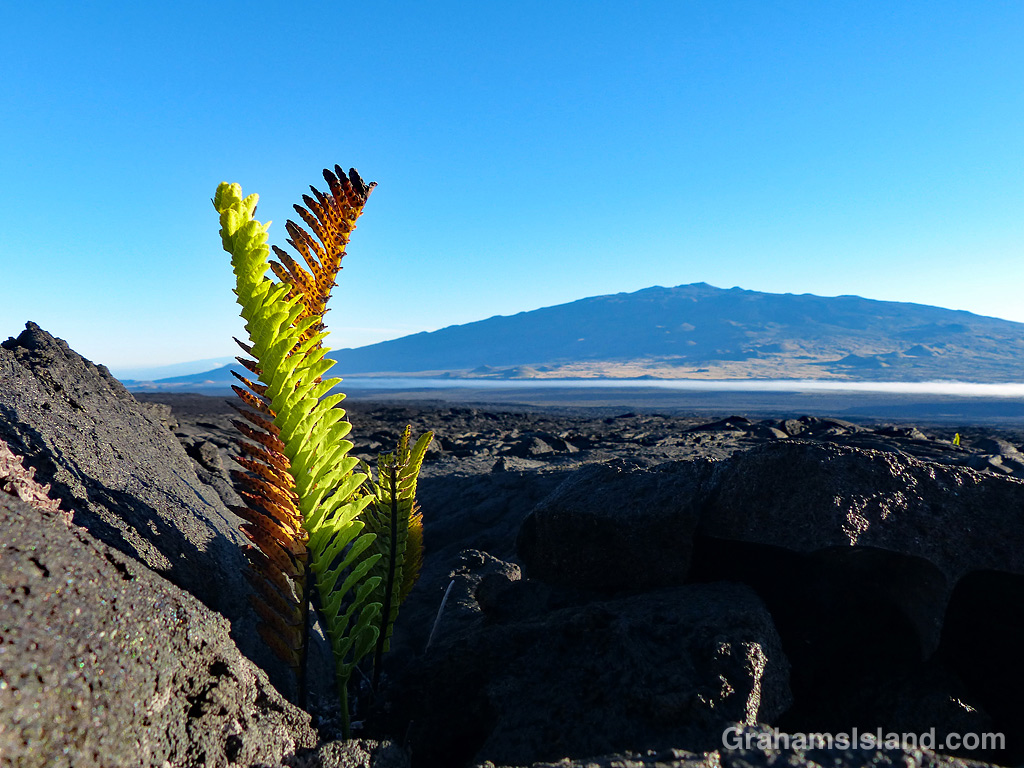
This flow was on the north side of Mauna Loa, looking across to Mauna Kea.

For a more thorough description of the difference between a’a and pahoehoe lava, go to http://volcano.oregonstate.edu/book/export/html/131

Wind turbines crank out the power

Wind turbines Hawi and Mauna Kea

This week’s Sunday Stills challenge is ‘Drunk with .…’ I thought about a photo of my liquor cabinet, but settled instead for ‘Drunk with Power,’ a reasonable choice in these turbulent times.

Hawi Wind Farm began operations in 2006 and has 16 turbines churning out 10.56 MW. This power is supplied to Hawaii Electric Light Company, which runs the power grid on the island.

My interest in the wind farm is mostly visual. I like the patterns that the turbines make, and every once in a while the telescopes of Mauna Kea can be seen in the distance.

See more Sunday Stills responses here.

Wind turbines Hawi