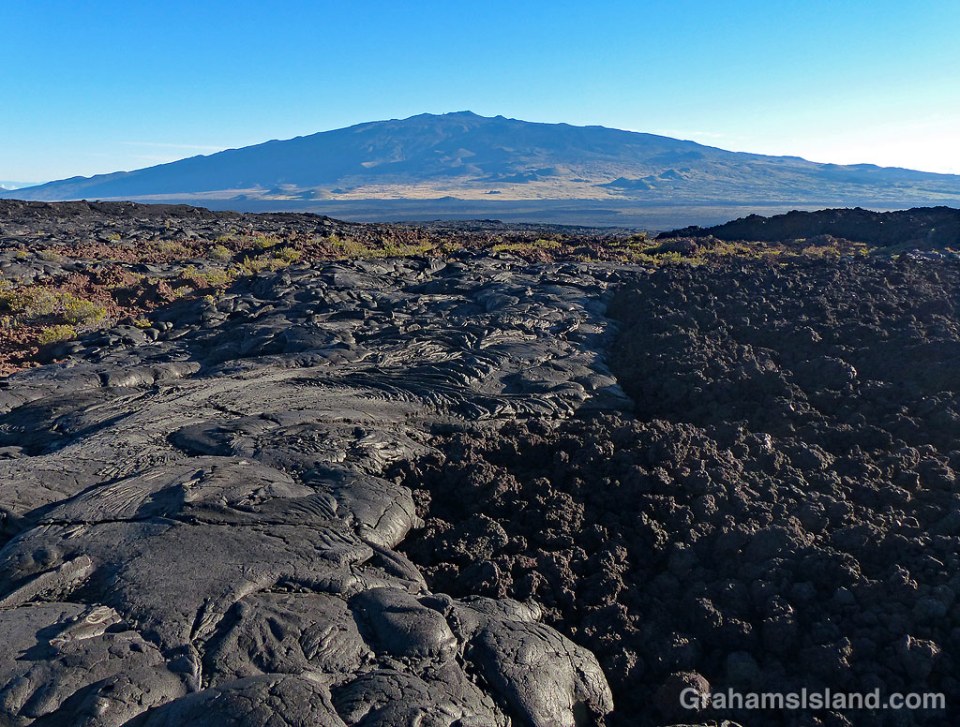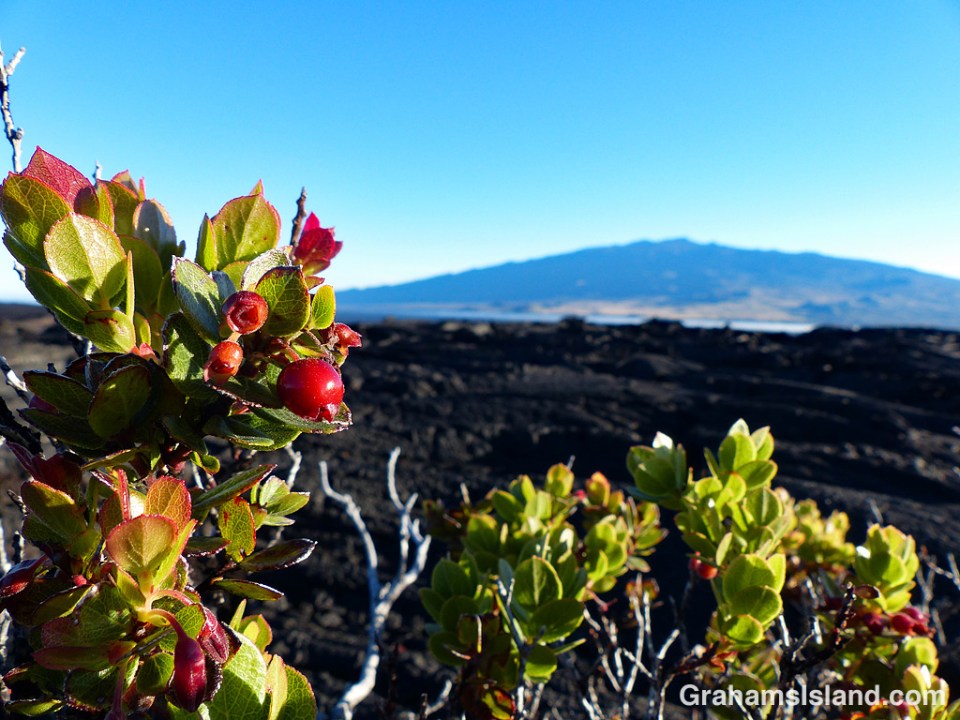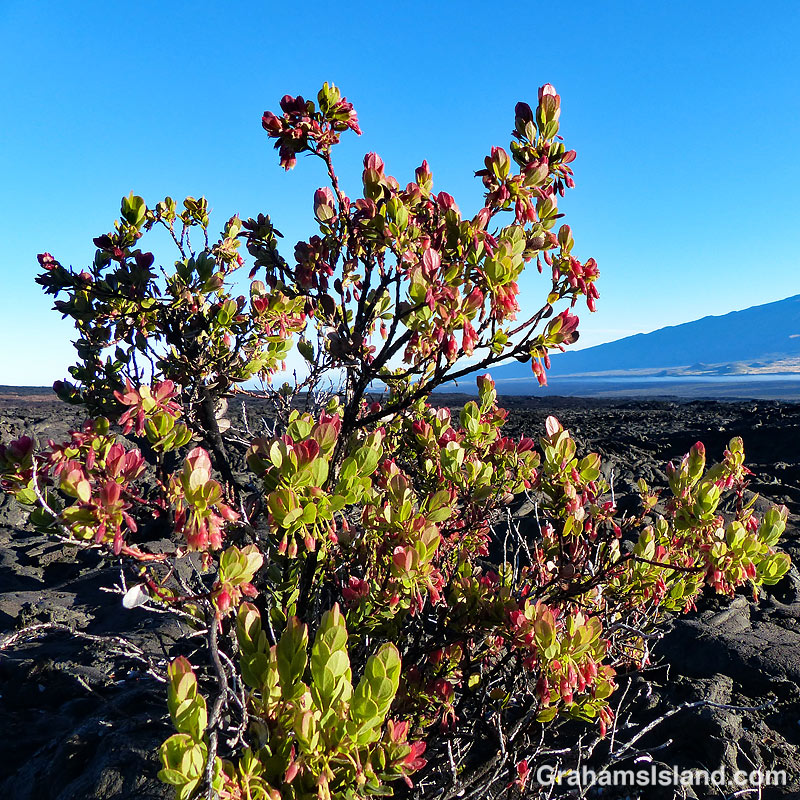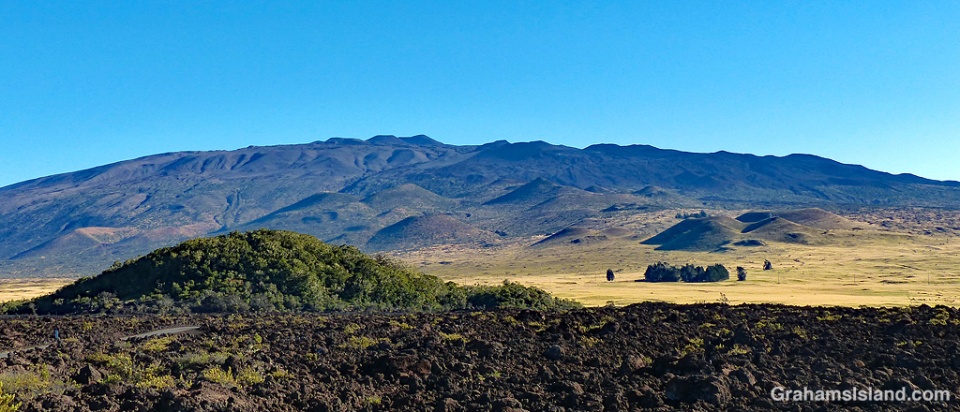

Ohelo ‘Ai (Vaccinium reticulatum) is an endemic plant also known as Hawaiian blueberry. It’s seen here growing on the inhospitable slopes of Mauna Loa, with Mauna Kea in the background.


Ohelo ‘Ai (Vaccinium reticulatum) is an endemic plant also known as Hawaiian blueberry. It’s seen here growing on the inhospitable slopes of Mauna Loa, with Mauna Kea in the background.


Another response to the last edition of the WordPress photo challenge with a theme of ‘All time favorites.’
I post this for two reasons. The first is that recently I had an exchange on this blog with the wife of the Director of the Submillimeter Array (SMA). The second is that Mauna Kea is a favorite place of mine to visit.
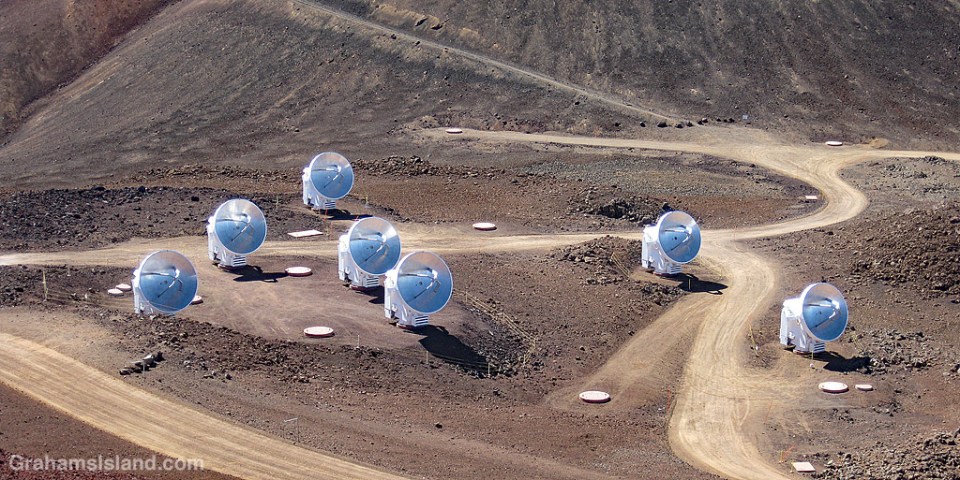
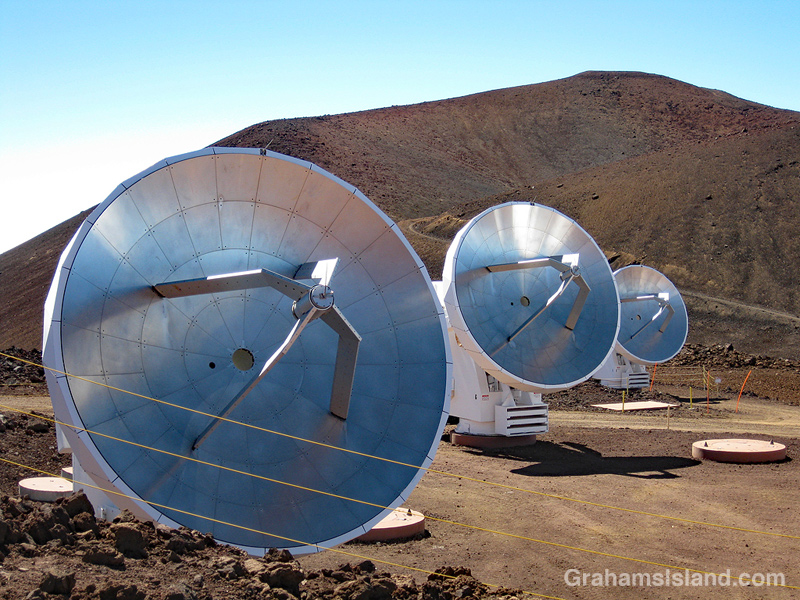
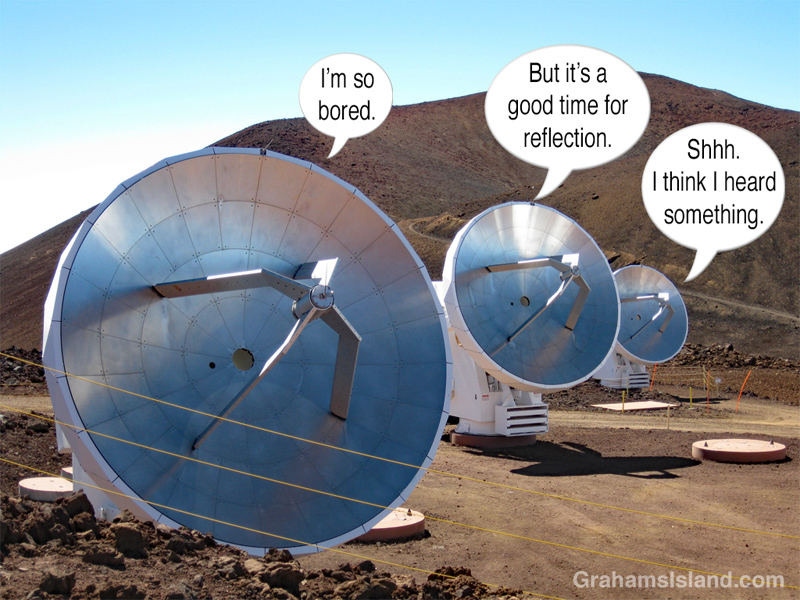
So here are a couple of photos of the SMA taken a few years back. The dishes are mounted on those little round pads in the photos, and they can be moved to different pads to produce different configurations. In my ignorance of most things scientific, I marvel at the idea of moving a dish a few meters makes a big difference in observations of things way the heck out there in space. That’s not an official measurement there.
The top photo shows seven of the eight dishes that make up the array.
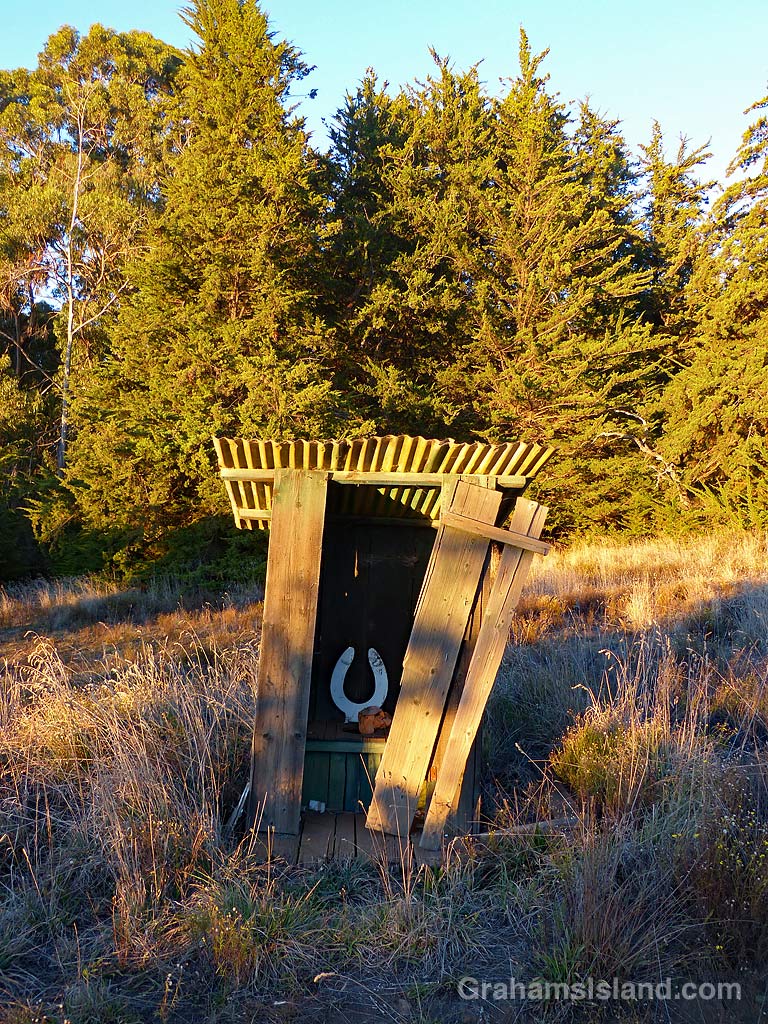
The other photos, of three dishes and what immediately popped into my head when I saw them, show why I never made it as a scientist.
For more information about the Submillimeter Array, go to https://www.cfa.harvard.edu/sma/.

On the first decent day after a long spell of grey, wet weather, I headed up to the Palila Forest Discovery Trail, just off Saddle Road on the lower slopes of Mauna Kea. I figured that even if the weather let me down, it’s a drive that I enjoy, so it would be OK regardless.
However, the closer I got to my destination, the less promising it looked. When I got to the junction, where a 4-mile dirt road leads to the trailhead, I almost turned around since it seemed unlikely there would be anything to see. The mountain looked shrouded in cloud, but since it’s only a 15-minute drive and the road didn’t look too muddy or washed out, I thought I’d give it a go.
When I pulled into the deserted parking area, the sky was grey, the air was damp, but it wasn’t actively raining and the visibility was OK, so I set out on the mile-long loop trail. As usual, I could hear a fair number of birds. It’s just spotting them that’s the trick there. But there are a couple of places on the trail that seem to get a lot of action and this day was no exception, including my first photos of a Hawaii ‘elepaio (Chasiempis sandwichensis sandwichensis).
Oahu, Kauai, and Hawaii Island each have their own species of the endemic ‘elepaio, which is a member of the flycatcher family. The Big Island version is more boldly marked than the other two and this one obligingly set down in a mamane tree not too far away, affording me a decent view and the opportunity to take photos.
One tidbit that I found interesting about the bird is that when ‘elepaio were seen to frequent a given koa tree, this was a sign to canoe makers that the tree was likely insect infested and unsuitable for making a canoe.
For more information about Palila Forest Discovery Trail, go to dlnr.hawaii.gov/restoremaunakea/palila-forest-discovery-trail/.
Posted in response to this week’s WordPress Photo Challenge ‘Unlikely.’
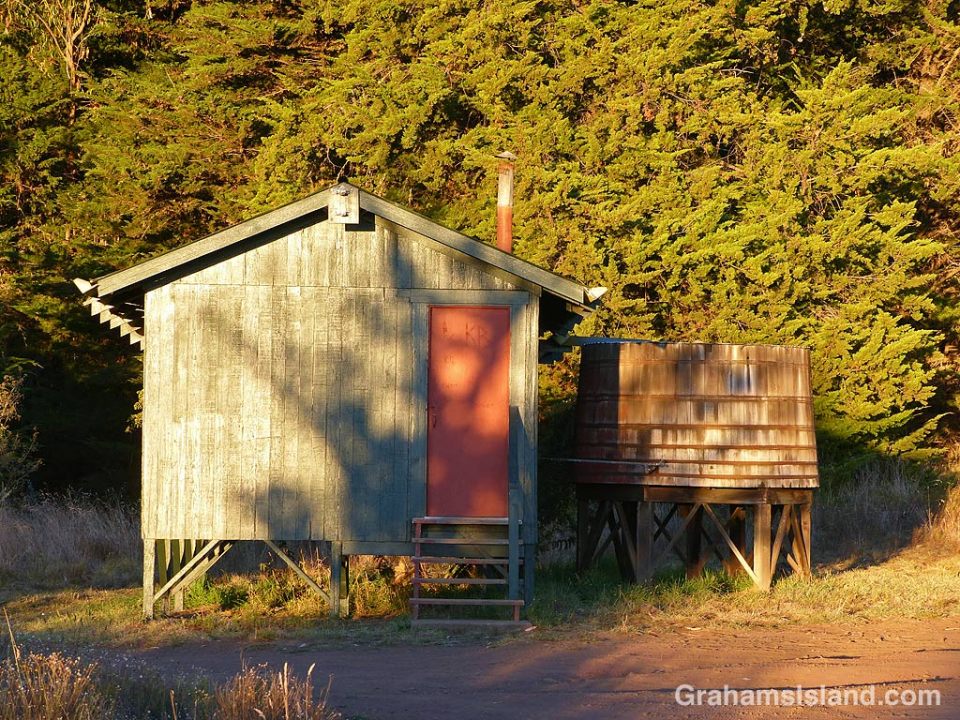
One of those photos better taken with a telephoto lens, perhaps. This is by the old Civilian Conservation Corps Cabin near the Palila Forest Discovery Trail on the slopes of Mauna Kea.
For more information about Palila Forest Discovery Trail, go to dlnr.hawaii.gov/restoremaunakea/palila-forest-discovery-trail/.

The sun sets behind Hualali, as seen from the lower slopes of Mauna Kea.
Posted in response to this week’s WordPress Photo Challenge, ‘Rise/set.’

Sunrise casts soft light on Mauna Kea and the town of Waimea, as seen from Kohala Mountain Road.
Posted in response to this week’s WordPress Photo Challenge, ‘Rise/set.’

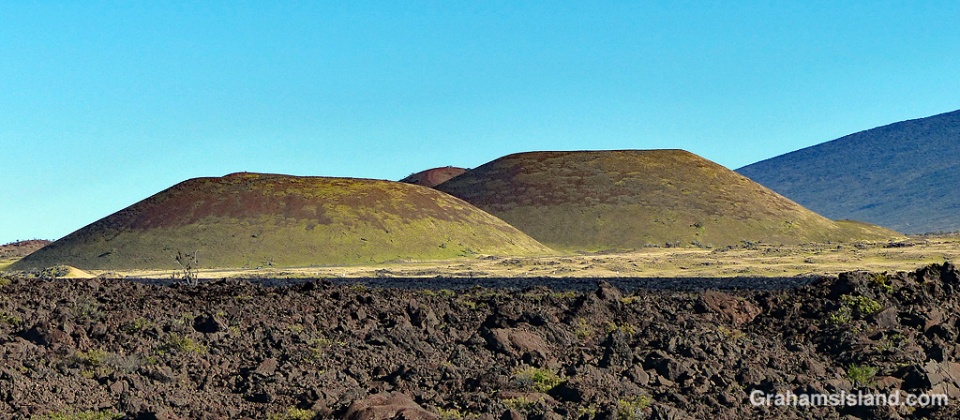
One of my favorite places on the Big Island is Mauna Kea. Besides being an imposing volcano, it also has a surreal quality with its mix of smaller volcanic cones and high tech telescopes around the summit.
This view is from Pu’u Kalepeamoa, otherwise known as Sunset Hill. Pu’u Kalepeamoa is lower on the mountain, at about 9,400 feet, a short hike from the visitor center. On this day, those low-hanging clouds ruled out a good sunset, but the light and shadows on the pu’us still made for a worthwhile view.
Posted in response to the WordPress photo challenge, ‘Favorite place’.

I haven’t ever been a real birder, but since moving to Hawaii I’ve been more drawn to them. Because of this interest, one of my favorite places to visit on the Big Island is the Palila Forest Discovery Trail. Opened in July, 2016, this one mile loop trail passes through Mauna Kea’s unique, high-elevation dry forest.
The endangered palila (top two photos, eating a mamane seed), which I posted about previously here, is the signature bird to be seen there, but there are many other kinds of birds, both native and introduced, in the area. In addition, the trail has a good variety of other wildlife from bugs to wild pigs. To top it off, the views towards Mauna Loa (below) and Maui are wonderful.
Finally, the drive to the trail goes along Old Saddle Road, which is a fun drive and a place where I often see pueos, the native Hawaiian owl, as well as wild turkeys and other birds and wildlife. All in all, a trip I never tire of making.
The Palila Forest Discovery Trail is featured on the Hawaii Island Coast to Coast Trail, a selection of sites that offer birding opportunities on the Big Island. For more information about Hawaii Island Coast to Coast Trail, go to hawaiibirdingtrails.hawaii.gov/.
For more information about Palila Forest Discovery Trail, go to dlnr.hawaii.gov/restoremaunakea/palila-forest-discovery-trail/.
Posted in response to the WordPress photo challenge, ‘Favorite place’.