Tag Archives: Sunday Stills

Barbecue

This week’s Sunday Stills challenge theme is ‘Taste.’ See more responses here.

In Hawaii, cooking outdoors is an everyday affair. Some houses have their kitchens outside. Others, with kitchens inside, have a secondary setup on the lanai (deck) for outdoor cooking. And of course when we’re talking outdoor cooking, we’re talking barbecue. Most days, when I’m out and about, I’ll catch a scent on the air and think, ‘Oh, someone’s cooking something good.’

This photo was from a simple lunchtime barbecue and, yes, it did taste good.

Two geckos

These two gold dust day geckos share the same expression as they gaze up at the interloper looking down at them. It’s not unusual for plants to harbor several geckos. Sometimes this results in turf wars, but mostly they seem to tolerate each other, once the pecking order has been established.

Posted in response to this week’s Sunday Stills challenge on the theme of ‘Creatures and Critters.’ See more responses here.
Pu’u Wa’awa’a views

This week’s Sunday Stills challenge theme is ‘Great Outdoors.’ (See more responses here.) When I think of the great outdoors, I think of hiking, and one of my favorite hikes on the Big Island is up Pu’u Wa’awa’a. It’s an 8-mile round trip and tops out at just under 4,000 feet. On a good day, the hike offers great views, not only from the top, but also on the way up and down. And there are several benches where a person can rest and take in those views, including a couple on the summit.

The top photo shows the view north from around 3,500-feet elevation, with Tamaki Coral in the foreground and Kohala Mountain in the background. The bottom photo is a view from 100 feet or so below the summit looking east toward Mauna Kea.

The hike can also include many native trees and plants as well as a variety of wildlife. There are domestic sheep, cattle, and horses, as well as wild pigs and goats. When the trees are in bloom, they’re rich with insects and birds including several native varieties.

To top it off, most of the times I’ve visited, usually in the early morning, I’ve had the place to myself.

For more information about Pu’u Wa’awa’a and its trails, go to puuwaawaa.org.

Black-crowned night heron

This week’s Sunday Stills challenge theme is ‘Stillness.’ (See more offerings here.) It made me think of this scene.

I was out early one morning and stopped by the port at Kawaihae. There wasn’t much going on, but I was happy to see this adult black-crowned night heron perched on a rock in the shallows. It didn’t seem to be actively fishing.

Indeed, the heron remained mostly still. It was just dark enough for the lights of the port to illuminate the rippled waters inside the harbor. The port itself was also quiet. No boats moving, no trucks lining up, no machinery grinding. Just a couple of men fishing off the small boat dock.

Kilauea Iki Trail

This week’s Sunday Stills challenge theme is ‘Paths.’ (See more offerings here.)

Kilauea Iki Trail is one of the more popular trails in Hawaii Volcanoes National Park. But last year’s volcanic activity, with numerous earthquakes, resulted in the park being closed for several months. Even after it reopened in September 2018, many parts of the park remained closed because the areas were too unstable to be opened to the public.

The Kilauea Iki Trail was one of those areas along with Thurston Lava Tube and Jaggar Museum. The latter two locations are still closed and Jagger Museum may never be reopened, but the Kilauea Iki Trail is currently listed as mostly open. Given that this is a loop trail, it would be wise to check ahead and find out what ‘mostly open’ means.

These photos were taken during a hike I took a couple of years back. The top photo shows the view from the part of the trail that follows the rim of the crater before it descends to the crater floor. The second photo shows two hikers heading out across the crater floor. The dark hill in the background is Pu‘u Pua‘i where a 1959 eruption poured lava out into the crater. The third photo shows hikers near the center of the crater where the path winds through broken areas of the crater floor. Below, cairns mark the trail across a flat area of the crater that leads to the switchback trail which takes hikers back up to the crater rim.

For more information about Hawaii Volcanoes National Park, go to nps.gov/havo/.

One-eyed pueo

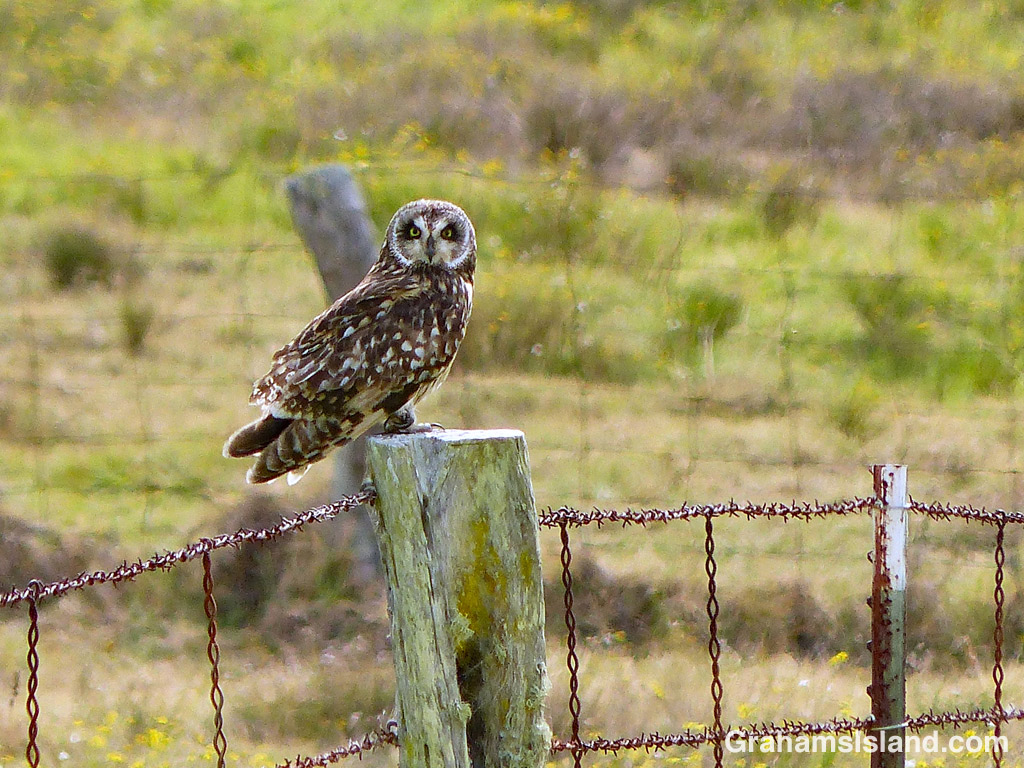
I saw this pueo (Hawaiian short-eared owl) near Waimea and pulled over to take photos. I watched and photographed it for 15 minutes or so and, at the time, I thought there was something unusual about it. Something didn’t seem quite right. But it wasn’t until I got home and looked at the photos that I realized what was up.

The pueo was missing its left eye. The eye socket seemed healed and the pueo didn’t appear to be in pain. Nor did it seem affected in its flying or behavior. In some ways this makes sense. Owls have great eyesight, but it’s their hearing that is truly extraordinary. They can pinpoint prey just by listening. However, in Hawaii, pueos are active during the day so one would think eyesight might be a more important sense than for nocturnal owls.

Either way, I felt a bit sad for the pueo, but I’m also keenly aware that nature isn’t all warm and fuzzy. And I’ve seen several creatures that have been significantly damaged in one way or another that seem to be doing fine despite their handicaps. Perhaps, from a Darwinian point of view, they’re not successful when it comes to finding a mate and breeding, so their genes are not passed on. I don’t know whether this is the case, but it’s certainly possible.

Regardless, I hope for the best for this pueo. Life for them is tough enough as it is without added challenges.

Posted in response to this week’s Sunday Stills challenge on the theme of ‘Unusual.’ (See more offerings here.)