
A view from the window during a recent downpour.

A view from the window during a recent downpour.
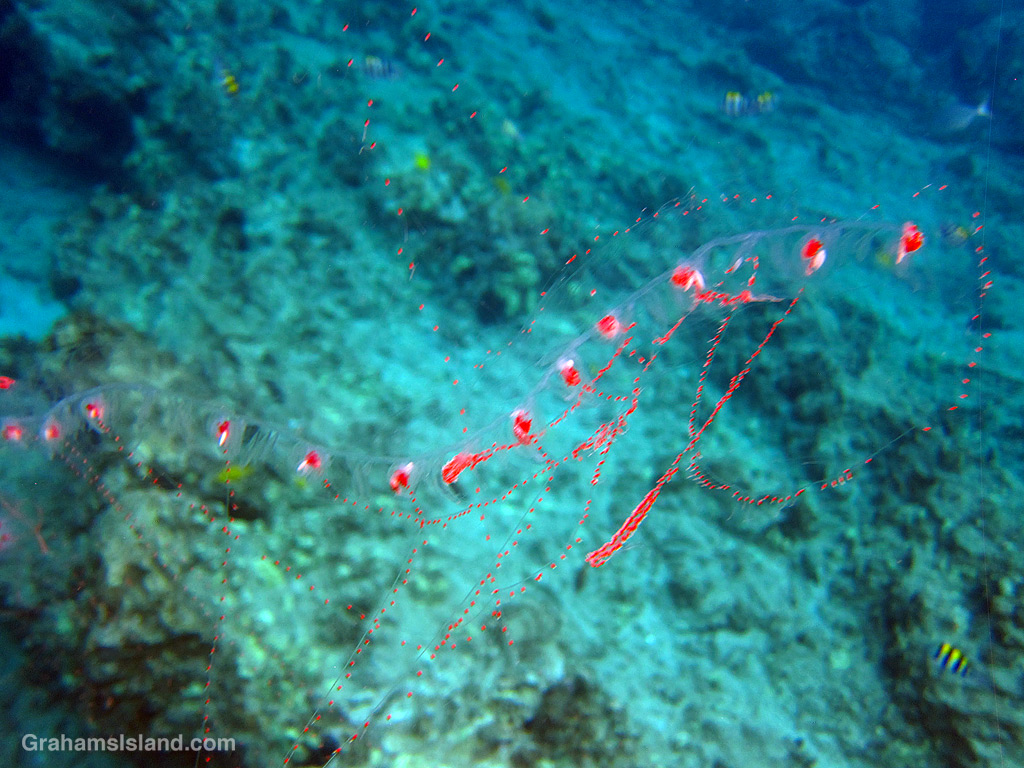
I was snorkeling recently when I saw this strange tubular stringy thing. That’s not a scientific term. My first thought was that it was a Chained Salp, a tunicate that is a colony of individual Salps. But this one seemed a bit different. There was the main tube, but also thinner strings hanging off it.
I started taking photos, which was a bit of a trick in the lumpy swell. I wasn’t worried about getting too close since Chained Salps are harmless. I wasn’t worried until I got too close and realized I’d been stung on the hand by some those tendrils! That was enough for me and I headed to shore.
Back at the house, I couldn’t identify it in my book so I emailed a fellow snorkeler who is well-versed in these sort of things. She had encountered these before and identified it as a Siphonophore (Thanks, Wendy.). Like the Chained Salp, this is a colony of individuals, but unlike the harmless salps, siphonophores have stinging tentacles which they use to catch prey.
Possibly the best known Siphonophore is the Portugese Man-Of-War, one of which had stung a fellow snorkeler just a few days earlier. His wounds were very painful, but I got off easily, with just red welts and a mild burning sensation for a couple of hours.


A paddleboarder heads back to the shore on a gray, but not too windy morning recently. That’s a slice of Maui in the background.
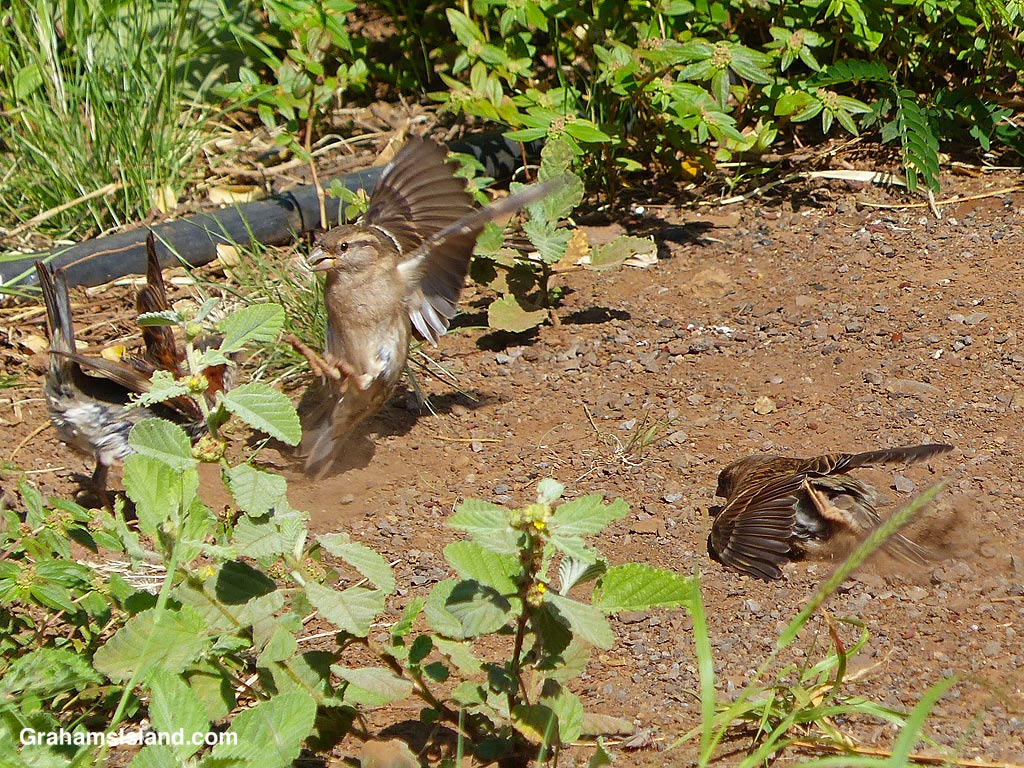


These House Sparrows enthusiastically embraced a dust bath. They’d just hopped over from a wash in a puddle, which they shared with a couple of African Silverbills. Even there, they got engaged in a tussle, all in good fun I expect.


I saw this Southern Green Stink Bug nymph (Nezara viridula) climbing up a door and, since it was something I hadn’t seen before, I was keen to get a photo. With its distinctive markings, it was fairly easy to identify.
The bugs were first seen in Hawaii in 1961 and are considered something of pest.

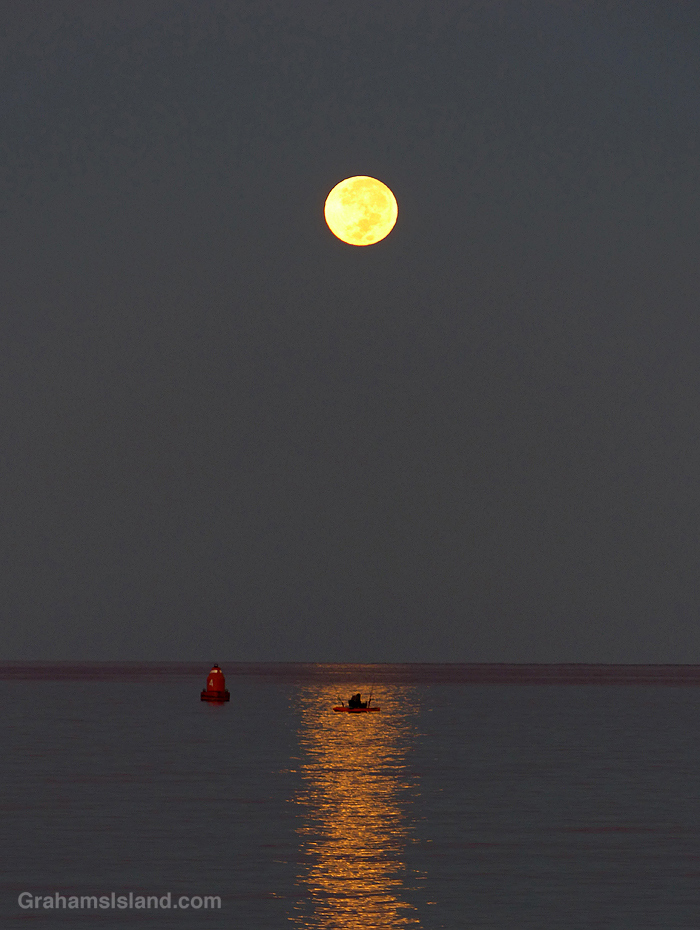
This week’s Sunday Stills challenge theme is ‘Out of this World.’ See more responses here.
Having managed to miss all the recent big astronomical events, such as the green comet and the conjunction of Jupiter and Venus, I’ve dipped into my archive for a few other worldly photos.
The first two are of the moon, first rising, then setting. The third is a view of the night sky with distant stars peeping through a typically cloudy North Kohala night.


The boat hoist at Mahukona has featured in a few of my posts, most notably here and here. Over the years, it’s taken a lot of punishment and that has finally caught up with it. When I went for a swim a couple of weeks ago, this was all that remained of it. I rather liked the jaunty hat on the piece at the left. When I went down there again a few days ago, the last of the metal had gone.
I’ve heard it might be replaced, but the wharf would probably need fixing first. Next door at the beach park – though there is no beach – the old pavilion is cordoned off awaiting demolition and replacement. That process started several years ago and the old building is still standing. Everything will happen in its own good Hawaii time!


A pair of Fourspot Butterflyfishes disturbed a pair of Arc-eye Hawkfishes perched in a head of Cauliflower Coral, as they often do. The coral head is doing OK, but areas of it have died off, probably during one of the coral bleaching events that have happened in the past few years, where the water gets too warm.
I can get chilly fairly easily when I go swimming, but for me, it’s more distressing when the water feels oddly warm because I know this is bad news for the corals.

