This fiery skipper butterfly was feeding on top of a cluster of tree heliotrope flowers, some open, some about to bloom. It was one of a host of insects buzzing around the tree.
Posted in response to Becky’s April Squares challenge theme of ‘Top.’ See more responses here.
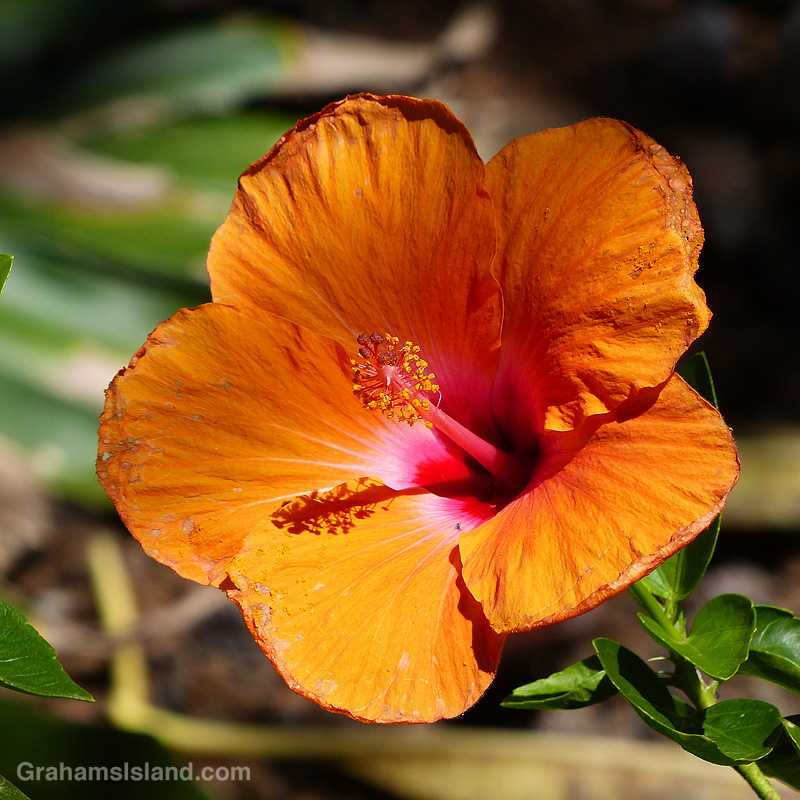
I noticed this orange hibiscus catching the sunlight and returned to it a few minutes later with my camera. But, close up, I saw that it was past the top of its bloom and starting to fade. Still pretty though.
Posted in response to Becky’s April Squares challenge theme of ‘Top.’ See more responses here.
Calathea roseopicta is a native of Brazil, notable for its large leaves that have conspicuous markings, and are various shades of green on top and dark red underneath.
Posted in response to Becky’s April Squares challenge theme of ‘Top.’ See more responses here.
This is the third and final part of a three-part description of a hike along the Puna Coast Trail in Hawaii Volcanoes National Park (See part 1 here, part 2 here).
The last part of the trail before ʻĀpua Point crosses over the only stretch of ʻaʻā lava on the trail which, as can be seen in the second photo, is markedly more rough and jagged than pahoehoe lava. This ʻaʻā is part of a 1969 flow from the same eruption at Mana Ulu that produced the pahoehoe lava that most of the trail passes over. The Mauna Ulu eruption lasted from 1969 to 1974.
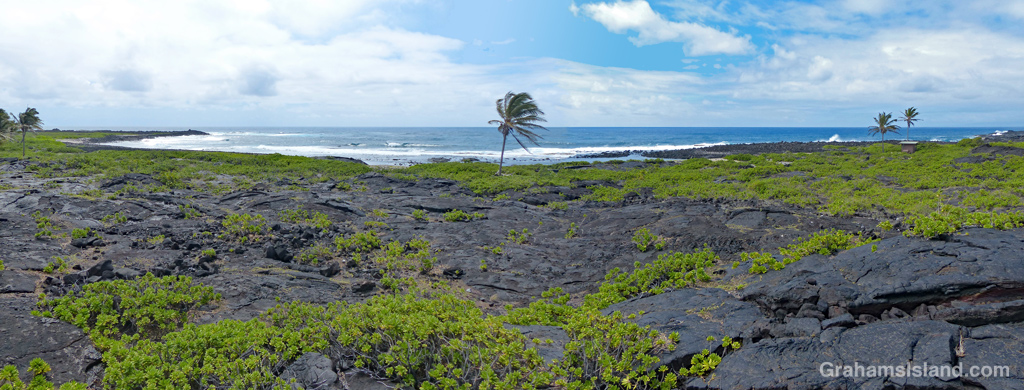
ʻĀpua Point is like a little oasis in a bleak landscape. Flows from the Mauna Ulu eruption reached the ocean on either side of the point, but the point itself was spared. The top photo is a panoramic view of the coast, stitched together (not well) from two photos, to show the view from ʻĀpua Point’s outhouse – actually a composting toilet. This toilet also represents the sum total of the facilities for anyone thinking of camping there.
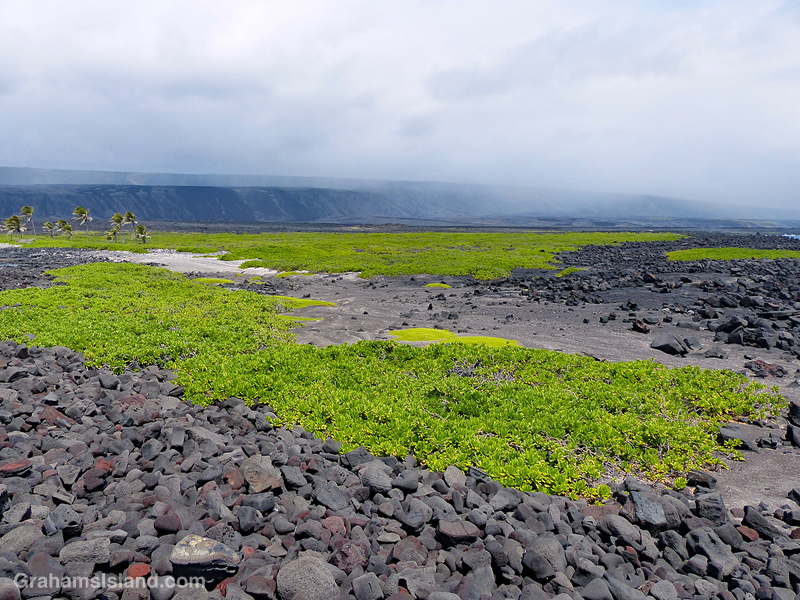
ʻĀpua Point itself is a rocky coastline jutting into the ocean. But behind this wall of rock, a sandier area hosts fields of naupaka, sea purslane, and other plant life, as seen in the third photo. Also in the background of this photo, a passing shower runs along Hōlei Pali. As I mentioned in part one of this description, the trail can be hot, wet, and windy, but for my hike, I saw moderate breezes, some overcast skies, and just a few spritzing showers.
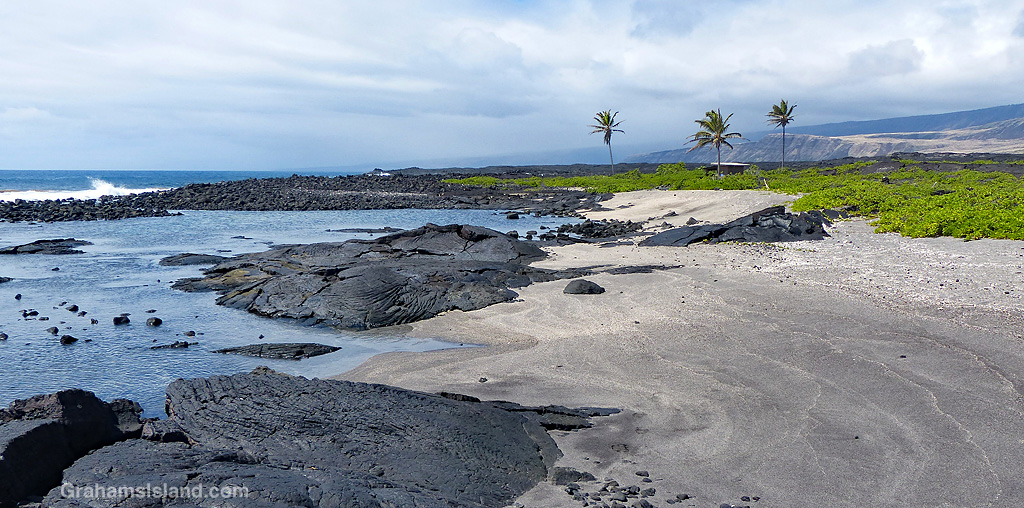
Swimming in the ocean along this coast is very dangerous because of high surf and strong currents. But at ʻĀpua Point there are shallow pools, suitable for soaking, that are protected from the surf by a border of rocks. There are also a few small sandy beaches such as the ones in the photo below.
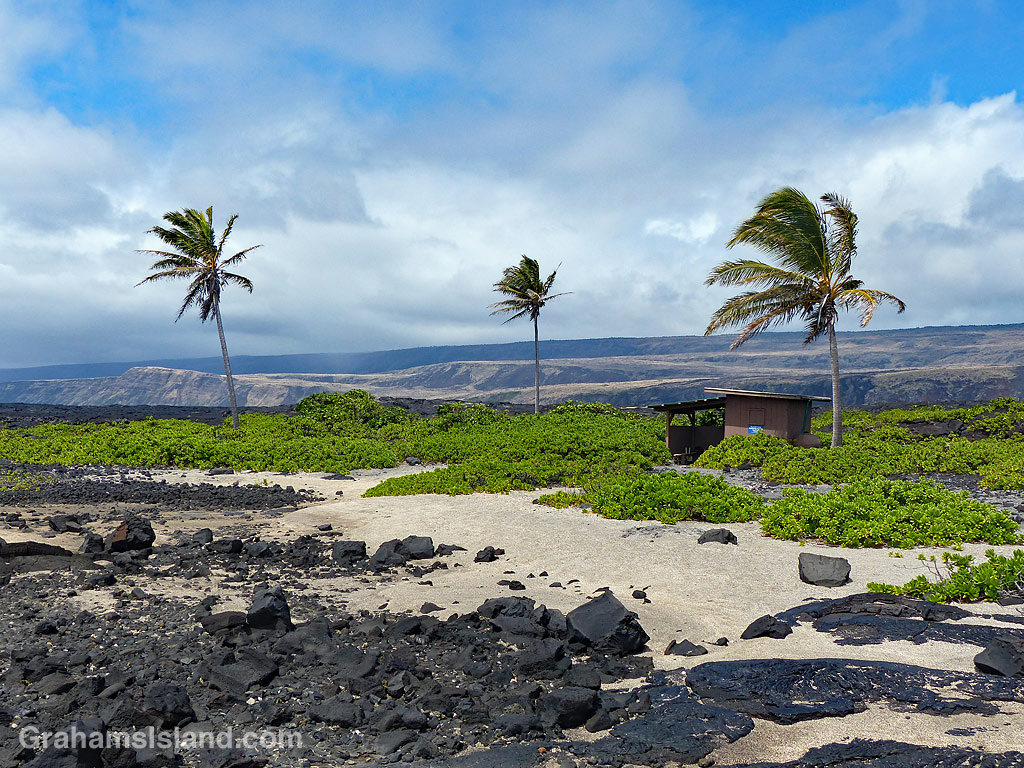
Besides the composting toilet, there is one other structure on ʻĀpua Point. It’s a small shed with an open covered area beside it, surrounded by naupaka and a few palm trees. This covered area represents pretty much the only shade to be found on the entire hike. The shed is used by the Hawksbill Sea Turtle Recovery Project, which monitors and protects endangered hawksbill turtles which use this area for nesting. I believe the nesting season runs from May to September, so I might have to return sometime after that.
And speaking of returning, from here it was time to turn around and hike the 6.6 miles back to the car. The hike took me about 3 hours each way with, of course, numerous stops for photography and just to enjoy the views.