Until I moved to Hawaii, I was not aware that lobsters molt. I only learned this when a local diver presented my wife with a lobster molt he’d recovered.
I’d seen live lobsters here, scuttling around on the sea floor, and others looking like the one in the photo. This one was moving, but only because of the action of the water on it. I used to think these were either dead or resting lobsters. In part this was because adult lobsters, which molt once or twice a year, discard a remarkably complete exoskeleton. It then takes them a few weeks for their new exoskeleton to fully harden.
This is probably a molt from a banded spiny lobster. True lobsters and their relatives have enlarged pincers on their front pair of legs. Spiny lobsters (family Palinuridae) are among the lobster varieties that don’t have those enlarged pincers.
This week’s Sunday Stills challenge theme is ‘Danger.’ (See more offerings here.) It seemed a suitable opportunity to post some photos reviewing on Kilauea Volcano’s last eruption, which began in May of last year.
The bottom photo, taken from the Jaggar Museum overlook, shows the scene on the morning of April 25, 2018. Lava in the active vent in Halema’uma’u Crater, at Kilauea’s summit, was just below the crater floor and had been overflowing into the crater in previous days. The overflow is the large dark area to the right of the glowing lava.
By early May, the lava level in the vent had dropped around 1,000 feet. This drop occurred at the same time that lava disappeared from Pu’u O’o vent. Not long afterwards, cracks opened in the ground at Leilani Estates, a housing subdivision in the southeastern part of the island. By the end of May, 24 fissures had opened in the area. The most prolific lava flow emanated from Fissure 8, which flowed to the ocean and created more than 800 acres of new land. However, more than 700 homes were destroyed by this eruption.
Meanwhile, back at the summit, the absence of lava in the vent in Halema’uma’u Crater resulted in a series of collapses of the crater floor. Each collapse triggered earthquakes and shot clouds of ash and toxic gas thousands of feet into the air.
The top photo shows Halema’uma’u Crater as it looks today. The crater is twice the size it was the year before and the floor, which was mostly flat, is now a huge cascading pit. In the upper left of the photo, the Jaggar Museum, where I stood to take the bottom photo, can just be seen. It was heavily damaged by the earthquakes, as were the parking lot and access road. It’s also much closer to the crater edge than it was. (Technically the crater edge is closer to it, since the museum hasn’t moved!)
The museum, along with the rest of the park, closed in May 2018, because of the eruption. While much of the rest of the park reopened in September, Jaggar Museum did not. There’s a good possibility it never will and that its fate will be the same as the portion of Crater Rim Drive in the middle photo. A significant length of that road, which used to encircle the whole summit caldera, was destroyed, including the section in the photo which slid, intact, into the crater.
Things have settled down since September 2018 and there has been no volcanic activity anywhere on the island since then. But Kilauea remains an active volcano and will undoubtedly erupt again. It’s just that no one knows exactly when or where that will happen.
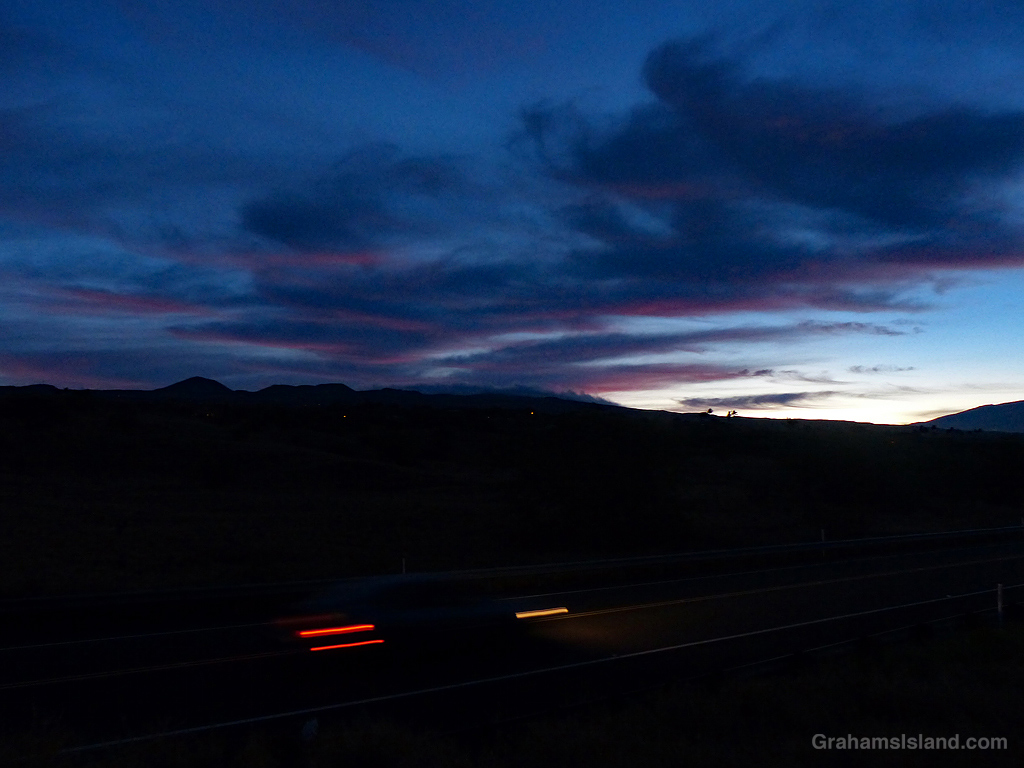
This week’s Friendly Friday challenge theme is ‘Illumination.’ (See more responses here.) I plumped for this image for the early morning light and for the two house lights, nicely positioned above the illumination of the passing car’s lights, as though they are somehow all connected.
I think this is a white-faced ibis. According to my bird book, Jim Denny’s A Photographic Guide To The Birds Of Hawai’i, it is an occasional visitor and all reports have been of juveniles or birds in non-breeding plumage. It also notes that it is very similar to the glossy ibis, but doesn’t include a listing for that bird in the book. So I’m going to stick with the white-faced ibis identity unless someone has a better idea.
This one was wading in the shallow of the lagoon behind the beach at Kaloko-Honokohau National Historical Park. The yellow float was one of several isolating an area where restoration work was taking place. The lagoon is a popular spot for many birds, both endemic and visiting.
An ongoing problem, both here in Hawaii and in all the oceans of the world, is marine debris. There are floating garbage patches of such a size that nations will surely soon be fighting over whose territory they are. There’s debris washed up onto beaches that is both unsightly and dangerous. And then there’s discarded or lost items that are a danger to marine creatures everywhere.
Sadly, I saw one such example recently. I hadn’t seen an eagle ray in a while, so I was excited to see this one. But it’s progress seemed a bit odd and I quickly realized that it was, unwillingly, towing some kind of marine debris. It looked like an old net or something similar, on the end of a loop of line that had become hooked over the beak of the ray.
In the top photo, the clump of debris can be seen on the right, above the black triggerfish swimming in the opposite direction. The loop of line can also be seen. In the second photo, the line can be seen looped over the bill of the ray. I shared this photo with several people, alerting them to the situation, and some thought the line was caught in the ray’s mouth, but I don’t think that’s the case, though it has clearly dug a furrow into the face of the ray.
While I spread the word about this, there’s not a lot that can be done. I didn’t see the ray again and, to my knowledge, no one else has either. Even if they do, the chances of being able to approach the ray and free the line are slim. The debris is probably part of some fishing gear, which is lost in great abundance around here.
Hopefully, the ray will find some way to dislodge its unwanted haul, but while that could happen, it’s also possible that the ray is stuck with its burden. And, in the end, that might tip the balance in its chances of survival.
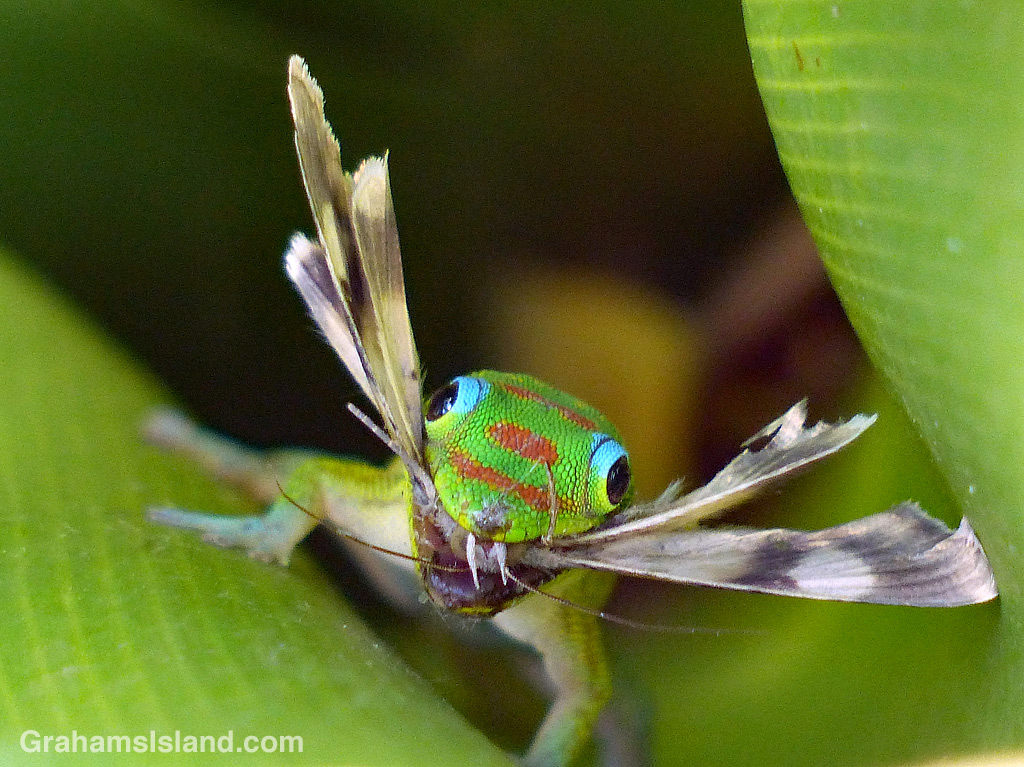
I peered down into a spider lily one day and this is what I saw looking up at me, a gecko with wings. The wings, of course, were those of an unlucky moth, which the gold dust day gecko had snagged from behind. The moth struggled a good deal, but there was only ever going to be one winner in this contest.
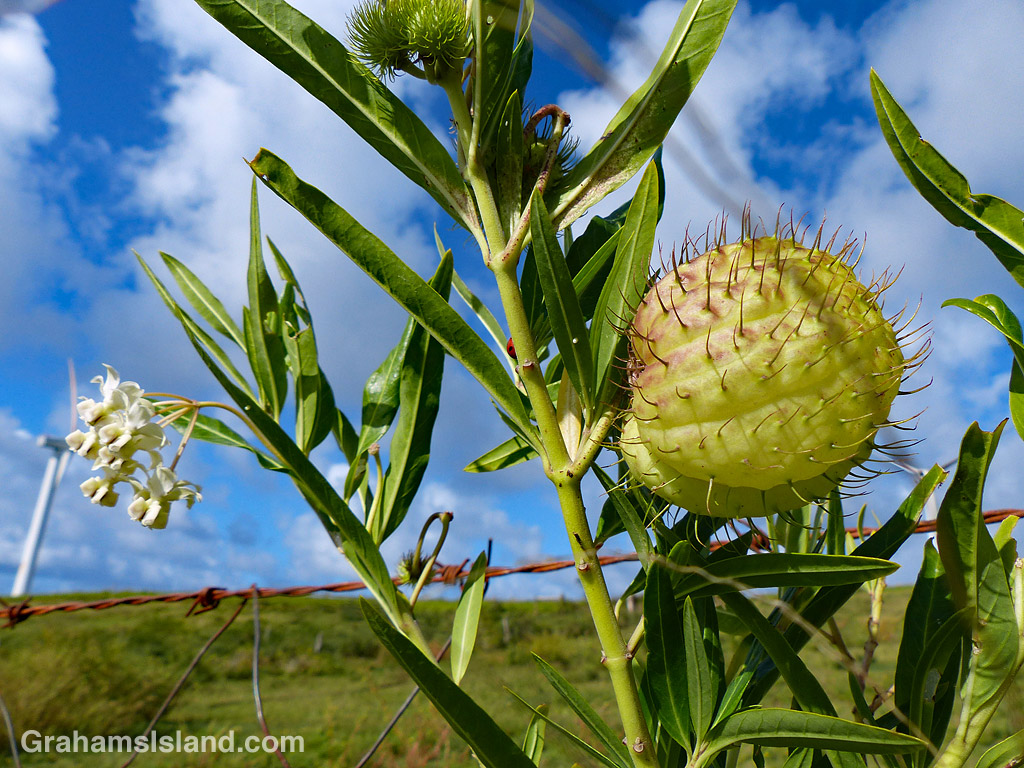
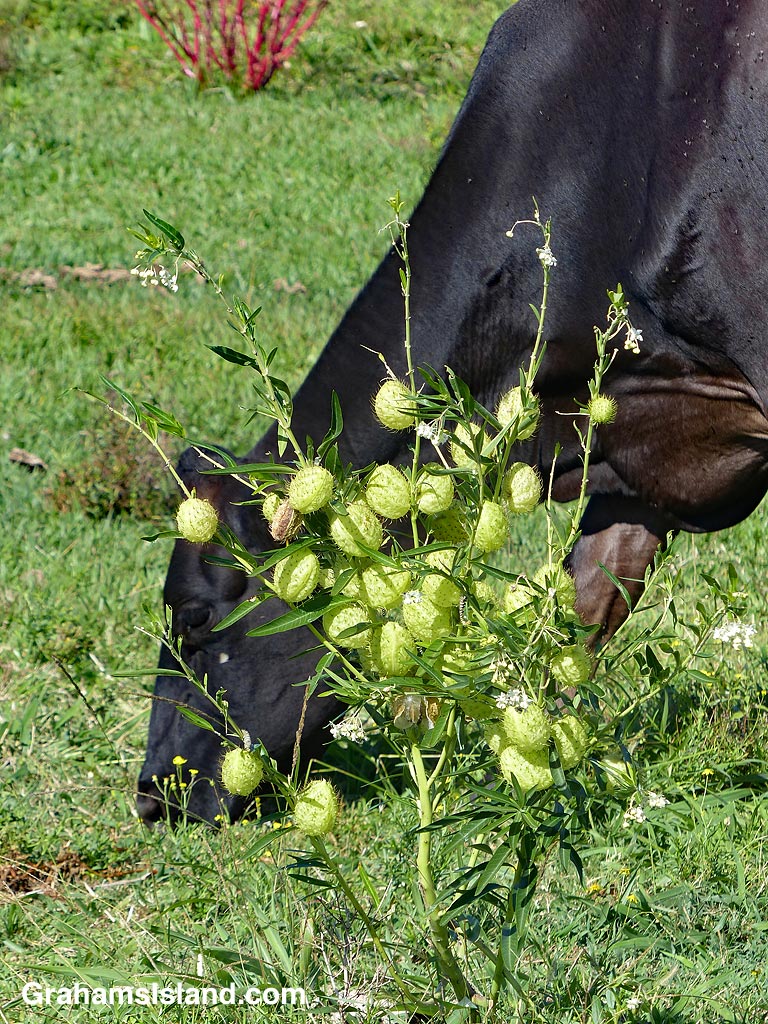
Balloon plant (Asclepias physocarpa) is an invasive weed, introduced to Hawaii as a fiber crop. A member of the milkweed family, it is considered to have medicinal properties, but parts of the plant are also poisonous.
I saw several of these plants in a pasture occupied by livestock and, like the cow in the photo, they were avoiding the plants. Consequently, the pasture consisted of close-cropped grass and a generous sprinkling of these scrubby plants, 2- to 3-feet high, though they can grow to 6-feet tall.
The ‘balloons’ are actually the fruits of the plants. When ripe, they’ll burst and release a multitude of white silky-haired seeds.