These lava flows, on the northeast slopes of Mauna Loa, show some of the colors lava takes. Together with the untouched islands of vegetation and cloud shadows, I think they make an interesting patterned landscape.

These lava flows, on the northeast slopes of Mauna Loa, show some of the colors lava takes. Together with the untouched islands of vegetation and cloud shadows, I think they make an interesting patterned landscape.

Most people think of Hawaii as a tropical paradise so, being something of a contrarian, I feel obligated every now and then to post something about the seamier side of the islands, and I think most would agree that today’s subject falls squarely into that category. Cockroaches are everywhere. Houses, shops, restaurants (eek), even the fanciest resorts have them. If you don’t see them, it’s because they’re out of sight, not because they’re not there.
Supposedly, Hawaii hosts 19 species of cockroach, of which three are most associated with human activity. These are the American cockroach (Periplaneta americana), German cockroach (Blattella germanica), and Surinam cockroach (Pycnoscelus surinamensis).
The beauty in these photos is an American cockroach. This one was around an inch-and-a-half long, not including its extremely long antennae; some are bigger. They’re a fearsome sight in the air, speedy on the ground, and loathsome in a sandwich. But living here, one has to get used to them, because they’re also survivors. Chances are that when humans are long gone, cockroaches will still be around, scampering across the rubble, skittering into semi-destroyed fast-food joints, and snacking on the still fresh-looking chicken nuggets.


A while ago, I posted a photo of an ember parrotfish missing a chunk from its back (here), but able to carry on quite normally.
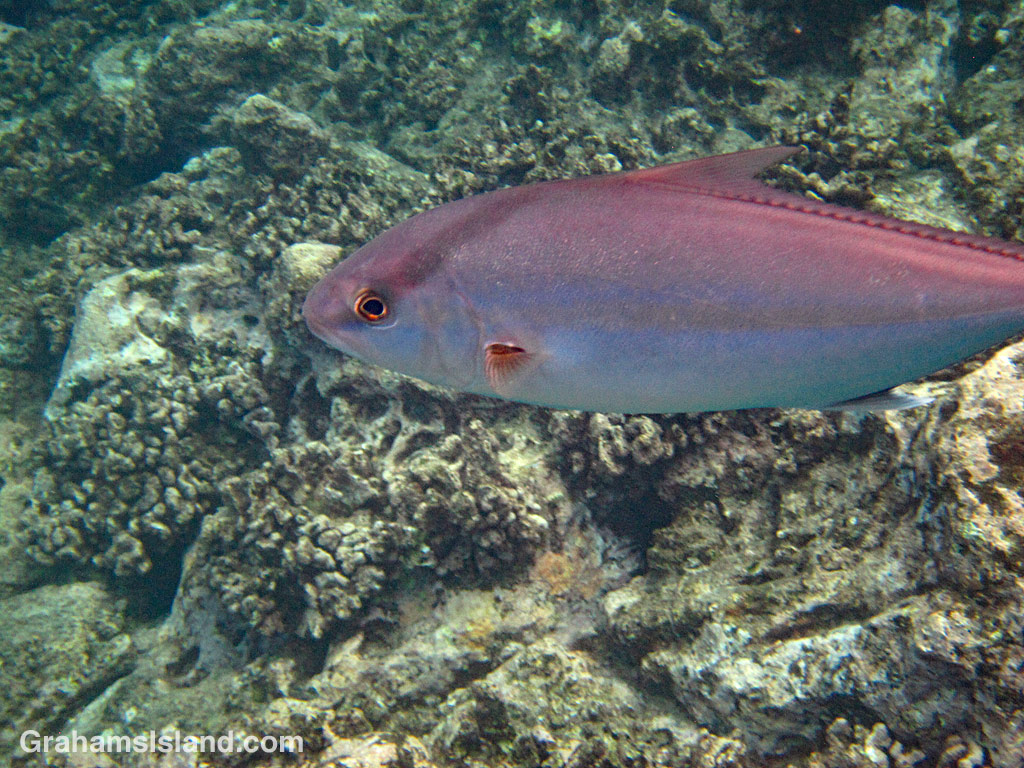
In this photo, a bluespotted cornetfish has had its back end removed, likely by a larger predator. However, it too seemed to be getting around fine, though the tail fin is certainly one that cornetfish use a lot.
The other thing about this photo is that it nicely illustrates why this species is called the bluespotted cornetfish.

I noticed this bee one day, buzzing around this water cooler and then disappearing into the spill tray. Since then, I’ve seen it, or other similar bees, making the same journey to gather water from the tray and then, presumably, head back to the hive. Getting into the tray was the easy bit. Getting out tended to be more of a struggle.

House sparrows made it to Hawaii in the 1870s and are firmly established here. Where I see them most is at restaurants open to the outdoors, a common occurrence here in Hawaii. The sparrows mostly hop about scavenging tidbits from the floor. But sometimes the sparrows are bolder and savvy diners will remain alert during their meal or risk French fries disappearing from their plates.

These yellow walking iris (Trimezia martinicensis) were growing at Hawaii Tropical Botanical Garden, near Hilo.
For more information about Hawaii Tropical Botanical Garden, go to htbg.com.


This week’s Sunday Stills challenge theme is ‘Time.’ (See more responses here.) I had a couple of thoughts about this. The first is that the state of Hawaii is a kind of geologic timepiece. The Hawaiian islands exist because a magma source known as the Hawaii hotspot generates volcanic activity. This creates underwater seamounts that eventually break the surface to form new islands. Such a process is currently taking place with Lōʻihi Seamount, off the southeast coast of the Big Island. It’s about 3,000 feet below the surface but, if it continues its present activity, it will rise above sea level in another 10,000 to 100,000 years.
But if Hawaii is on a volcanic hotspot, why doesn’t it produce one volcano that just gets bigger and bigger? Well, the tectonic plate on which Hawaii sits is in constant motion to the northwest. So the volcanic activity generates an island, but as the plate moves, that island edges away from its creative source and the volcanic activity ceases. What happens then is that the winds and waves begin a long process of erosion until that island is reduced to an atoll and finally disappears below the ocean’s surface. We’re not talking months here. We’re talking millions of years for this process to take place.
Look at a map and you’ll see this chain of Hawaiian Islands stretching away to the northwest, the islands or atolls becoming progressively smaller until they disappear and return to being below-surface seamounts. And while I say this is a slow process, it can also be speedy. In October of this year, Hurricane Walaka ripped through the French Frigate Shoals, part of the northwest Hawaiian chain. Its passage completely removed the second largest island in the group, East Island, from the map. Researchers had been working there before the hurricane struck. After its passage, it was gone (more info here).
So Hawaii is an example of the geologic passage of time. But there’s another aspect of our view of time that is illustrated here. The photos are of Kilauea’s Pu’u O’o vent. Kilauea is one of the planet’s most active volcanoes and the Pu’u O’o vent had been more-or-less continuously active since 1983. Then, in May of this year, the activity in this vent, and in the summit vent at Halema’uma’u Crater, ceased. The magma drained from these places and traveled down the east rift zone of the volcano before emerging in a residential subdivision, Leilani Estates, in the southeast corner of the island. This new eruption produced a lava flow that reached the ocean, destroying more than 700 structures en route, but adding hundreds of acres to the Big Island coastline.
What’s the time aspect of this? Well, it’s part of the geologic time process noted above. But there’s another way of looking at it. Kilauea has been erupting so long and so regularly that it’s been a little bit taken for granted. “Oh, lava’s flowing into the ocean? You know, I’m really busy right now. I’ll catch it later.” “The summit vent is spilling onto Halema’uma’u Crater’s floor? I’ll check that out next time I’m down that way.”
I consider myself fortunate that I got to see the firehose of lava entering the sea after a cliff collapse (here). Next day, following another cliff collapse, it was no longer visible. And in April of this year I went down to see the summit lava lake (here) bubbling up to the crater floor and visible from Jagger Museum. Two weeks later, the level had dropped a thousand feet. It continued to fall.
I might never see these things again in my lifetime, but at the time, there seemed to be lots of time to visit. But even events happening in a long, geologic timeframe might occur in the space of a week, a day, even an hour. It’s a reminder to me that each moment is something fleeting, perhaps something special, something to pay attention to.
These photos are of Pu’u O’o vent in late September of this year. No lava is visible in the vent, but it’s still hot enough that rainfall generates steam, which is what’s visible here. It was quite dramatic to pass over this vent, which for 35 years has pumped lava out onto the surrounding landscape.


This is the ship that brings military troops and supplies from Oahu to Kawaihae Harbor en route to Pōhakuloa Training Area (PTA). I often see the ship going back and forth off the Big Island and had always assumed it to be a Navy vessel because, well, it’s a ship. But no, this is an Army LSV (Landing Ship, Vehicle) where they drop the ramp and roll the vehicles on or off.
These activities coexist with commercial shipping, pleasure craft, and locals enjoying the splendid beach and calm waters of the harbor, where I understand the snorkeling is pretty good. Got to try it out sometime soon.