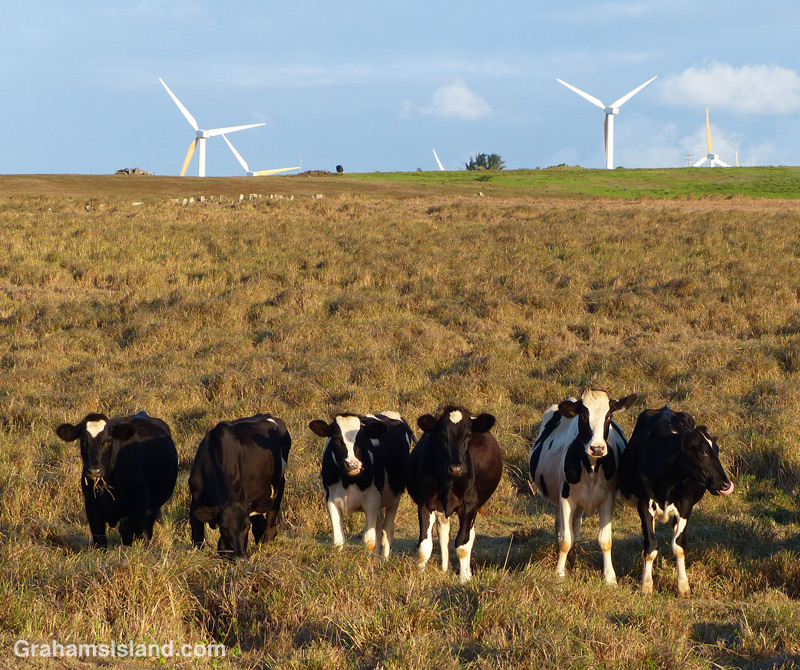
I grew up on a dairy farm so I have a soft spot for cattle (as opposed to some who may have grown up on a dairy farm and have a virulent dislike of cattle).
Sometimes, when I walk by on the dirt road bordering their pasture, the cattle run away. Other times they run towards me. These six lined up and just watched me, which was probably the right response. I’m not that exciting.
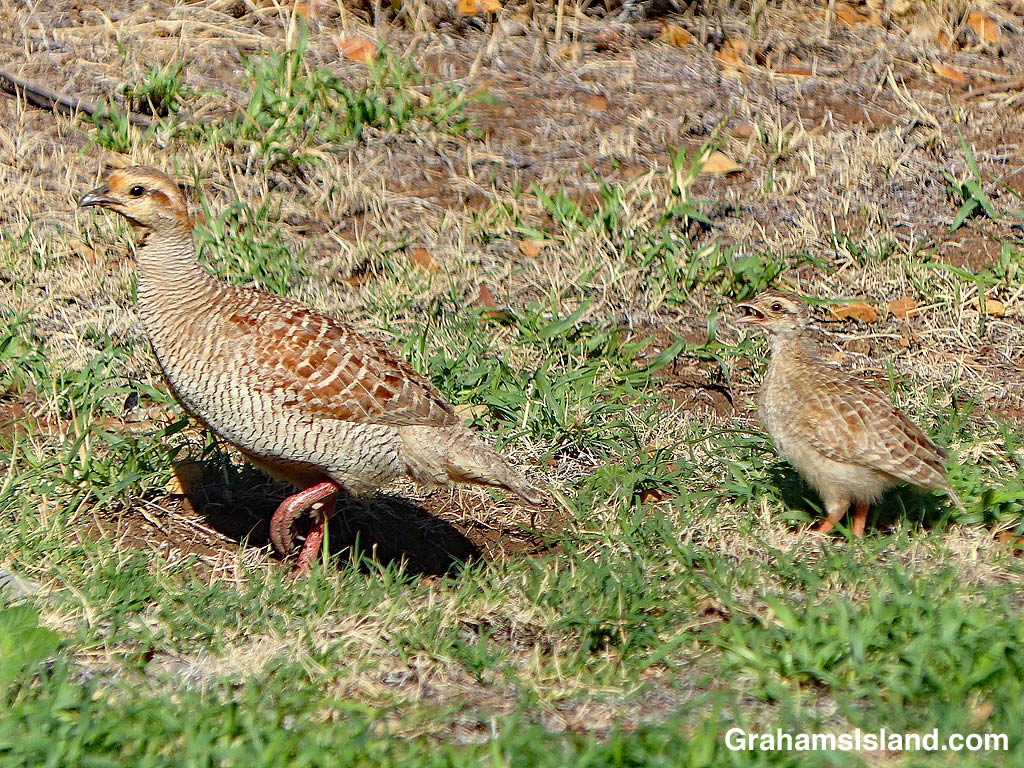
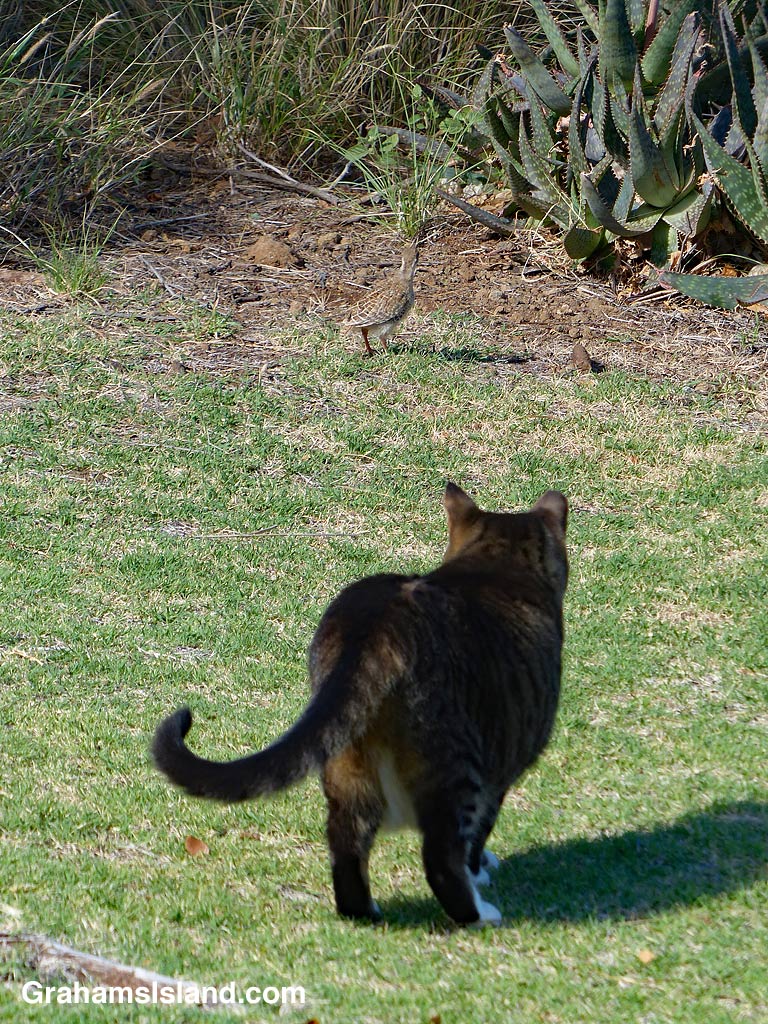
A gray francolin and it’s chick blend in well with the scrubby grassland they inhabit. Life is hard for the chicks of any bird on the island. Mongooses and rats are an ever-present menace as are cats, such as the one on the left, eyeing a potential meal.
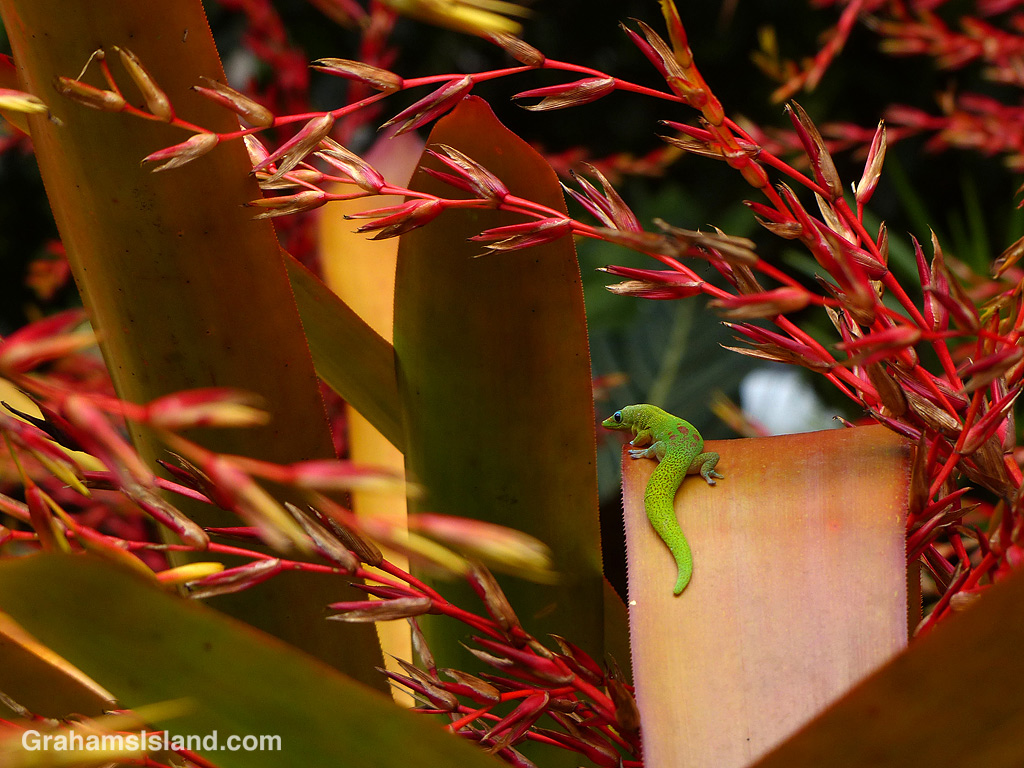
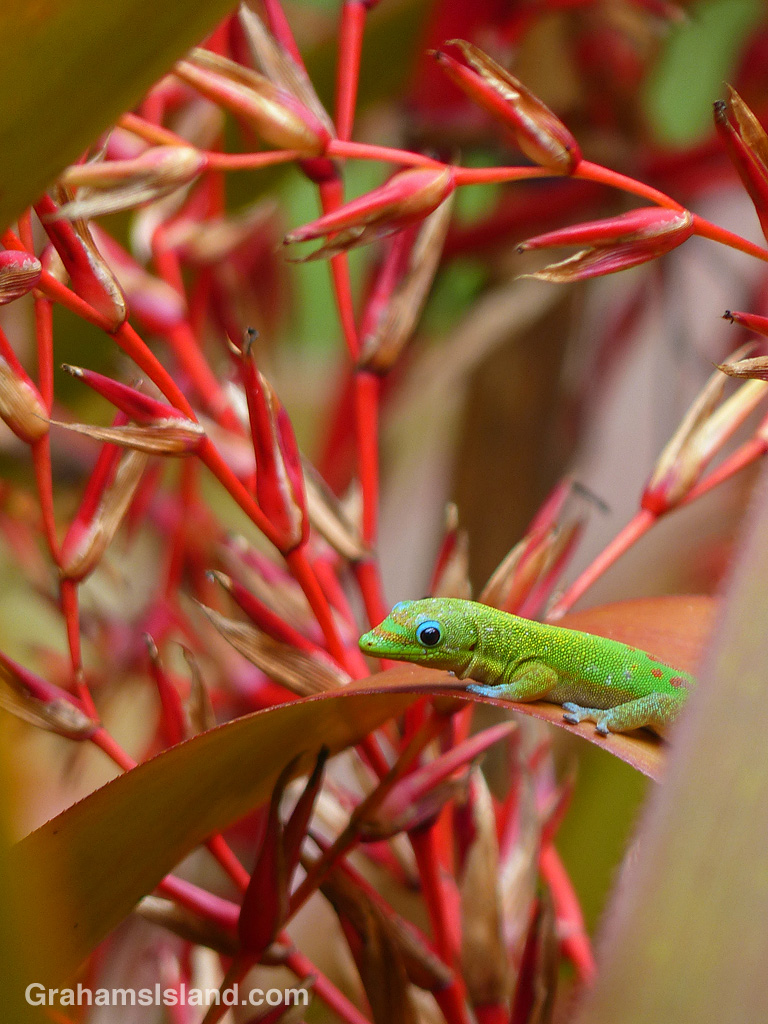
The gecko is a gold dust day gecko, originally from Madagascar, and the bromeliad is aechmea blanchetiana, originally from Brazil. I liked this scene for the strong color contrast.
These were seen at Hawaii Tropical Botanical Garden. For more information about Hawaii Tropical Botanical Garden, go to htbg.com.
A few miles north of Kona Airport is a stretch of highway where these signs can be seen – the written warning in the foreground and a handy image in background for those who don’t know what a donkey looks like. Not that they’re going to find out here. There are no donkeys.
The signs hark back to when there were a number of wild donkeys roaming the island and this was, apparently a place where they crossed the road on a regular basis. But donkeys crossing a major road travelled by many speeding vehicles is not a tale that ends well, for the donkey or the vehicle. So the donkeys were all rounded up and put out to pasture, as it were, in domestic situations. Only the signs remain.
Except … I’ve been told that not all of them were captured. Unaccountable braying has been heard, though no donkeys have been seen, but do you want to take that chance speeding past these signs only to see, too late …
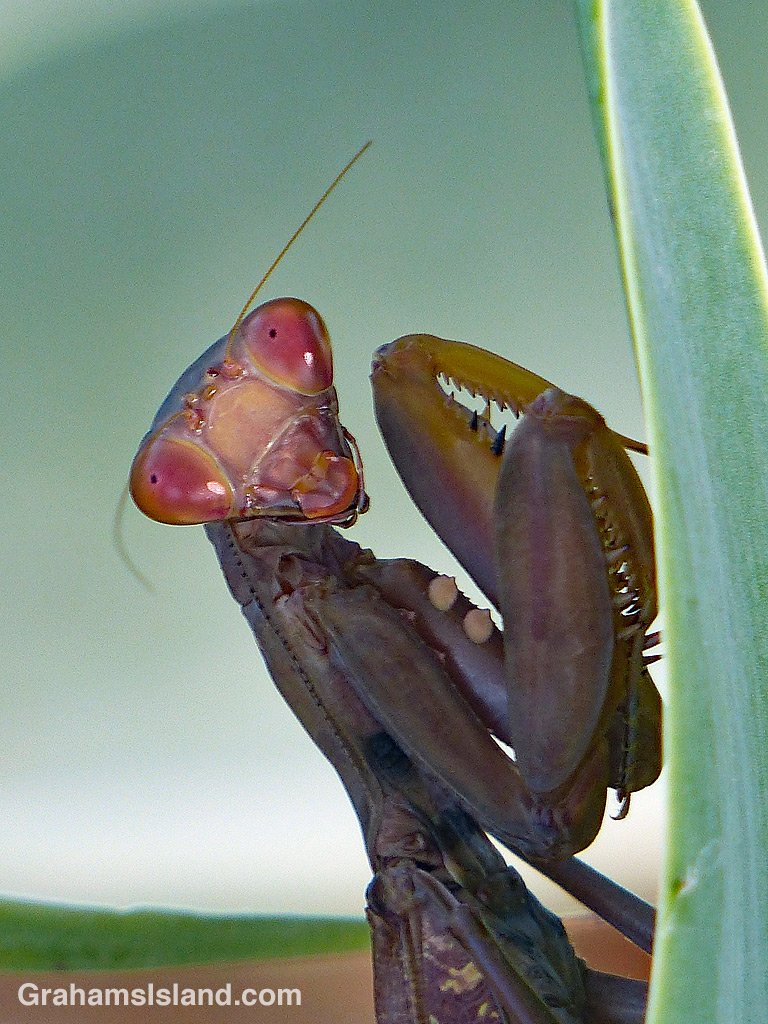
I usually think of praying mantises as just that, but there are more than 2,000 mantis varieties. Ones that are most often seen in Hawaii include Giant Asian mantis (Hierodula patellifera), Carolina mantis (Stagmomantis carolina), and European mantis (Mantis religiosa).
This one is probably a Giant Asian mantis. While I usually see green mantises, they can change color so this reddish one is not that unusual.
Thanks to Hawai’i Insect ID for help with identifying this. For more information about Hawai’i Insect Identification, go to flickr.com/groups/hawaii-insect-id/pool/.
This week’s Friendly Friday challenge theme is ‘Odd Couples.’ See more responses here.
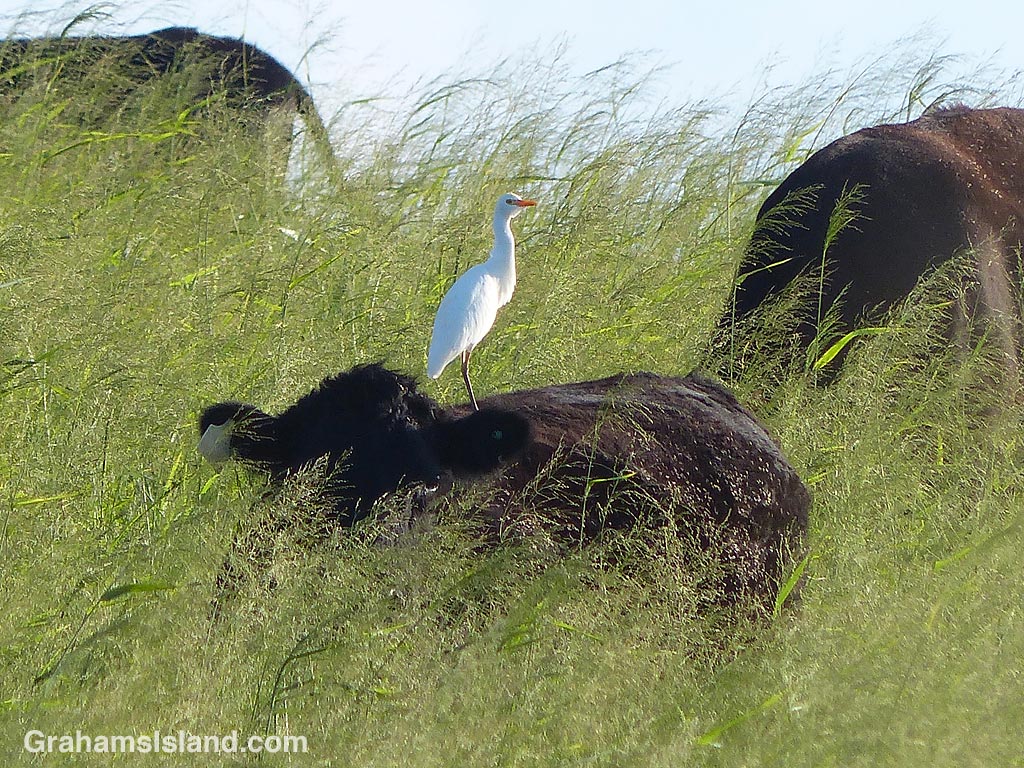
It’s common to see cattle egrets in the company of cattle and yet they still make an odd pairing – the bulky, stolid cow or bull and the slender, flighty cattle egret. The benefits for the cattle egret are clear. They catch insects and other prey disturbed by the grazing cattle (or horse, sheep, goat, etc.). But they also remove flies and ticks from the cattle themselves, which also benefits the cattle.
The cattle also don’t seem to mind being used as a perch. I imagine the egret above giving directions: ‘take a left up ahead buddy.’ The one in the middle is switching allegiances. Below, gotta find someplace with a view when in the tall grasses.
In my seven plus years of living in Hawaii, I’d never encountered a scorpion. Then I saw my first, squashed, in a box I was emptying. Earlier this week I saw my second. It wasn’t dead, but it wasn’t well. I think it had been stepped on, which is why its large, claw-like pedipalps aren’t so prominent in this photo.
This is a lesser brown scorpion (Isometrus maculatus), the only scorpion species in Hawaii. It’s not as dangerous as some scorpions, with a sting similar to bees. It’s also not common, in part because it’s nocturnal and also small. This one was less than two inches long.
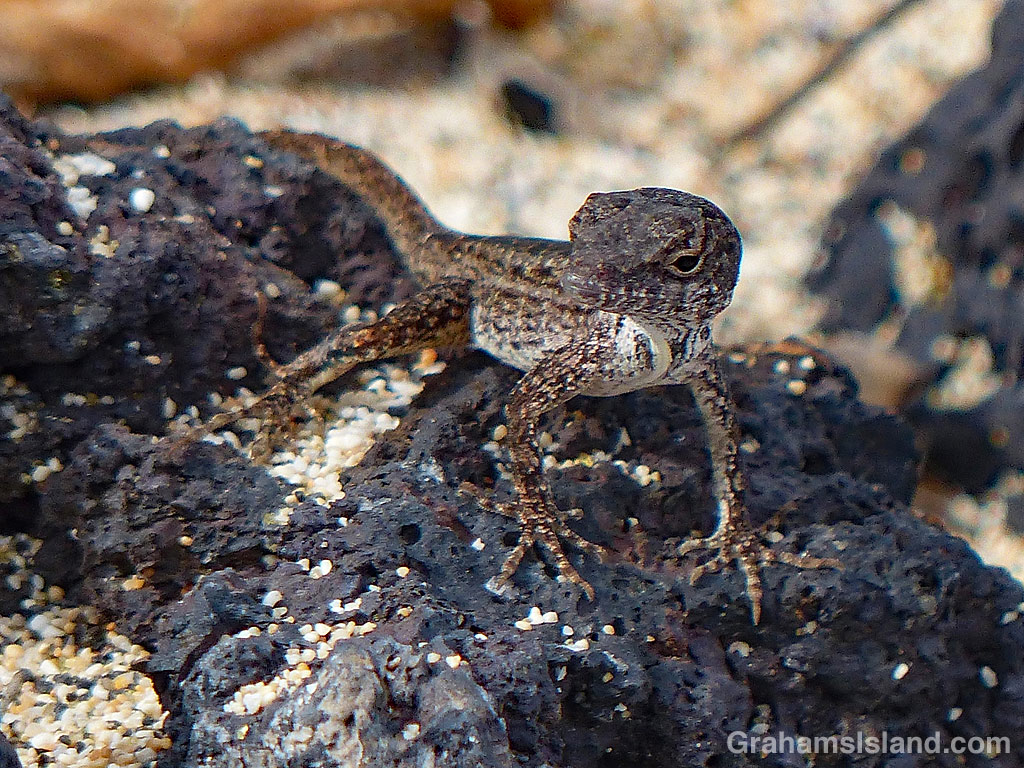
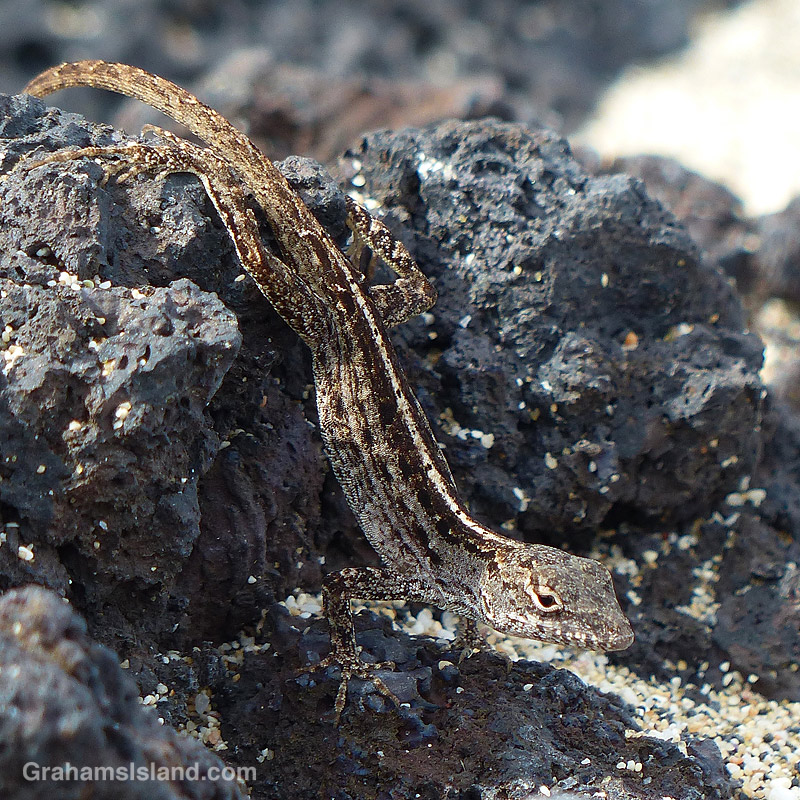
I’ve posted plenty of anole photos on this blog, but they have all been of the green anole or Carolina anole (Anolis carolinensis). Some of these photos have shown an anole that is colored brown, but that’s because the green anole can change color to brown.
It was only recently that I saw my first brown anole (Anolis sagrei), which has a quite different look and different markings to the green anole. Native to Cuba and the Bahamas, it is considered quite invasive and will outcompete green anoles for territory. This one was next to the coast path through Hualalai Resort on the Kona coast.






 Graham's Island