
It’s not a partridge in a pear tree, but I like the lines and patterns that palm fronds make and this little sparrow gives them a bit of scale.

It’s not a partridge in a pear tree, but I like the lines and patterns that palm fronds make and this little sparrow gives them a bit of scale.
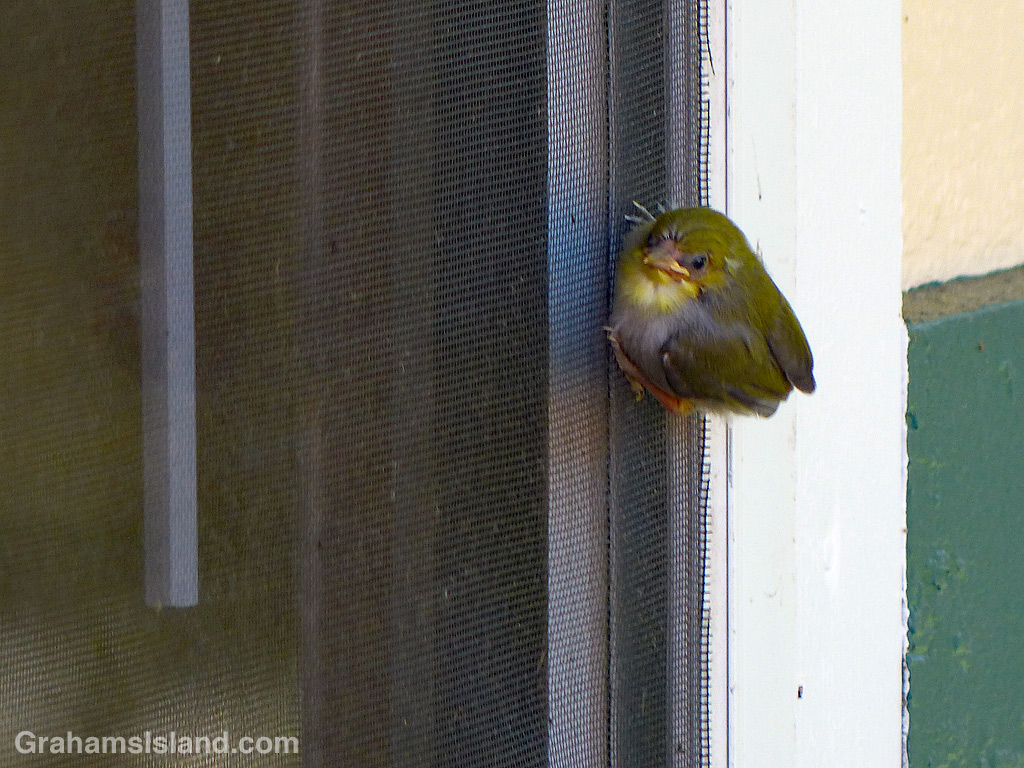
The top photo shows a Japanese white-eye chick clinging to a window screen. This was the first view I had of this bird, but from inside. When I went out to look there was quite a kerfuffle going on. The white-eyes were squawking in the bushes and flitting around.
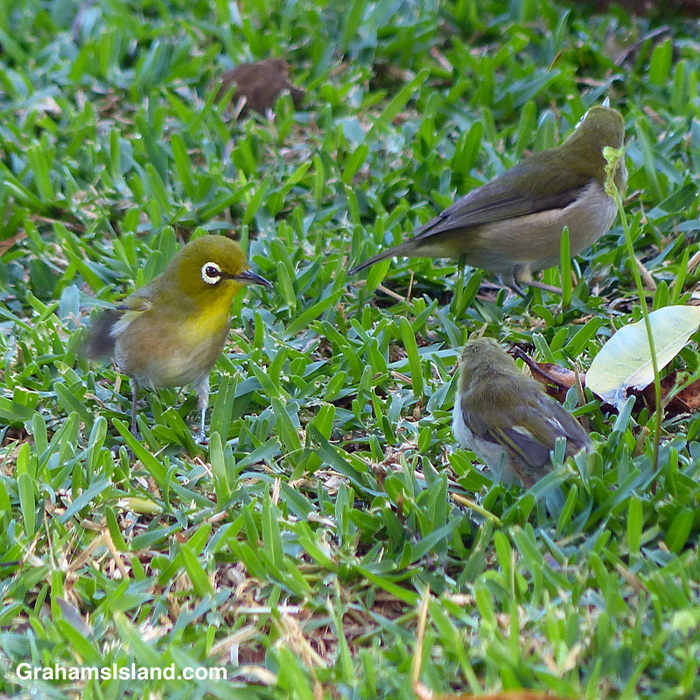
After a while, the chick hopped off the screen onto the grass where the two parents, I presume, flew down to join it (middle photo). The squawking continued. Eventually the chick took to the air again and wobbled over to a nearby hedge where it clunked into the branches and gained a perch. The other white-eyes continued to flit around, making quite a din.
The chick moved a couple more times, tentatively, but must have landed somewhere safe because the hubbub subsided and calm returned to the yard. It must have been old enough to fly, but not yet adept at it so that it could control where the flight might take it.
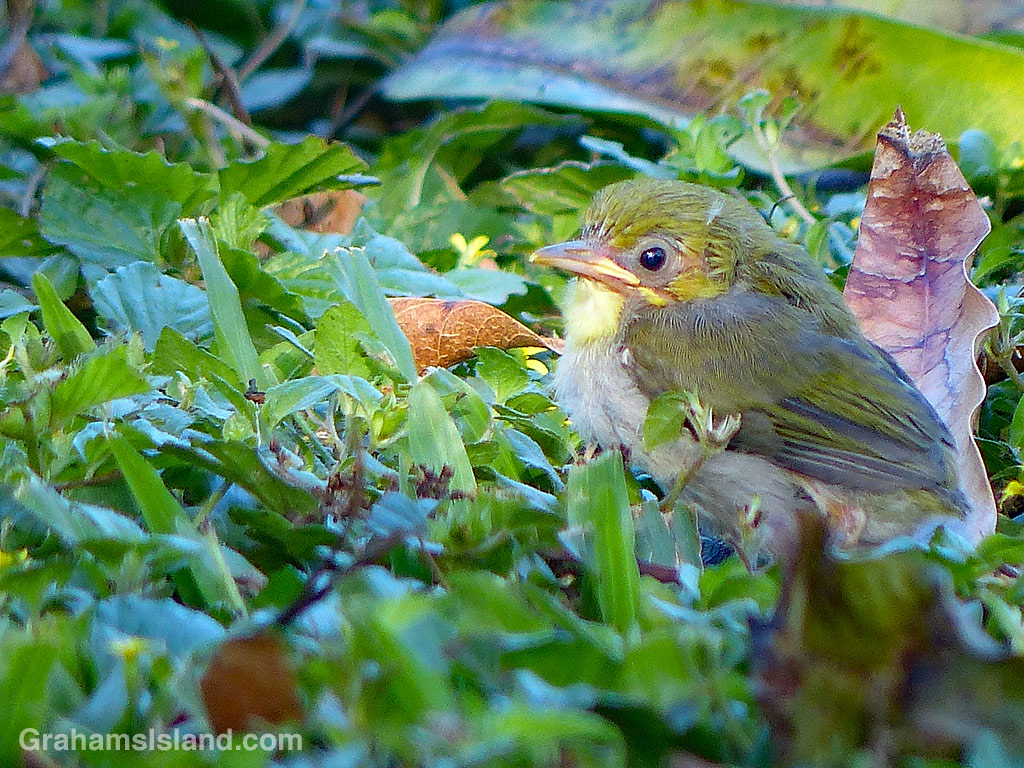
In the bottom photo, taken while it was resting in the grass, the chick looks quite similar to the adults, but the signature white eye ring is not yet present.

Hawaiian stilts are endemic, but also endangered because of loss of habitat and a rise in predators. They’re easy to identify with their strong black and white coloration, long black beak, and even longer pink legs. This one was wading in deeper water than I usually see them, probing for arthropods and insects.

Wild turkeys abound alongside the Old Saddle Road. This one was wandering through a green pasture bordered by an old fence.
Posted in response to Becky’s July Squares challenge theme of ‘Perspective.’ See more responses here.

This week’s Friendly Friday challenge theme is ‘Capturing a Feeling.’ See more responses here.
A fair number of my photos of perched pueos (Hawaiian short-eared owls) show the birds giving me a scowling look of disapproval. This one has a bit of that, but there’s also a look of astonishment. If I had to give this bird a speech bubble, it would be something along the lines of, ‘He took my picture. He didn’t even ask. The nerve.’
I like this photo for two additional reasons. One is that single, visible curved talon resting on the post. Easy to imagine the effect of that on some unfortunate rodent. The second reason is the eyes. Notice anything about them?
Also posted in response to Becky’s July Squares challenge theme of ‘Perspective.’ See more responses here.
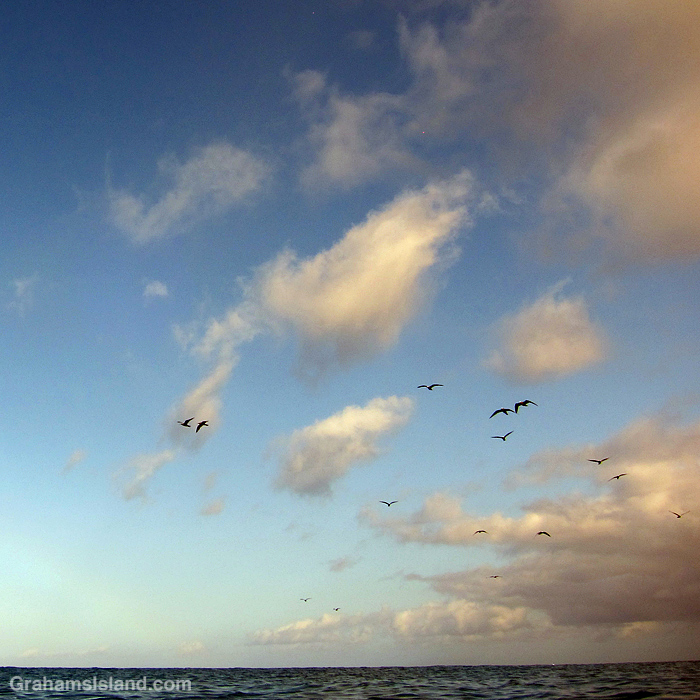
Yesterday, I was processing photos I’d taken over the past few days. When I saw this one, I thought, ‘I could have used that on Sunday,’ when responding to the Sunday Stills challenge theme of ‘Sky’ (more responses here), and Becky’s July Squares challenge theme of ‘Perspective’ (more responses here).
Usually, when I’m in the water, my focus is on spotting fish. But I also look around with my head above water and, one morning, I saw this flock of Hawaiian noddys wheeling back and forth over the ocean. Just after I took this photo, they flew directly overhead before gliding away to the south.
This is the first day of Becky’s July Squares challenge theme of ‘Perspective.’ See more responses here.
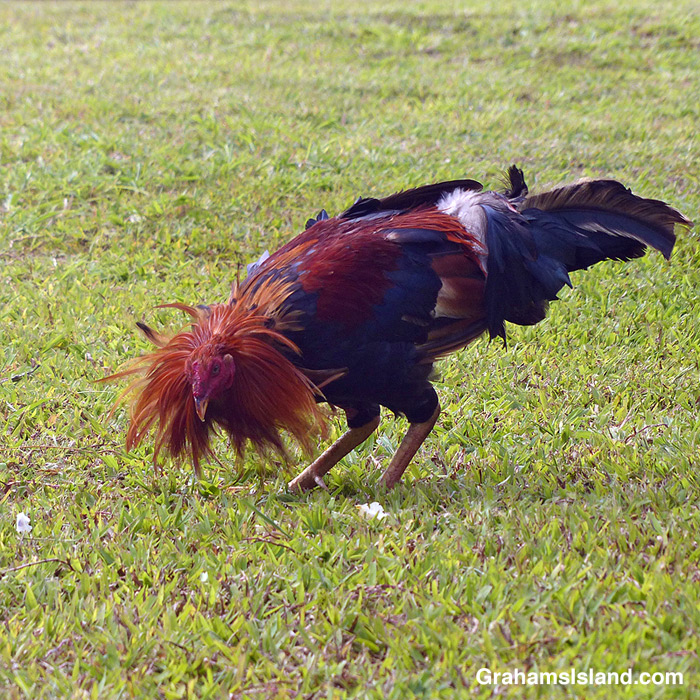
I thought I’d start with this photo. To many people this probably looks like a somewhat windblown rooster, but from my perspective, this is something else entirely. This is Hoppy, the temporally-challenged rooster. This is Hoppy, the no-amplifier-required rooster. This is Hoppy, the demon rooster.
Hoppy has a bad foot, hence the name, and perhaps this has thrown him off. He’s started crowing as early as 1:30 in the morning, but regularly pipes up in the two o’clock hour, the three o’clock hour, the four o’clock hour, and the five o’clock hour. Since his roost is in the hedge next to the house, his first blasts tend to be close by, and he is loud. Perhaps it’s just because it’s so quiet otherwise, but his call carries and I don’t need to hear rooster rock at those hours.
I generally succeeded in training him not to hang out into the yard, but have failed to dislodge him from his roost. He keeps coming back. Or should I say, kept coming back. Whisper it quietly, but I haven’t seen or, more importantly, heard Hoppy for three days now. Whilst I’ve thought unkind thoughts about him, I haven’t actually done anything to him. But other people live within earshot, so perhaps they have. Or maybe Hoppy just wandered off in the same way that he wandered in. He never acquired any hens here, so I’ll think positively and and hope he’s found a true love and is happy. Unless he comes back, that is.


This week’s Sunday Stills challenge theme is ‘Freedom.’ See more offerings here.
When Terri posts the Sunday Stills challenge themes for the month ahead, I usually check out what’s coming up. That way I can see what photos I have that fit the themes, or come up with ideas for what I could shoot.
When June’s themes were posted, my first thought for this one was of flying. Since the earliest of times, people have looked to the skies, watched birds, and envied their freedom of flight. Of the various birds I see here, the great frigatebird most epitomizes that freedom. These large birds cover great distances, gliding effortlessly across the sky, rarely flapping their wings but using the wind to maximum advantage.
I picked a couple of photos from my archives, expecting to use them since I hand’t seen any frigatebirds for many weeks. But a couple of days later, I saw one, though I didn’t get any good photos. That’s the other thing about these birds: they seem to have a knack for sneaking up on me, so that I usually notice them disappearing into the distance.
Over the next week or two, I saw a few more birds in similar situations. Then, one day, as I neared the coast below Upolu Airport, I saw a frigatebird flying into a strong wind. By the time I had my camera ready, it was again getting smaller. Still, I took photos and as I did so I saw a second bird, then a third. They continued heading east and I carried on down to the coast.
I hadn’t been there more than a couple of minutes when one of the birds shot by in front of me. It was pointing east, but heading north of west riding the stiff northeast trades that were blowing. A second followed, then a third, and a fourth that I hadn’t seen before. I expected them to quickly disappear on the wind, but once over the water, they regrouped and held their position, circling and gliding up and down. Then I noticed them edging back into and across the wind, heading my way. Slowly they came closer, still appearing to make little effort.
Eventually, the four of them passed directly overhead, the lowest maybe 20 feet above me. Almost immediately they turned and slipped back they way they came, only this time they kept going, gliding sideways in the general direction of Maui. I watched until I couldn’t see them anymore. The whole episode probably lasted no more than 15 minutes, but it seemed to last much longer.
I’m not much of a poetry buff, but these birds made me think of the opening lines of a poem called High Flight, written in 1941 by John Gillespie Magee Jr. when he was 19 and a pilot in the Royal Canadian Air Force, stationed in England. They read:
Oh! I have slipped the surly bonds of Earth
And danced the skies on laughter-silvered wings.
 Graham's Island