This week’s Sunday Stills challenge theme is ‘Rise/Set.’ See more offerings here.
I decided to go with sunrise and sunset photos taken from more or less the same spot on Kawaihae harborside. Above, a man fishes from the end of the harbor breakwater around sunrise. Below, a fisherman seated on the shoreline at sunset, with the breakwater across the harbor in the background.
This week’s Friendly Friday challenge theme is ‘Unusual.’ See more responses here.
Nēnē, the endemic Hawaiian geese, are long-distant relatives of Canada geese. They were listed as an endangered species, until the end of last year when their status was changed to ‘threatened.’
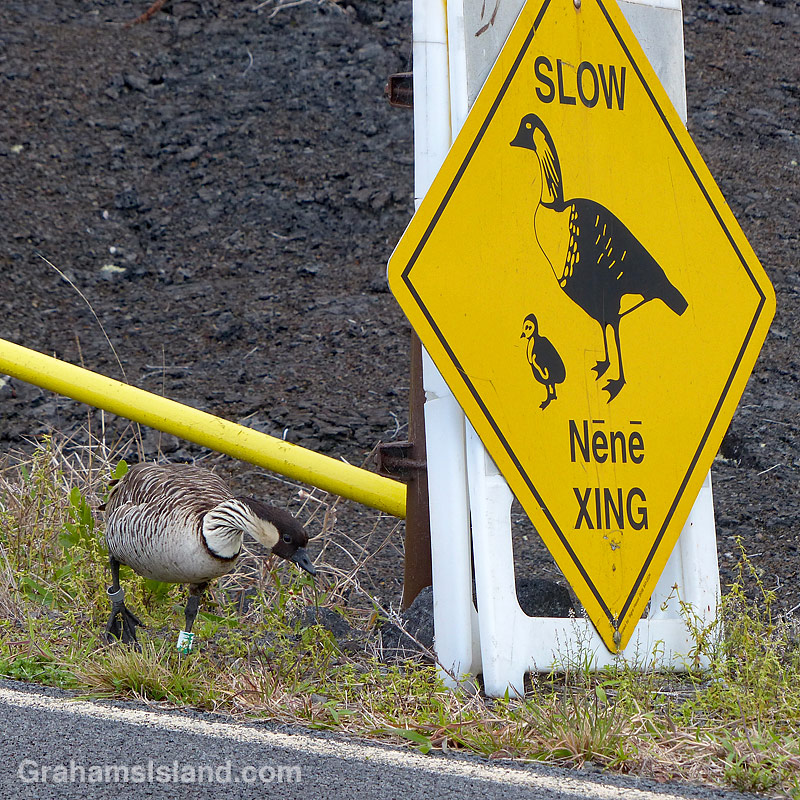
Because of the nēnē’s precarious numbers, it isn’t unusual to see “Slow, Nēnē Crossing” signs, particularly in areas where nēnē breed. Because their numbers are on the rebound on the Big Island, it’s also not unusual for me to see nēnē, on my daily walks or when I was working. But in my years on the island, I never saw a nēnē anywhere near one of the warning signs, until earlier this year, just before the lockdown. This sign and these two birds were in Hawaii Volcanoes National Park, where a fair number of the birds live and breed.
I had to stop and get a photo of this unusual event, fortunately without getting myself or the birds killed (it’s a busy, narrow road). The only disappointing thing about this encounter was that neither of the nēnē actually crossed the road. I guess I’ll have to wait another seven years to witness that.
This week’s Sunday Stills challenge theme is ‘Home.’ See more offerings here.
Here in Hawaii, home is where the termites are, and if nothing is done about them, they will literally eat you out of house and home. So every few years most houses get tented and filled with poisonous gas. Best not to be home at the time. The house stays tented overnight to give the gas time to seep into all the nooks and crannies. Next day, the tent is removed and the homeowner is supposedly guaranteed a few more years of termite-free living.
This was a neighbor’s house, and every time I see a tented house like this, I think of circuses.
This week’s Friendly Friday challenge theme is ‘In Transit.’ See more responses here.
Here in Hawaii, tourism is our number one industry. In normal years, more than 30,000 visitors arrive in Hawaii every day. Currently, the number of daily arrivals is around 1,500. In this topsy-turvy world that precipitous decline is a good thing.
In the U.S., states don’t have the authority to regulate flights; that’s a federal matter. But Hawaii was able to require that people arriving in the state had to quarantine for 14 days. This effectively killed tourism. Why visit Hawaii for two weeks if you have to spend every day of that visit confined to your hotel room? This 14-day quarantine even applied to inter-island travel. Because of these restrictions, Hawaii has had a very low infection rate and very few deaths. Here on the Big Island, there have been less than 100 cases and zero deaths. Next week, the inter-island quarantine requirement will be lifted, but it will be retained until at least the end of July for visitors from out of state and abroad.
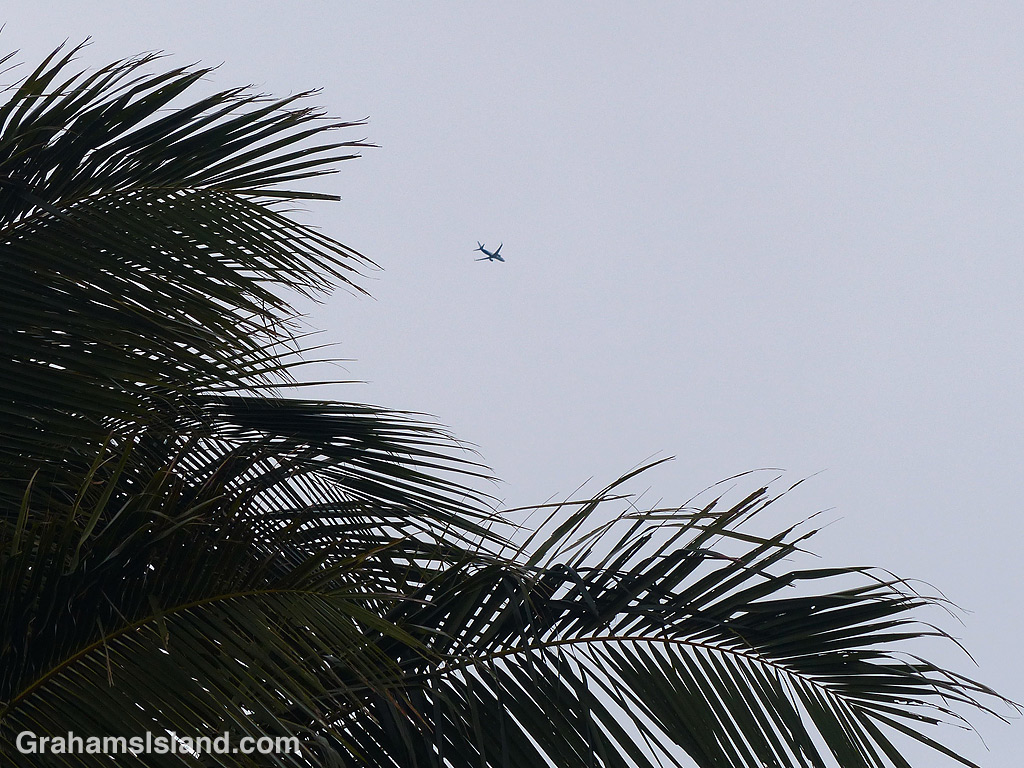
So the reason for the similar-looking photos? The top one is from a previous year and shows one of a procession of planes landing at Kona airport. The photo below shows a recent photo of a plane flying overhead, which was noteworthy because it was unusual. The planes aren’t there. The skies are quiet. Currently, the daily number of passenger flights arriving at Kona airport can be counted on one hand. The number of visitors is in the 20s or 30s. When and if those numbers return to previous levels is anybody’s guess.
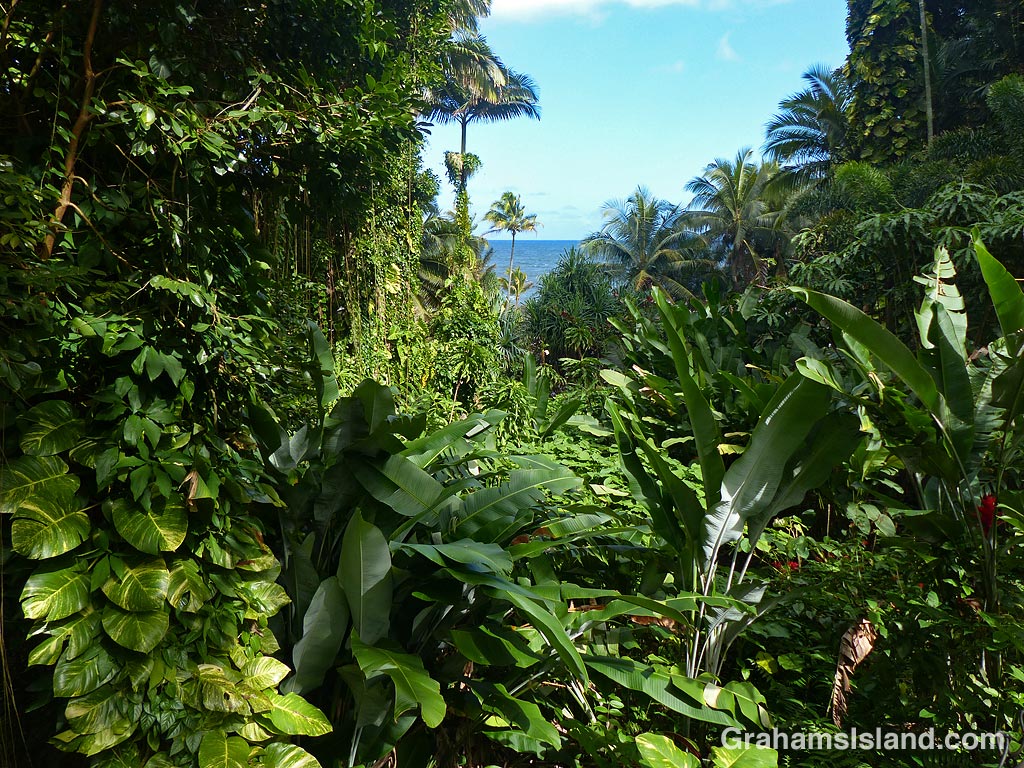
A riot of tropical foliage frames a view towards the ocean.
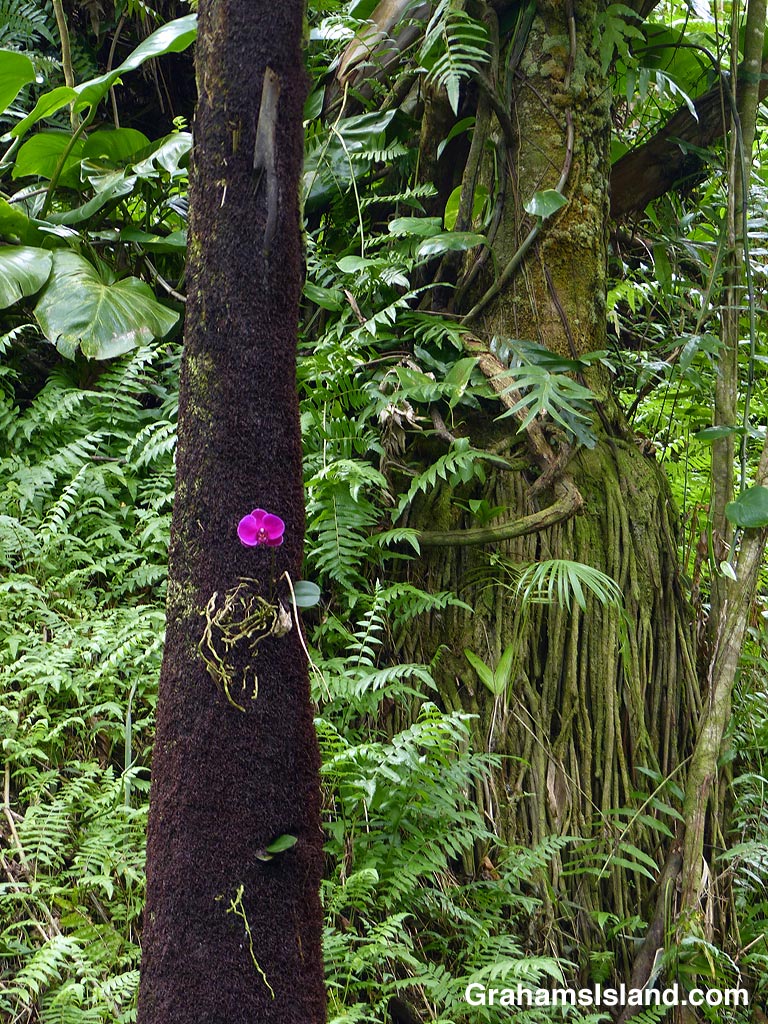
A single purple orchid is a spot of color against the green and brown background.
This week’s Sunday Stills challenge theme is ‘Plant Life.’ See more offerings here.
The east side of the Big Island is the place for plant life thanks to good soils, warmth, and abundant rainfall. These photos were taken on my last visit to Hawai’i Tropical Botanical Garden, before it closed because of the Covid-19 virus.
This doesn’t mean they’ve been slacking during the closure. Instead they appear to have launched a new name and new website. The new name is Hawai’i Tropical Bioreserve & Garden and, I think reflects more of the purpose behind the garden. The new name, conveniently, means they didn’t have to change their website. It’s still htbg.com.
The new website is definitely a spiffier looking production, but it comes with a drawback. They used to have a plant database that I found very useful in identifying what I saw there. I can’t find it on the new website. Hopefully, this is just an issue with transitioning the information. Otherwise, I’ll be in a bit of difficulty.
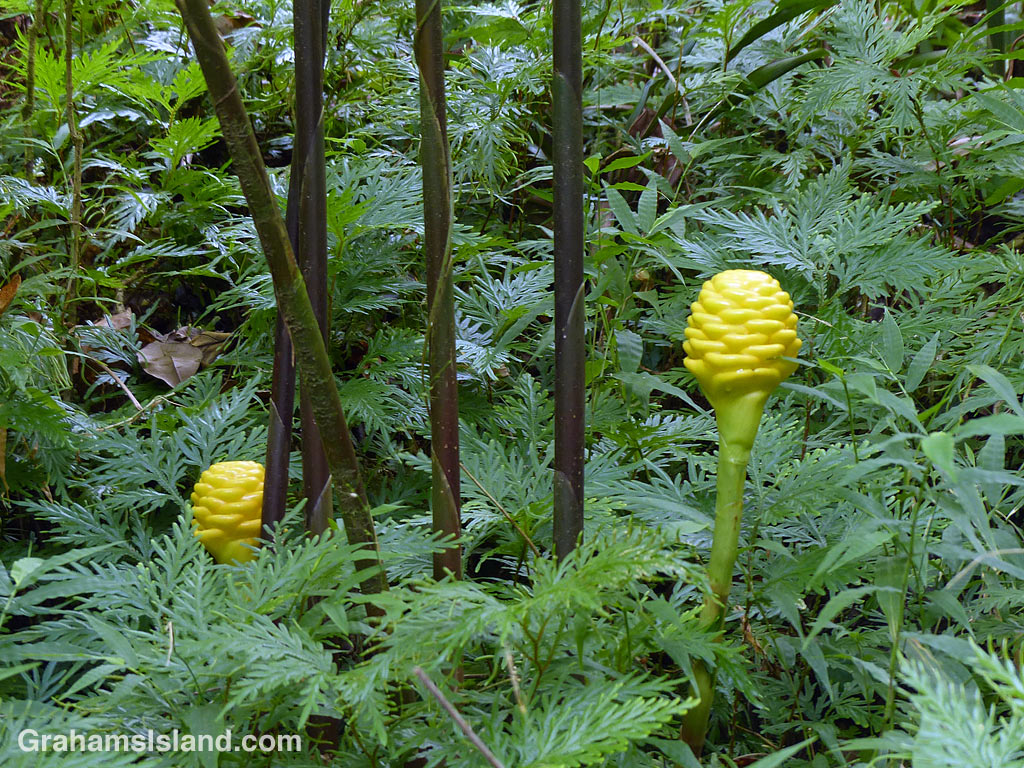
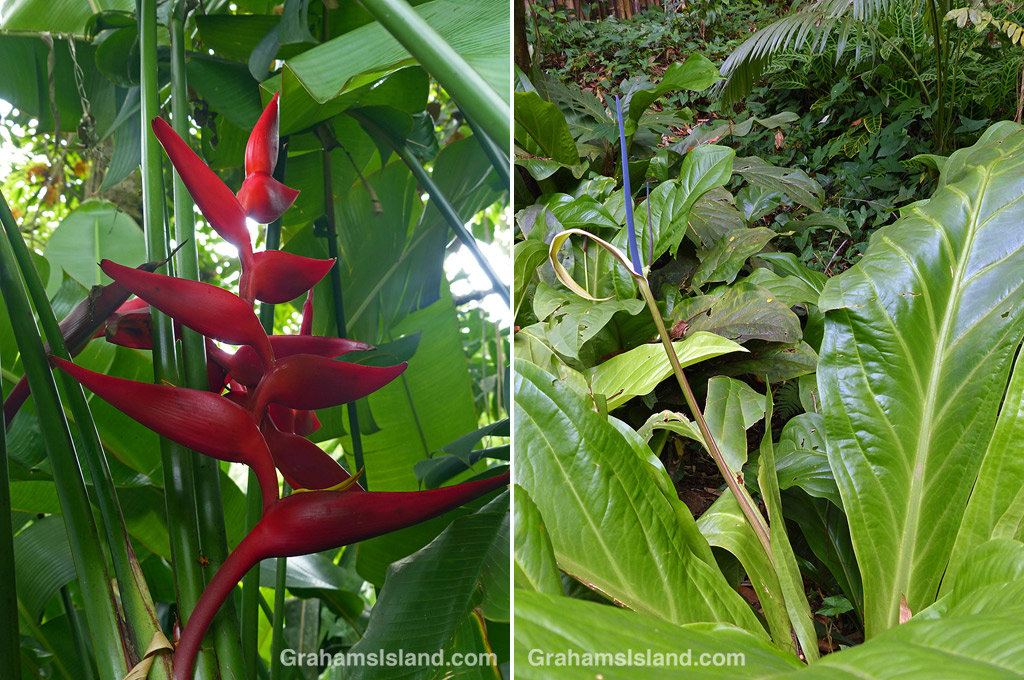
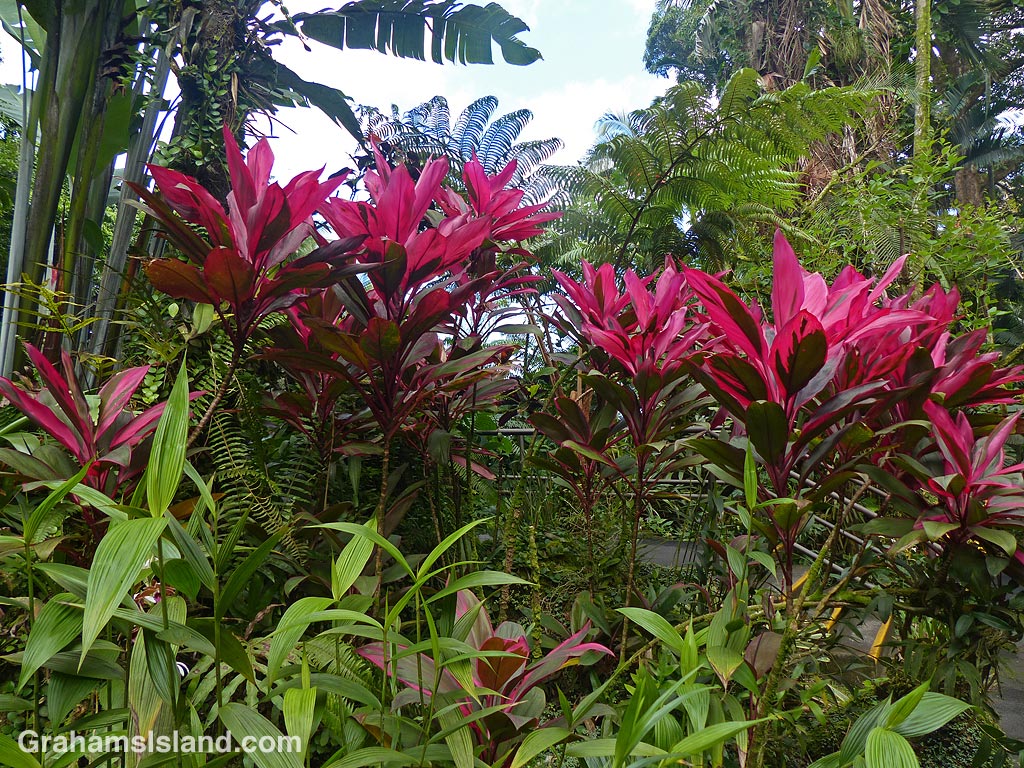
Early Yellow beehive ginger makes colorful focal points against a backdrop of green foliage.On the left, a deep red heliconia against large green leaves. On the right, the purple bract of anthurium schlechtendalii or pheasant’s tail.Not all leaves are green as these colorful ti plants attest.
This week’s Friendly Friday challenge theme is ‘The Color Pink.’ See more responses here.
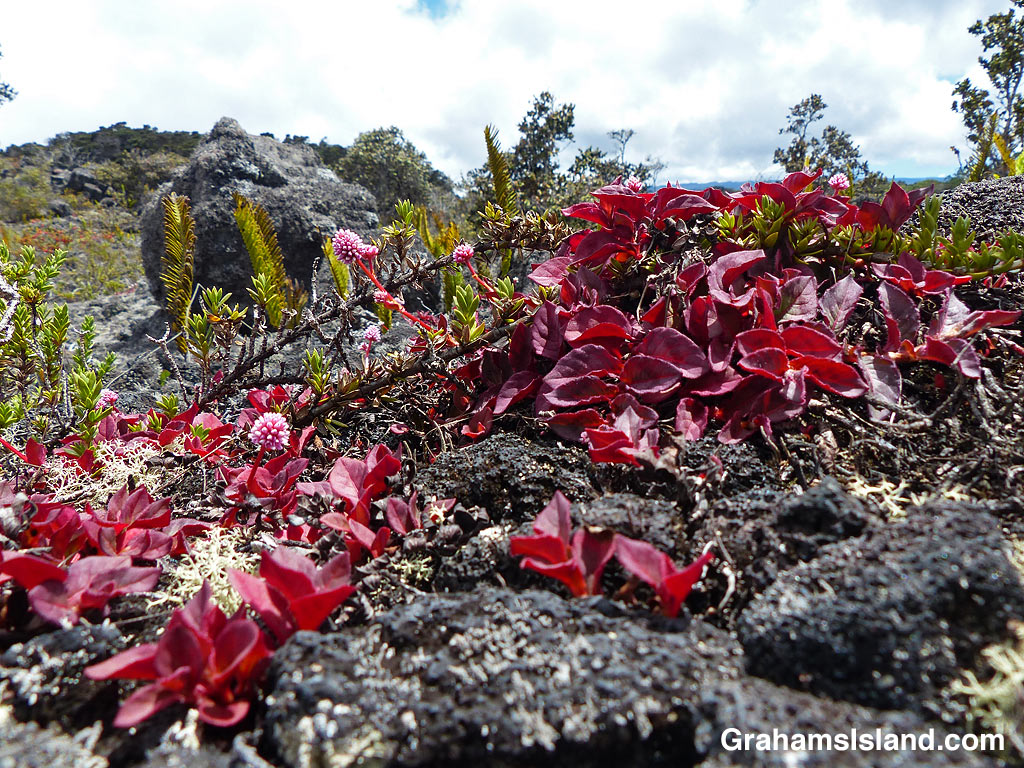
Pinkhead smartweed (Polygonum capitatum or Persicaria capitata) is a groundcover that hails from western China and the Himalayas. It’s variously known as pinkhead knotweed, pink knotweed, Japanese knotweed, pink-headed persicaria, or pink bubble persicaria. I use pinkhead smartweed for the very good reason that I like the name. It sounds like the name of someone pretentious, but slightly seedy, from the alleged upper crust of society.
In this bounty of names, a couple of elements stand out. One is ‘pink,’ the other is ‘weed.’ This is a very pink plant and, in Hawaii and elsewhere, an invasive weed. Drive eastbound over Saddle Road (officially Hawaii Route 200, the Daniel K. Inouye Highway) and, once you cross the saddle and begin your descent, this plant will become obvious very quickly. It lines the road on both sides for several miles with very little in the way of other plants competing for that space. This is because pinkhead smartweed will grow in poor ground and lava fields fit that description.
This is also a stretch of highway that, relatively recently, was converted from a narrow, winding road, that rental car companies routinely forbid their clients from driving on, to a wide, smooth thoroughfare, the only place on the island where you can legally go 60 mph, and where you can expect to receive a ticket if you go 80 mph like everybody else.
Redoing the road left verges of rock and gravel and very little else. Pinkhead smartweed was quick to move in and colonize this unpromising territory so that now the descent toward Hilo begins with pleasing pink borders.
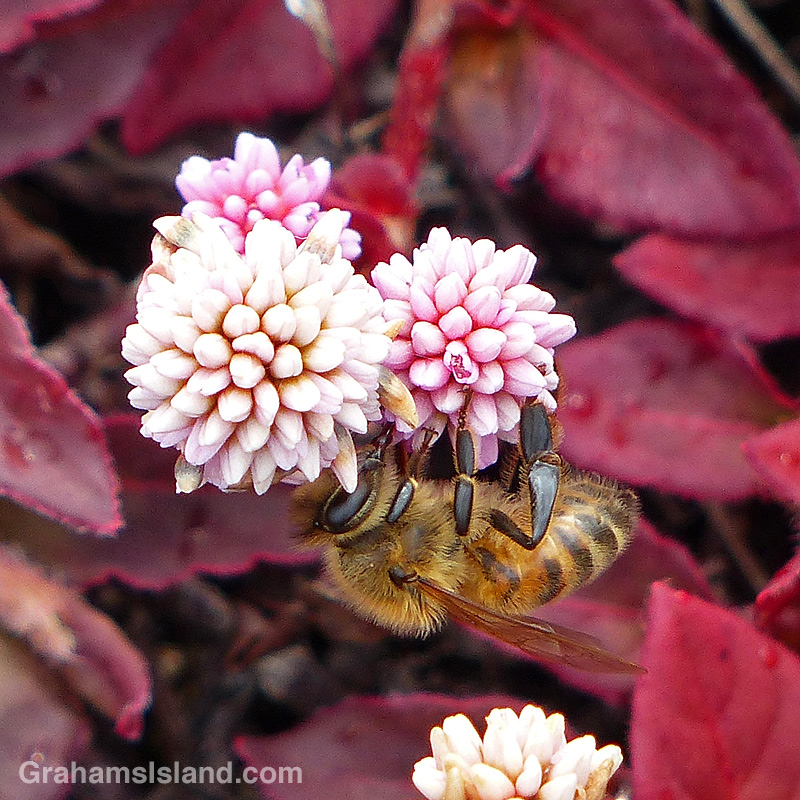
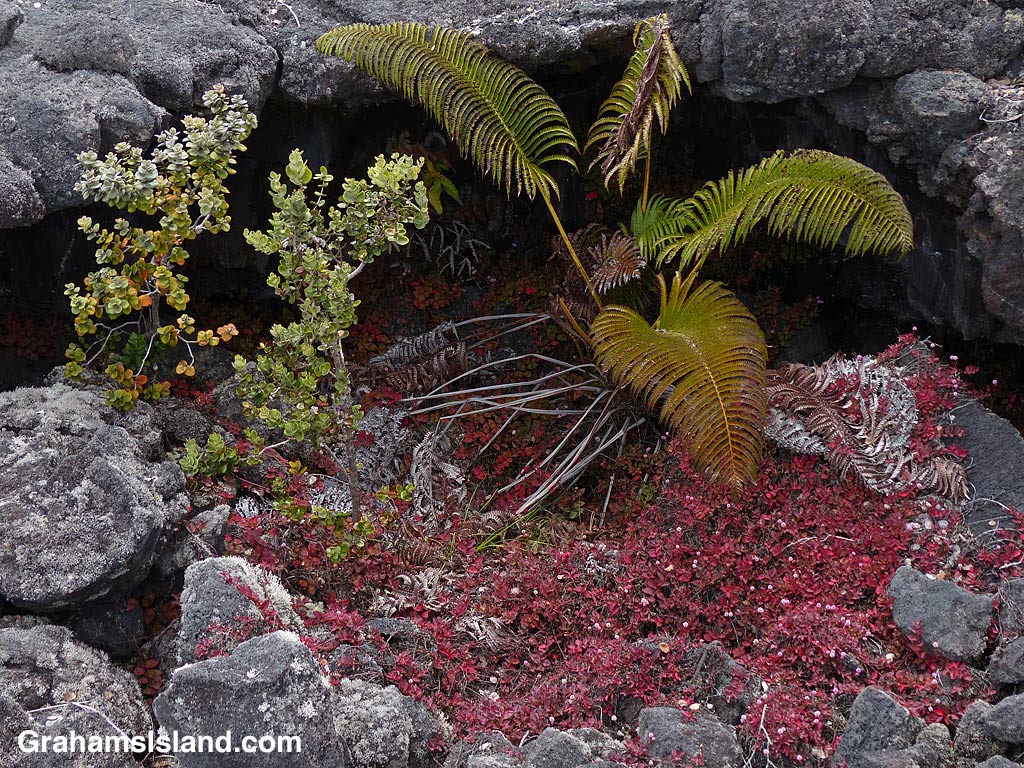
The top photo shows the rugged kind of ground pinkhead smartweed can grow in. To the right, bees appreciate the flowers of this plant growing at an elevation over 5,000 feet. Below, the collapse of a lava tube has left a shady hole where pinkhead smartweed, an endemic amaumau fern, and an ohia tree have established a good foothold.
This week’s Sunday Stills challenge theme is ‘Straight.’ See more offerings here.
Last week, I revisited the Powerline Trail off of Saddle Road. This trail, when combined with the Pu’u O’o Trail, makes a good long loop hike. I like hiking the Pu’u O’o Trail because it passes through several kipukas (patches of old forest that have been spared by lava flows) and those kipukas have lots of birds living in them.
The Powerline Trail is a bit less interesting. There are fewer kipukas and it’s a long, exposed hike in a straight line across the lava. The reason for this can be found in the name. It follows an old 4-wheel drive road that serviced a power line that ran across the lava fields. The line is gone, but the sawn-off stumps of power poles can be seen alongside the trail (to the right of the trail in the top photo, to the left in the bottom photo).
One advantage the Powerline Trail has over the Pu’u O’o Trail can be seen in the bottom photo. This was near the end of my hike in the mid-afternoon as clouds closed in. It’s not unusual for this part of the saddle to be shrouded in thick fog and, if you happen to be out hiking in those conditions, the straight and clear Powerline Trail is much easier to follow than the Pu’u O’o Trail which, crossing the lava fields, can be hard to follow when you can’t see the cairns that mark its route.
The trail, of course, isn’t perfectly straight (though I suspect the power line was). It bumps around lava upwellings and collapsed tubes. But most of the time, one just needs to look up to see, straight ahead in the distance, the faint pale thread of the trail topping a hill or emerging from a dip in the landscape.
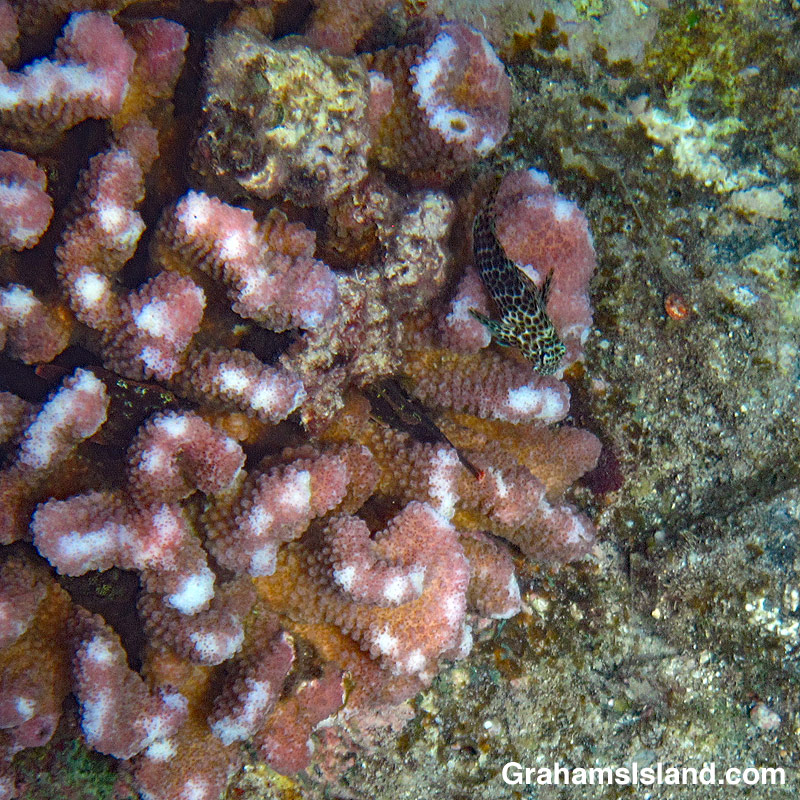
I think this is a spotted coral blenny on a head of purple cauliflower coral, and possibly a small trumpetfish.
This is a second response to this week’s Sunday Stills challenge theme of ‘Waterworld.’ (See more responses here.) Yesterday, I posted about the movie Waterworld. Today, it’s a probably more expected response.
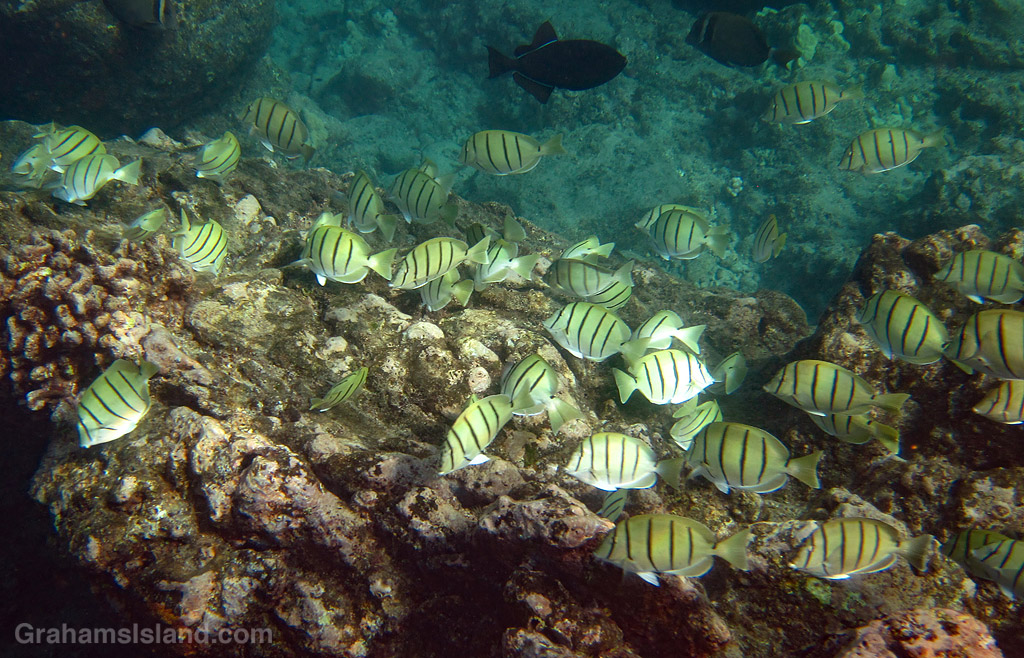
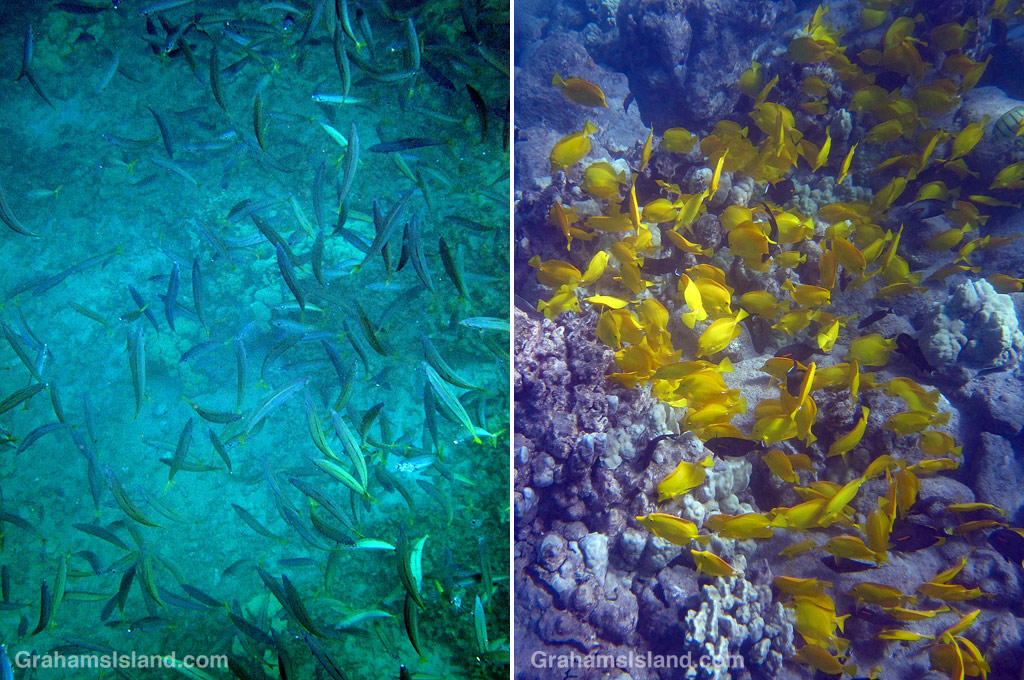
These are photos I took during my swim yesterday. Visibility in the water was patchy with some good areas and some not so good. I didn’t see anything startling, though the mackerel shads aren’t a common sight. Last time I saw such a shoal there was a great barracuda lurking on the other side. I looked around and, sure enough, there was another one looking interested as it cruised low down, too low for a decent photo.
The other oddity was in the photo at left. I saw what I think is a spotted coral blenny on this patch of cauliflower coral, and snapped a quick photo before it took off. But it was only when I processed the photos that I saw something else, to the left and slightly below the blenny. I think it’s a small trumpetfish, but it could be something else. A lot of small fish and other creatures hide in coral heads so I must pay more attention from here on.
In short, it was a fairly typical swim.
A shoal of mackerel scad on the left with yellow tang on the right.Little fish enjoy the comparative safety of the shallow water in the surge zone.On the left, a fourspot butterflyfish and a cushion star. On the right, black triggerfish are cleaned by a Hawaiian cleaner wrasse.Just before getting out I saw this small Pacific trumpetfish with goldring surgeonfishes.