
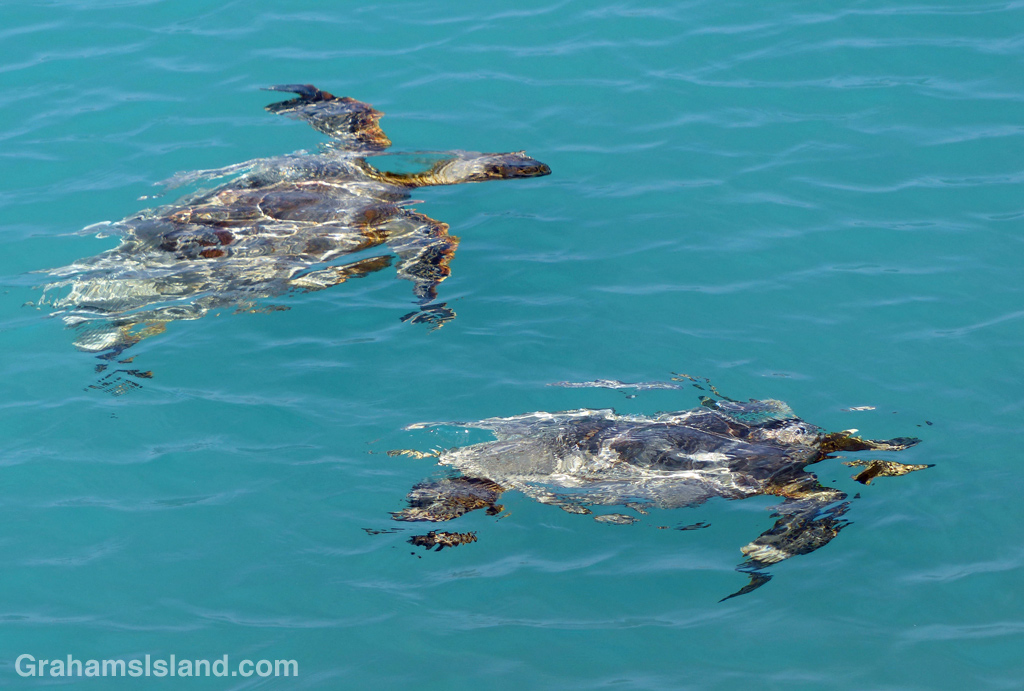
Kiholo Bay is a popular spot for Hawaiian green sea turtles. On a recent hike I saw several of them on land and in the water. A light breeze rippled the water and when the turtles swam just below the surface, their appearance was in constant flux. It was a nice surprise to find I’d captured this impressionistic effect.
Category Archives: Photo Challenges
Mountain of water

Sometimes I get caught up taking a set of photos of certain things. Lately, I’ve been trying to capture waves breaking toward me. On this day the water looked promising, but mostly the waves refused to break.
However, it was a pleasant surprise to find that I’d managed to capture this image. The water has lumped into a pleasing mountain shape and the coral below looks like aspects of its rocky face.
Moon landing


When I saw these skydivers I thought of Kurt Vonnegut’s satirical essay “Excelsior! We’re Going to the Moon! Excelsior!” The connection was really nothing more than the title.
In this case, I imagined the captions as “Coming in for landing,” “Whoa, just missed,” and “Let’s go round again.” I bet this is along the lines of how the moon landings were faked!
The reality is these were part of Upolu Airport’s newest/only economic enterprise, B.I.G Skydiving. On this outing, a couple of solo skydivers had already landed. These two were on a tandem skydive, where a paying customer has the much-needed security of being attached to an experienced skydiver.
For more information about B. I. G. Skydiving go to skydivebig.com.

Tangled trunks

For dense foliage, the east side (otherwise known as the wet side, or Hilo side) of the Big Island can’t be beat. Here the trunks of two trees are entwined by a tangled vine, surrounded by exotic foliage.
Green anole with raised ridge
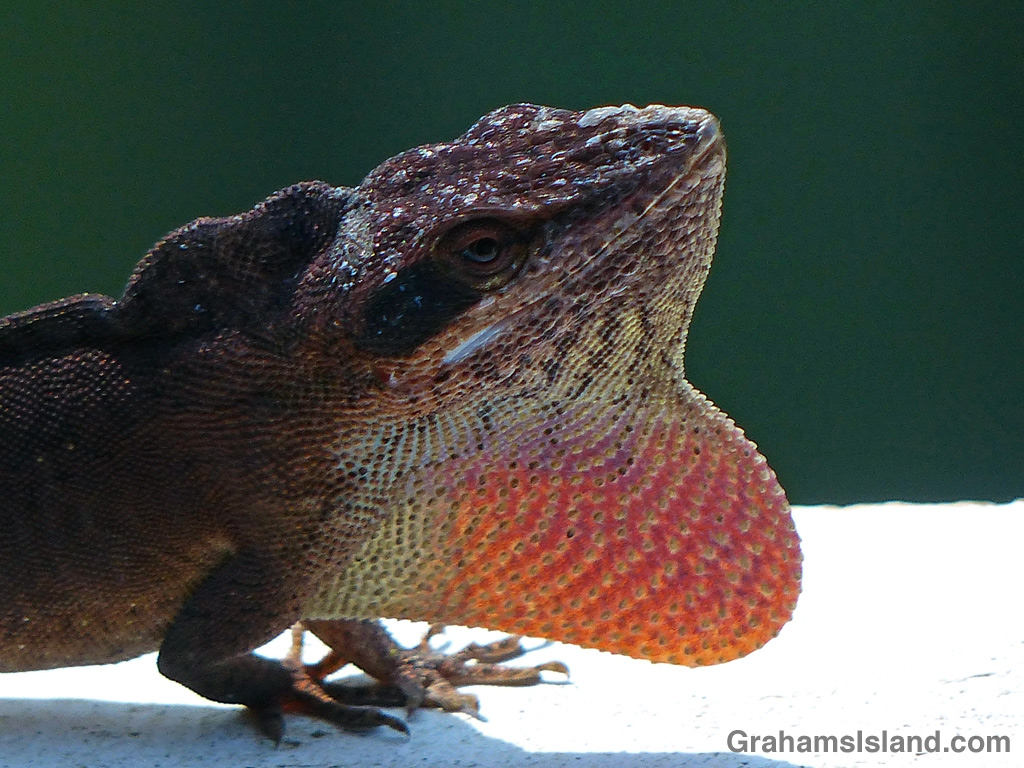
I saw this anole on the lanai one day and thought at first it was something new to me. It was a very deep brown with pronounced markings and it had a raised ridge on the back of its neck that I’d never seen before. It was already pretty agitated, but my taking photos riled it even more, causing it to strut around and puff out its dewlap.
After watching it for a while, I thought it had a lot in common with the green anoles I see around here, and sure enough, its color started to fade and then shift to green.
I suspect what was happening is that it was trying to stake out a new territory and was moving in with the most impressive display it could muster. I’ve found out since that the raised ridge is one such display technique that green anoles have. I didn’t see it again. Probably it decided that it didn’t need a territory already crawling with paparazzi.
A jumping spider snags a meal
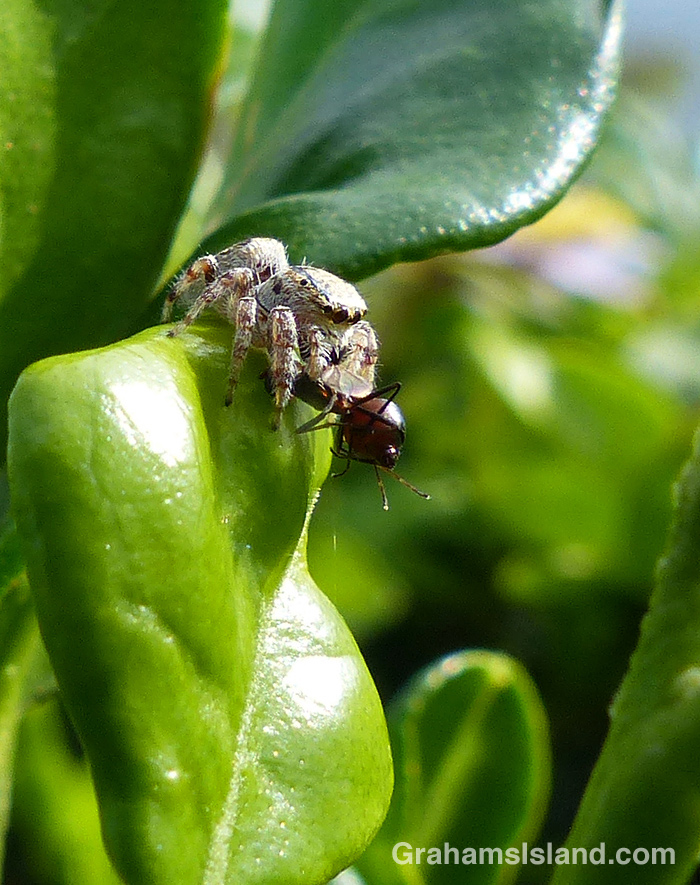
I was watching some butterflies recently when my eye was caught by something tiny (we’re talking a quarter-inch long here) bouncing across the dirt in front of me. I peered down and snapped a couple of photos before it disappeared. I’d seen enough to recognize it as a spider and the photos, while not great, were good enough to enable me to identify it as a striped lynx spider, a kind of jumping spider.
Not long after that, I was again watching butterflies and other bugs inhabiting a mock orange hedge, when I saw this little creature. Again, no more than a quarter inch long, it’s movement caught my eye against the glossy green of the mock orange leaves. A different kind of jumping spider, it hung around, enabling me to get this photo, because it had latched on to what I think is a parasitic wasp. Jumping spider don’t make webs, they pounce on their prey.
Jumping spiders are in the family Salticidae, but there are numerous species within the family and I haven’t yet been able to identify which this is. A characteristic of these jumping spiders is the pair of large eyes in front. This gives them very good eyesight, useful in identifying prey.
Another thing I’ve found out is that they’re everywhere around here. Now that I’m aware of them, and looking out for them, I see them often where I had never noticed them before. Mine eyes have been opened to the glories of the jumping spider – or something like that.
A passion vine butterfly lays her eggs

I watched this passion vine butterfly flitting around on a hedge, laying eggs atop the leaves of, you guessed it, a passion vine growing in the hedge. Typically, she deposits a single egg on each leaf, but this butterfly laid two on this one.
The butterfly is selective about which leaves to use. She chooses ones that have no eggs on them yet, since this will reduce the competition for her offspring. On the leaf she’s using in the photo are some yellow spots. I thought these might be where eggs had been laid previously, but some passion vines produce these colored bumps to make it look like eggs are already there and thus discourage the butterfly.
Not that laying eggs on unoccupied leaves guarantees survival. I saw a number of small parasitic wasps checking out the yellow bumps on several leaves. I have no doubt they do the same with the real eggs. I also saw a very small passion vine butterfly caterpillar snacking on what looked suspiciously like a newly-laid egg. And there’s always the possibility that someone will come along and trim the hedge. Not sure what the vine or the butterfly can do about that.
Humpback whale breach

I could wish for the humpback whales to be around all year, but perhaps that would not be for the best. Aside from the minor detail that they would starve to death here, there’s also so the chance of becoming jaded. As it is, seeing a humpback breaching – raising its huge bulk out of the water and then crashing back in – continues to be a thrill every time I see it.

