Category Archives: Trees

Abstracts: Rainbow Falls banyans

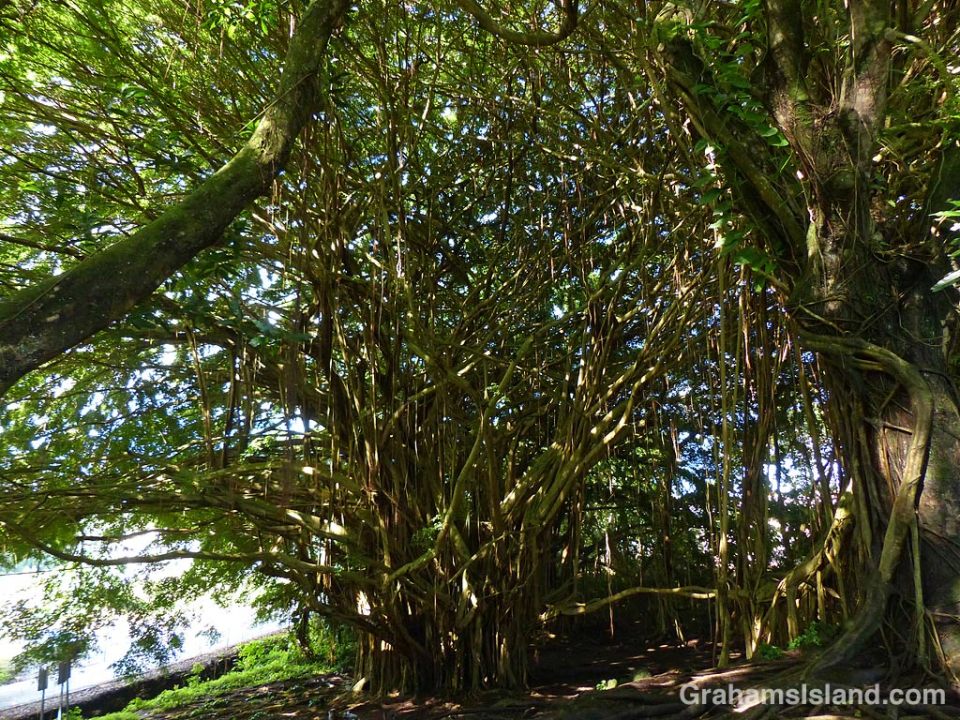
Abstracts-Rainbow Falls Banyans

Abstracts-Rainbow Falls BanyanThe main attraction of Wailuku River State Park, in Hilo, is Rainbow Falls. But at the top of the hill are these huge banyan trees.

Banyans are not just a huge sprawl of branches, but a sprawl of roots, too. As epiphytes they begin life growing on other trees, from seeds dispersed there by birds. Over time, they send roots down to the ground, known as prop roots, which help support the mass of branches.

Banyan trees are also known as strangler figs because their roots and branches will ultimately overwhelm the host tree and kill it. Eventually, the dead host will decay and leave a hollow center to the banyan tree that’s left.

By continuing to send down prop roots, banyans grow out as well as up. Very old trees can cover a huge area. For example, the Great Banyan Tree in Kolkata, India is more than 250 years old. Its covers around four acres and has more than 3,500 prop roots. Here in Hawaii, the largest banyan grows in Lahaina on Maui. Planted in 1873, it now has 16 main trunks and covers two thirds of an acre.

The Rainbow Falls trees aren’t that large, but they’re coming along nicely.
Abstracts: Eucalyptus trees

Abstracts-Eucalyptus trees

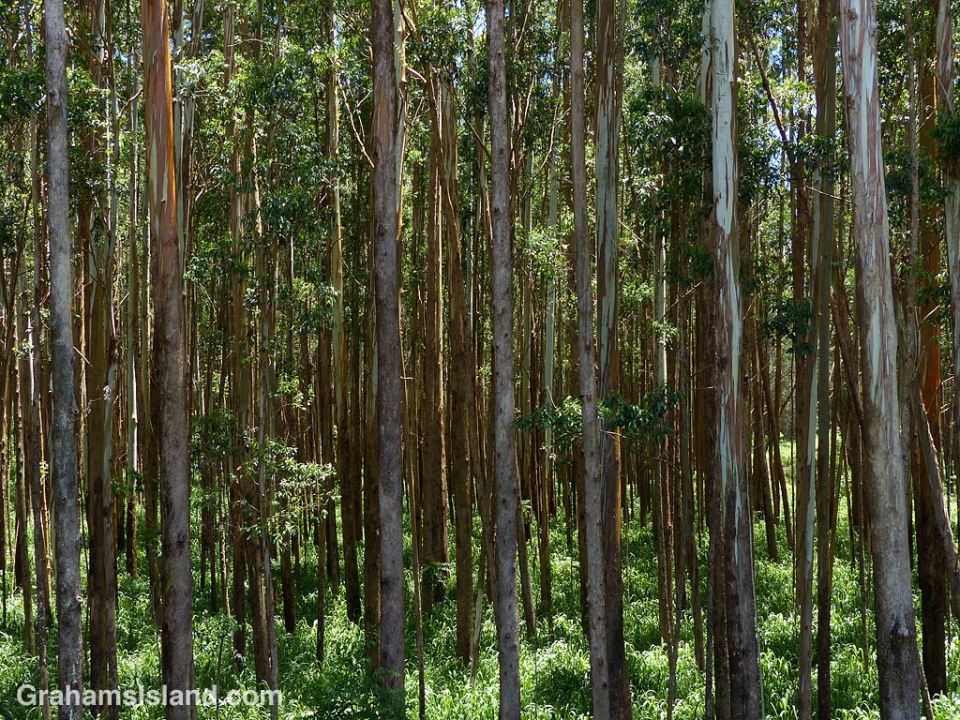
The Hamakua coast of the Big Island is the site of extensive eucalyptus forests. These tall, fast-growing trees are grown for export to Asia. Harvested trees are trucked to the west side port of Kawaihae and stored there until the next ship comes in.

However, last year, the company running the operation decided not to renew its lease. Since then, the landowners have been casting around for a new business to carry on the work, so far without success. So the trees continue to grow, making a pleasing sight with their dappled trunks catching dappled sunlight.

Is it windy here?

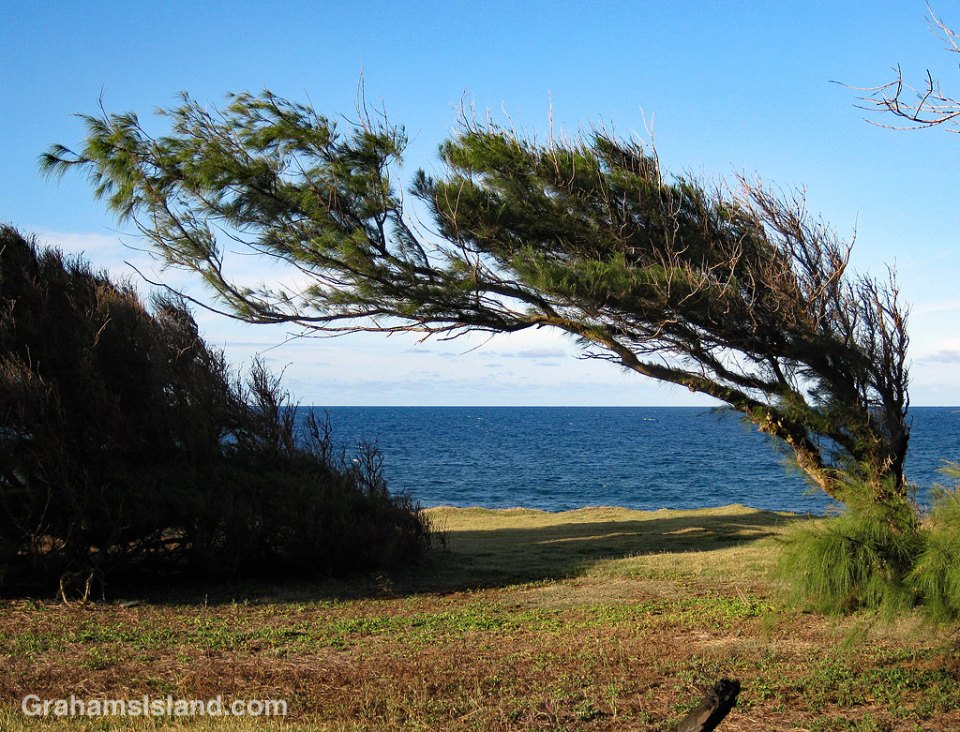
Kauhola Point tree

Northeast trade winds are Hawaii’s air conditioner, moderating what would otherwise be much hotter temperatures. The North Kohala coast is a spot where the winds whistle ashore. They can be very strong, but if you want to know how strong, the surest way is to ask a tree. This one is near the Kauhola Point light.

Posted in response to this week’s Sunday Stills challenge on the theme of ‘Wind.’ See more responses here.

Jacaranda flowers

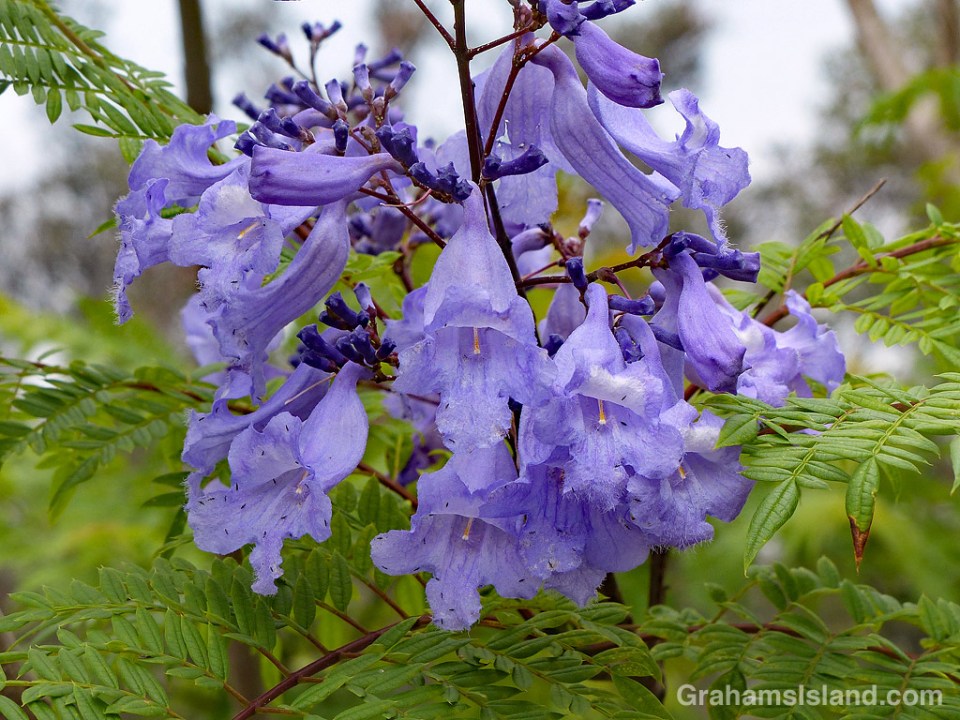
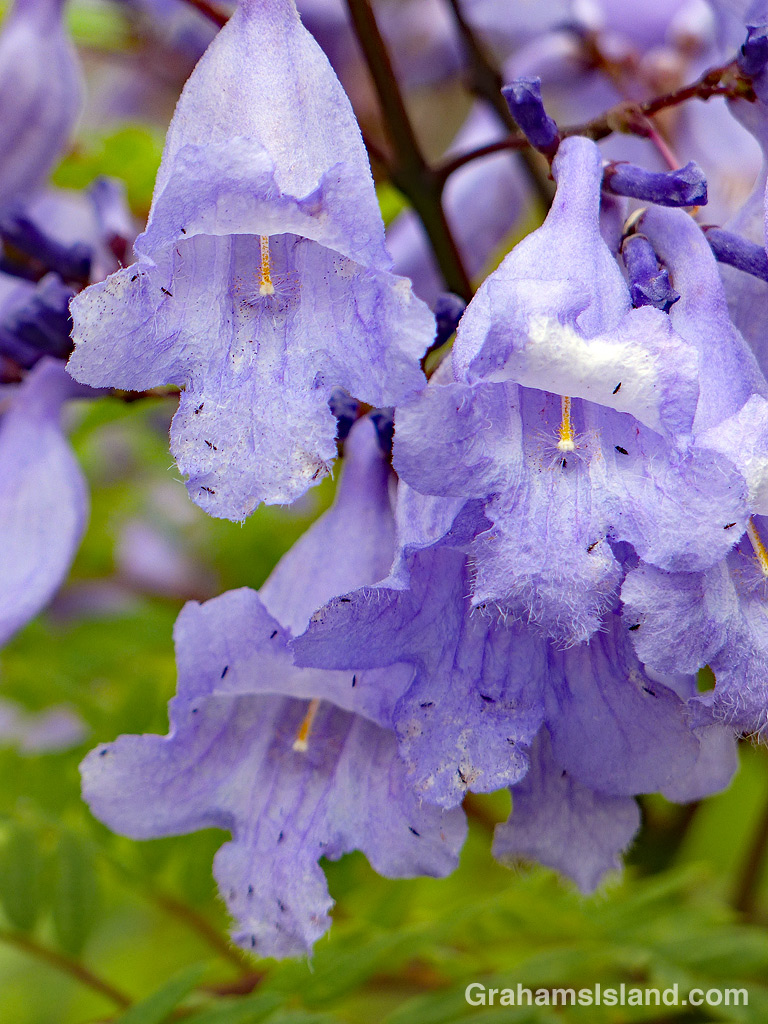
Jacaranda flowers cluster

Jacaranda flowersA final response to the last edition of the WordPress photo challenge with a theme of ‘All time favorites.’
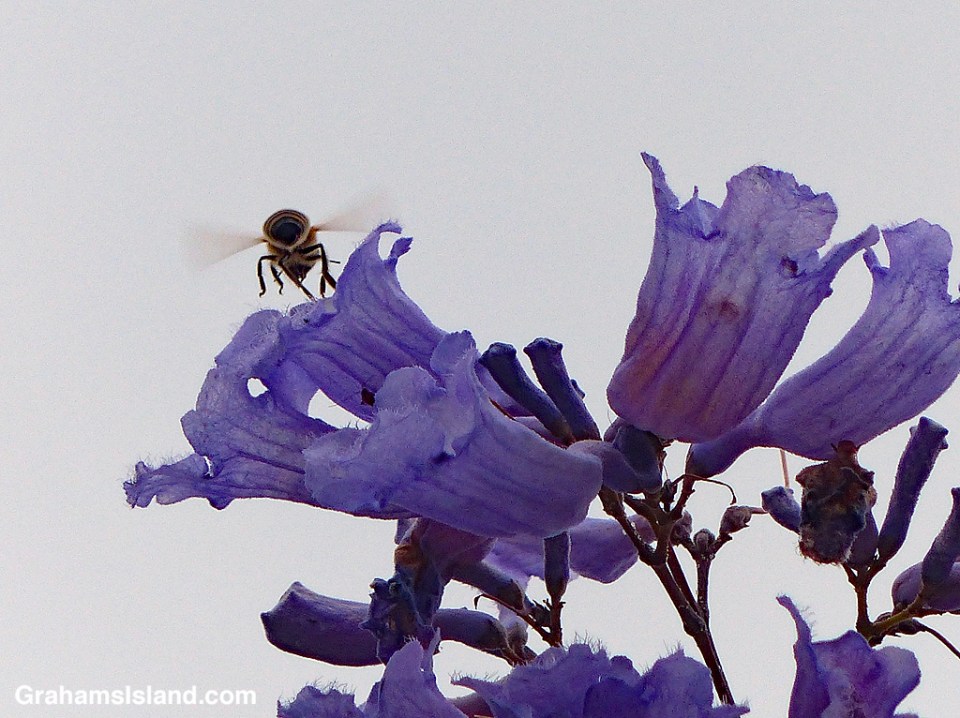
I headed back to Pu’u Wa’awa’a last week, because this is the time of year when several kinds of trees are in bloom. One of those trees is the jacaranda, which blooms from April to June, and produces masses of blue to lavender flowers. Jacarandas prefer cooler elevations so the lower areas of Pu’u Wa’awa’a are right in their zone.

I wasn’t disappointed. Several trees were covered with these delicate flowers, which somewhat made up for the fact that the entire hill was shrouded in thick vog, exacerbated by the ongoing eruption down in Puna.

Jacaranda flowers and bee

Dead tree in the lava

Dead tree in the lava

The twisted remains of a dead tree lie, under heavy skies, on an old lava field at Hawaii Volcanoes National Park.

For more information about Hawaii Volcanoes National Park, go to nps.gov/havo/.

Posted in response to this week’s WordPress Photo Challenge ‘Twisted.’


Green anoles mating

Green Anoles mating

I happened to glance out of a window in time to see this green anole leap onto the trunk of a mango tree and scamper upwards. They’re fast movers, so it was only a glimpse, but I did see it had something in its mouth. ‘It’s caught a meal,’ I thought. Time to grab the camera and see what’s going on.

When I got to the tree, I found this scene. That wasn’t lunch the anole had grasped in its jaws, it was his mate. He had dragged her across the grass and up the tree in a most unceremonial manner. But this bite on the neck and the rough handling is the norm for anoles.

In fact, this episode seemed less fraught than others I’ve seen. Once on the tree there was no thrashing around or falling off as I’ve seen before. The two were twisted and locked as one, and their tails arched together. A few minutes later they were done. The female wandered off looking bemused while the male remained in the same spot, lord of all he surveyed.

Posted in response to this week’s WordPress Photo Challenge ‘Twisted.’


Hawaii ‘elepaio

Hawaii Elepaio

Hawaii Elepaio on a branchOn the first decent day after a long spell of grey, wet weather, I headed up to the Palila Forest Discovery Trail, just off Saddle Road on the lower slopes of Mauna Kea. I figured that even if the weather let me down, it’s a drive that I enjoy, so it would be OK regardless.

However, the closer I got to my destination, the less promising it looked. When I got to the junction, where a 4-mile dirt road leads to the trailhead, I almost turned around since it seemed unlikely there would be anything to see. The mountain looked shrouded in cloud, but since it’s only a 15-minute drive and the road didn’t look too muddy or washed out, I thought I’d give it a go.

When I pulled into the deserted parking area, the sky was grey, the air was damp, but it wasn’t actively raining and the visibility was OK, so I set out on the mile-long loop trail. As usual, I could hear a fair number of birds. It’s just spotting them that’s the trick there. But there are a couple of places on the trail that seem to get a lot of action and this day was no exception, including my first photos of a Hawaii ‘elepaio (Chasiempis sandwichensis sandwichensis).

Oahu, Kauai, and Hawaii Island each have their own species of the endemic ‘elepaio, which is a member of the flycatcher family. The Big Island version is more boldly marked than the other two and this one obligingly set down in a mamane tree not too far away, affording me a decent view and the opportunity to take photos.

One tidbit that I found interesting about the bird is that when ‘elepaio were seen to frequent a given koa tree, this was a sign to canoe makers that the tree was likely insect infested and unsuitable for making a canoe.

For more information about Palila Forest Discovery Trail, go to dlnr.hawaii.gov/restoremaunakea/palila-forest-discovery-trail/.

Posted in response to this week’s WordPress Photo Challenge ‘Unlikely.’