This week’s Sunday Stills challenge theme is ‘Shadows.’ See more offerings here.
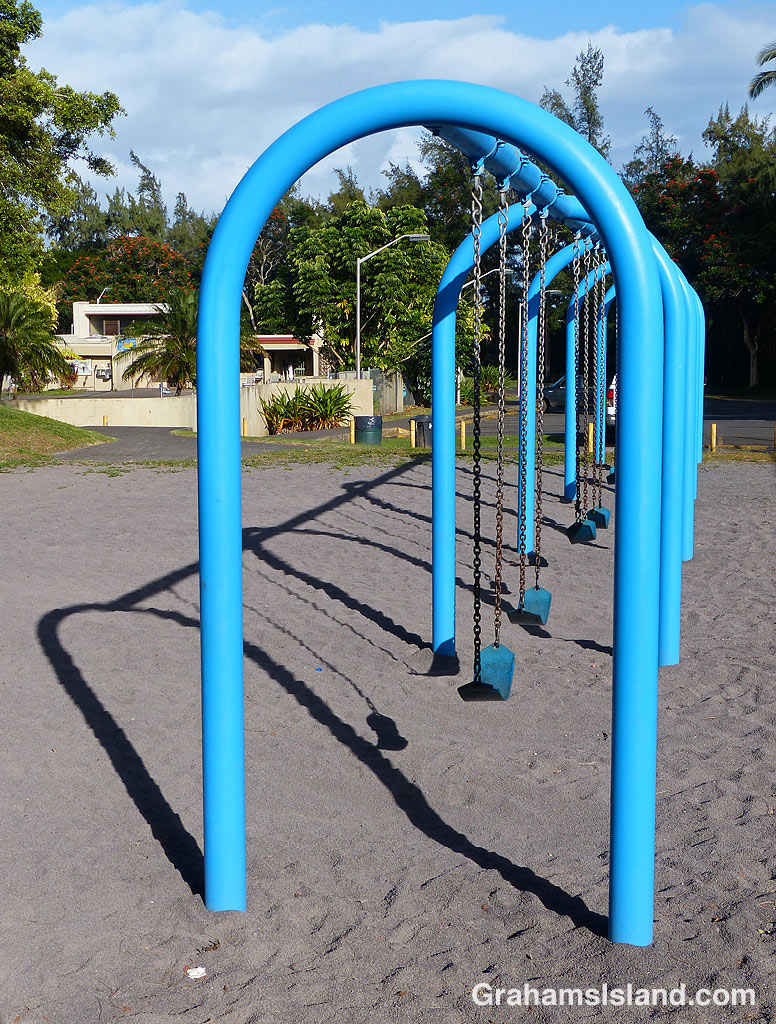
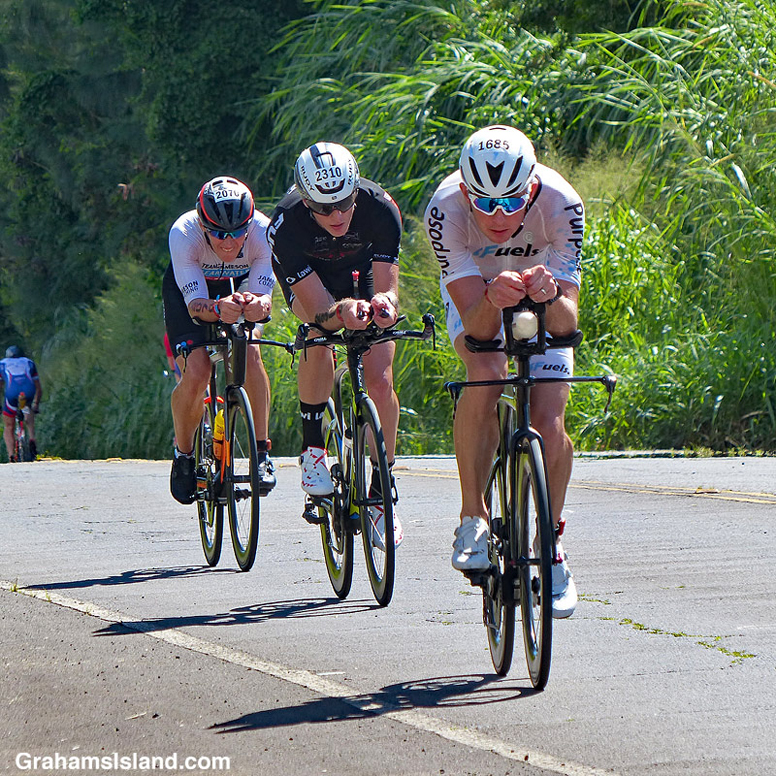
The top photo is a row of colorful playground swings at Kamehameha Park in Kapaau. Below are three cyclists in line, heading out of Hawi during an Ironman World Championship race.
Also posted as a second offering for this week’s Friendly Friday challenge theme of ‘All in a Row.’ (See more responses here.) My first post for this theme is here.
This week’s Sunday Stills challenge theme is ‘Gray.’ See more offerings here.
This photo shows a pueo, the native Hawaiian short-eared owl, gliding over a gray road beneath a gray sky. This is a stretch of Old Saddle Road, which is one of the best places to see pueos as they hunt in the pastures on either side of the road or rest on fence posts alongside the road.
Last week, I went down to Hualalai Resort while the 2020 Mitsubishi Electric Championship, the first event on this year’s PGA Tour Champions, was going on. I was going to spend time at the event but, on arrival, found that the PGA doesn’t allow cameras. Since I was mostly going to take photos I wasn’t sure how much time I wanted to spend watching golf without it.
Instead, I went for walk along the waterfront, which is public access. This path also happens to go by the 17th hole of the golf course, so I took some photos and returned later when the players reached that point.
The top photo shows the 17th green with Hualalai volcano in the background. The tee for this par 3 hole is on the slightly elevated area to the right of the photo. This was taken in the morning, before the tournament started. In the middle photo, staff rake the 17th hole bunker before the event. Below, Ken Tanigawa puts on the 17th green. He missed, though got close enough to make par. Technically, I wasn’t supposed to take this photo, so if this blog suddenly stops it’s probably because the PGA’s lawyers have bludgeoned me with five irons (the preferred club for that kind of activity) and buried me in a bunker on the 13th hole.
This week’s Sunday Stills challenge theme is ‘Yin-Yang.’ (See more offerings here.) I had no idea what I’d post for this, but ended up with a couple of posts.
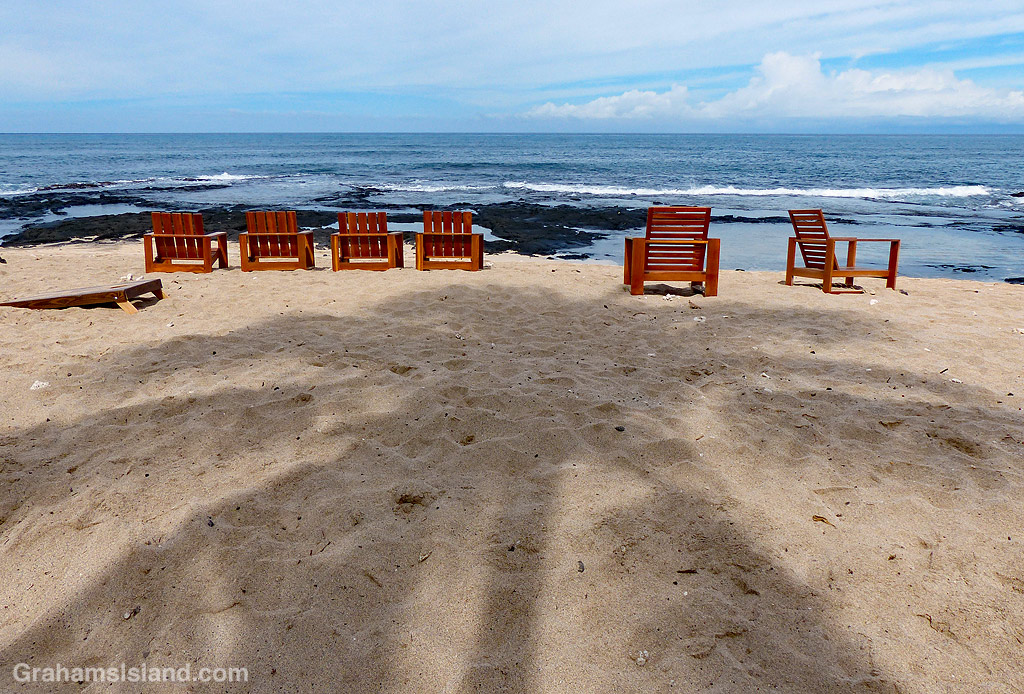
The first is a simple take on light and dark, or light and shadow. On a recent walk along the shoreline, the shadow of a palm tree imposed on a sunny beach, deserted except for empty chairs.
This past week or so has been a bit bleak weather-wise. At one point we had a high wind warning, winter storm warning, flash flood warning, and a high surf warning. The warnings were justified. Winds blew at 40 to 50 knots with higher gusts. Rain bucketed down. Surf pounded the shorelines. It was an unfortunate week to be vacationing here.
Meanwhile, up on Mauna Kea and Mauna Loa, the winter storm warning produced a decent snowfall giving those peaks a Christmassy look, albeit a few weeks too late.
I saw this plane when I was out walking one day, near the northern tip of the Big Island. It was flying quite low, unusually so for a big plane, as it headed south toward Kailua Kona.
The plane is a Boeing 747-400, formerly owned by Japan Airlines, but now used by GE to test jet engines. Apparently, it was operating out of Kona Airport for a week, performing warm weather engine tests.
This week’s Sunday Stills challenge theme is ‘Old.’ See more offerings here.
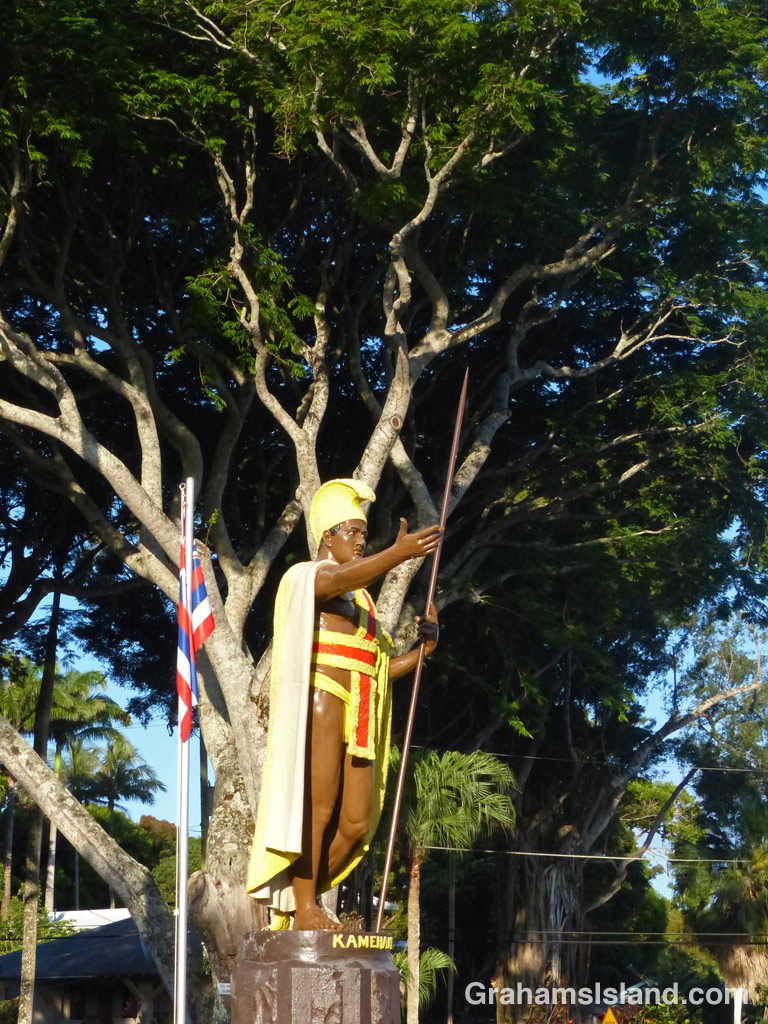
This is the original statue of Kamehameha 1, the king who first united the Hawaiian Islands. The statue was commissioned in 1878, but was lost off the Falkland Islands. A new statue was made, but in the meantime, the original one was salvaged. The new statue was put up in Honolulu and the original shipped to Kapaau.
Not long after I took this photo, the trees in the background were badly damaged during a windstorm and had to be cut down, so this scene looks quite different today.
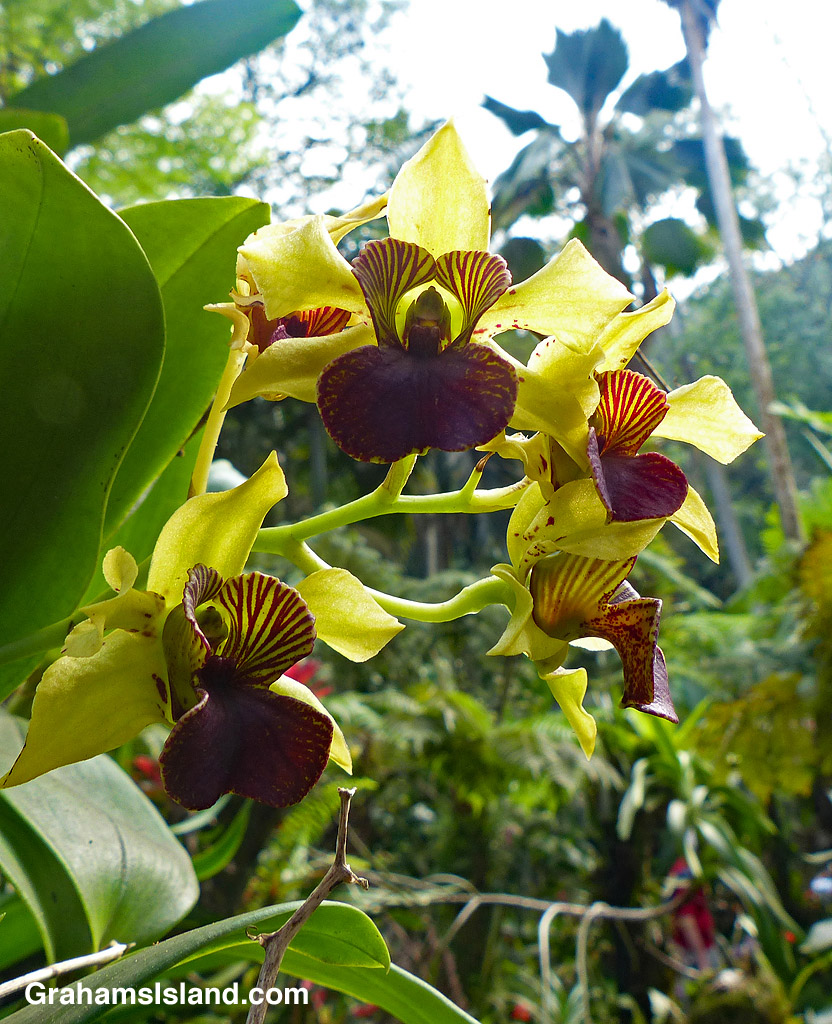
This laelia rubescens (aurea x alba) orchid was at Hawaii Tropical Botanical Garden. For more information about Hawaii Tropical Botanical Garden, go to htbg.com.





 Graham's Island