Churches

The Kalahikiola Congregational Church in Kapaau, Hawaii
The St. Augustines Episcopal Church in Kapaau, Hawaii
The Sacred Heart Catholic Church in Hawi, Hawaii

This week’s Sunday Stills challenge theme is ‘Churches, Temples, and Spiritual Centers.’ See more responses here.

Here’s a few of the churches that can be found in this part of the island.

Kalāhikiola Congregational Church (top photo) is located east of Kapaau, where rainfall is plentiful and the foliage lush. It was built in 1855, though previous versions had existed for some years before this. The church was badly damaged by an earthquake in 2006, but rebuilt in the winter of 2009/2010.

St. Augustine’s Episcopal Church (second photo) was founded in 1884 in Kapaau, and expanded in 1913. It sits on a small hill by the main highway.

Sacred Heart Catholic Church (third photo) was founded in Hawi in 1905, but this structure was built in 1925 and continues to be used daily to this day.

Kohala Baptist Church (bottom photo) is located on the road to Pololu at Makapala. It can’t be seen from the road, but there is a sign by the highway pointing out the way. Currently, the church is undergoing some renovations and services are held in the area below the Royal Poinciana tree on the grounds.

The Kohala Baptist Church in Kapaau, Hawaii

Akala

An unripe Akala berry and leaves
An Akala flower with leaves and a new berry
A ripe Akala berry

‘Akala (Rubus macraei) is a native Hawaiian raspberry. It’s unusual for its large edible berries and slightly thorny stems. Most Hawaiian native plants didn’t need such lures or defenses because there were no grazing animals in Hawaii until their introduction by humans.

The berries are larger than non-native blackberries, but less sweet, and their juice was used as a dye in days gone by.

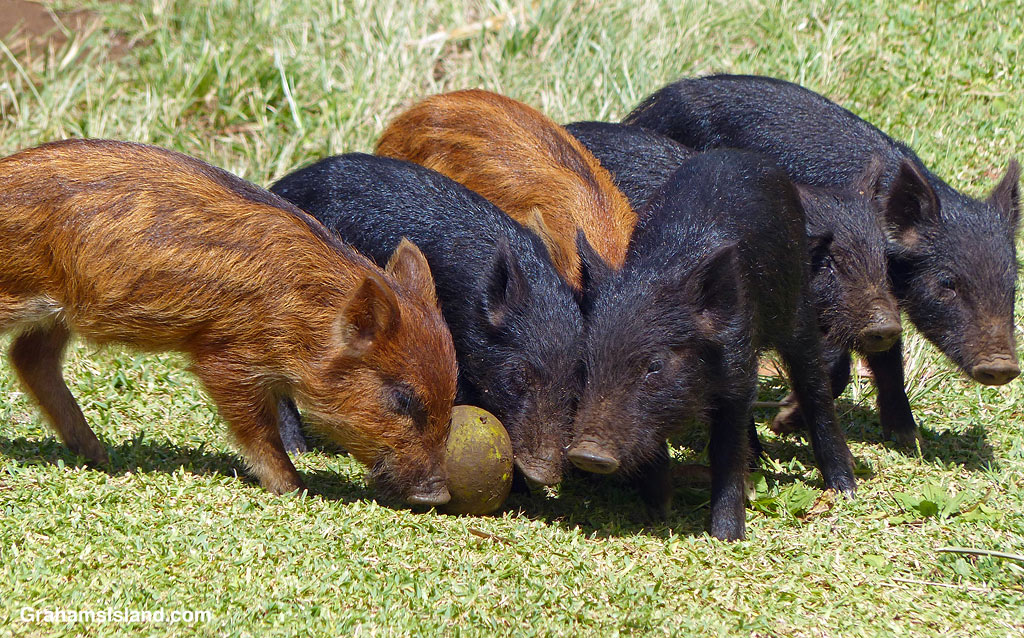
How to play pigball

Piglets wrestle for a mango

Leave one large unripe mango on the ground and wait for the arrival of seven small piglets. Watch them bat the mango around, trying to snare it in their small jaws. There are no rules in this game, so pushing and shoving is common, as is running around for no clear reason.

The winner is the one who snags and keeps the mango.

Piglets wrestle for a mango

It’s a strenuous activity so a post-game rest is advised.

Piglets resting

Yellow Tangs

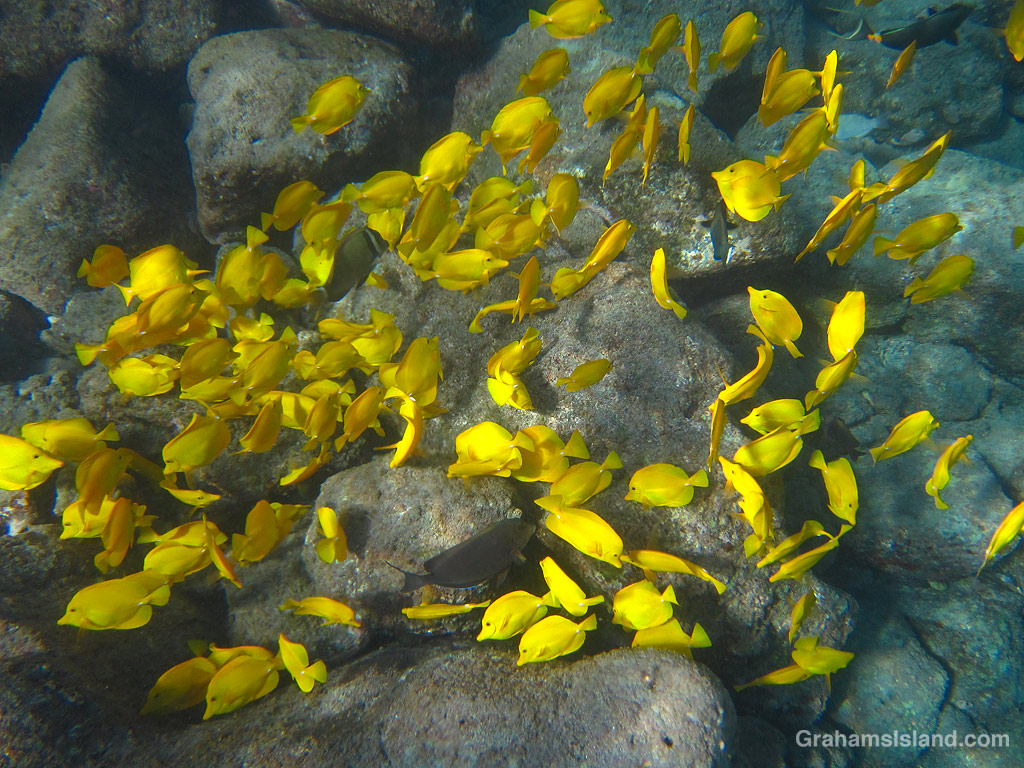
Yellow tangs swim in the waters off Hawaii

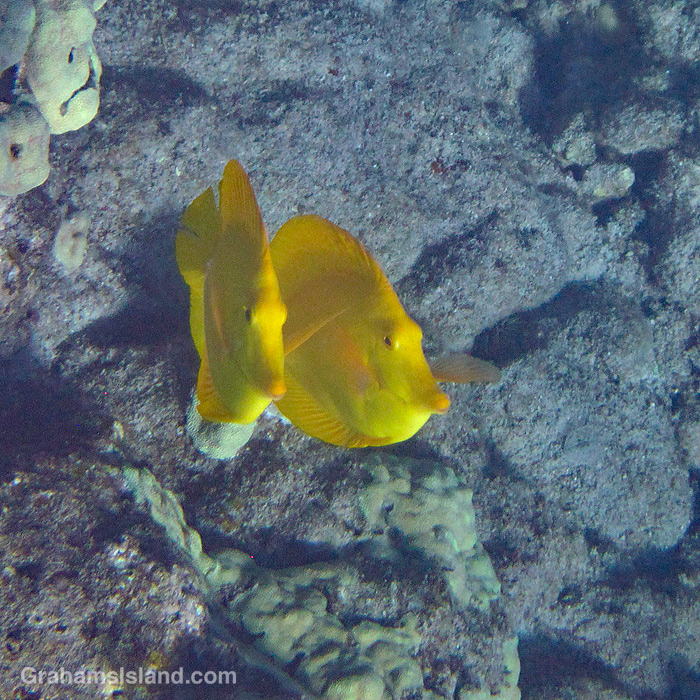
Yellow Tangs are about the most easily identified reef fish. They’re easily spotted from shore, puttering about in the shallows in large schools. In the water, their bright yellow color stands out even in murky water.

These fish are almost entirely yellow except for the white scalpel at the base of the tail. One or the other of these sharp spines can be flicked out and can inflict a serious cut on the unwary. When they spar with each other, they go round in circles trying to keep the exposed scalpel of the other fish away from them while trying to maneuver their own into a dangerous position.

Yellow tangs are a prime target of the aquarium fish industry. They don’t breed in captivity so every yellow tang in an aquarium is one taken from the wild. While these fish can been found around the Pacific, Hawaii is where they are most numerous and where most of these yellow tangs are taken. There have been a few bans on the trade in some places, affording some respite from the steady decline in numbers. Alas, our elected representatives have yet to exhibit enough backbone to impose a ban that is permanent and significant enough to allow fish stocks to truly rebound.

Yellow tangs swim in the waters off Hawaii

Another invasive species

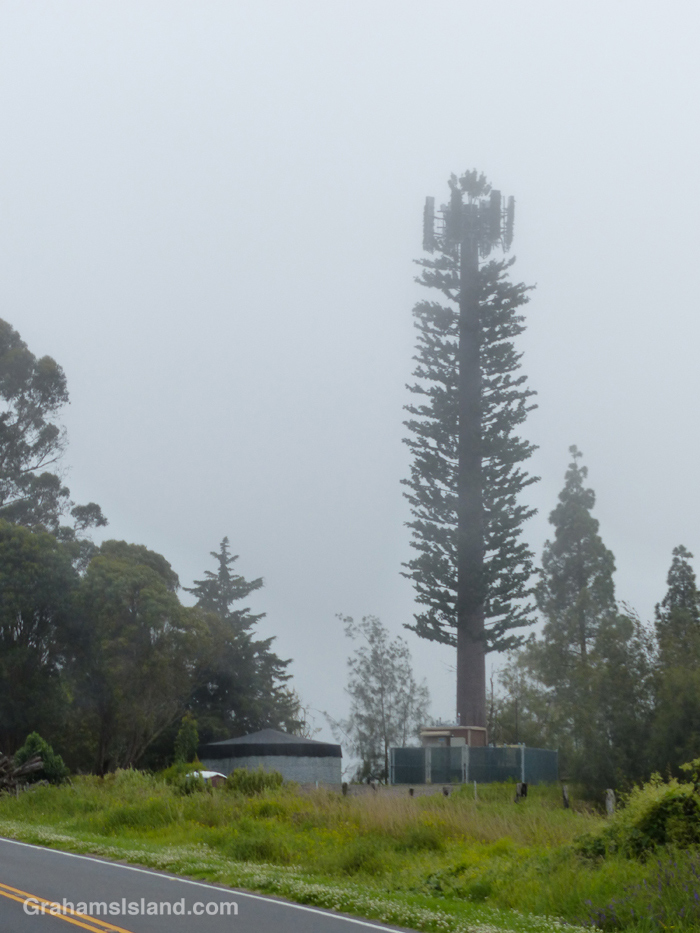
A cell phone tower disguised as a tree in Hawaii

I went for a drive up Old Saddle Road yesterday and noticed this unusual tree. It is, of course, that now ubiquitous invasive species, the cell phone tower. At least this one had the good grace to try and blend into its surroundings, and does a decent job of it.

This ‘tree’ is located on the grounds of Camp Kilohana, the Girls Scouts Camp on the Big Island.

Posted for Bushboy’s Last on the Card photo challenge. See more responses here.

Road closed

The spot where the 2022 Mauna Loa eruption crossed the road to the observatory

This week’s Sunday Stills challenge theme is ‘Roads, Paths, and Streets.’ See more responses here.

After a recent hike off Saddle Road, I had time to take a drive up one of my favorite roads on the island, which leads to the Mauna Loa Observatory. Well, it used to; it doesn’t get there anymore. That’s because a flow from last fall’s eruption of Mauna Loa crossed the road a few miles short of its destination. I was curious to see what the scene looked like now.

The cloudy skies added some atmosphere to the drive which was, as always, a lot of fun. It’s a winding one lane road, so even though there’s little traffic, one has to pay attention. Any distraction could result in driving off the road into the inhospitable lava fields bordering it.

I confess, my secret hope was that, when I arrived at the flow, there would be a sign saying ‘Road Closed.’ Alas, that was not the case. Clearly, the Department of Transportation figured the seven foot high wall of lava conveyed the message well enough on its own. The only sign there warned against walking on the new flow. I didn’t need that warning. This is a’a lava which is really hard to walk on anyway, and in a new flow it could be quite unstable and even harbor pockets where one could fall through into still hot lava! Still, I’m sure some folks have clambered up there just because it’s there.

I took a few photos, then turned around and headed back down, not least because it was damp, windy and I was freezing, which is not why anyone comes to, or lives in, Hawaii.

The HISEAS dome on the slopes of Mauna Loa

On the drive down, I got a good view of the HI-SEAS (Hawai’i Space Exploration Analog and Simulation) dome. This is where teams of volunteers do research for what it would be like to be living on the Moon or Mars. I’m not sure if it’s in use since the COVID shutdown, but at least it survived the last eruption.

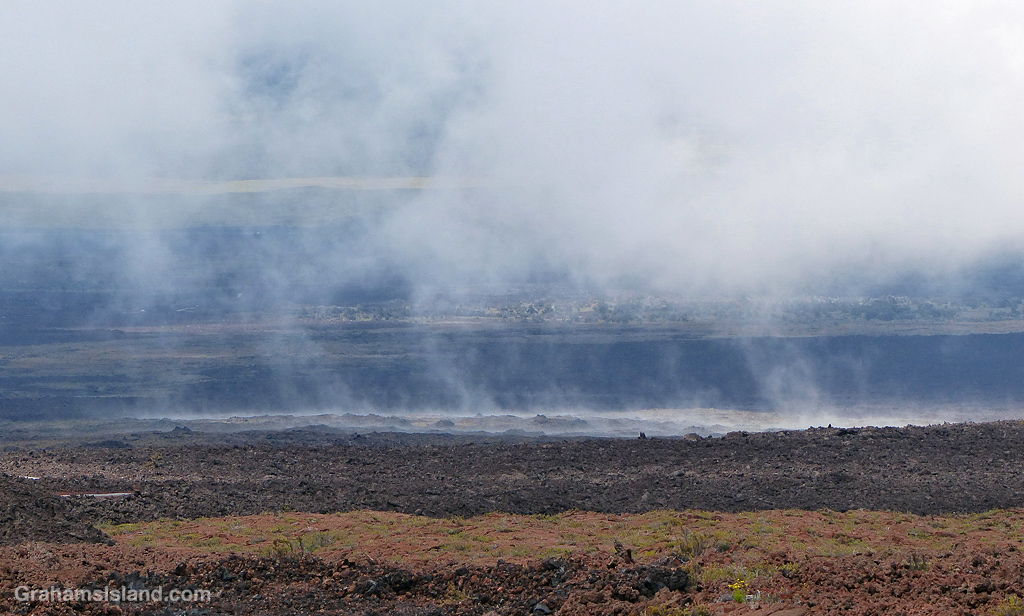
Clouds meet the and on the saddle between Mauna Loa and Mauna Kea in Hawaii

Farther down, the land seemed to be steaming, but in the saddle between Mauna Kea and Mauna Loa, the weather often seems to be part of the landscape.

The Mauna Loa Observatory Road on a cloudy afternoon

And the views, which change with every twist in the road, are strange and stunning and wonderful. It may not be possible currently to reach the end of the road, but it’s still a great drive.