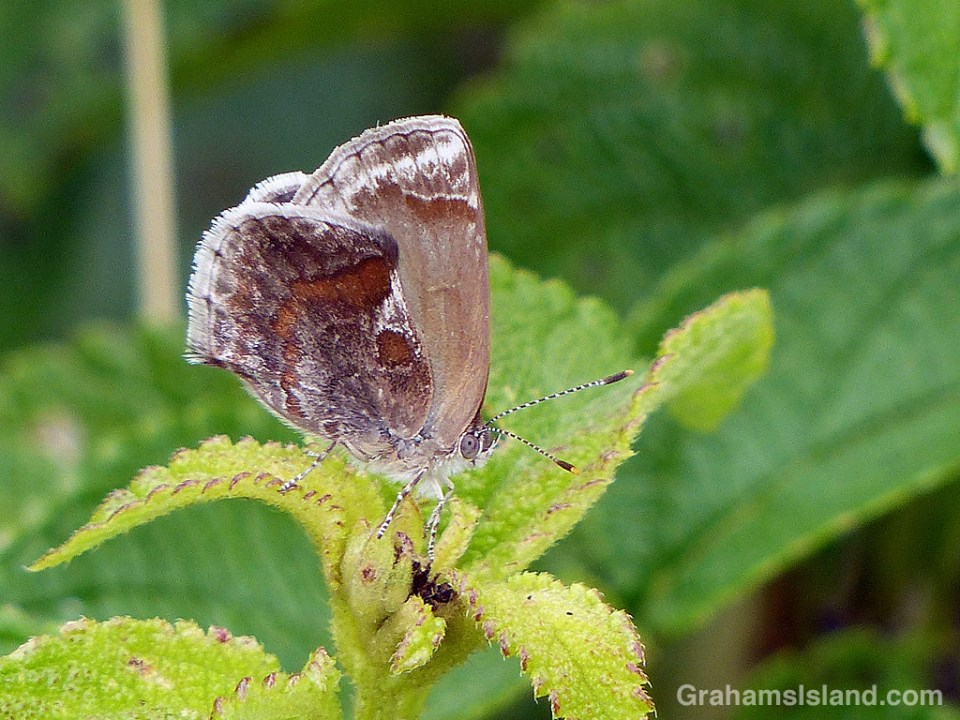
Smaller lantana butterfly

Smaller Lantana Butterfly

The smaller lantana butterfly, also known as the lantana scrub-hairstreak (Strymon bazochii), was introduced to Hawaii in 1902 to control lantana species. I don’t believe it has been terribly successful in that regard, but it has managed to establish itself in Hawaii. At least it hasn’t turned out to be a deadly scourge like the mongoose and several other species. For that we can be grateful.


Cannonball tree flowers

Cannonball tree flowers

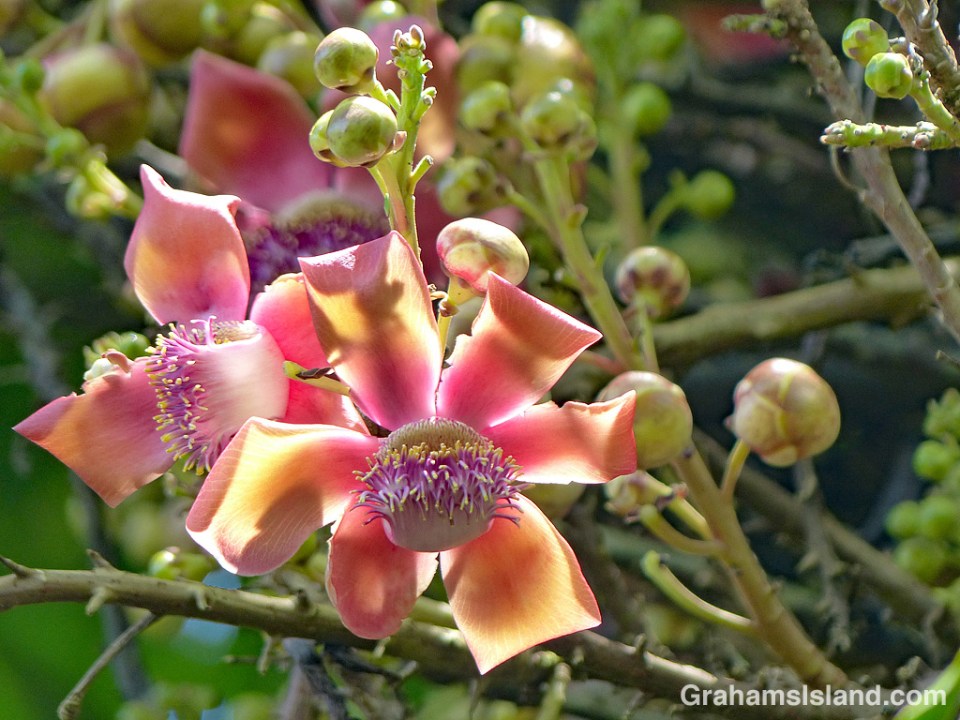
Cannonball treeI’ve posted a photo of a cannonball tree (Couroupita guianensis) before, here. That one focused on the cannonballs that give the tree its name. On this occasion I was taken by the flowers which can vary in color from pink to deep red. These flowers were on the pink end of the scale. The flowers are also fragrant, especially in the early morning and evening.

The flowers grow directly off the tree trunk and all the way up, but it takes a closer look to really appreciate how beautiful they are.

Rainbow Falls

Rainbow Falls and rainbow

Rainbow Falls and offeringRainbow Falls are located in Wailuku River State Park, in Hilo. They get their name from the fact that, in the mornings, rainbows often form in the mist from the falls (above).

Center, someone left an offering, possibly to Hina, mother of the demigod Maui, who is said to have lived in the cave behind the falls.

And below, someone who has inadvertently walked past the 83,000 ‘Danger’ and ‘Warning’ signs to wander around at the top of the falls. Flash floods occur often and people die here every year.

Rainbow Falls

This is your 5 a.m. alarm call

Northern Cardinal in a tree

Northern Cardinal looking downA while back, I exposed roosters (here) as the frauds they are when it comes to greeting the dawn. Yes, they crow at dawn, but only because they crow, randomly, 24/7.

But the dawn chorus is not a myth. It’s the time when birds that have managed to get a decent night’s sleep, despite the roosters, wake up and let other birds know that they made it through the night and this is still their territory. Around here, there’s both a great variety and large number of birds singing in the chorus, but the chorus leader is this bird.

At this time of year, this northern cardinal cranks it up around five in the morning. He’s almost always in this spot, high in a tree, about 60 feet from the house and, if I didn’t know better, I’d swear he has an amplifier and speakers up there, too. The northern cardinal has a loud and piercing voice, as well as a wide variety of songs to use it on. They include, ‘pichooey, pichooey, pichooey,’ ‘puertorico, puertorico, puertorico,’ and the ever popular ‘party, party, party, party.’

Sometimes, these calls get a response from another cardinal in the hedge about 10 feet from the bedroom window, which is startling to say the least, especially at that time in the morning when I’m not exactly at my best.

While I confess to having muttered a few less-than-complimentary words at the chorus, and this bird in particular, I’m grateful for the numbers and variety of birds around here. So I guess I wouldn’t have it any other way. And just lately, this cardinal hasn’t been on his appointed perch in the wee hours. I’m kind of worried.

Monk seals resting

Monk Seals Resting

I’m posting this photo in response to this week’s Sunday Stills challenge on the theme of ‘Friend’ (see more responses here), though it would be equally suitable for next week’s ‘Lazy Days.’

Monk seals are solitary animals, the main exception being the six weeks or so a mother spends with her new pup, teaching it the tricks of the trade, before leaving it to fend for itself. But for a three month period in late 2016, these two monk seals spent a lot of time together.

The top seal is I05, a male, affectionately known as Igor. He’s a Big Island seal and appears to spend his time on the Kohala and Kona coast. The other is B00, a female, affectionately known as Boo. She was born in Kauai and had previously been seen on Molokai and Maui, but now appears to spend much of her time on the Kona coast. Whereas not too much had been known about B00, I05 was regularly seen and was a notorious loner. So his ongoing liaison was quite out of character.

They seemed very relaxed and content in each other’s company, and here are resting ashore, as monk seals do, before heading back into the water to feed.

A green anole looking for its keys?

Anole hanging on to leaf

Something about how this green anole is hanging on to the leaf, and its expression — a touch of frustration and resignation — made me imagine it was looking for something, lost keys perhaps, or that bug it had stashed for later.

More likely, it’s thinking, ‘If I keep very still, perhaps this annoying thing will go away.’

Tenting for termites

Tented for termites

No, it’s not the circus come to town. These tents are for a more macabre purpose, the termination of termites.

As in most warm climates, termites are a problem here. Houses, especially older ones, are easily colonized. Without treatment, the occupying termites will consume wood from the inside, leaving a thin membrane as protection. Infested wood might look fine, but a gentle push on the surface will go right through two or three layers of paint to the termites’ cavern inside.

Besides leaning against a wall and going right through, a prime indicator of termites is small mounds of little round pellets below a pinprick hole in a wall or piece of furniture. These are termite fecal pellets, which the worker termites clear out of the nest from time to time.

Another indicator of the presence of termites is to turn a light on and find a horde of them flying around the room. Around here, May is the prime time for this activity. These flying termites are fertile males and females, leaving the nest they grew up in to find a place of their own and start a new colony.

As unpleasant as it is to find a room full of flying termites, it’s even worse to wake up and see countertops littered with discarded wings, a sure sign that these fertile termites have moved in to a new spot.

So tenting for termites is common practice here. The structure is covered with nylon sheeting until it is completely sealed and then a fumigant is pumped in. The tent usually remains on overnight. After the tent is removed, the house has to sit empty a while for the gas to dissipate. It’s not wise to go back in too early or one could find oneself joining the termites. Typically it can be two or three days before a home can be reoccupied.

Tenting for termites is effective but it has downsides. It works for drywood termites, but not subterranean termites since they live outside the house and just dine inside. There are also environmental concerns about the process. And while fumigation works, there’s no guarantee that a new colony of termites won’t move in just as soon as the gas has cleared.

Tenting for termites