Helicopters circle Pu’u O’o vent

Tour helicopters circle Pu'u O'o vent on the Big Island of Hawaii

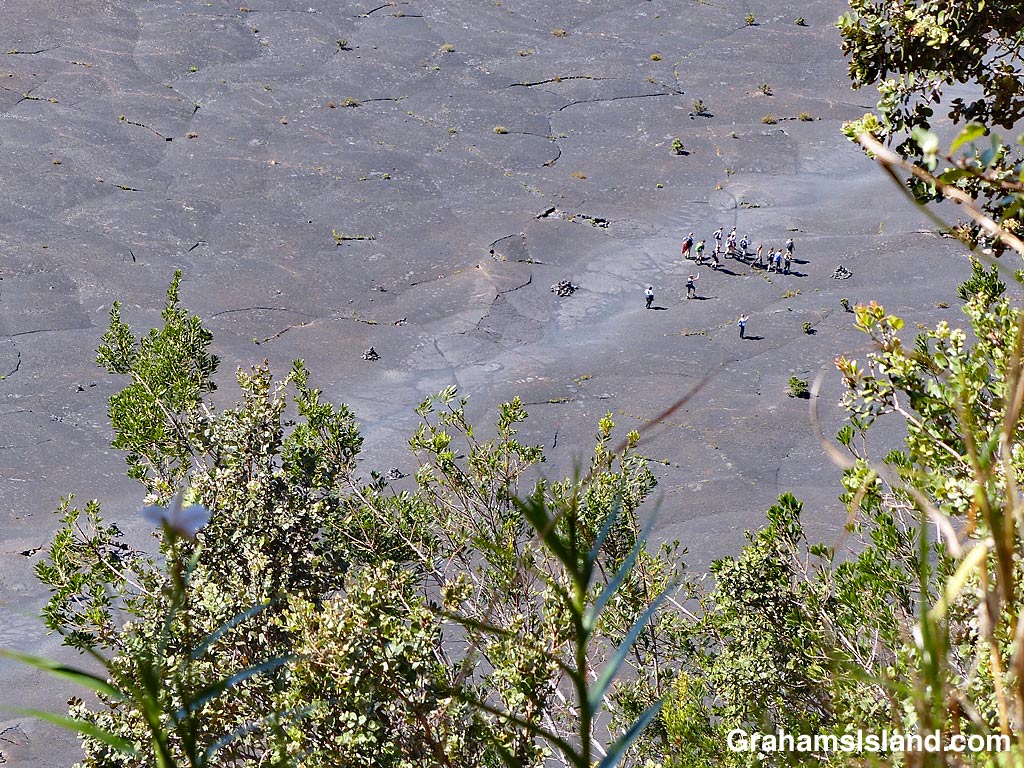
During a recent hike on the Nāpau Trail in Hawaii Volcanoes National Park, one accompaniment was the throb of helicopter engines. The active flow from Pu’u O’o vent, and its ultimate outpouring into the ocean, is a great attraction for visitors and locals alike.

One way of seeing these events is on a helicopter tour and, as I sat at the Nāpau overlook, I noticed there was a clear order to those helicopter visits. A pair would arrive from the west, one a bit behind the other. One would circle the vent, the other visit the ocean entry. Then they’d switch. After 10 or 15 minutes, the two helicopters would head off to the northeast and soon after, the next pair would arrive.

For more information about Hawaii Volcanoes National Park, go to nps.gov/havo/.
 For more information about Kilauea Volcano and it’s eruptions, go to hvo.wr.usgs.gov/kilauea/history/main.html.


Threadfin jack juveniles

A pair of Threadfin Jack juveniles swim in the waters off the Big Island of Hawaii

Adult threadfin jack are large, stocky, deepwater fish and rarely seen. Juvenile threadfins aren’t seen often either, even though they spend their time in shallow waters. One reason for this is that they don’t appear in great numbers. Another is that they’re easy to miss in the often stirred-up shallows. When they are seen, many people see their long, wavering filaments and think they’re jellyfish (I did the first time I saw one).

If the juveniles are to be seen, this is time of year for it. I’ve been looking out for them for a few weeks without success. Then, a few days ago, my wife saw one. A couple of days later, in the same area, we got in the water and saw one, then another, then a third. The water was quite murky and the threadfins quickly shimmied off among the rocks.

I managed to snap a couple of photos, but wasn’t sure the fish were even in the frame because they were hard to see on the camera screen. So I was thrilled that one of the photos had captured these two as they swam by. Hopefully, they’ll be around a few more weeks before they head out to deeper water, so I’ll get to see them again.


Kaloko fishpond

The wall of Kaloko Fishpond, in Kaloko-Honokohau National Historical Park

The wall of Kaloko Fishpond, in Kaloko-Honokohau National Historical Park, is currently under repair. According to the park’s website, work on rebuilding the wall began in 1998. This end looks good, but there’s still work to be done at the far end.

For more information about Kaloko-Honokohau National Historical Park, go to www.nps.gov/kaho/index.htm

For more information about Kaloko Fishpond, go to www.keolamagazine.com/ocean/kaloko-fishpond-a-valuable-cultural-resource/


Hawai‘i ‘amakihi

A Hawaii Amakihi about to feed on mamane flowers.A Hawaii Amakihi about to feed on mamane flowers.

‘Amakihi are endemic honeycreepers and the different islands have slightly different versions of the bird. The Hawai‘i ‘amakihi is very similar to the Maui ‘amakihi, but the O‘ahu and Kaua‘i birds have more noticeable differences. They’re one native bird that has adapted relatively well to changing habitat and introduced diseases including avian malaria.

This one was feeding from bright yellow māmane flowers at the Palila Forest Discovery Trail on the southwest slope of Mauna Kea.


Cattle and egrets

A cow chats with two cattle egrets.

I’m not sure one could call cows and cattle egrets friends. When cows graze, cattle egrets snaffle bugs stirred up in that process, but I don’t know of anything the egrets do for the cows in return.

However, this photo has a friendly feel to it. I picture the cow saying, ‘So you can fly, right? Could you teach me how?’ The egrets look suitably nonplussed at the suggestion.

Feel free to suggest your own caption in the comments.