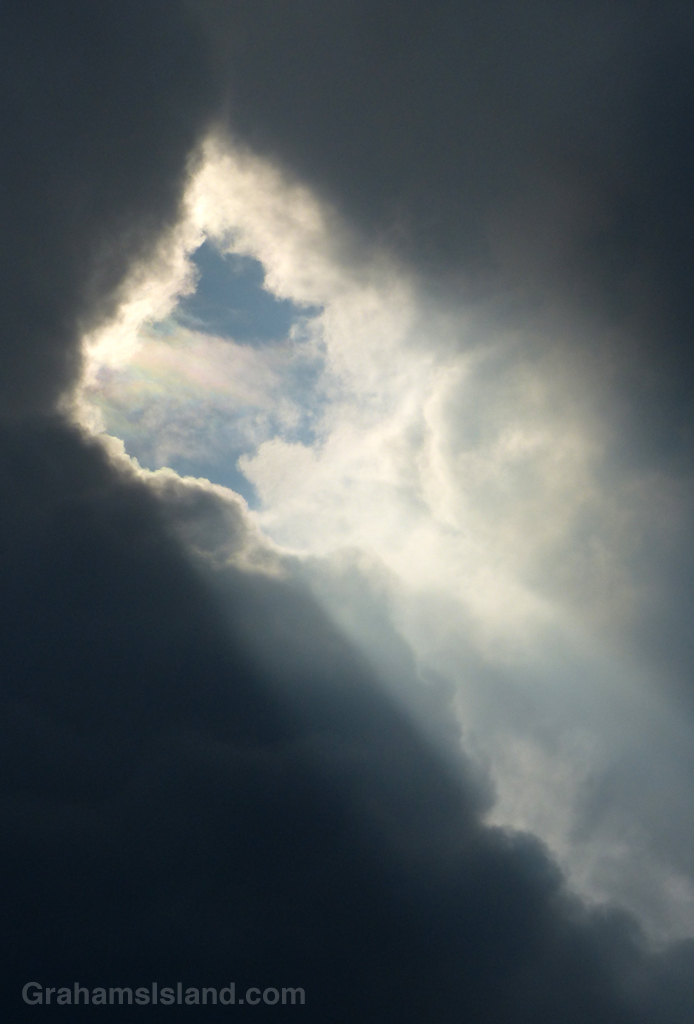
A shaft of sunlight blazes through a small hole in the clouds. I was waiting for God to speak to me – kind of like the scene in Monty Python and the Holy Grail where King Arthur gets his marching orders.

A shaft of sunlight blazes through a small hole in the clouds. I was waiting for God to speak to me – kind of like the scene in Monty Python and the Holy Grail where King Arthur gets his marching orders.
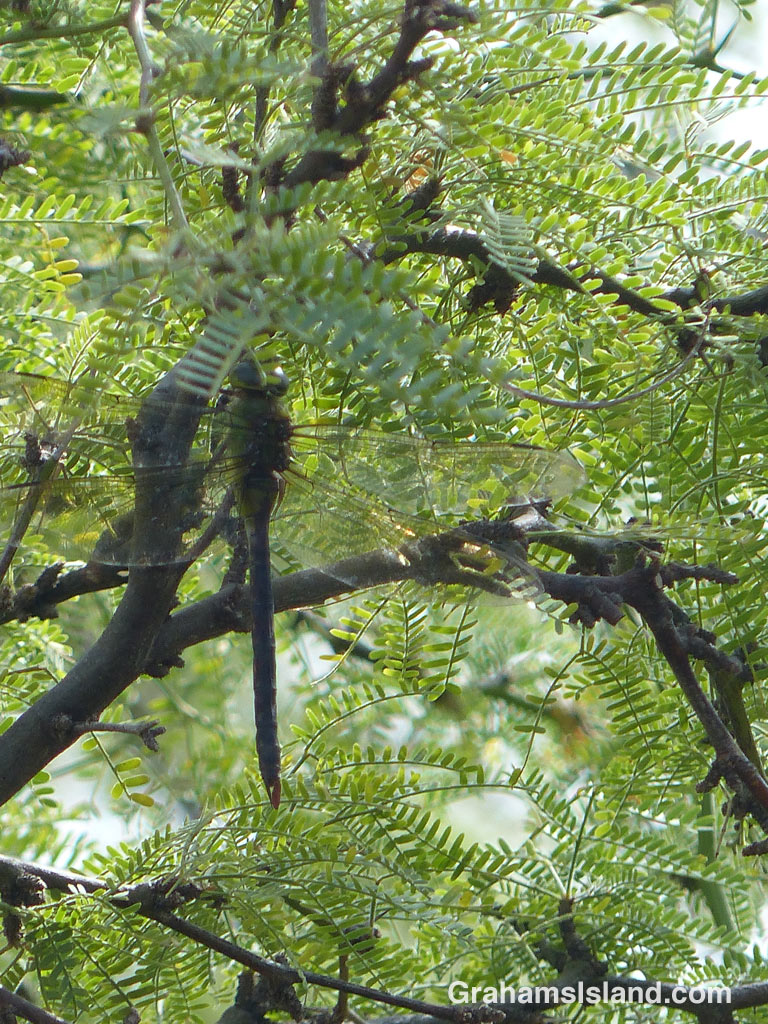
I was walking through a stand of kiawes when a dragonfly jitterbugged by. I hoped it might loop back so that I could get a photo of it, but instead it headed toward the top of a tree and disappeared. I thought I saw where it went and got as close as I could, which was still a good distance away. I trained my camera in its direction and took a few photos, not sure if it was even in shot. I thought I might just be taking pictures of a twig. It wasn’t until I got home and looked at the photos that I saw I’d been right about its location all along.

The start of the trail below the parking area at Kiholo.

The house built for Loretta Lynn at Kiholo.
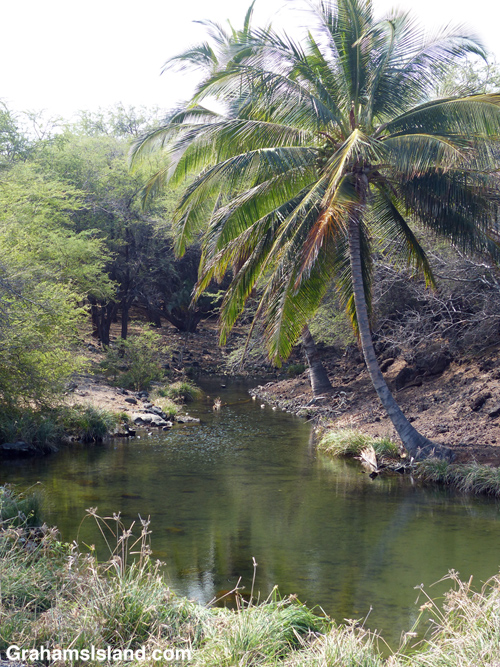
The anchialine pool at the south end of the first beach.
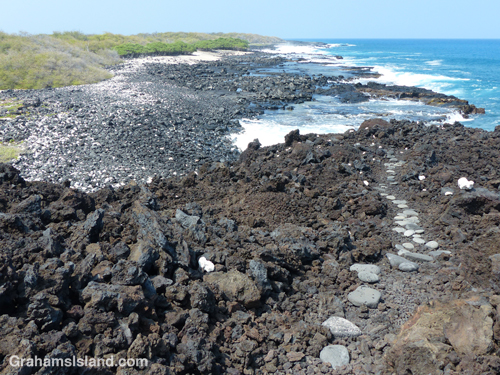
The trail winds down to the bench before Mano Point.
This hike is a not-too difficult, out and back, 4-mile round trip. Aside from wanting to check out this part of the coast, I also wanted to try out a new pair of shoes, more suited to hiking, rather than the old pair of walking shoes I’d been flogging my toes in recently.
The access road to the trailhead can be rough, but on this occasion had been recently graded, at least down to the private road near the bottom. The hike follows the coast south from the Kiholo parking lot. There’s camping here Friday through Sunday, but on this day it was much quieter – three people on the beach when I set out, not many more when I returned. The day was hot, as it usually is on this coast, and the vog was thick enough to chew on.
The hike starts out crossing the first of three black sand beaches. It’s part of Kiholo State Park Reserve, which means it’s a park for which the plans have not yet been finalized. Behind this first beach is a house built by country singer Loretta Lynn back in the 1980s. It’s boarded up now, but is tabbed to be some sort of visitor/cultural center in the new park. Check back in 10 years or so to see how things are going!
At the south end of the beach is an anchialine pool. After the pool, the trail winds up and over a’a lava to another smaller black sand beach. There’s another up and over to the third beach, Luahinewai, which is backed by a large private residence, overlooking another anchialine pool and surrounded by vegetation. The second and third beaches were deserted, the a’a lava lumpy, the new shoes doing a splendid job of cushioning my feet.
After this third beach the trail heads up onto the lava for a while and crosses inland from Nawaikulua Point until it reaches a lava bench backed by vegetation. The trail, which is marked by some rounded stones in the trail and white coral markers on the edges, ends here. Mano Point is reached by crossing the lava bench, which is not difficult but, as always, requires keeping an eye on the ocean. On this day the waves were thudding against the edge of the bench, sending spray into the air and some whitewater onto the bench.
It was a day for keeping toward the back of the bench. A couple of days earlier, when the surf was higher, it would have been a place to avoid altogether. On a calmer day one could walk along the edge of the bench. This is an area of tide pools, arches, and collapsed lava tubes that have become surging inlets.
Mano Point itself is not much of a point, but it is easy to identify because it’s where most of the vegetation ends. It’s also marked by a black-bordered, yellow sign (only the back of which is seen from the land), which I think means that no aquarium fish collection (a contentious issue here) is allowed south of the sign. The return is back the same way. I took a dip in the water at one of the beaches on the way back, but the surge was fierce and I ended up discovering black sand in unlikely places for a couple of days afterwards.
It’s not an earth-shaking hike, but enjoyable in its own way. There was a breeze on the coast as there usually is, some whales to be seen offshore, and my new hiking shoes performed admirably. That said, crossing behind the last beach en route to my truck, I felt a pricking in my foot and took off my shoe to find a kiawe thorn that had penetrated the sole. Not the fault of the shoe though, just an occupational hazard of hiking here.
For more information about the Kiholo to Mano Point hike, go to bigislandhikes.com/kiholo-to-mano-point.
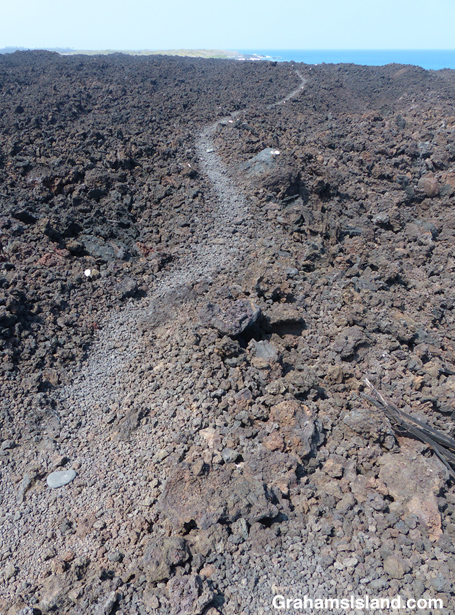
The trail heads across a’a lava after the third beach.
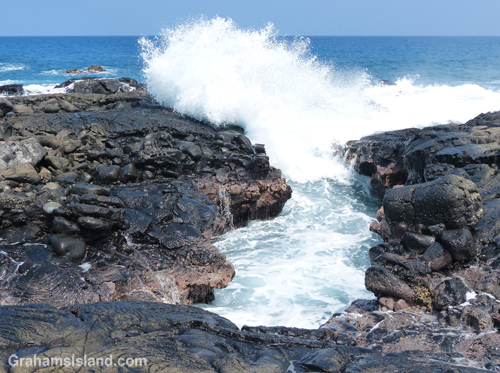
The water surges into a small inlet, probably an old lava tube.
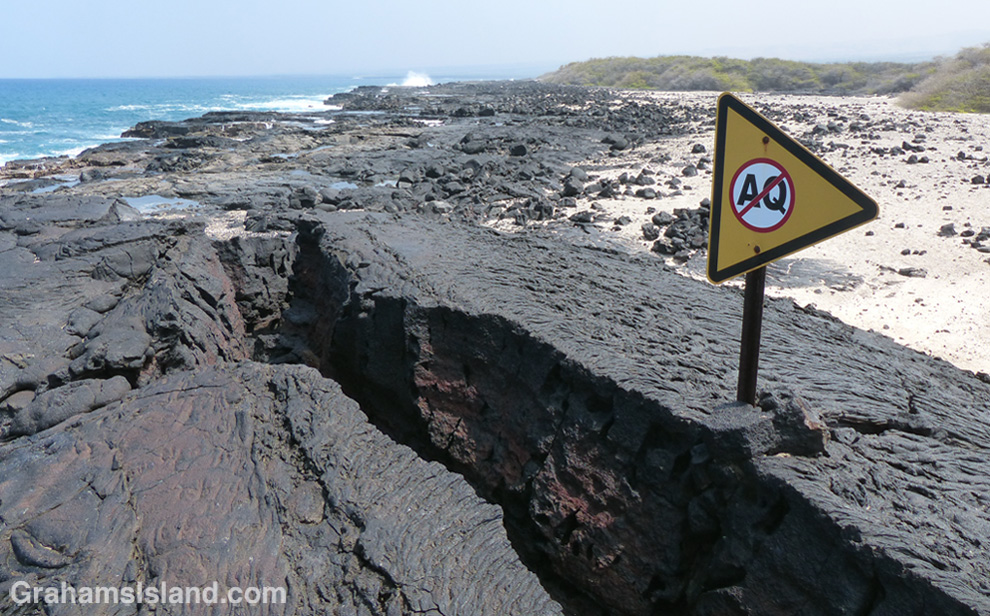
The sign at Mano Point which I think means ‘No Aquarium Fishing.’
 I saw this vanda orchid (v. Robert delight) while having lunch at Waipio Cookhouse. Love the blooms and hanging roots.
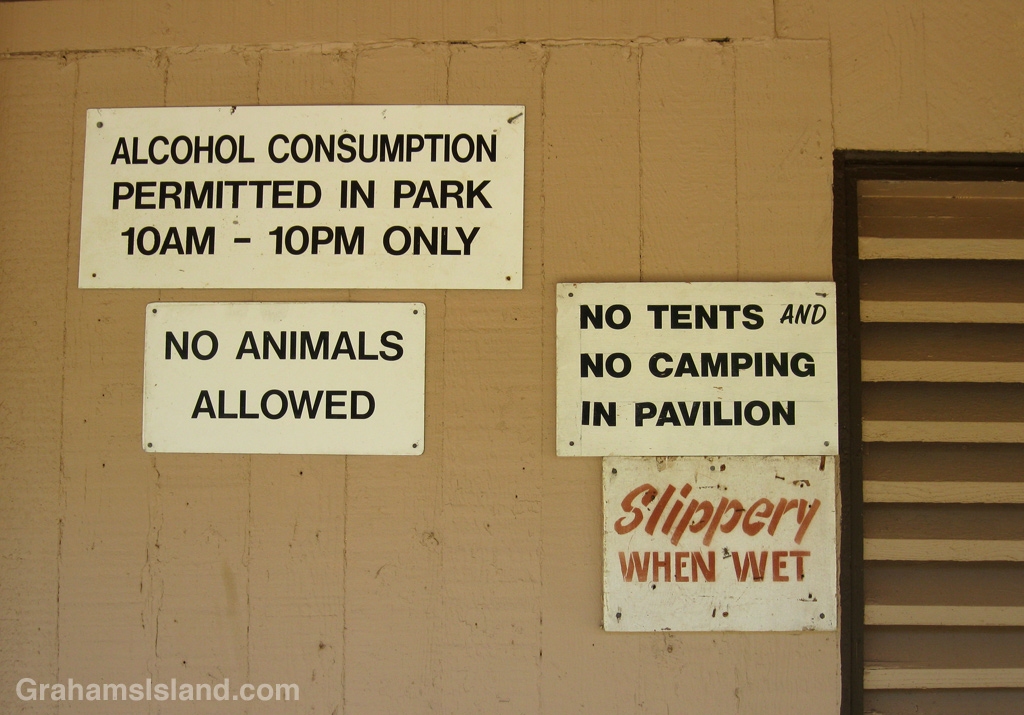 A favorite sign of mine at a local state park. Among the usual warnings is the draconian limit on drinking hours. I mean, what’s a person supposed to do for breakfast? It will come as no surprise to know that the rule is routinely ignored and I doubt it’s ever been enforced.
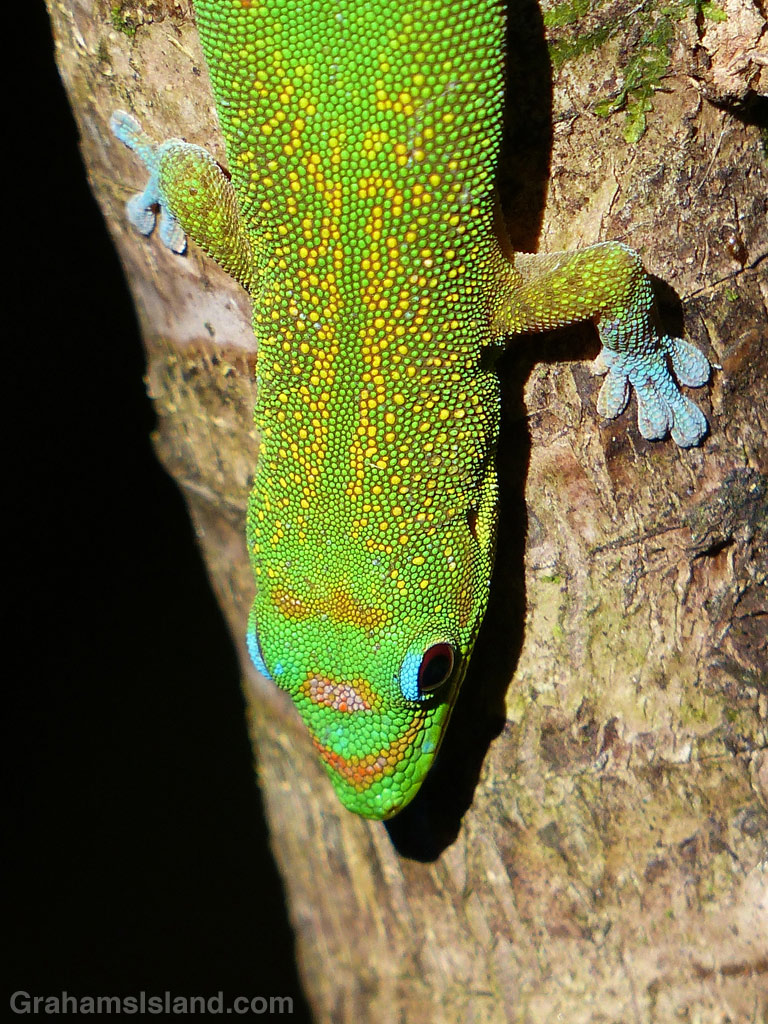 This gecko is probably the most commonly seen here, given that it’s diurnal, numerous, and not shy. It doesn’t hurt either that it’s so brightly colored. Its brilliant green and gold body has red markings on the head and back. A striking blue above the eyes and matching blue feet complete the ensemble.
The intensity of the colors can dull to a dowdy hue at certain times but when they’re at their brightest, they really are like little jewels.
For more information about geckos, go to geckoweb.org.
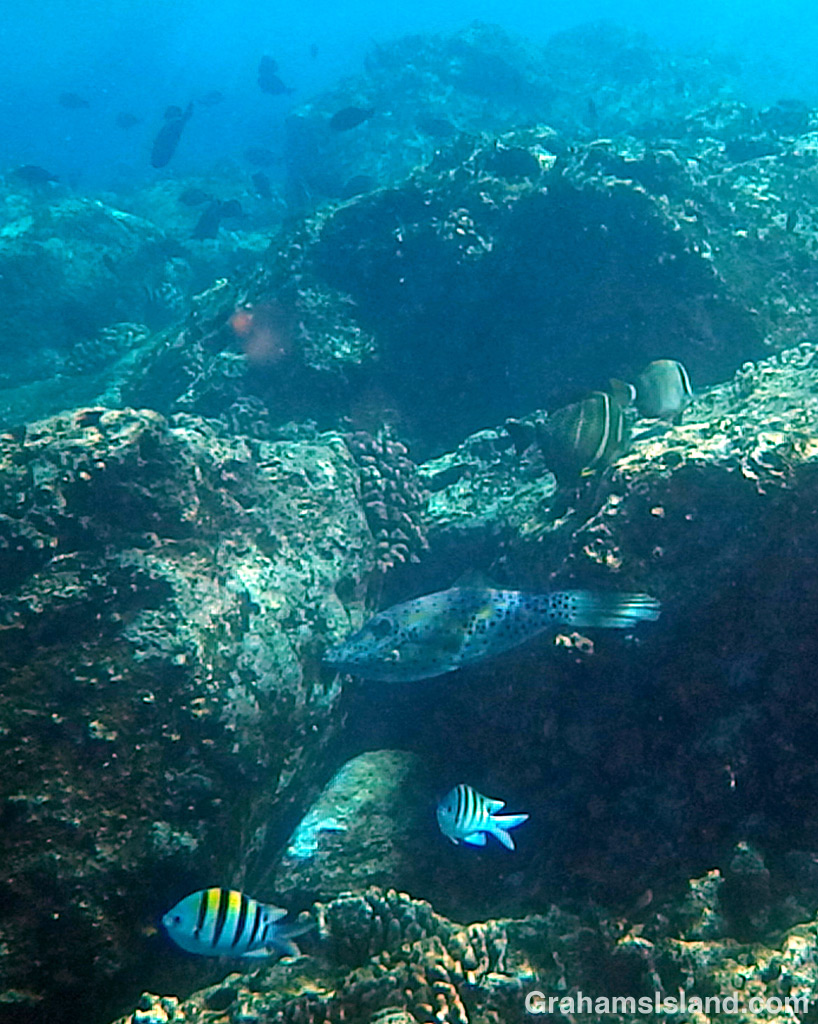 A great variety of fish make their home among the rocks and coral on the coast. From the bottom these are: two indo-pacific sergeants, a scrawled filefish, two or three whitebar surgeonfish, and in the background, a number of black triggerfish.
One of the pleasures of snorkeling here is that there’s always something to see and every day is different.
In my attempts to identify what I see in the water, I use John P. Hoover’s book The Ultimate Guide to Hawaiian Reef Fishes, Sea Turtles, Dolphins, Whales, and Seals. His website is hawaiisfishes.com.
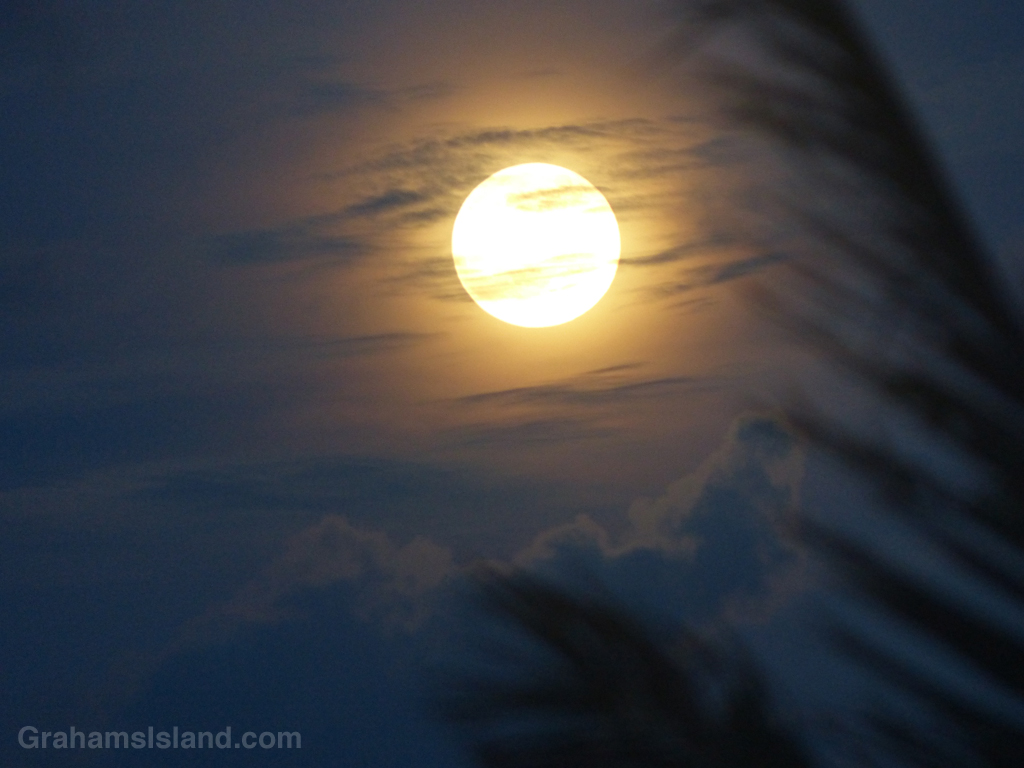 A full moon rises behind scattered clouds.

