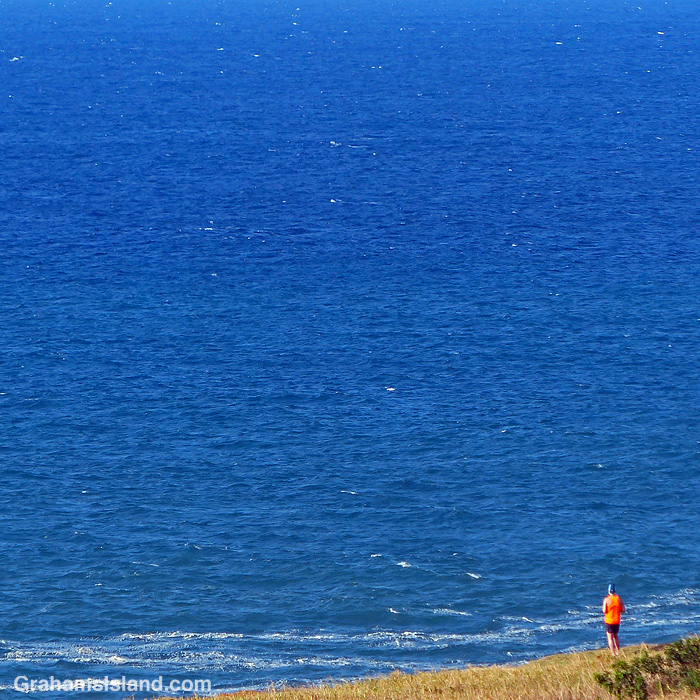
This is a holdover from the last Becky’s Squares challenge. I went with a different soupçon for that, but this one works for the current theme of ‘Bright,’ with that orange shirt standing out against the blue expanse of the ocean. (See more responses here.)
The seventh and final installment of my rainbow colors in response to Becky’s April Squares challenge theme of ‘Bright.’ (See more responses here.) ‘Violet’ also happens to be this week’s Sunday Stills challenge theme, which is what gave me the rainbow series idea in the first place. (See more responses here.)
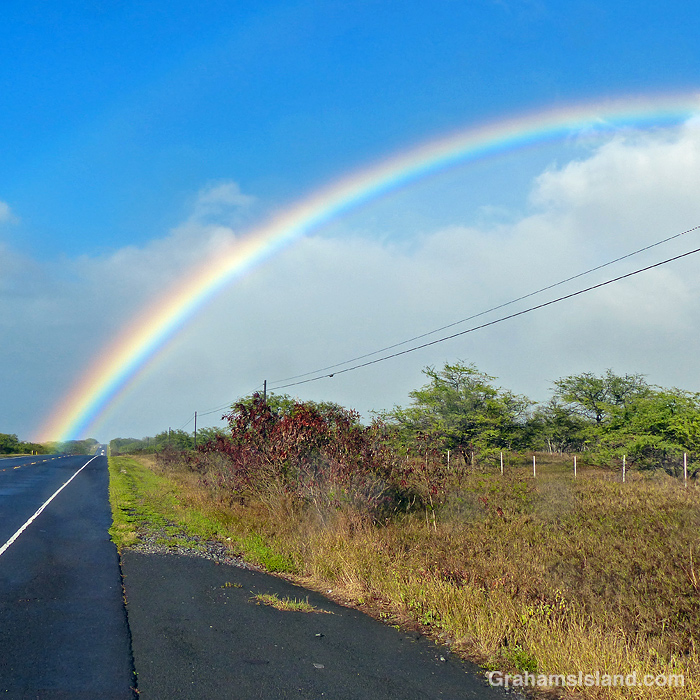
My last rainbow spans the main highway to North Kohala. This is a good spot to see rainbows in the afternoon. It’s cloudy and wet toward Kohala Mountain on the right, sunny and dry down by the coast on the left.
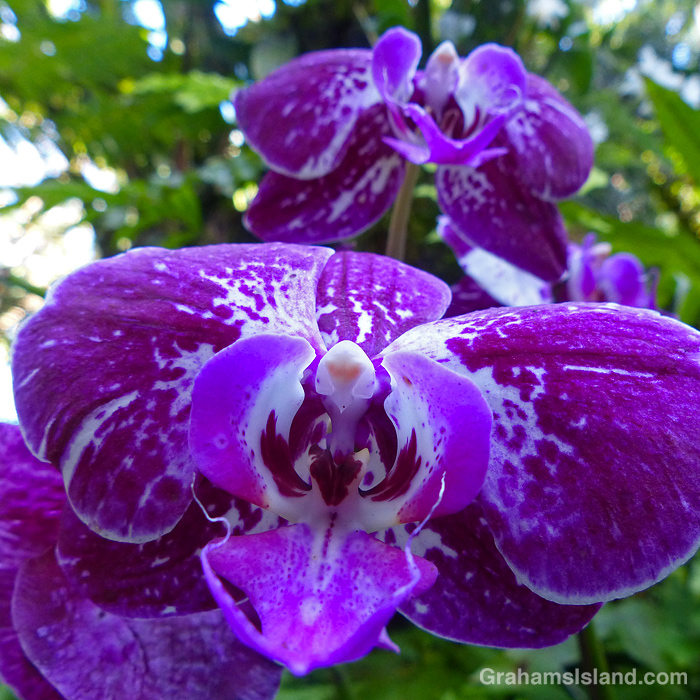
This phalaenopsis orchid falls somewhere in the violet/purple range. This was another instance where I looked up the official RGB color values for violet and found quite a range of possibilities.
The final photo has a Japanese white-eye sampling the good things on offer in a Japanese aloe flower, backed up by a bold and bright splash of violet bougainvillea flowers.
This is the sixth of my rainbow colors in response to Becky’s April Squares challenge theme of ‘Bright.’ (See more responses here.)
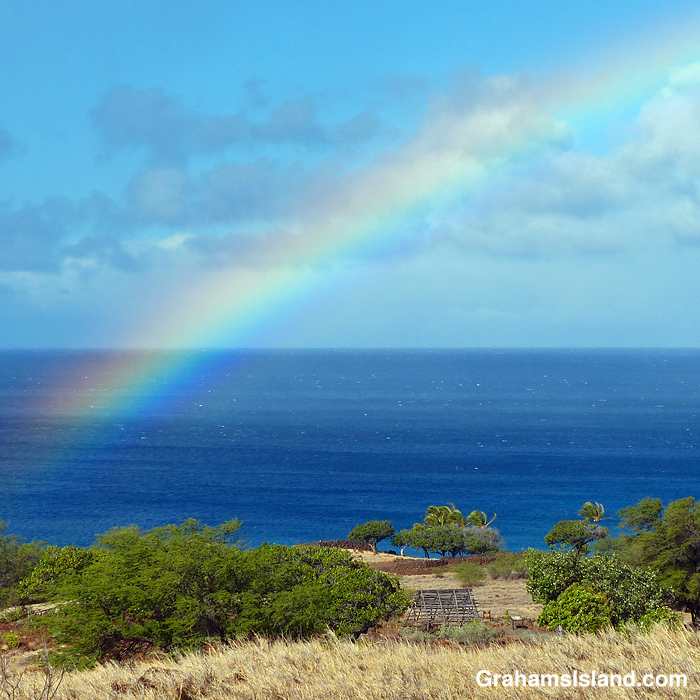
Today’s rainbow arches above Lapakahi State Historical Park in North Kohala. Lapakahi was an old Hawaiian fishing village and the ruins give some insight into the life and culture of those people.
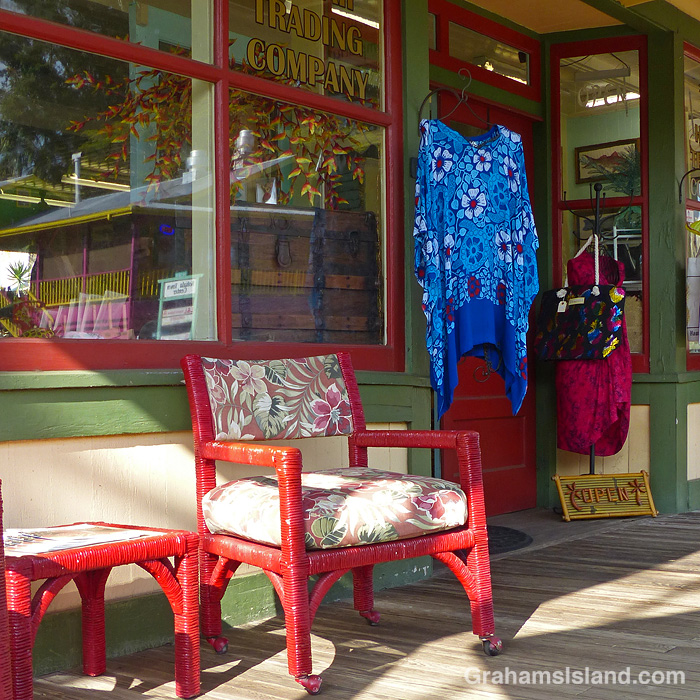
Second is a blue offering hanging outside the predominantly red and green Old Hawaiian Trading Company in Kapaau.
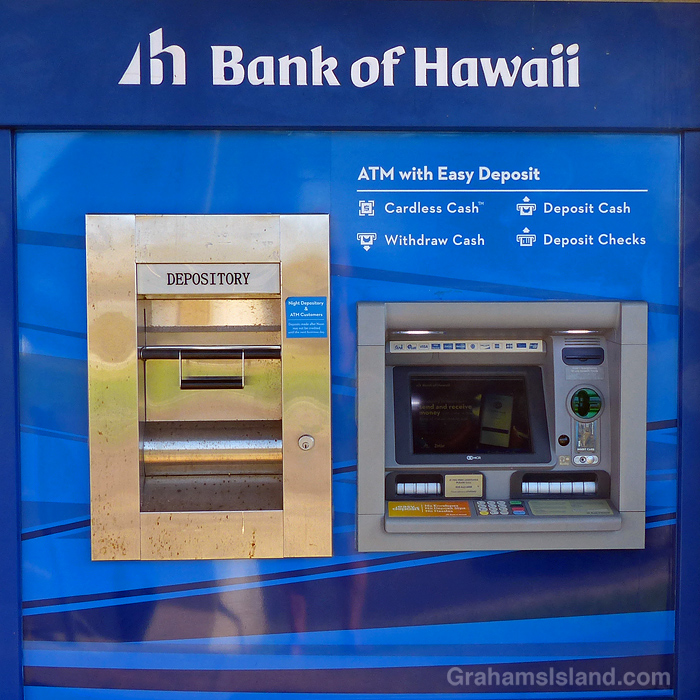
Third is all that’s left of the Bank of Hawaii in Kapaau. The bank used to occupy the whole building, but it’s now used as a senior center.
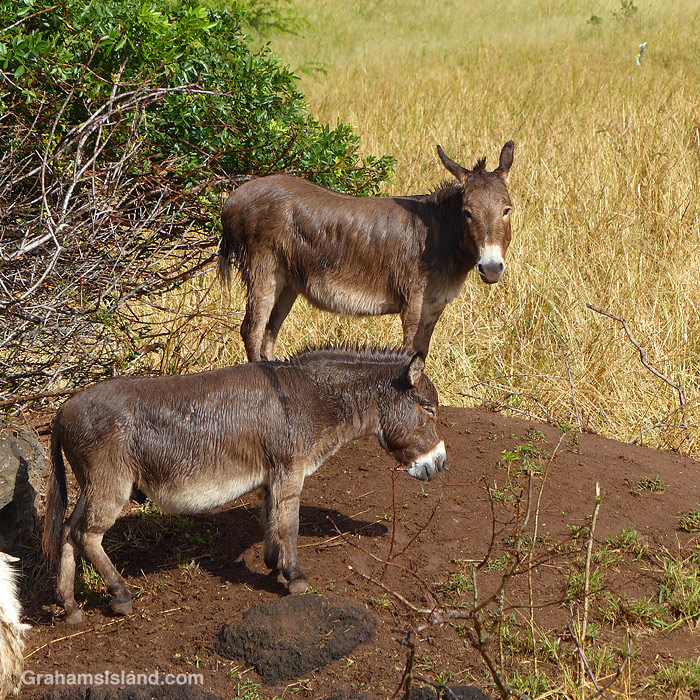
Here’s the third of my three weather-related posts. Driving home from the walk in yesterday’s second photo, I saw these two donkeys. They live right on the shoulder of Kohala Mountain in the same 45-inches-of-rain-a-year range as Upolu. They’d been on the receiving end of the same weather as my first photo yesterday, but now they were standing on their little hill, soaking up bright sunshine, and drying out a little.
Posted in response to Becky’s April Squares challenge theme of ‘Bright.’ See more responses here.
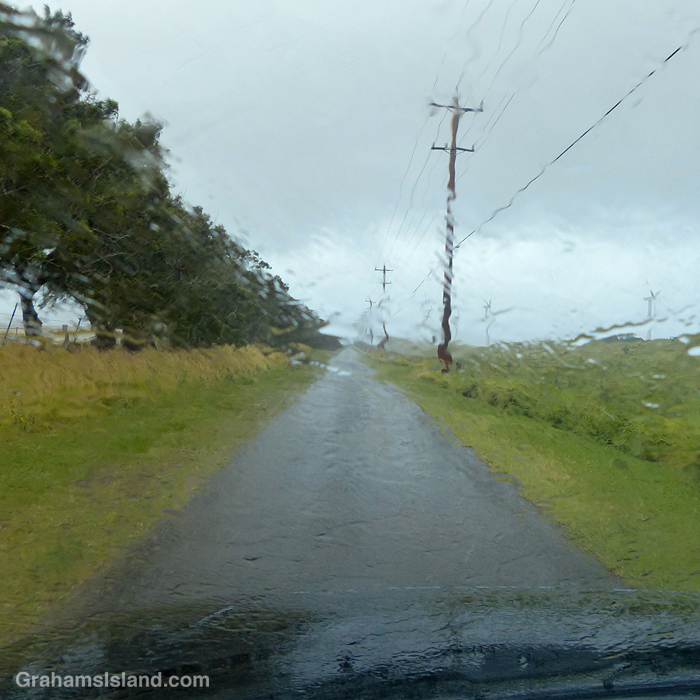
Yesterday, I posted a photo of clouds over Upolu. Sometimes, those clouds do what clouds often do, which is dump a load of rain. When that happens, my drive down to the airport looks like the top photo. It also means that walking on the coast there will not be pleasant. Rain is one thing, but it turns the dirt roads into cloying mud and I end up with sandals weighing five pounds more than when I started.
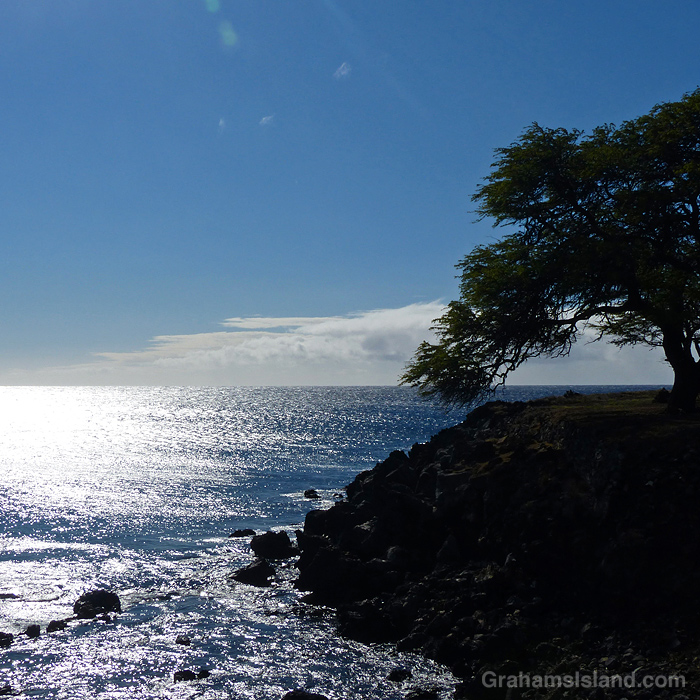
However, such is the nature of the weather here that, most of the time when this happens, I can drive seven miles down the coast and walk there in bright sunshine as in the bottom photo.
Where I live in Hawi, we get around 60 inches of rain a year. Upolu, about three miles away to the north, gets about 45 inches a year. The spot in the second photo receives less than 20 inches a year. The abrupt differences in rainfall are down to the northeast trade winds bumping into the Big Island’s volcanoes. The windward sides of those volcanoes get lots of rain topping out at a whopping 280 inches a year just north of Hilo. The leeward side of the island is much dryer with the South Kohala shore, where the resorts are, receiving less than 10 inches a year. The northern tip of the island, where I live, is a transition area where the shoulder of Kohala Mountain runs down to the sea. I always tell anyone thinking of moving here to check the isohyet map. A half mile east or west, or a half mile up or down the mountain, can make a world of difference to the weather they’ll be living in.
Posted in response to Becky’s April Squares challenge theme of ‘Bright.’ See more responses here.
This is the fifth of my rainbow colors in response to Becky’s April Squares challenge theme of ‘Bright.’ (See more responses here.) It’s also where I get into trouble. Cyan? What’s cyan doing in a rainbow? What happened to blue?
Well, blue is coming. What’s gone is indigo. The traditional rainbow colors are red, orange, yellow, green, blue, indigo and violet. These colors were assigned by Sir Isaac Newton way back in the 1600s. In fact, he started with just five colors – red, yellow, green, blue and violet. Later, he added orange and indigo to the color spectrum. These days though, what Newton called blue is today called cyan, and what he called indigo is now called blue.
In reality, there are no bands of color in a rainbow. There’s a continuous gradation of color. The bands are seen because the human eye is limited in the colors it perceives. Converted to black and white, the bands dissolve.
So, for my rainbow colors, I looked at my photos and what I see are red, orange, yellow, green, cyan, blue and violet. Of course, if you look at the colors on the inside of a rainbow, you’ll see they keep going, back through the same sequence. And where the red of this supplementary rainbow overlaps the violet of the primary, the result is more of a purple color.
Having labored through all that, today’s rainbow is a small, bright segment on the ocean, with a black and white version of the same image. Then we have a patch of sand underwater, showing different patterns and colors. Finally, a bullethead parrotfish, bashes its beak on some coral in its pursuit of food.




 Graham's Island