Tag Archives: Hawi

Super blood wolf moon

blood moon over hawi

blood moonThe recent lunar eclipse occurred last Sunday evening here in Hawaii. When the moon rose at 6:02 p.m. (five minutes before sunset) the eclipse was already well underway. Where I was watching, the sky was hazy so the moon wasn’t very clear. It then disappeared into a bank of clouds and I considered heading for home. But the cloud bank wasn’t huge and was drifting away from the area I was watching.

Sure enough, a little before 7 p.m., the now fully-eclipsed moon slid above the clouds into a beautiful starlit night. I took some photos where I’d set up, down by the coast, and then headed into Hawi to see what it looked like there.

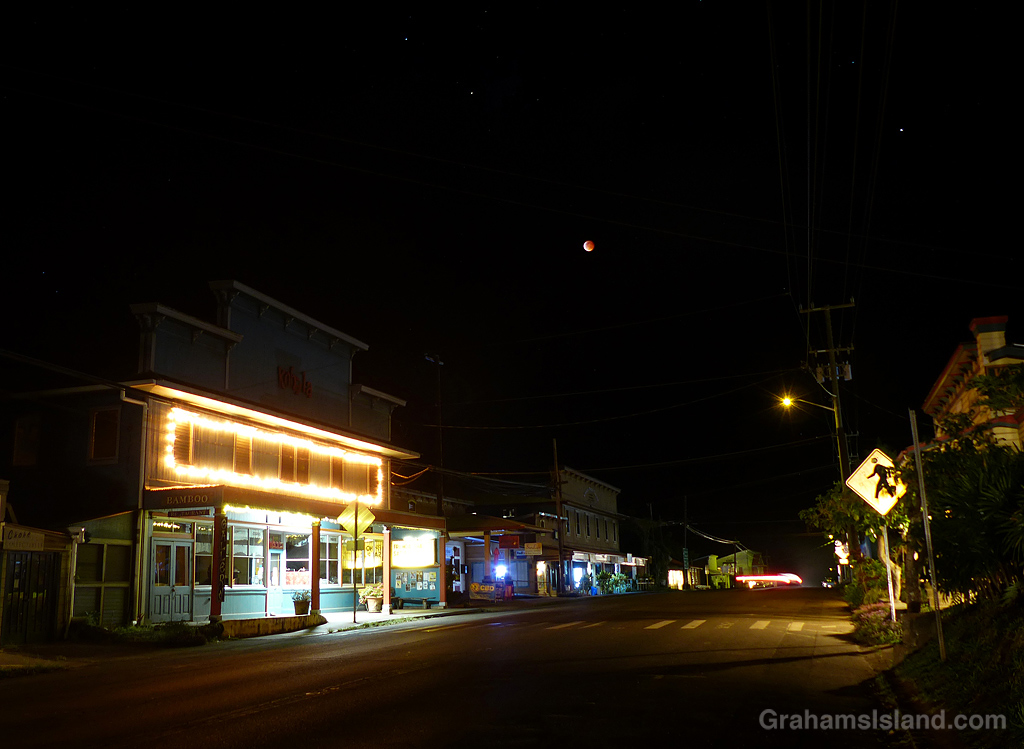
Above is a view from downtown Hawi (not exactly hopping at 7:20 on Sunday night). The second photo is the moon soon after it rose above the clouds before the sky was fully dark. Below is the night sky with the moon in the bottom left and Orion at the top right.

Why the grand name for this eclipse? The moon was closer to the Earth than normal so it seemed bigger and brighter than usual, which is known as a supermoon. Because this was a total eclipse it gave the moon a red tint, which is known as a blood moon. And January’s full moon is sometimes called a wolf moon. Voila – a super blood wolf moon.

Posted in response to this week’s Sunday Stills challenge on the theme of ‘Night,’ (See more responses here.) and this week’s Friendly Friday challenge on the theme of ‘Coral-ish colors.’ (See more responses here.)

blood moon and orion

Rainbow over the road

Rainbow

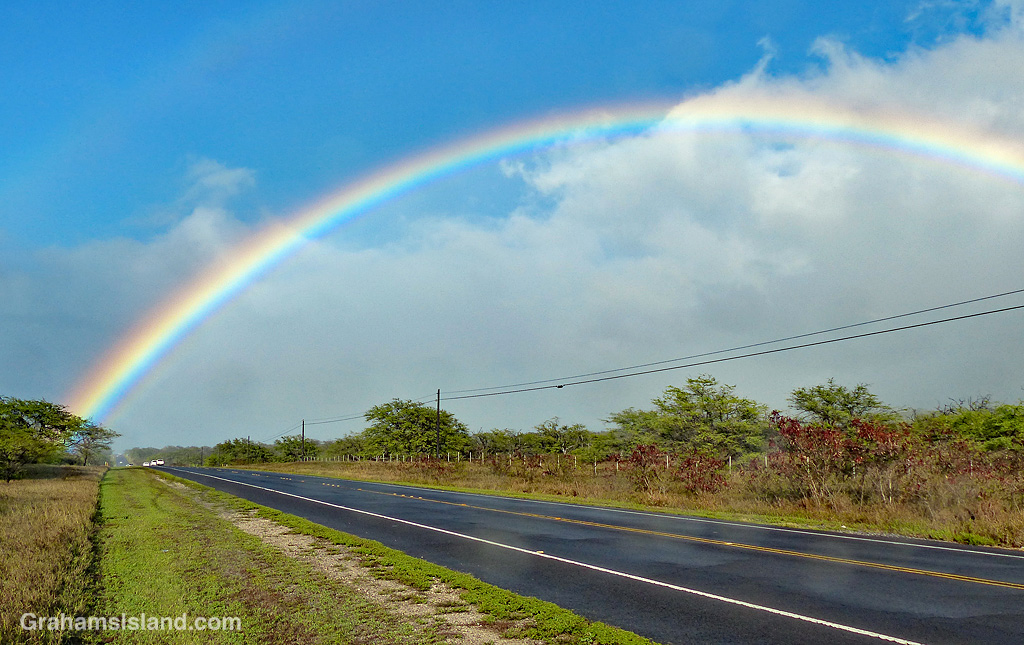
Rainbow over the roadToday marks the start of the fourth year for this blog. Post number one was of a rainbow over the northern coast, so I thought I’d post another one on the anniversary.

This rainbow occurred just last week over the road leading up to Hawi. Hawi gets around 60 inches of rain a year. A few miles south, the rainfall drops off to less than 20 inches, and it’s usually dry and sunny there. One byproduct of this climatic contrast is that there are frequent rainbows.

This one occurred in the late afternoon as I was heading home and, even though I see a lot of rainbows, I felt moved to pull over and snap a few photos before heading up into the clouds and rain over Hawi.

Under the banyan trees

Hawi Banyan trees

I could have used this photo for last week’s Sunday Stills challenge on the theme of ‘In Your Town,’ but it also works for this week’s theme of ‘Traditions.’ (see more offerings here.)

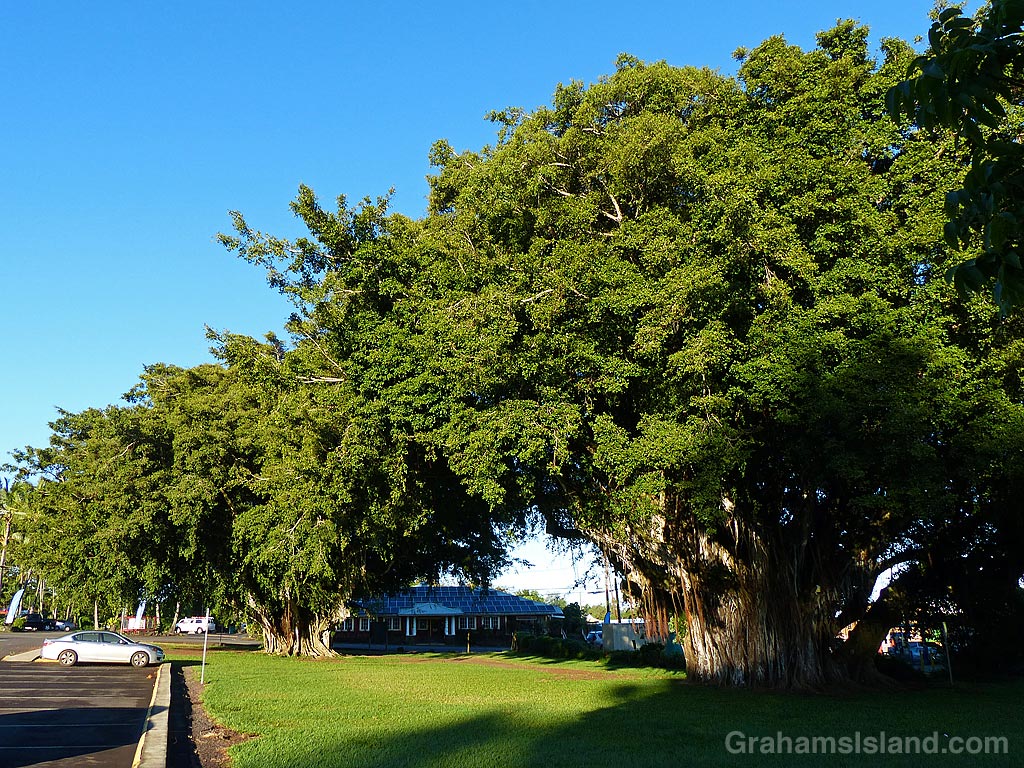
These two giant banyan trees are half a block up from the main highway through downtown Hawi. Each Saturday, a farmers market is held on the grassy area beneath these trees. That event is part grocery shop, part social gathering.

The rest of the week, the location is the traditional meeting place for the area, particularly for people carpooling. If someone says to meet under the banyans, or at the banyans, the location is immediately understood.

Hawi

Downtown Hawi

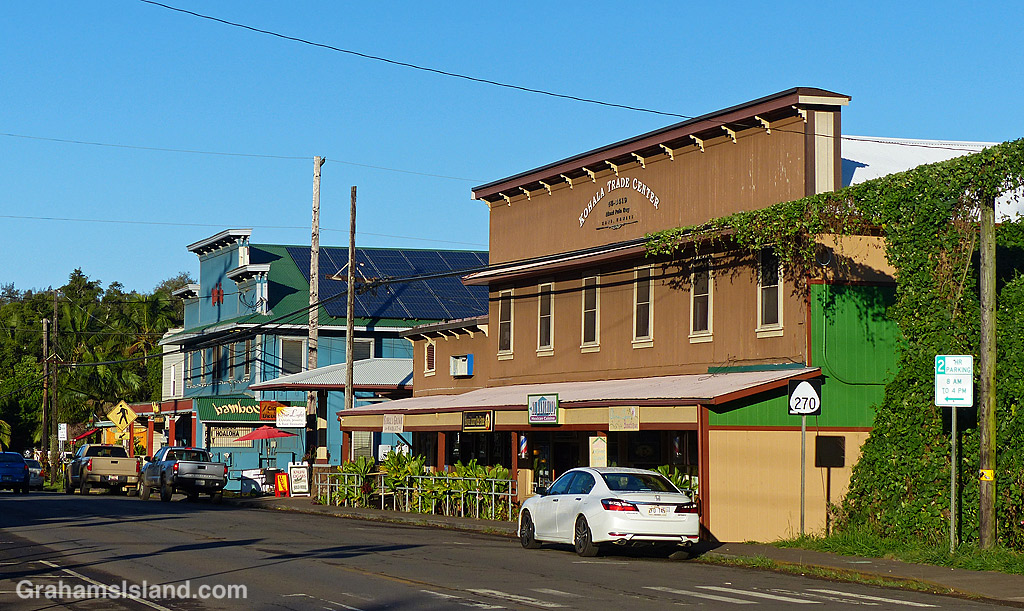
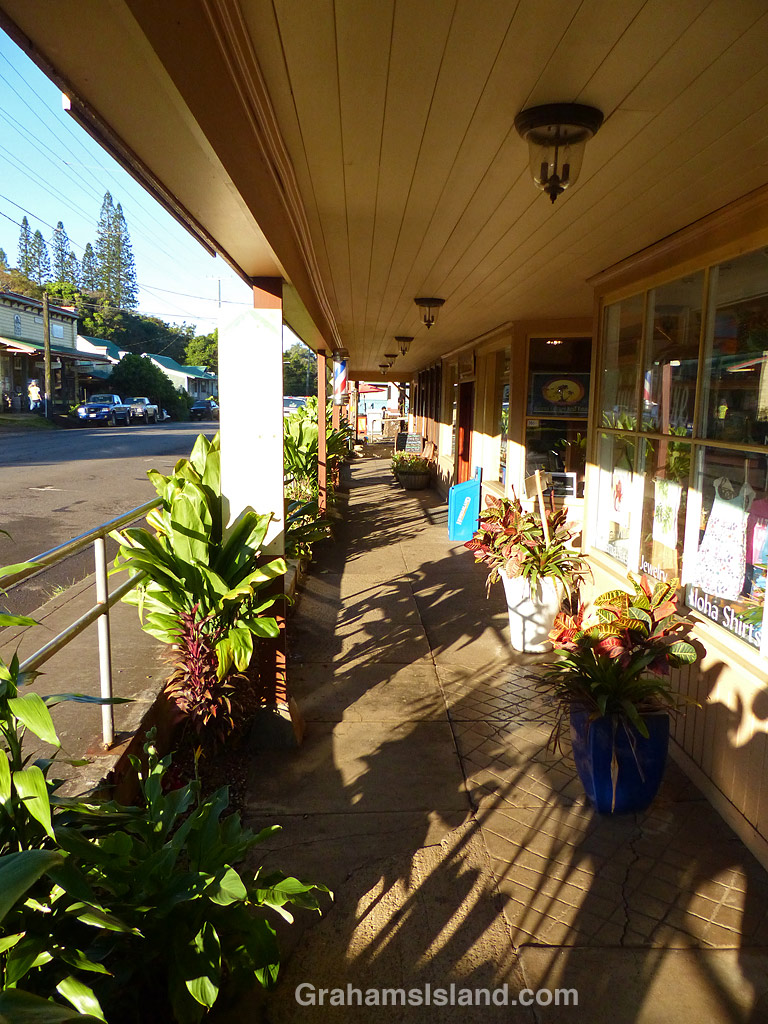
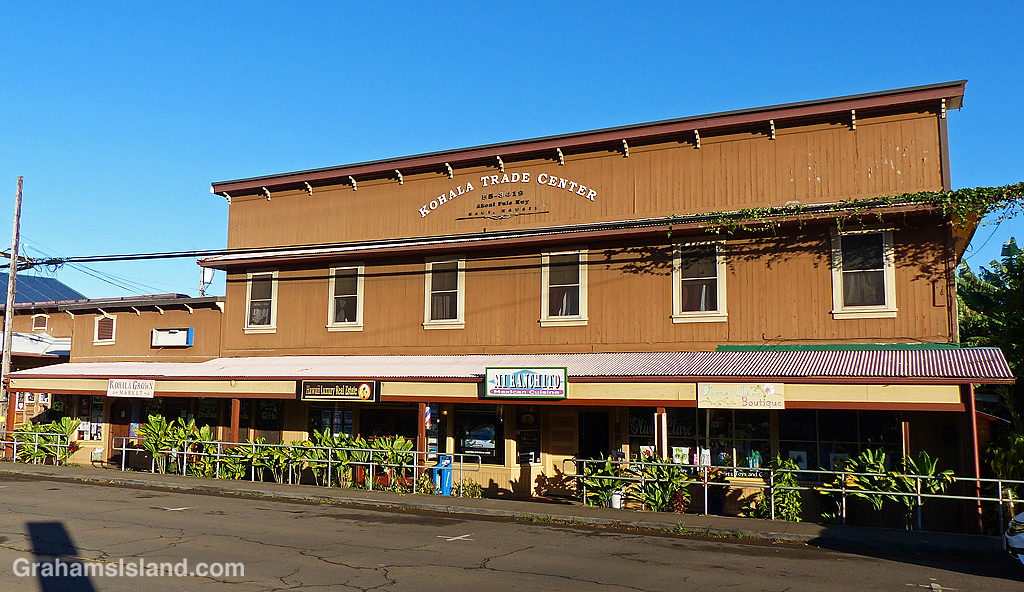
Hawi shopsHawi is the northernmost town on the Big Island. Together with Kapa’au, two miles to the east, it’s the main population center in North Kohala. This area was a center of sugar production from the mid 1800s to the early 1900s. Today, it’s geared towards tourism and agriculture.

Hawi’s population of around 1,000 is mostly located in areas above or below Akoni Pule Highway, which is the main road through town. The highway itself is where commercial activities are found, as seen in these photos.

In the top photo, the blue building houses the Bamboo Restaurant. This was the former home of K. Takata Store, the area’s main grocery store, which now occupies a newer building midway between Hawi and Kapaau. On the right of this photo is a vine climbing up a pole and along the power lines. I’m not sure what this vine is, but it’s everywhere, and periodically workers from the power or phone company pass through and hack at the lower reaches of it, killing off the higher parts engulfing the wires – at least until it (very quickly) grows back.

The Kohala Trade Center building is home to several smaller businesses and features the covered walkway at right which passes by the storefronts lining the street, but slightly below street level.

For its size, Hawi is quite a bustling place, popular with tourists and with a strong local community. But it’s also the kind of place where a person can ride a horse through town and not be considered unusual or out of place, and I like that quite a bit.

Posted in response to this week’s Sunday Stills challenge on the theme of ‘In Your Town.’ See more responses here.

Kohala Trade Center Hawi

Signs: Ironman advice

Signs-Ironman advice

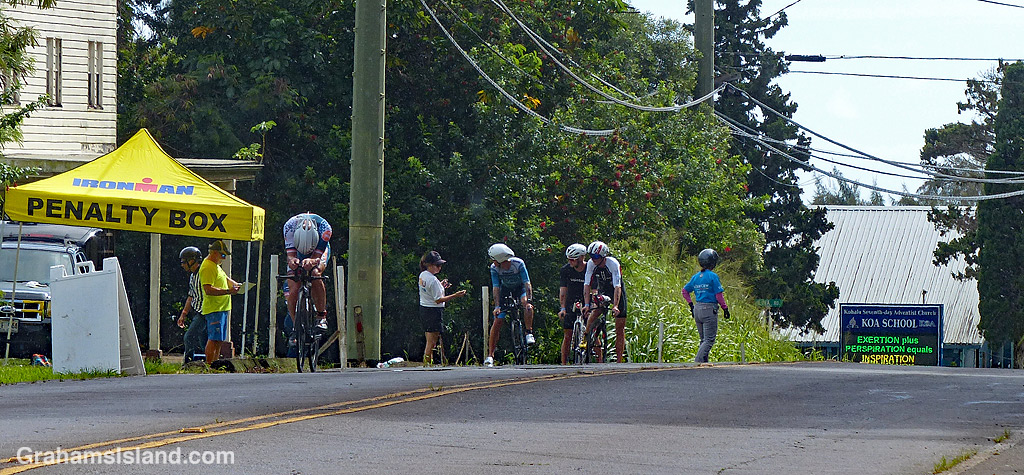
During last month’s Ironman race, these cyclists had committed some sort of misdemeanor, probably following too close, on their way to Hawi, and had been pulled over to serve a 5-minute penalty. But what I liked about this scene was the sign in the background reading ‘Exertion plus perspiration equals inspiration.’ I suspect many of the Ironman participants might have thought the sign should have read ‘Exertion plus perspiration equals pain.’

Incidentally, that bright neon sign was a source of great community consternation when it went up. Some locals thought it was OK. Others thought it was a blight on the community and a sign of the impending apocalypse. It’s been in place a few months now and the hubbub seems to have subsided. I have to say though that the neon colors are still as garish as they ever were.

Ironman 2018

Ironman winner Patrick Lange
Ironman cyclist leaving Hawi
Ironman cyclists
Ironman cyclist in blue

Saturday saw the running of the 40th edition of the Ironman World Championships in Kailua Kona. This is the event featuring a swim of 2.4 miles, a bike ride of 112 miles, and a run of 26.2 miles. As in previous years, I participated in this event by walking out to the main road and taking photos, whenever possible from a nice shady spot.

Actually, this year’s race was run in prime conditions for the athletes. It was overcast with occasional light rain and only a gentle breeze from time to time. Consequently many records were set, including new course records for both men and women.

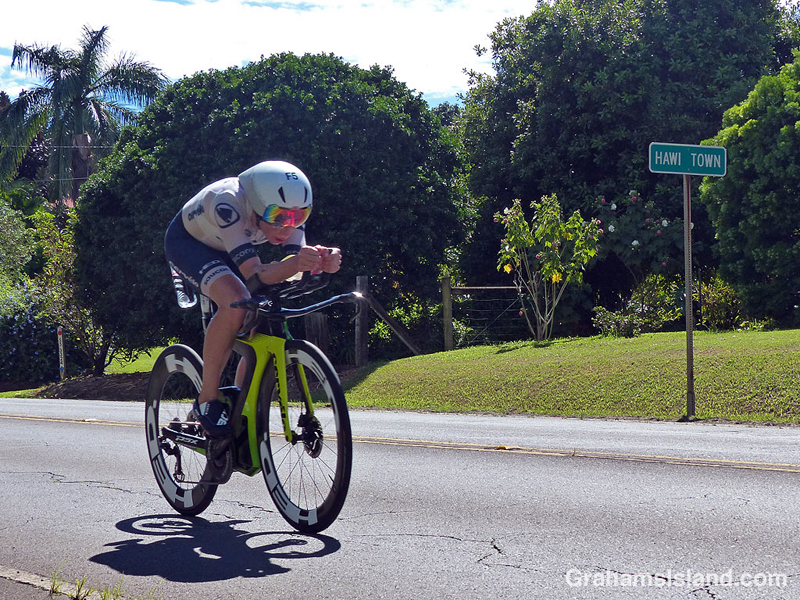
The top photo shows men’s winner and defending champion, Patrick Lange of Germany, zipping by on his way back towards Kona. Second photo, Great Britain’s Susie Cheetham heads out of Hawi. Third photo, Dan Plews of NewZealand (1685) leads Robin Schneider of Germany (2310), and Neil Eddy of Great Britain (2070). These three finished the bike leg in fairly close proximity, but after the marathon run, Plews finished 21 minutes ahead of Eddy and 45 minutes ahead of Schneider. Fourth photo, Jodie Robertson of the U.S.A demonstrates the importance of color coordination while cycling. Bottom, a large group of riders roll into Hawi, the turnaround point of the bike leg.

For more information about Ironman, go to Ironman.com.

Ironman group

Egrets and turbines

Egrets and turbines

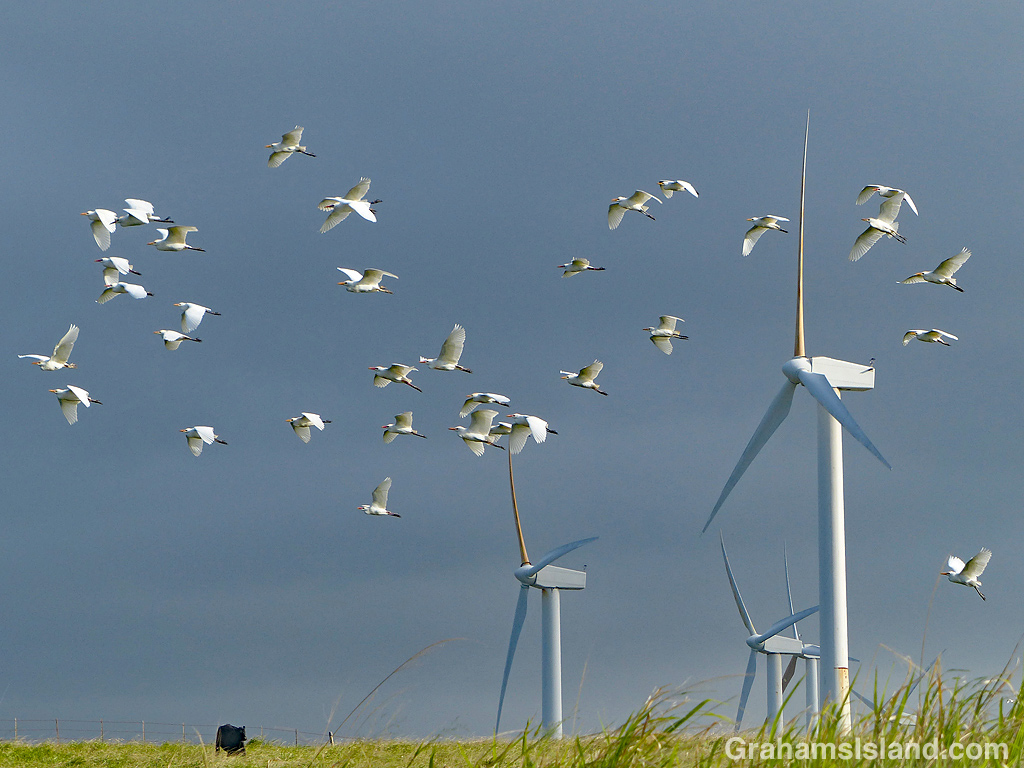
Today marks the 1,000th post on this blog. To mark the occasion I looked for a suitably appropriate subject and couldn’t find anything! So instead I chose this photo since it featured a couple of subjects I must have seen a thousand times.

I pass the turbines at Hawi Wind Farm on my way to the part of the coast where I regularly walk. And I’ve seen an awful lot of cattle/horse/sheep/goat/lawn mower egrets since they are omnipresent. Plus I have a soft spot for them.

In this photo, a flock of egrets is on a mission to get from one pasture to another one. They aren’t the most graceful of flyers, but en masse I find they make a very pleasing sight.

Tenting for termites

Tented for termites

No, it’s not the circus come to town. These tents are for a more macabre purpose, the termination of termites.

As in most warm climates, termites are a problem here. Houses, especially older ones, are easily colonized. Without treatment, the occupying termites will consume wood from the inside, leaving a thin membrane as protection. Infested wood might look fine, but a gentle push on the surface will go right through two or three layers of paint to the termites’ cavern inside.

Besides leaning against a wall and going right through, a prime indicator of termites is small mounds of little round pellets below a pinprick hole in a wall or piece of furniture. These are termite fecal pellets, which the worker termites clear out of the nest from time to time.

Another indicator of the presence of termites is to turn a light on and find a horde of them flying around the room. Around here, May is the prime time for this activity. These flying termites are fertile males and females, leaving the nest they grew up in to find a place of their own and start a new colony.

As unpleasant as it is to find a room full of flying termites, it’s even worse to wake up and see countertops littered with discarded wings, a sure sign that these fertile termites have moved in to a new spot.

So tenting for termites is common practice here. The structure is covered with nylon sheeting until it is completely sealed and then a fumigant is pumped in. The tent usually remains on overnight. After the tent is removed, the house has to sit empty a while for the gas to dissipate. It’s not wise to go back in too early or one could find oneself joining the termites. Typically it can be two or three days before a home can be reoccupied.

Tenting for termites is effective but it has downsides. It works for drywood termites, but not subterranean termites since they live outside the house and just dine inside. There are also environmental concerns about the process. And while fumigation works, there’s no guarantee that a new colony of termites won’t move in just as soon as the gas has cleared.

Tenting for termites