This week’s Sunday Stills challenge theme is ‘2021 in Your Rear-View Mirror.’ See more responses here. I’ve gone with a favorite photo from each month of 2021, with a caption and link to the post the photo first appeared in.



This week’s Sunday Stills challenge theme is ‘2021 in Your Rear-View Mirror.’ See more responses here. I’ve gone with a favorite photo from each month of 2021, with a caption and link to the post the photo first appeared in.

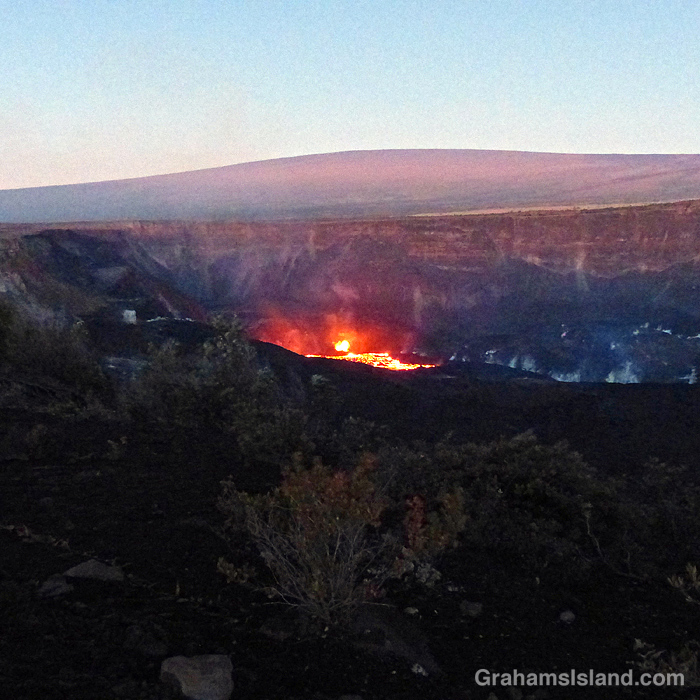
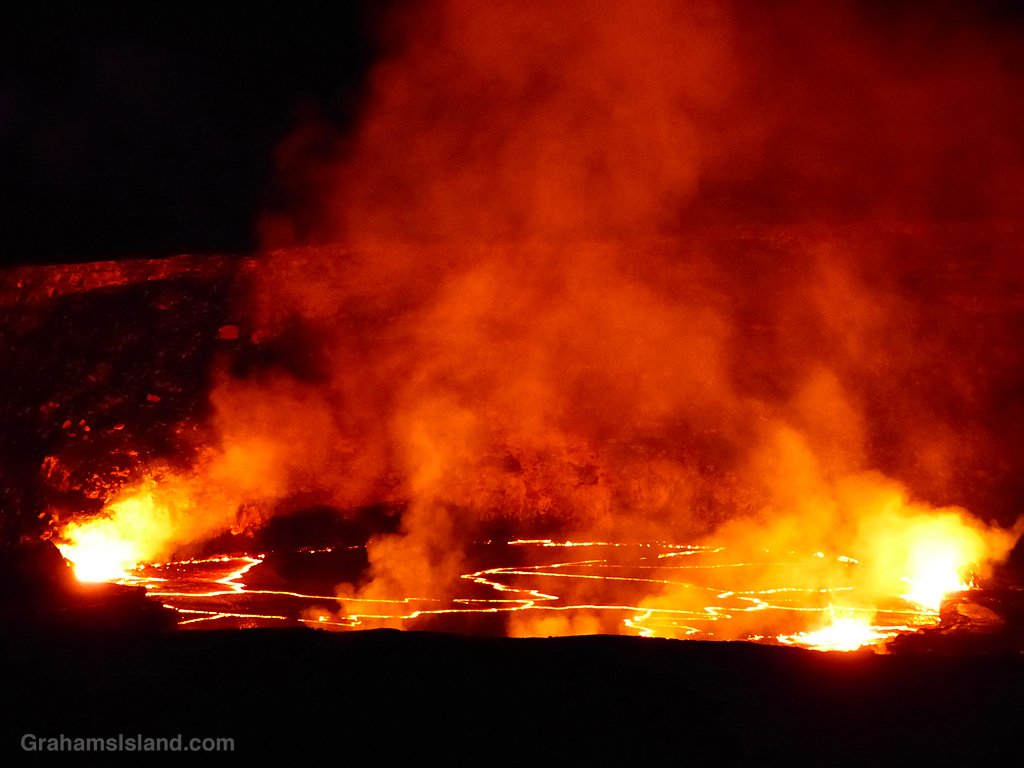
After my recent early morning visit to see the activity at Kilauea Volcano, I did a bit of hiking around the rim of Halema’uma’u Crater. This is a view towards the current active vent.
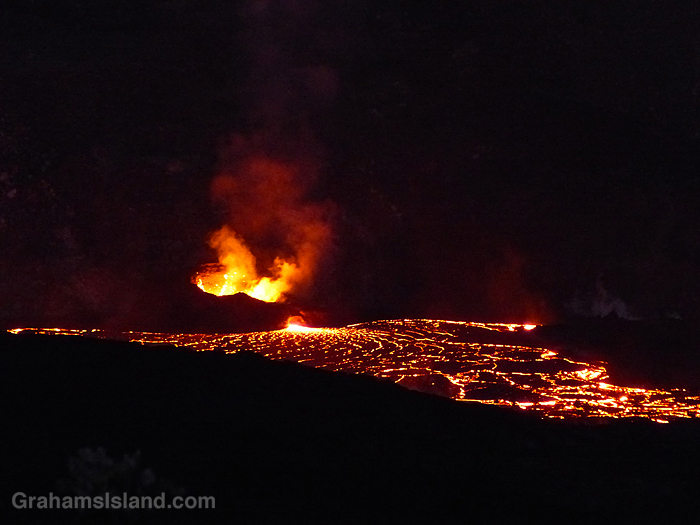
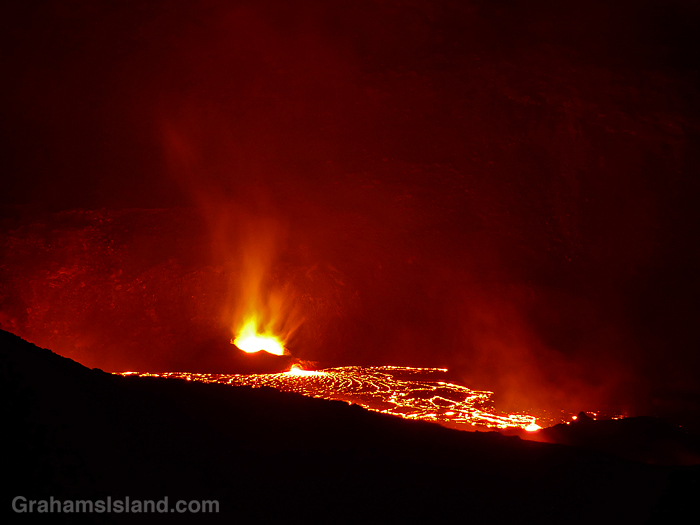
Yesterday was Guy Fawkes Day in Britain and to celebrate I finally got to see some fireworks, albeit of a very different kind and in the wee hours of the morning instead of the traditional Bonfire Night.
I got up just after 1 a.m., left the house around 2 a.m. and drove over to Hawaii Volcanoes National Park. I mostly had a beautiful starlit night for the drive except for about 15 minutes over the saddle between Mauna Kea and Mauna Loa when I was driving through cloud and not entirely sure whether there was any other traffic despite barreling along at 60 mph.
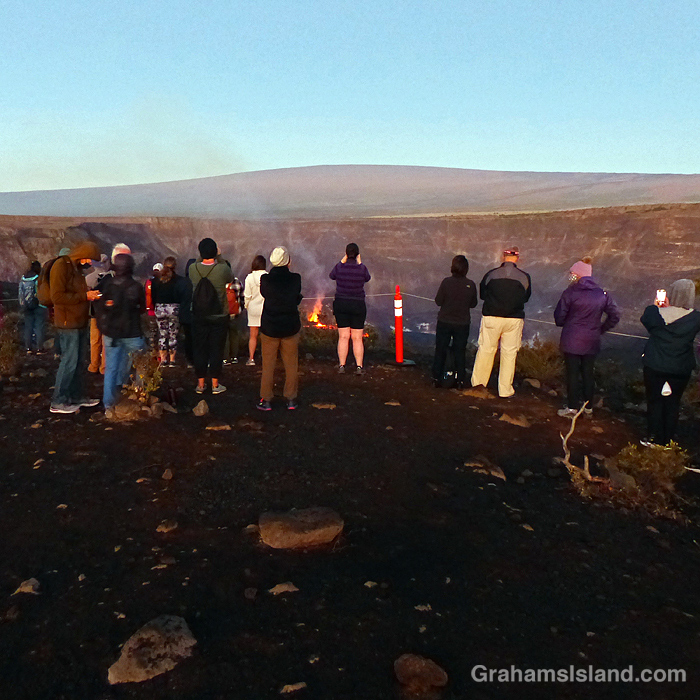
I made good time, arriving at the park around 4:30 a.m. and the viewing point about 15 minutes later. There were around 20 people already there, but a prime viewing spot was open so I set up my tripod and camera and began taking photos.
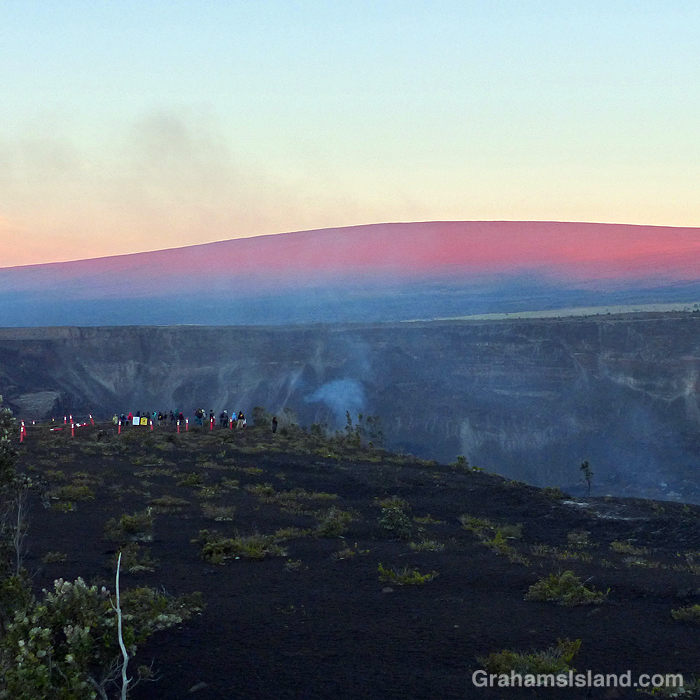
The viewing area was a place I’d stopped by during the previous eruption in December 2020. That spot only allowed a view of the glow of the eruption, which was lower in the crater. This time the eruption was higher up and the trail had been extended so that a good view could be had of both the eruption site and the crater floor the lava was flowing onto.
The eruption began on September 29, 2021 through a series of vents, but by October 4 this had settled down to two vents and by October 6 to the single vent in the west wall of Halemaʻumaʻu crater seen in these photos.
The eruption has added about 184 feet of lava to the previous lava lake level and though it appears to have slowed a tad lately, it still put on a good show with a good deal of spattering and some smaller fountains of lava. The active vent has formed its own cone with lava spilling into the lake through a gap in the cone. Recently, a bridge formed over that cone so that the lava spills out though a short tunnel as can be seen in these photos.
I stuck around until the sun rose high enough to illuminate the slopes of Mauna Loa and then headed back to the car. After a spot of hiking, the return drive and some shopping in Waimea. I got home around 2:30 p.m.. A long day, but well worth it in my book.

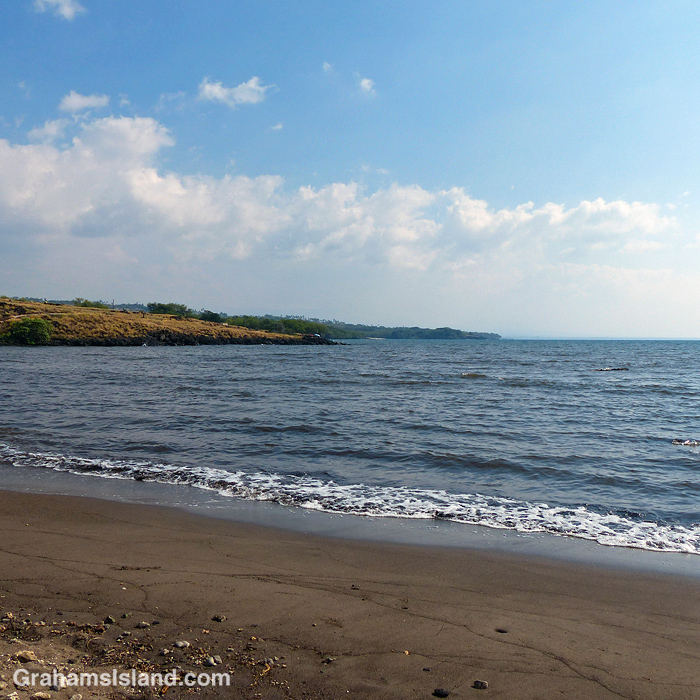
I took the top photo on my way to work one early morning. It’s a tranquil scene (the reason I go down there) shot from the beach below Pu’ukohala Heiau in Kawaihae. The second photo was shot on my way home in mid-afternoon. It was taken from the same beach in roughly the same place and looking in roughly the same direction.
Astute observers will see past the similarities in the photos and notice something is missing. Hualalai Volcano has disappeared. Now, it’s not unreasonable to think that those puffy white clouds in the second photo have something to do with this, but that’s not really the case. True, they might mask the upper reaches of the volcano, but the whole thing? No, the culprit is the fuzzy band between the clouds and the land – vog!
The latest eruption of Kilauea Volcano, which began on September 29th, is churning out vog, which forms when volcanic gases interact with sunlight, air, moisture, and dust. Two days later, when these photos were taken, it was having a visible effect. I’d noticed the vog drifting up the west side of the island during the morning and by afternoon visibility was greatly reduced. But it’s not just visibility that’s affected. Vog is especially troublesome for people with breathing difficulties, but can also irritate the eyes and skin of just about anyone.
Posted in response to Becky’s October Squares challenge theme of ‘Past Squares – Time.’ See more responses here.
Yesterday afternoon, around 3:20 p.m., Kilauea Volcano began a new eruption. Like the previous one, from December 2020 to May 2021, the eruption is in Halemaʻumaʻu crater, at the summit of the volcano. That eruption created a lava lake in an area that collapsed in 2018 when the main activity moved down the east rift zone to the Leilani Estates Subdivision. This new eruption has reactivated the lake in the crater.
These photos are from the 2018 activity in Halemaʻumaʻu crater shortly before the level of the lava lake dropped and the crater floor collapsed.

The latest eruption at Kilauea Volcano has recently been declared paused. It was never an especially dramatic eruption, but when I went down a few days after it began (here) the sky was illuminated by the activity. In recent weeks though, the lava lake formed by the eruption crusted over completely and lava from the active vent was also hidden from view.
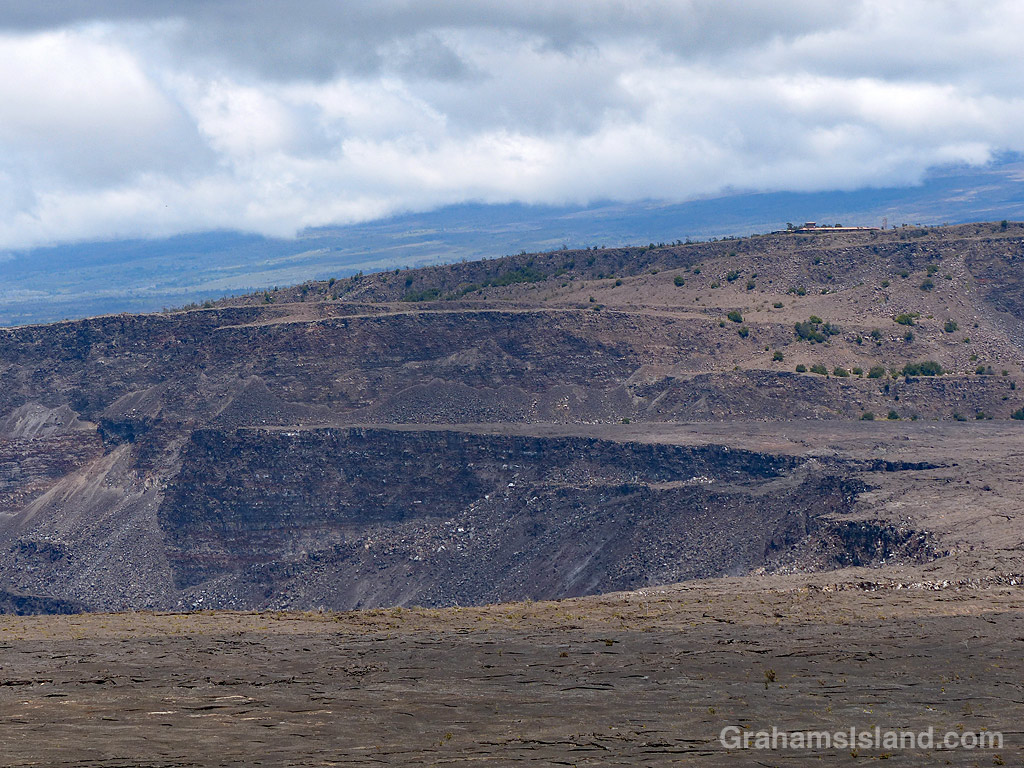
The photos are two views of Halemaumau Crater, taken before this latest eruption. In the top one, the collapsed floor of the crater is on the left. This is what the new lava lake was filling up. On the ridge, to the right side of the photo, is the low profile of the Jaggar Museum, which was closed after the 2018 eruption and likely won’t reopen.
The bottom photo shows the easternmost edge of Halemaumau Crater, which wasn’t greatly impacted by this eruption or the events of 2018. Consequently, the walls of the crater are quite green and the floor is dotted with plants. These plants are mostly ohia trees, which are among the first plants to grow in lava fields, in part because their roots will tap into lava tubes to find moisture and nutrients.
For more information about Hawaii Volcanoes National Park and Kilauea’s eruptions, go to nps.gov/havo/.


The latest eruption of Kilauea Volcano continues. It’s settled down to being a fairly well-behaved eruption as these often do. Currently, lava is still pouring from a vent on the northwest side of Halemaʻumaʻu crater. It has formed a lake more than 200 meters deep, which continues to rise slowly.
This photo was from my trip down there in December. These two people were silhouetted by the glow from the eruption. To see what’s currently happening at the volcano go to https://www.usgs.gov/volcanoes/kilauea/webcams.
Posted in response to Becky’s January Squares challenge theme of ‘Up.’ See more responses here.

This week’s Sunday Stills challenge theme is ‘Night.’ See more responses here. Also posted in response to Becky’s January Squares challenge theme of ‘Up.’ See more responses here.
On December 21st of last year, I went down to the coast to get a clear view of the ‘Christmas Star.’ This event was the closest coming together of the planets Jupiter and Saturn in almost 800 years. This isn’t to say that the planets themselves would be closer, but from our planet, they would appear so, so close that they would seem to be a single large ‘Christmas Star.’
I got down to the coast before sunset and stayed until it got dark enough that I knew I wouldn’t get more decent photos. I knew my best shot would be with some foreground still visible. The top photo is the best I could do with my camera. The two planets can clearly be seen close together, but with a sliver of late evening sky between them.
I headed home, downloaded the photos, and went to bed not long afterwards. Why the early night? Well, the next day I planned to drive over to see the new eruption at Kilauea Volcano, in the pre-dawn darkness, which required a 1 a.m. start. (That story can be found here.)
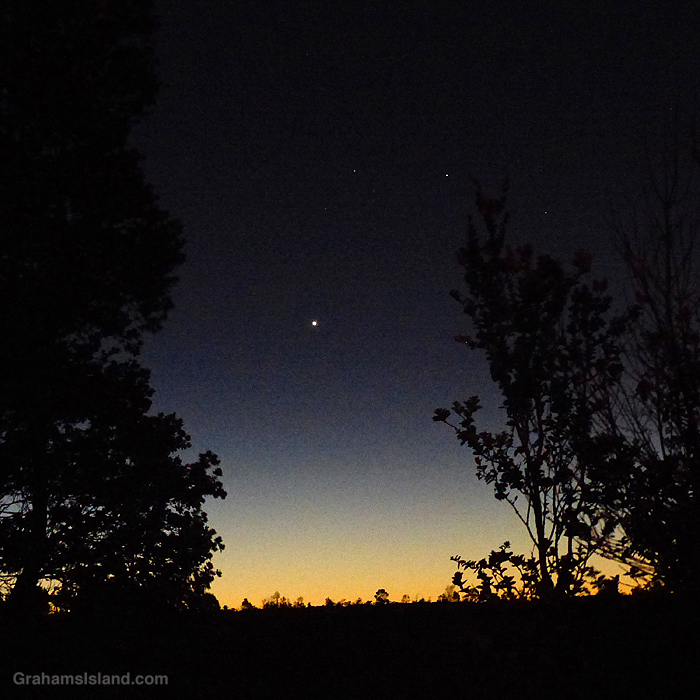
It was as I was wrapping up taking photos of the eruption that I turned to see the eastern horizon lightening. But there were still some stars visible in the sky and the brightest light of all was the planet Venus. That’s when I took the second photo before heading back to the car to start the three hour trip back home.
 Graham's Island