This sign guards what is presumably Hawaii’s heavy water plant, though why such a plant would be halfway up the side of Mauna Kea is a mystery. Or perhaps the sign is just a warning that it would not be a good idea to pick up the large water tank behind the sign. Either way, the sign made me smile.
Recently, I walked around the Palila Forest Discovery Trail on the slopes of Mauna Kea without seeing any palilas. The mamane seeds that they feed on were either dry and brown or just starting to form, so a return in a few weeks might bring more luck. But there were other birds flitting around, usually easier to hear than see, especially in some areas where the tangle of branches make it hard to see anything.
This endemic Hawaii Amakihi was one of them, but then it landed on part of a branch where I happened to have a clear view. I snapped two photos before it once more vanished. I like how this photo makes it looks like the bird is settled in for the long term rather than the momentary landing and take off that actually occurred.
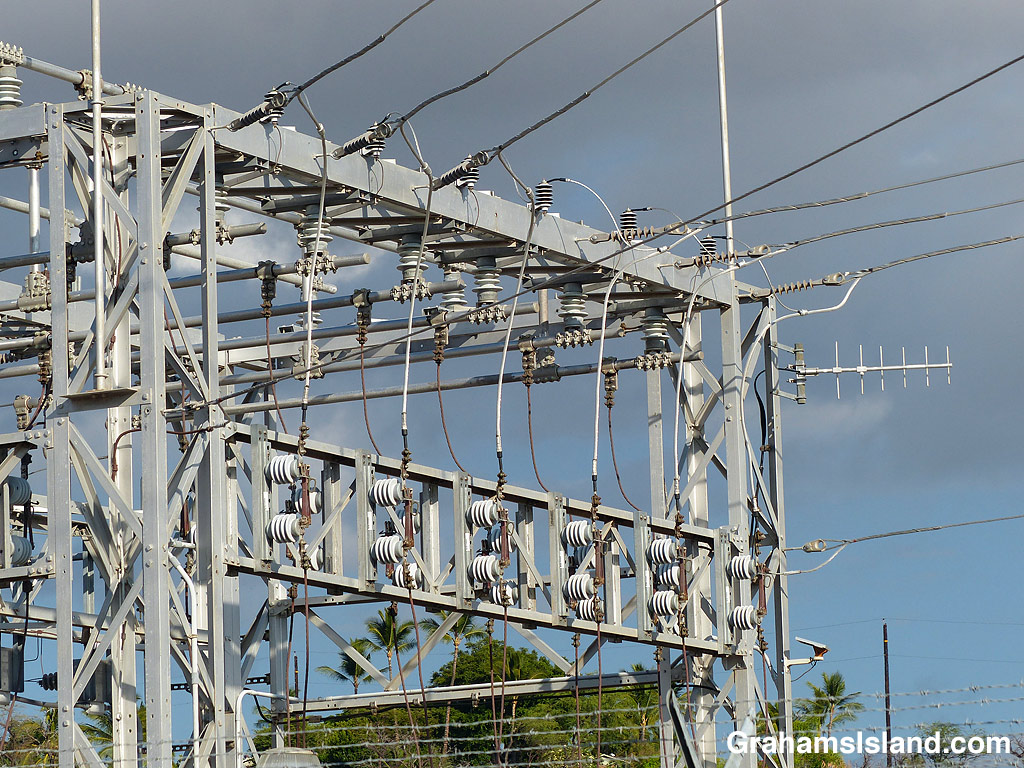
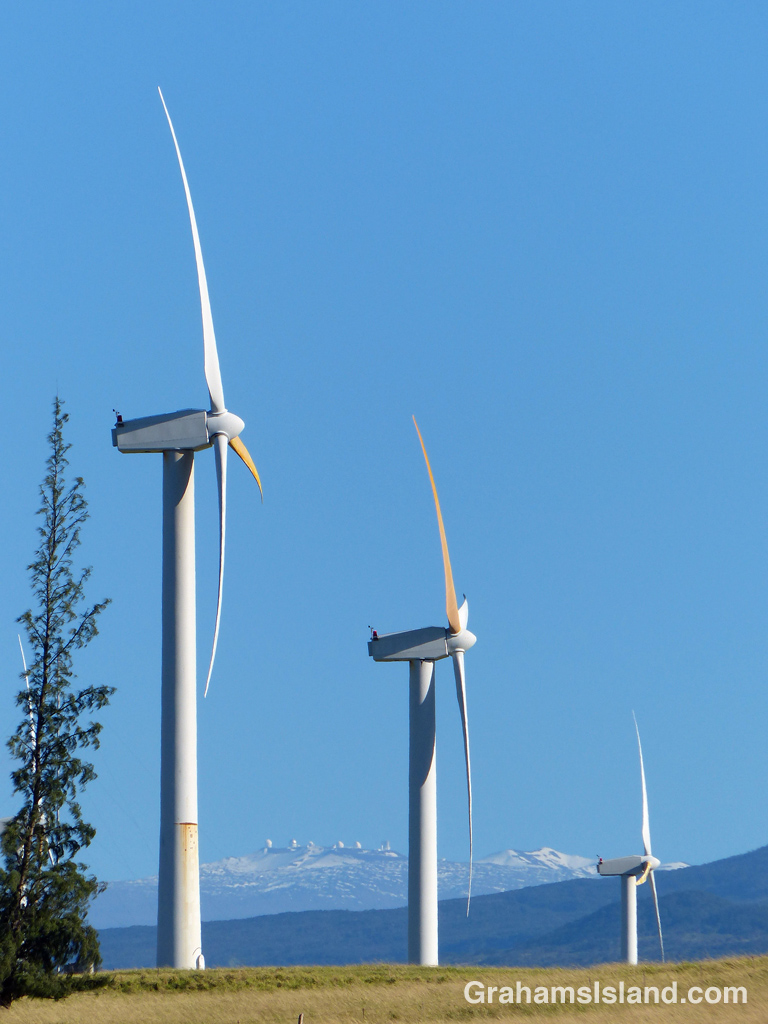
This week’s Friendly Friday challenge theme is ‘Electric.’ See more responses here. These three photos are quite different, but linked by this theme.
The top photo shows a view of an electric substation. I like the lines and shapes such facilities offer. But where does this power come from? A good deal is from oil fired plants, but Hawaii is working to get more of its electricity from locally sustainable sources.
In the middle is a view of Hawi wind farm, with Mauna Kea in the background. There are several wind farms of varying sizes in Hawaii including a few on the Big Island. Their contribution to the power grid is small, but growing. Solar power is also a big contributor, on an individual house basis or for whole communities (here).
One source that provided around 25% of the Big Island’s electricity was the Puna Geothermal Venture (PGV). Last year’s eruption shut them down, though, as the bottom photo shows, the flows mostly missed the plant itself. I think a couple of their wells were covered by lava, but most were spared. Currently, they’re in the process of restarting power production. Not everyone here is a fan of this power source. The same can be said about the Honua Ola bioenergy plant, which will generate electricity from burning eucalyptus chips, but which is still to become operational.
This week’s Friendly Friday challenge theme is ‘Remote.’ (See more responses here.)
I’m going for this photo for three reasons. First, Hawaii itself is remote at more than 2,200 miles from the nearest major landmass. The closest U.S. state is actually Alaska, though California is the closest state to the Big Island.
Secondly, Mauna Kea is one of the more remote spots on the island, particularly these days. Protests over building a new telescope on Mauna Kea have resulted in the road up the volcano being closed for some weeks now with no end to the dispute in sight. So if a person wants to go to the top, a long and arduous hike is the only way.
Thirdly, the telescopes on the summit are there to explore the farthest reaches of the universe, and you can’t get more remote than that.
This week’s Sunday Stills challenge theme is ‘Great Outdoors.’ (See more responses here.) When I think of the great outdoors, I think of hiking, and one of my favorite hikes on the Big Island is up Pu’u Wa’awa’a. It’s an 8-mile round trip and tops out at just under 4,000 feet. On a good day, the hike offers great views, not only from the top, but also on the way up and down. And there are several benches where a person can rest and take in those views, including a couple on the summit.
The top photo shows the view north from around 3,500-feet elevation, with Tamaki Coral in the foreground and Kohala Mountain in the background. The bottom photo is a view from 100 feet or so below the summit looking east toward Mauna Kea.
The hike can also include many native trees and plants as well as a variety of wildlife. There are domestic sheep, cattle, and horses, as well as wild pigs and goats. When the trees are in bloom, they’re rich with insects and birds including several native varieties.
To top it off, most of the times I’ve visited, usually in the early morning, I’ve had the place to myself.
For more information about Pu’u Wa’awa’a and its trails, go to puuwaawaa.org.
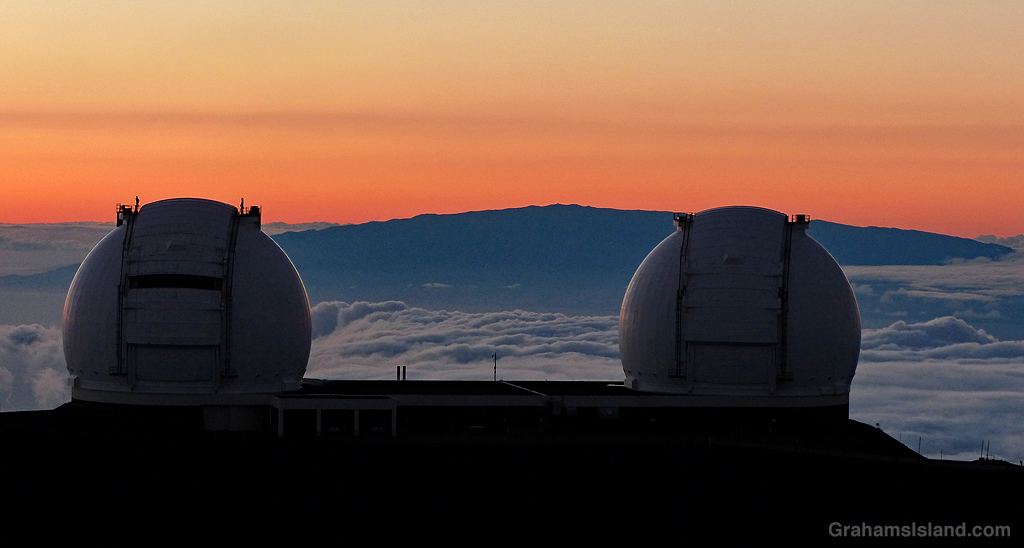
This week’s Friendly Friday challenge theme is ‘Twins.’ (See more responses here.)
These are the two telescopes of the W. M. Keck Observatory on Mauna Kea. Keck 1 began operation in November, 1990, while Keck 2 made its first observations in October 1996. Each telescope’s 10-meter primary mirror is made up of 36 segments, hexagonal in shape. Not that these segments are small themselves. Each one is 1.8 meters wide and weighs half a ton.
The telescopes can accommodate a wide variety of instruments, such as cameras and spectrometers, and are considered to be the most scientifically productive in the world.
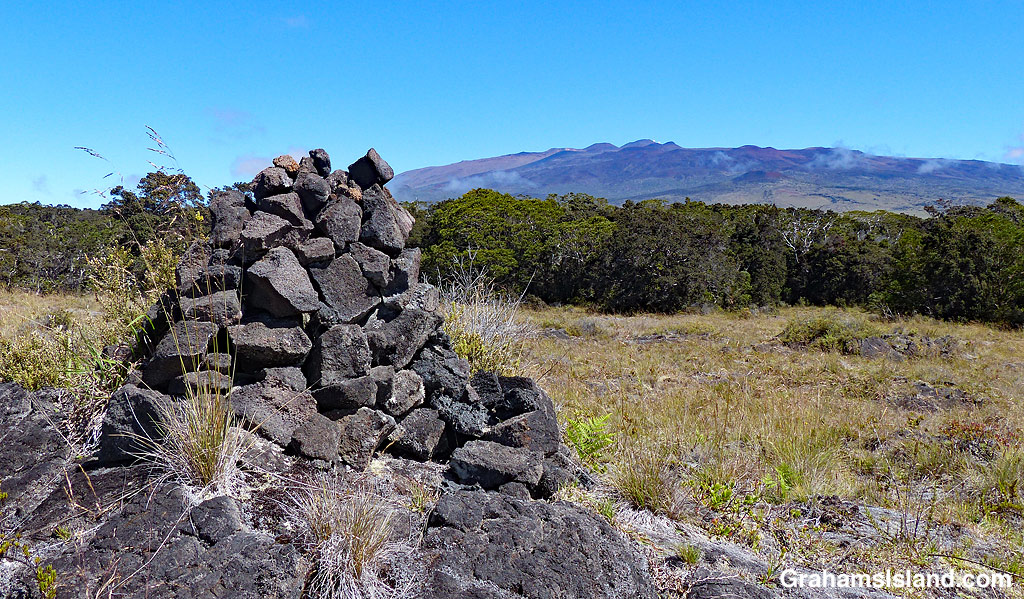
This cairn is one of many that mark the path of the Pu’u O’o Trail, off Saddle Road. At various spots, the trail offers good views of Mauna Kea such as this one.
This week’s Friendly Friday challenge theme is ‘Shadows.’ See more responses here.
This view was taken near the summit of Mauna Kea. Pu’us – little volcanic cinder cones – dot the landscape here, giving the area an otherworldly look. As the sun sets, the pu’us cast shadows on one another accentuating the slopes and craters.






 Graham's Island