

An image of lava from Kilauea Volcano’s Pu’u O’o vent entering the sea, taken from a rolling boat.
Tag Archives: On The Coast
A Bay to Keawaiki hike
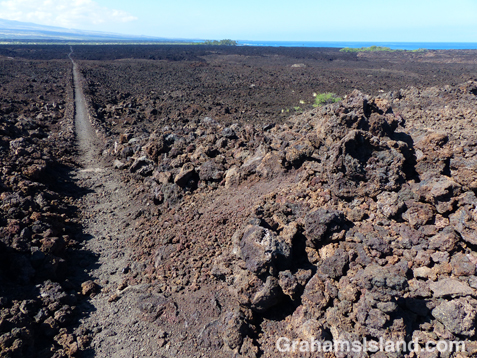
The Ala Loa Trail (King’s Trail) south of Waikoloa.

Keawaiki Beach with its lone palm tree and Hualalai volcano in the background.
This hike is a 7 mile loop directly north of the Keawaiki to Kiholo loop hike that I posted about here and here. One could combine the two, but it would make for a long, hot walk, though with several opportunities to take a cooling dip. I chose to start the loop at its northern end, heading south on the inland lava field before it got too hot. The return, along the coast, is still over lava, but usually features a cooling sea breeze.
A Bay is officially known as ʻAnaehoʻomalu Bay, but most people find A Bay easier to pronounce. There’s bathrooms and showers at the beach here so I find it a good place to start and finish.
From the parking area, head inland to pick up the old King’s Trail which is marked by a sign, though it’s obvious without it. The King’s Trail heads south in a ramrod straight line. Eventually, this trail intersects with a dirt road headed toward a cluster of palm trees on the coast. Follow this road down to the Brown estate, which is surrounded with barbed-wire. The trail goes down the side of this fence to Keawaiki Bay and its lone palm tree.

The Golden Pools of Keawaiki (though they’re actually inland of the next beach down the coast). The golden color is due to a unique algae.
Heading north again, the next bay is Pueo Bay and a small trail inland from this leads to the Golden Pools of Keawaiki. The color of these pools is due to a unique algae that grows here. There’s no swimming in these pools, but further up the coast, after passing Weliweli Point, another lone palm tree marks Akahu Kaimu Bay. Just inland from the palm is a large freshwater pool which is perfect for a cooling dip. When I visited, there was no one else there, or indeed within a mile of the spot.
Heading north along the coast again, the lava transitions to the kind of sandy beaches that Hawaii is renowned for. The southernmost beaches are usually sparsely populated or just plain empty. These beaches lead back to A Bay and its welcome facilities.
For more information about this, and other hikes on the Big Island, go to bigislandhikes.com. (This hike is listed as Keawaiki Bay to ʻAnaehoʻomalu Bay (A Bay), starting from the southern end.)

The freshwater pool behind Akahu Kaimu beach, marked by another lone palm tree. After a hot, dry walk, a dip in the pool was very refreshing.

A sandy beach straight out of the brochures at the south end of A Bay.
Hawaiian monk seals getting together

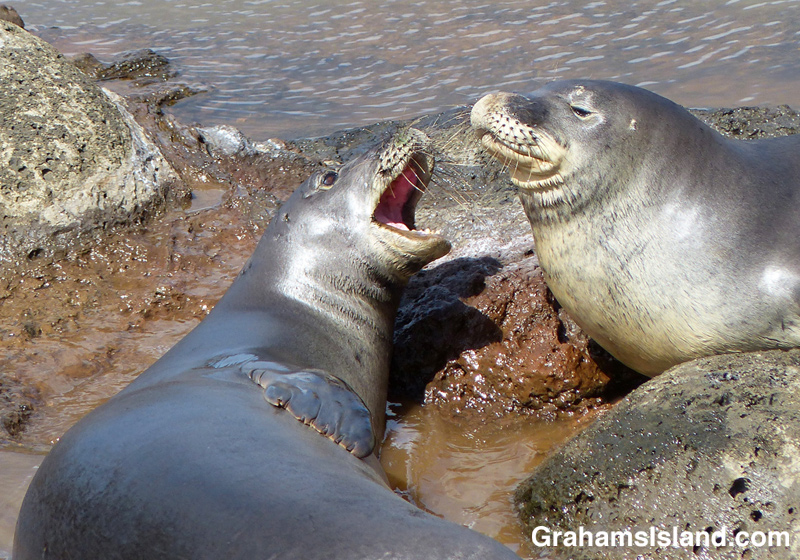
 Last month, I posted here about how unusual it was to see two Hawaiian monk seals in the same tide pool. Those two, identified as IO5 and BOO, were stretched out, resting.
A couple of weeks later, I came across the same two seals in a different tide pool, but definitely not resting. Bouts of circling and interaction were interspersed with them just lying together or in close proximity. Mostly IO5, the male seal, seemed to be the pursuer, but when he stopped, BOO, the female, was just as likely to reinitiate the activity.
Eventually BOO left the water and IO5 followed. He made another attempt to initiate some action, but she seemed to have tired of the game. Eventually, he eased off to the side not far away, and by the time I left, the two of them seemed to have settled in for some rest.
To me, IO5 looked like he was interested in mating, and half the time, she seemed amenable, but I’m not sure they’d do that in a tide pool. None of the barking, slapping, or nipping seemed to have any malevolence behind it; after such exchanges they mostly settled down again next to each other.
IO5 is on the left in the top photo, the right in the middle photo, and the foreground in the bottom photo. He’s the seal I see most often and his expression in the middle photo is quite representative of him.
For more information about Hawaiian monk seals, see here or here.
Abstracts: Rocks in blue water
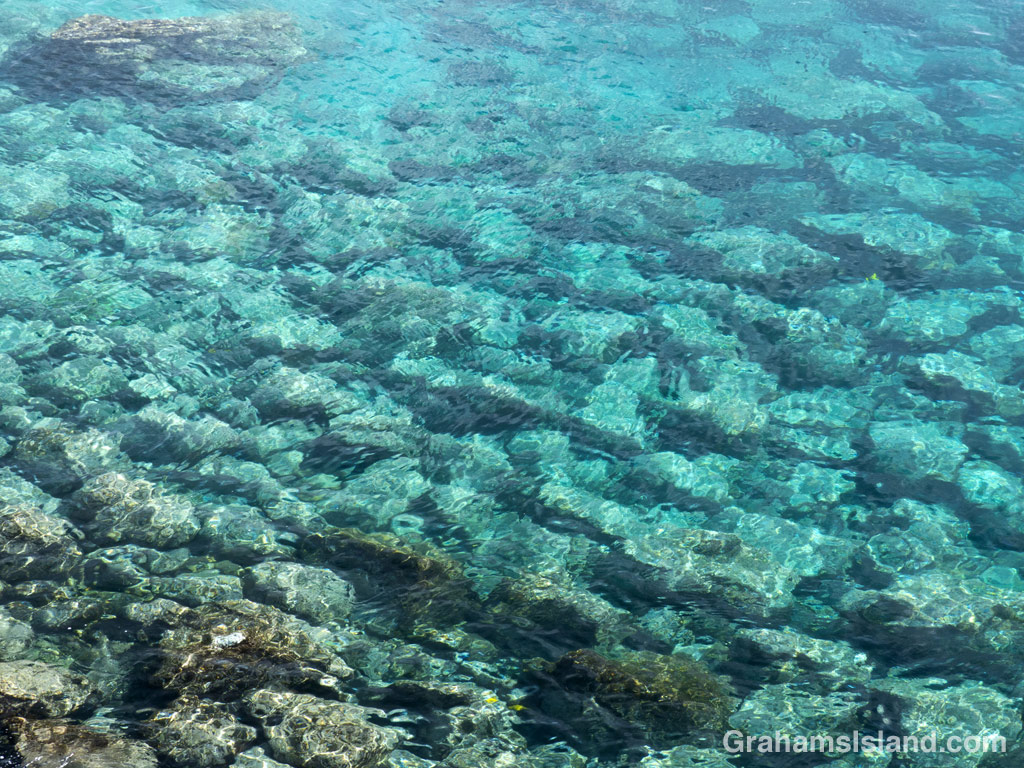
Looking down onto clear blue waters close to shore.
Memorial on the coast
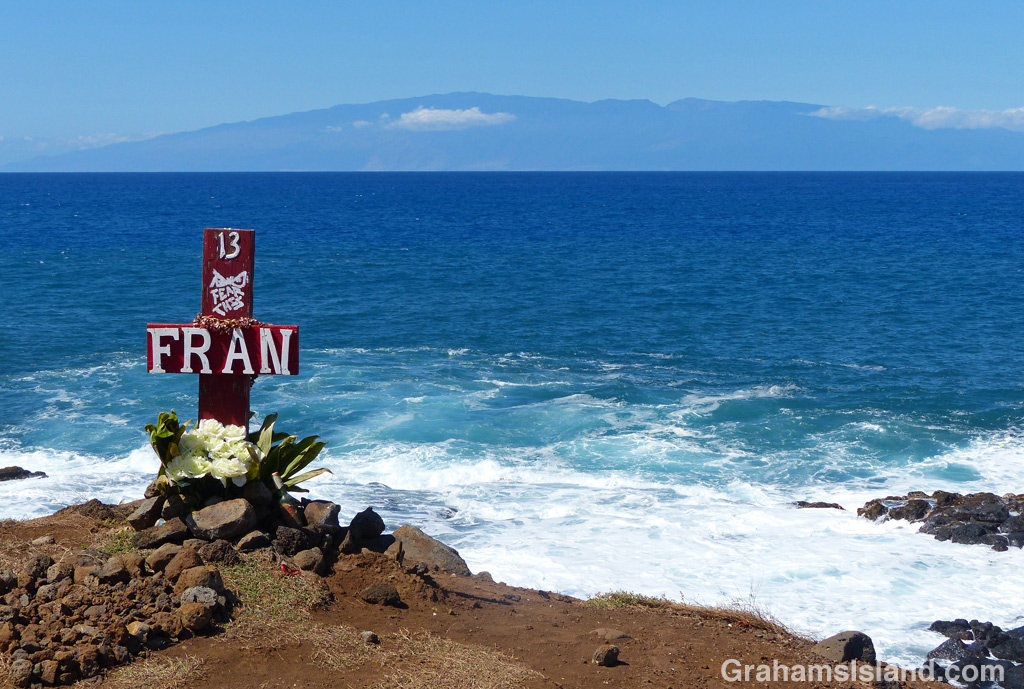
As is the case in many places, the Big Island is home to a variety of memorials, put in place and maintained by loved ones. Many can be seen by the side of highways, marking the spot where a life ended.
I don’t know the story behind this one, but it’s a beautiful, peaceful spot with its view across the ʻAlenuihāhā Channel to Maui.
Signs: High surf

This is what people think of when they think of Hawaii: golden sand, blue water, and rolling surf at Hapuna beach, often touted as one of the best beaches in the world. Trouble is sometimes the surf gets too big, which is when the lifeguards have to get busy. Not sure the surf in this photo warrants the sign, but even small surf can cause trouble for people unfamiliar with it.
A pigeon, but rock or racing?

I thought this was one of the local rock pigeons hanging out near the cliff edge, but when I got home and looked at the photo, I noticed the bands on its legs. A bit of research on birdwatchingdaily.com revealed that banded pigeons are the same rock pigeon species, but are usually lost racing pigeons.
Turns out there are three racing pigeon clubs on the island as well as several more on the other islands. Unfortunately, I didn’t have a photo with enough information on the band to tell where it might have come from. I saw the same bird a couple more times without getting a better view, and then it was gone.
I don’t know if it suddenly remembered its way home or simply ingratiated its way into the local rock pigeon flock.
Hawaiian monk seals

This photo is somewhat unusual, particularly for the Big Island. Outside of mothers with pups, it’s uncommon to see two monk seals together, much less relaxing in the same tide pool. One reason is the scarcity of seals. There are 1,000 or so in the remote northwest islands, but only about 200 around the main Hawaiian islands. Of those 200, there may be as few as 5 living around the Big Island.
One of those is IO5, a 7-year-old male, who I’ve posted about before (here, here, and here). He’s the seal I see most. In this photo, IO5 is in the foreground in what I can only describe as a characteristic pose. He’s resting, which is what monk seals do when they haul out on land.
The other seal was new to me so I was keen to identify it. There are two main means of identification. Many seals have a code bleached onto their sides. Such a mark is good for about a year until the seal molts when it sheds it’s skin. This new seal was not bleached.
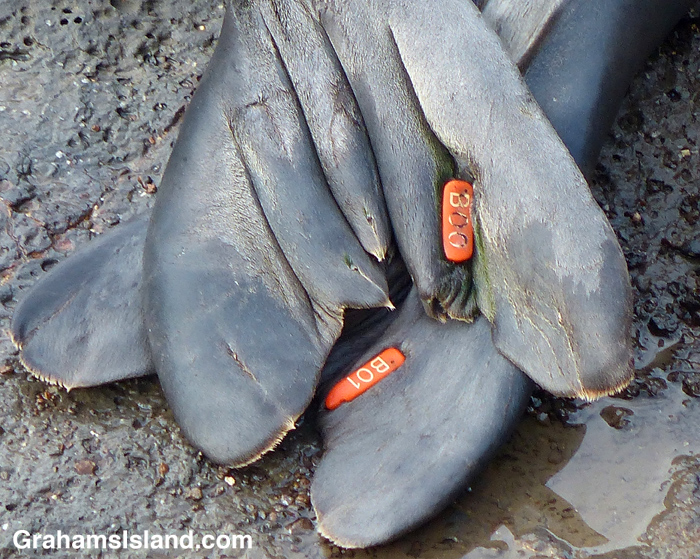
The other prime method is red tags attached to the seal’s tail flippers. I moved around, trying to get a good view of the tail, but couldn’t see any tags. (I should mention here that the goal is never to disturb seals when they’re resting, so while they reclined in the tide pool, I was sneaking around on the cliff 30 feet away and another 10 to 20 feet up.) I watched for a while but this seal showed even less inclination to move than IO5. It was so still, I wondered if it was dead, but I did see a couple of twitches.
Over the next few days I saw the new seal three more times. The first time it was in a position where I couldn’t see the tail. The second time, I caught a tantalizing glimpse of red, but that told me nothing more than that the seal had been tagged. (IO5 has also been tagged, but has lost them over the years and now bears only a nubbin of one tag.) The third time I saw the new seal it was out in an open spot where I could get a great view without disturbing it. Again I could see part of the tag, but not enough to identify it. So I hung around for the best part of an hour. I got good photos both sides, of the head and tail, but still only a glimpse of a tag. During that time the seal’s only movement was a twitch of the tail, which covered the bit of tag I could see. The only good news about all this was that the seal looked in excellent shape. I didn’t see any wounds or other marks that might indicate a problem.
Finally, a full week after the first sighting, I went down to the same area again. At first, I didn’t see any seals, but I thought I’d check a low spot on the cliff for another view. About 15 feet away, stretched out on the rock, was the new seal. It was facing me but, eyes closed, remained unaware of my presence. I took a couple of photos, then climbed back up the cliff and around to where I could see the tail flippers. Eureka! The flippers were splayed in such a way that I could clearly see two tags, one in each flipper.
I sent the photos in to the NOAA Fisheries Marine Mammal Response Coordinator and a couple of days later I learned that the new seal is B00 (not sure why the other tag says B01). The seal is a 9-year-old female that was born on Kauai. In recent years she has also been seen on Molokai and Maui. I think is the first sighting for her on the Big Island. She had her first pup this year on Maui, but unfortunately it was stillborn. Perhaps her sojourn on the Big Island with IO5 will presage another pup sometime next year.
For more information about Hawaiian monk seals, go to www.pifsc.noaa.gov/hawaiian_monk_seal/ or www.marinemammalcenter.org/hawaii.
 Graham's Island