Tag Archives: Sunday Stills

I told you so

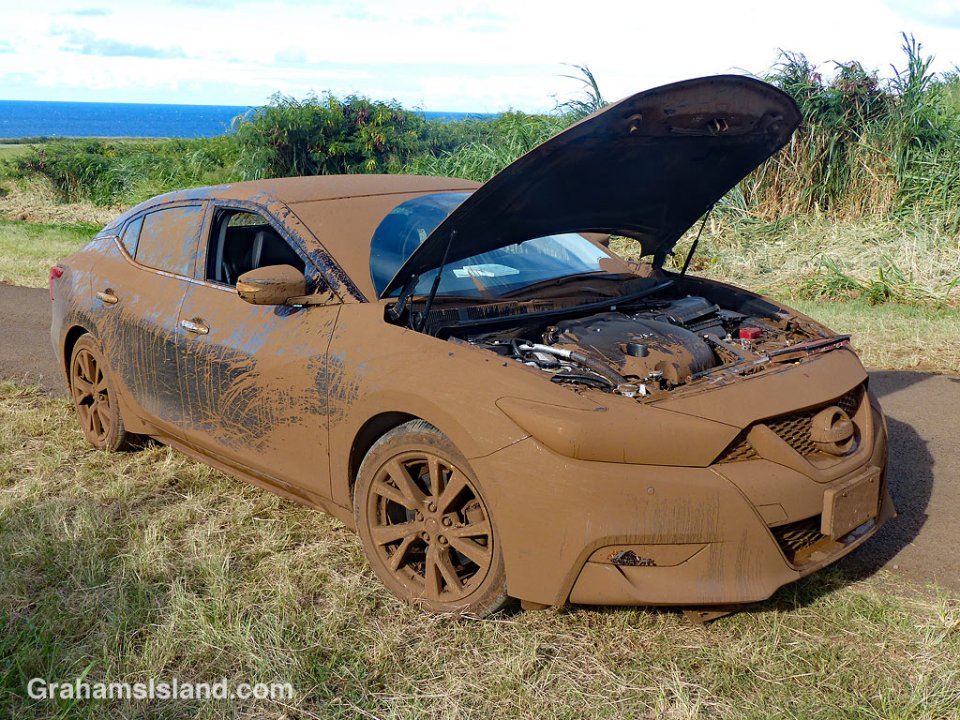
Mud covered car

This week’s Sunday Stills challenge theme is ‘On the road’ (more responses here), and I thought of this image.

One of my regular walks is a loop around Upolu Airport, at the northern tip of the Big Island. It’s a dirt road and rough in places, but excellent for walking, especially along the coast. There’s a spot where this loop reaches the coast where visitors, en route to Mo’okini Heiau and King Kamehameha’s Birthplace, pause to view the coast and get their bearings.

On this day, I ran into two older men in the car in the photo and they asked me about driving to the heiaus. I said it was possible (I’ve seen a Smart Car out there before), but there were two things to watch out for. The first was clearance. As you can see, their car didn’t have a lot of that and the dirt road is studded with rocks, some of them capable of disemboweling a vehicle. The second thing I mentioned was that the road could have significant mud puddles. I hadn’t been down that way in a while and so didn’t know the state of the large puddles that form when there’s rain. But I said they could drive down past the house and they’d see the first one. I cautioned that if there’s mud I wouldn’t recommend them driving through it. A Jeep would be OK, but not that car. The mud can be quite deep, which is bad enough for a low-clearance car, but that mud can also conceal those disemboweling rocks.

The two men thanked me for the information and drove off. I carried on with my walk.

About 45 minutes later I neared the parking lot and saw their car pulled over on the side of the road. My first thought was that the car looked as if it had been coated with chocolate. The brown layer across the front, top, and back, was perfectly smooth. The sides were more splattered, but it was clear that an impressive amount of mud had somehow been made to coat most of the car.

I had a momentary panic. Had I somehow forgotten to mention the rough road and the mud? Had I said, ‘Don’t worry about the conditions. Just go for it.’ One of the men I’d seen earlier was talking on a phone next to another car. The other was standing besides the muddied car. I walked up to him and before I could say a word he said, “Do you know what the four most satisfying words in the English language are?” I looked blank. “I told you so,” he said. I told him that wasn’t what I was thinking and that was true. I was more curious about what the heck had happened.

He said they’d come to the first mud puddle and his friend, who was driving, said the thing to do was to go through at speed. He’d urged caution, but they zoomed into the mud, disappeared from view, and emerged in a different color car. Oh, and then the car died. They got it going again and somehow coaxed it back to the paved road near where I found them. Quite how they managed this, I don’t know. It meant driving back through the mud and then easing along for another mile to the paved road. They did this very slowly. Once they reached this road, they sped up and the car promptly died again.

I looked into the engine compartment and it was as liberally coated with mud as the exterior. They’d removed the air filter because that was full of mud. Chances were that several other significant engine cavities were similarly choked.

I waited with them until a tow truck arrived and then left. I never learned how bad the car was damaged or how they explained it away. I didn’t really want to know. Instead, I preferred to remember the image of that chocolate-coated car and my image of the magnificent ride that made it that way.
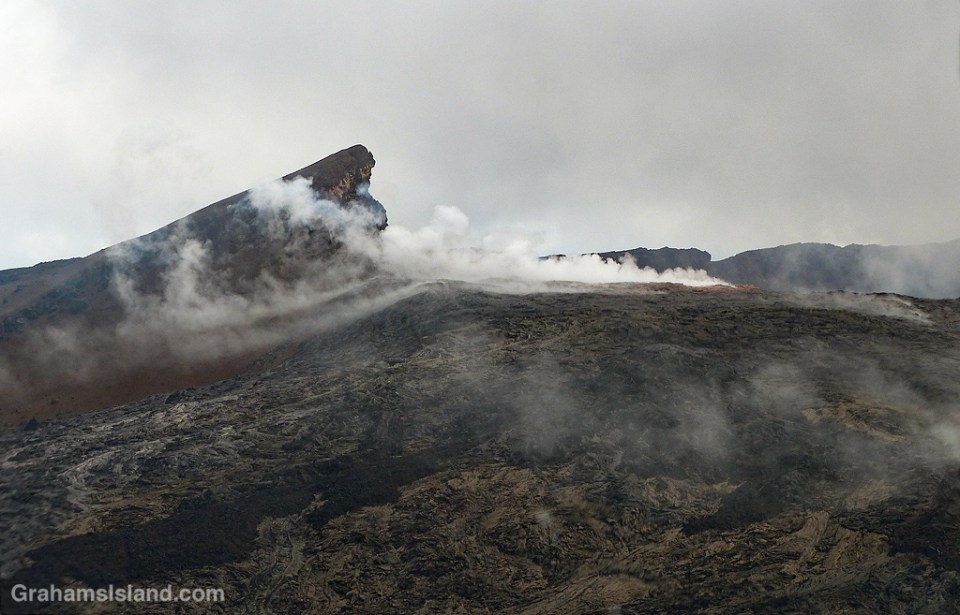
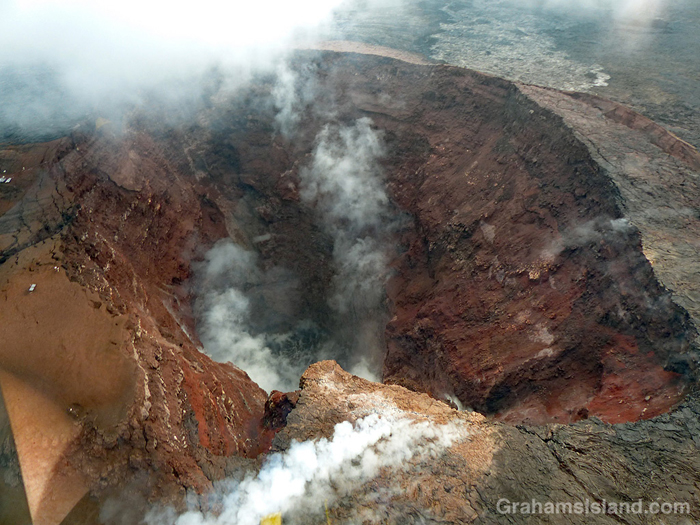
Pu’u O’o vent

Pu'u O'o vent

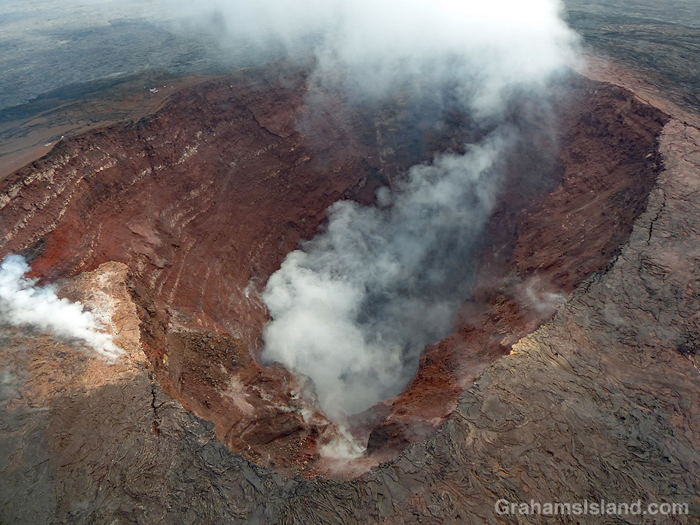
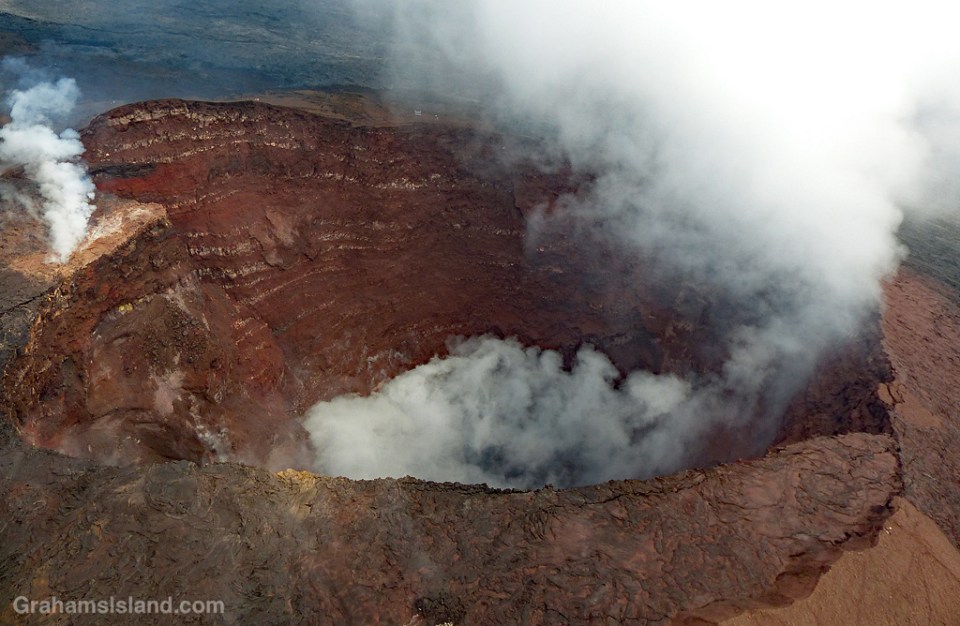
Pu'u O'o vent and steamPu'u O'o vent from aboveThis week’s Sunday Stills challenge theme is ‘Time.’ (See more responses here.) I had a couple of thoughts about this. The first is that the state of Hawaii is a kind of geologic timepiece. The Hawaiian islands exist because a magma source known as the Hawaii hotspot generates volcanic activity. This creates underwater seamounts that eventually break the surface to form new islands. Such a process is currently taking place with Lōʻihi Seamount, off the southeast coast of the Big Island. It’s about 3,000 feet below the surface but, if it continues its present activity, it will rise above sea level in another 10,000 to 100,000 years.
But if Hawaii is on a volcanic hotspot, why doesn’t it produce one volcano that just gets bigger and bigger? Well, the tectonic plate on which Hawaii sits is in constant motion to the northwest. So the volcanic activity generates an island, but as the plate moves, that island edges away from its creative source and the volcanic activity ceases. What happens then is that the winds and waves begin a long process of erosion until that island is reduced to an atoll and finally disappears below the ocean’s surface. We’re not talking months here. We’re talking millions of years for this process to take place.

Look at a map and you’ll see this chain of Hawaiian Islands stretching away to the northwest, the islands or atolls becoming progressively smaller until they disappear and return to being below-surface seamounts. And while I say this is a slow process, it can also be speedy. In October of this year, Hurricane Walaka ripped through the French Frigate Shoals, part of the northwest Hawaiian chain. Its passage completely removed the second largest island in the group, East Island, from the map. Researchers had been working there before the hurricane struck. After its passage, it was gone (more info here).

So Hawaii is an example of the geologic passage of time. But there’s another aspect of our view of time that is illustrated here. The photos are of Kilauea’s Pu’u O’o vent. Kilauea is one of the planet’s most active volcanoes and the Pu’u O’o vent had been more-or-less continuously active since 1983. Then, in May of this year, the activity in this vent, and in the summit vent at Halema’uma’u Crater, ceased. The magma drained from these places and traveled down the east rift zone of the volcano before emerging in a residential subdivision, Leilani Estates, in the southeast corner of the island. This new eruption produced a lava flow that reached the ocean, destroying more than 700 structures en route, but adding hundreds of acres to the Big Island coastline.

What’s the time aspect of this? Well, it’s part of the geologic time process noted above. But there’s another way of looking at it. Kilauea has been erupting so long and so regularly that it’s been a little bit taken for granted. “Oh, lava’s flowing into the ocean? You know, I’m really busy right now. I’ll catch it later.” “The summit vent is spilling onto Halema’uma’u Crater’s floor? I’ll check that out next time I’m down that way.”

I consider myself fortunate that I got to see the firehose of lava entering the sea after a cliff collapse (here). Next day, following another cliff collapse, it was no longer visible. And in April of this year I went down to see the summit lava lake (here) bubbling up to the crater floor and visible from Jagger Museum. Two weeks later, the level had dropped a thousand feet. It continued to fall.

I might never see these things again in my lifetime, but at the time, there seemed to be lots of time to visit. But even events happening in a long, geologic timeframe might occur in the space of a week, a day, even an hour. It’s a reminder to me that each moment is something fleeting, perhaps something special, something to pay attention to.

These photos are of Pu’u O’o vent in late September of this year. No lava is visible in the vent, but it’s still hot enough that rainfall generates steam, which is what’s visible here. It was quite dramatic to pass over this vent, which for 35 years has pumped lava out onto the surrounding landscape.

Pu'u O'o vent steam

Passion vine butterfly

Passion vine butterfly

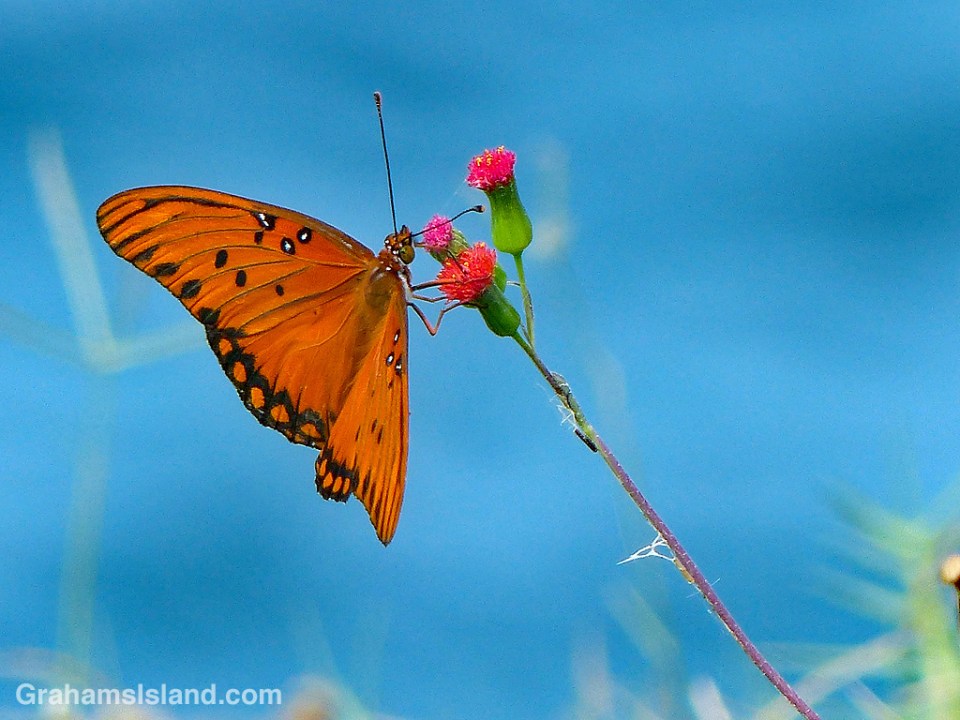
I already ran a post for this week’s Sunday Stills challenge on the theme of ‘Orange’ (here, and other responses here). But yesterday, while taking a walk, I came across this passion vine butterfly and thought it fit the theme too well to pass up. The butterfly was feeding on a tasselflower with the blue Pacific as a backdrop.

Orange

Dendrobium secundum flowers

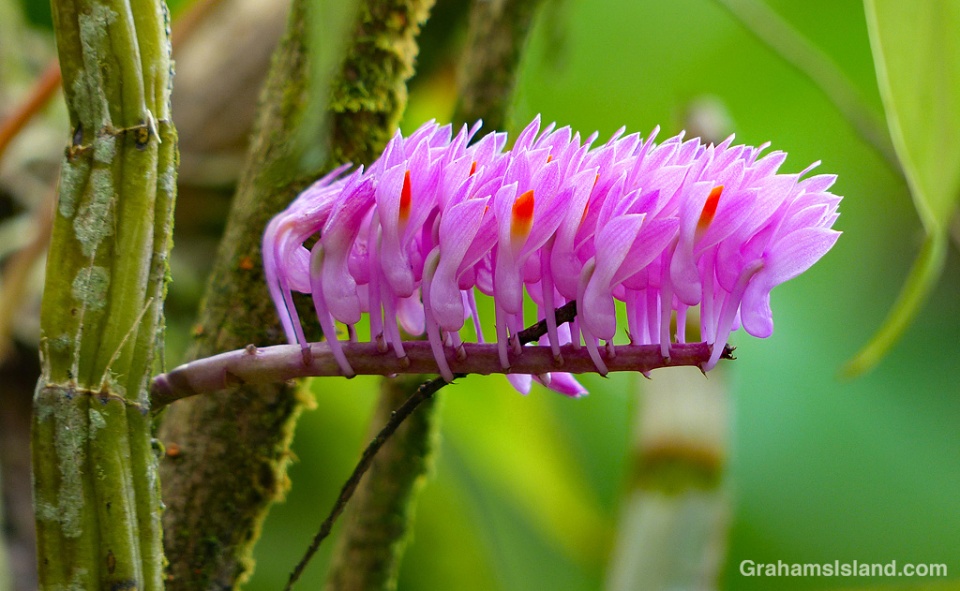
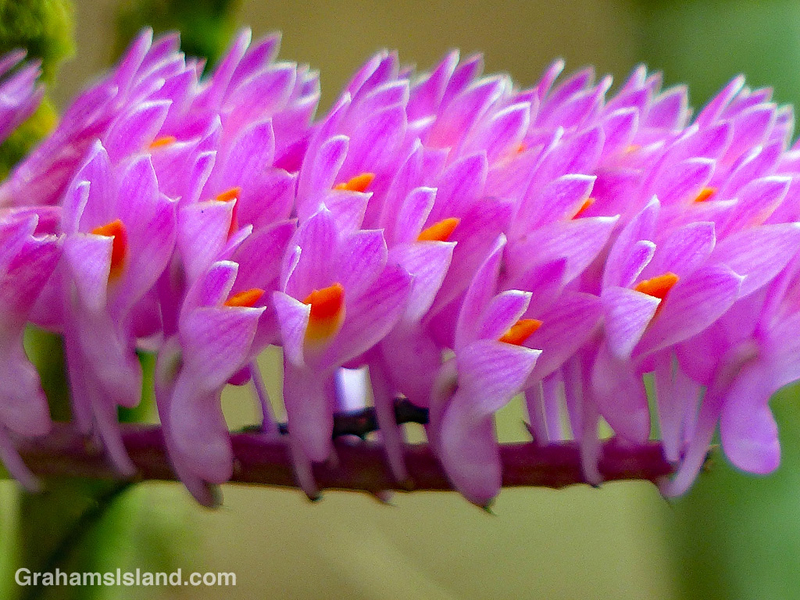
Dendrobium secundum orchidThis week’s Sunday Stills theme is ‘Orange.’ (See more responses here.) Usually I pick one subject for these challenges, but I had two recent subjects that fit the bill and I couldn’t make up my mind, so I’m including both.

The flower photos are of a dendrobium secundum orchid, which is also known as a toothbrush orchid. The flower color can vary from pale pink to purple with an orange labellum at the tip. These flowers were soft and delicate looking, yet so lush.

The bottom photo is from the recent Ironman race on the island. I liked the pop of this cyclist’s outfit and how his water bottle matched his orange helmet.

Ironman cyclist and old shed

Kohala waterfall

Kohala Waterfall

This week’s Sunday Stills challenge theme is ‘Photo-editor.’ See more responses here.

A few weeks ago I posted a composite photo of a rainbow here, which would have been a good choice for this challenge. But I also had more recent photos, of a waterfall in the Kohala Mountains, that I wanted to combine.

I couldn’t capture the full drop of this waterfall, probably somewhere between 500 and 1,000 feet, in one image, so I took two photos. This presented a couple of challenges. First was to combine the image of the top of the falls with the one of the bottom of the falls. The second challenge involved dealing with the horizontal offset of these two photos. Since I was in a helicopter at the time, we’d moved forward between shooting the images.

I’m pretty happy with the final image, especially the capture of the mini rainbow at the base of the falls. Anyway, feel free to see if you can spot where the two photos are connected.

Thanks to Sunshine Helicopters for the tour.

Java sparrow

Java Sparrow

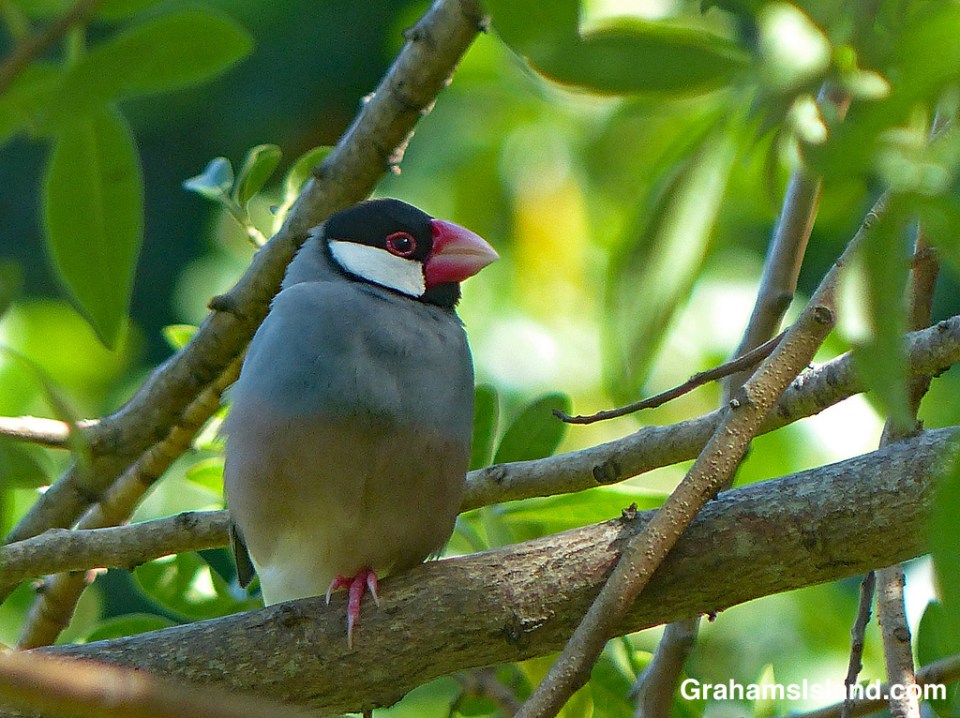
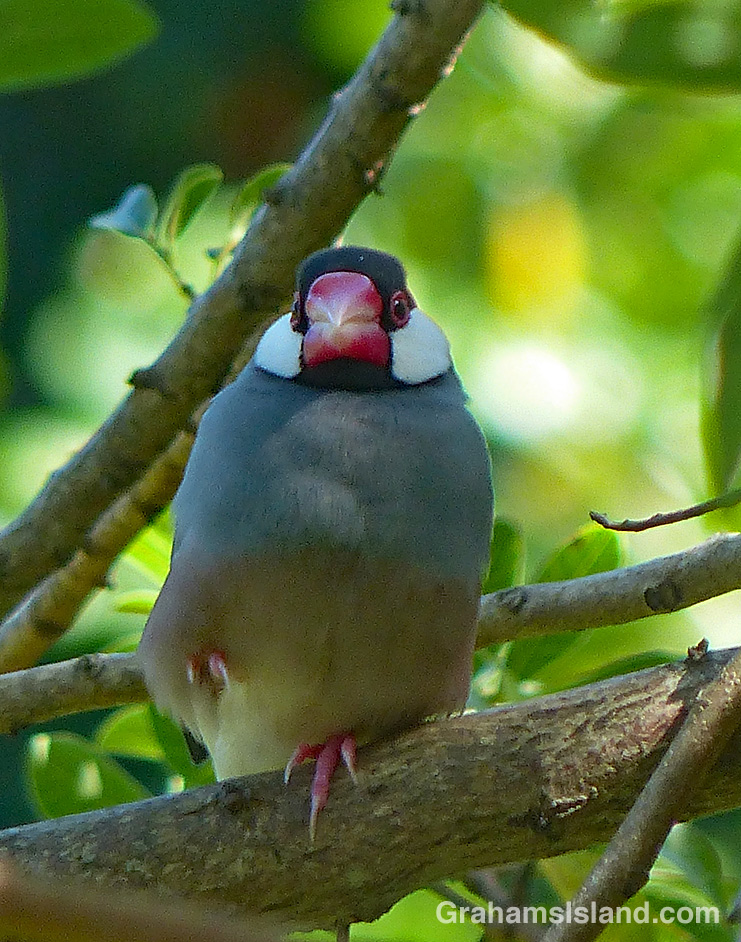
Java Sparrow from the frontThis week’s Sunday Stills challenge theme is ‘Pink.’ (See more responses here.) I mulled a few possibilities before settling on this fine little bird, a Java sparrow. The Java sparrow, as its name suggests, is native to Indonesia, but is now well established in Hawaii. It’s notable for its thick, pink bill which matches its eye ring and feet.


Island hopping

Mokulele plane landing at Kona

Honolulu AirportIn Hawaii, it’s not unusual for people to commute between islands. Many medical professionals are based in Honolulu, but have offices on the Big Island which they visit on a weekly basis. The same can be said for other professionals: lawyers, scientists, engineers and the like. Politicians and government officials go back and forth on a regular basis.

But it’s not just professionals. Skilled tradespeople might work on any of the islands, commuting on a daily or weekly basis. Highway construction crews likewise move from island to island depending on where and what projects are being worked on. Musicians and other artists are regular island hoppers. The list goes on.

There’s one mode of transport for all these people and that’s air travel. There are no inter-island ferries. The Hawaii Superferry operated from 2007 to 2009 but was suspended when the Hawaii Supreme Court ruled that a second environmental impact statement was required. One concern with a ferry is the increased risk of spreading invasive species and diseases of plants and animals.

Hawaiian Airlines is the biggest operator in the islands, with the lion’s share of the inter-island business. It operates from its hub in Honolulu, but also offers direct flights between the other islands. The second photo shows the distinctive tails of a couple of its planes at Honolulu Airport.

Smaller airlines have also offered inter-island routes. These include Aloha Airlines, Go! Airlines and Island Air. These three ceased business in 2008, 2014, and 2017 respectively. Currently, the only other island airline is Mokulele Airlines, though it doesn’t fly to Kauai. They service some smaller airports and operate smaller planes such as the one above, coming in to land at Kona Airport.

Posted in response to this week’s Sunday Stills challenge is on the theme of ‘Transportation or Commute.’ (More responses here.)