Crab spiders are small, but they build good-sized webs. They’re also not territorial, which means they’re fine having other crab spiders for neighbors. When there’s a lot in one area, walking around becomes a bit of a challenge. I’ve wrapped webs around my head so many times it’s amazing I haven’t turned into a spider myself!
… They go together in this week’s Sunday Stills challenge theme of ‘Rainy Days.’ See more responses here.
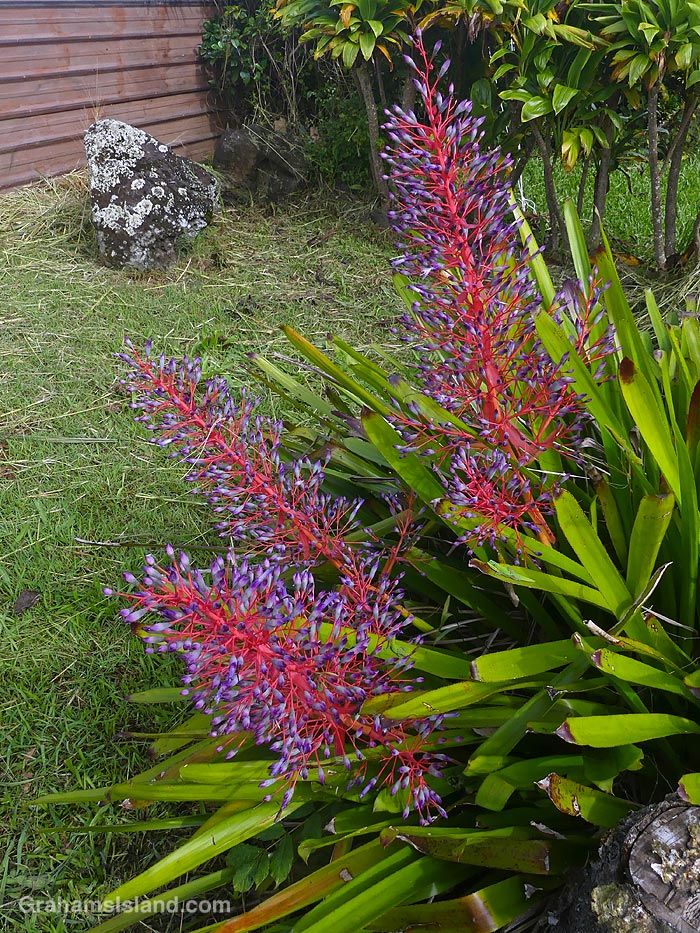
Kahili Gingers illuminate a wet day in Kalōpā Forest Reserve.
There’s plenty of rain on the Big Island. Most falls on the wet east side, but the dry west side can get its share too. Hilo, on the wet side, averages around 140 inches of rain a year, and just to the west of Hilo is an area that gets more than 200 inches a year. In contrast, Kawaihae, on the Kohala coast, gets around 10 inches of rain annually, though I suspect last year was one of its wetter ones.
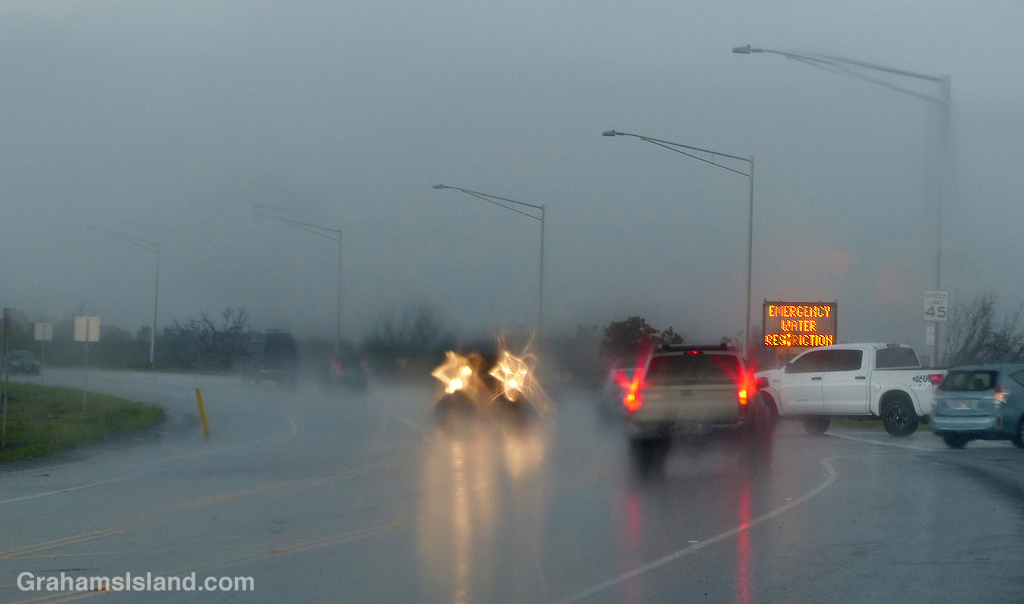
The highway to the Mauna Kea visitor center awash with rain.
Where I live, on the northern end of the island, we get around 50 inches of rain a year, but being on the shoulder of Kohala Mountain, that figure can change quickly going a mile east or west, or a mile up the hill or down toward the ocean.
Looking out the window as a passing shower dumps a load of rain.
Saddleback Butterflyfish are easily identified with their bold and colorful markings. They’re almost always seen in pairs, and have a fairly wide range when it comes to the depths of water they inhabit. They feed mostly on coral polyps and, like Yellow Tangs, don’t do well in captivity.
First time I’ve noticed this in downtown Hawi. That means it’s either new, or my powers of observation are continuing their steady decline! The fish doesn’t seem to be associated with any kind of business. It’s just there for decoration. Maybe that’s why it looks so angry.
Posted for Bushboy’s Last on the Card photo challenge. See more responses here.
The idea of The Numbers Game is to enter a number into the search bar of your computer and then post a selection of the photos that turn up. This week’s number is 131.
When I was down at Pu’uhonua o Hōnaunau National Historical Park recently, I noticed, possibly for the first time, these circles in some of the fishponds. They are the nests of male Mozambique tilapia (Oreochromis mossambicus). The males hope to entice a female into laying her eggs in their nest, after which the male will fertilize them.
Tilapia were introduced to the fishponds to control mosquitoes, but like many such ideas, they have proved detrimental to the well-being of native species. Currently, efforts are underway to remove them from the ponds.
I was driving home yesterday when I noticed some haze blowing out to sea. I thought it was rain at first, but quickly realized that this was smoke, likely another brush fire, and my heart sank. I was halfway home. Up ahead was Lapakahi and beyond that, Mahukona, two places I spend a lot of time at.
As I got closer I saw that the fire was burning at Lapakahi. Traffic was still passing on the highway though the land beside it was black and smoking. But strong trade winds had blown the fire, which apparently started near the park entrance, down towards the ocean.
My guess is the fire had been going less than an hour when I got there, though a considerable area had already burned. Fires were burning along the north edge of the area, not far from the road, but the most smoke and bigger flames could be seen closer to the ocean. It looked like the small visitor center had escaped, surrounded as it is by the looping access road. But other structures might not have been so lucky, and the native plants, birds and insects probably did not fare well.