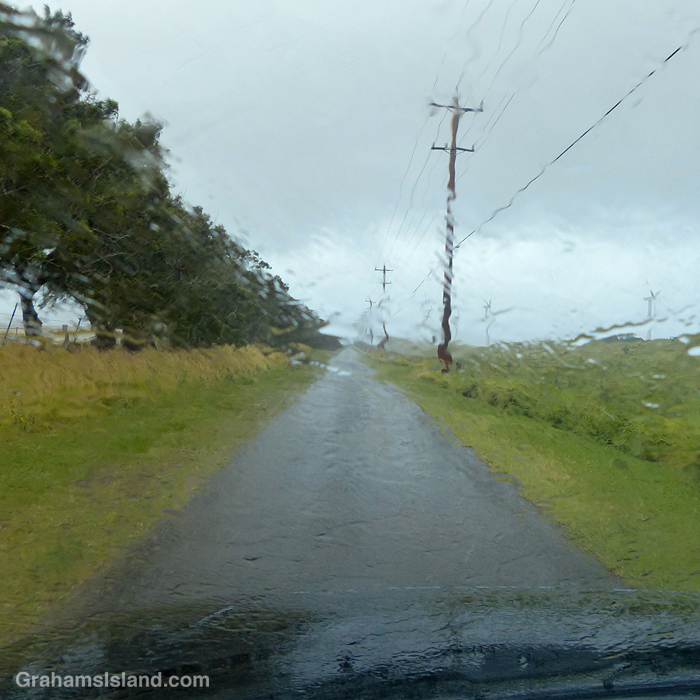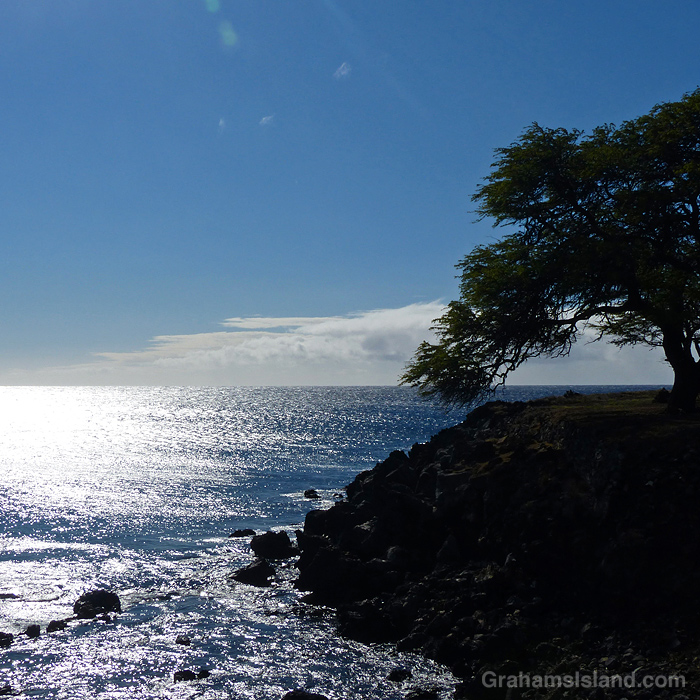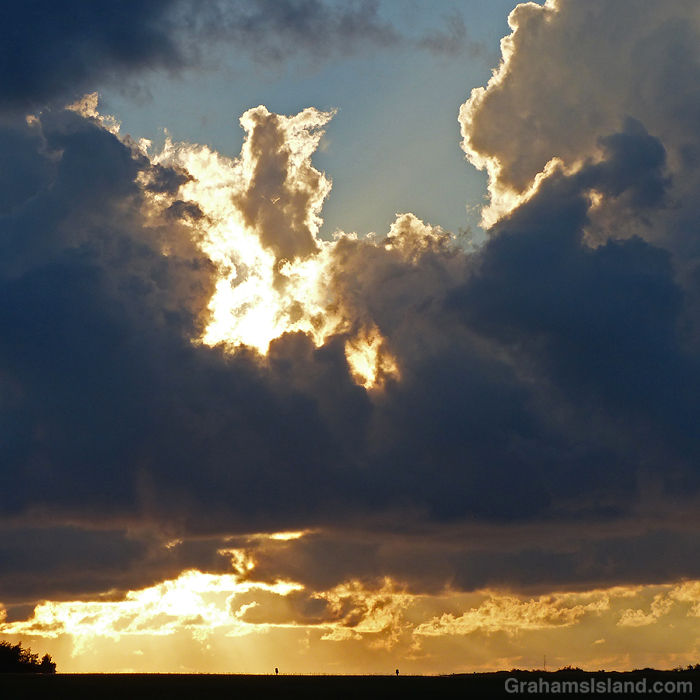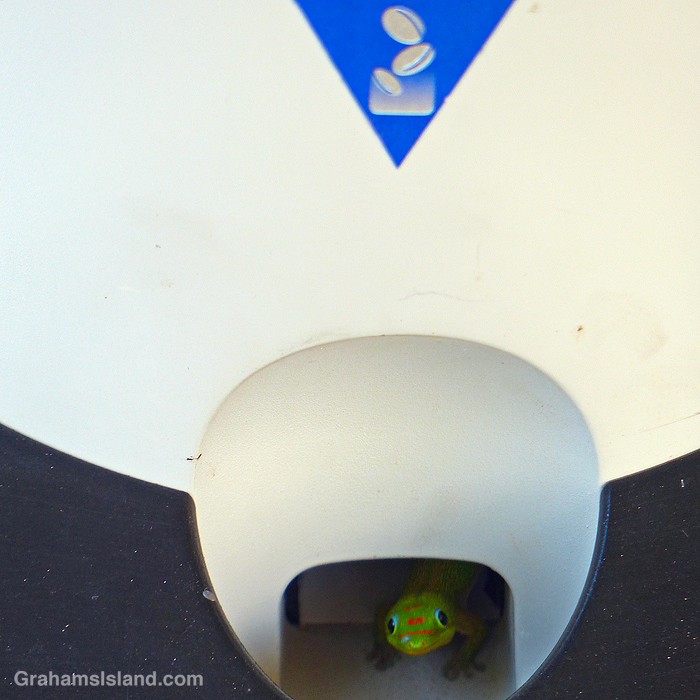
This week’s Sunday Stills challenge theme is ‘Lights.’ See more responses here.
I ventured out into the chill Hawaiian night to see what kind of displays the area had to offer. I was pleasantly surprised to find that, despite the difficult circumstances, many people had hauled their lights out and illuminated their properties.
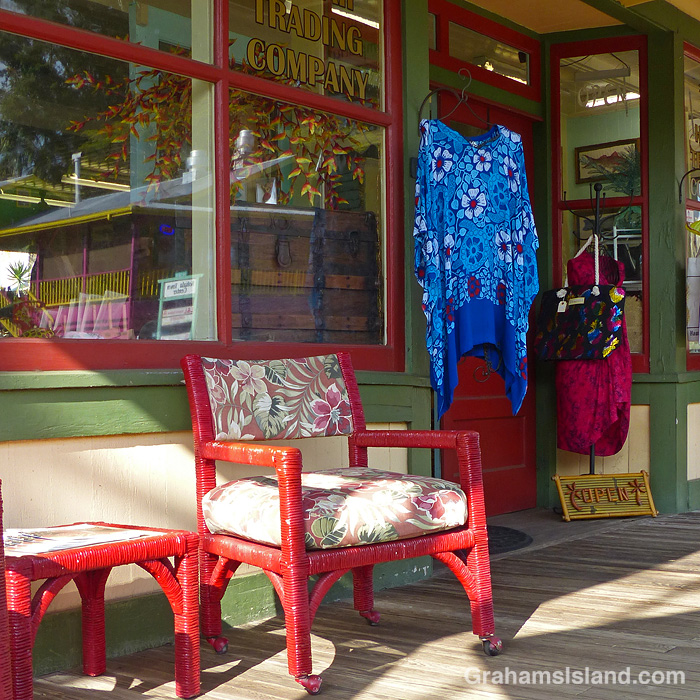
In the end though, I was taken by the window display at the Old Hawaiian Trading Company in Kapaau. I mean, who doesn’t like lights that flash on and off in different colors? People susceptible to seizures perhaps, but let’s not dwell on that. They worked for me. I’m a sucker for shiny things and blinking lights.
This week’s Sunday Stills challenge theme is ‘Winter Wonderland.’ See more responses here.
We do get snow here on the Big Island, on the summits of Mauna Kea and Mauna Loa, but there’s none up there right now. However, for those knee deep in snow, shrouded in freezing fog, or sliding on icy sidewalks, I thought these photos might seem like something of a winter wonderland.
Hapuna beach (officially Hapuna Beach State Recreation Area) regularly features on lists of the world’s best beaches. It’s a long stretch of golden sand across the head of a wide bay with fairly protected waters. Swimming is good, but when waves do roll in, surfers take over.
The top two photos show the view from the south end of the beach. In the second photo, the line of greenery jutting into the beach represents the edge of the State Recreation Area. North of there is Hapuna Resort, which is private, but the beach is still open to the public. The bottom photo shows the view from the north, looking south. The tracks in the sand are from vehicles used in beach maintenance or by the lifeguards who patrol the beach.
This week’s Sunday Stills challenge theme is ‘City Sidewalks.’ See more responses here. The Big Island is a bit short on cities, but we do have a few sidewalks, even up here in North Kohala.
For many years, Hawi had a Saturday farmers’ market, which was held on a green space, under the banyan trees, near the heart of the community. The Covid virus shut that down and after a while, it was announced that the market wouldn’t return. Instead, once restrictions were eased, a Saturday morning market appeared on the sidewalks downtown. This wasn’t a problem since pretty much all the businesses were closed.
Yesterday’s market was quite busy, with the added boost of the approaching Christmas season. In the top photo, the Kohala Coffee Mill was open for business but still had room for a couple of vendors out front. In the second photo, the space in front of the Bamboo Restaurant is fully occupied. The restaurant has been closed since March, and while limited seating and take out is allowed now, the restaurant has not reopened. A lot of their trade was from tourists so I suspect they’re waiting to see how that develops. They do, however, appear to be planning on reopening.
The third photo, taken farther down the street, was taken a few days earlier and reflects how things are without an event like the market. This building, at street level, was occupied by a gallery and a popular restaurant. Both have not only closed, but aren’t going to reopen. The spaces appear to be in the process of gaining new tenants, though I doubt they’ll open soon since there are still relatively few tourists visiting the island, at least compared to previous years.
The bottom photo shows a covered sidewalk, which complements the street sidewalk. There are several active businesses in this building, but it’s still much quieter than it used to be. I suspect that this year might have reminded old timers of how this part of the island used to be in the days before the tourist boom happened.
The bottom photo is also posted in response to Bushboy’s Last on the Card photo challenge for November. See more responses here.
This week’s Friendly Friday challenge theme is ‘Red and Green.’ See more responses here.
Poinsettias (Euphorbia pulcherrima) have been associated with Christmas for centuries in Mexico and Central America, where the plant hails from. The plant was introduced to the United States in the 1800s, but it wasn’t until the last century that the Christmas link really took off. This was mostly due to savvy marketing tactics by the Ecke family, which had a monopoly on the poinsettia market thanks to their discovery of a secret grafting method which produced a denser plant and wasn’t duplicated until the 1990s.
The red ‘flowers’ are actually bracts, which hold the fairly insignificant flowers. On the Big Island, their brilliant displays are quite common on the west side of the island, where they can be seen as bushes and trees.
This week’s Sunday Stills challenge theme is ‘Texture.’ See more responses here.
We had a lot of rain here last week, not tropical downpours, but steady, continuous rain. Along the coast, this turned parts of the dirt road into mud baths. Areas to be avoided, right? Not if you’re a mudder, someone for whom heavy rain is an excuse, a calling even, to drive their 4×4 trucks to the area and carve figure eights into the morass.
The top photo shows an area where this activity is particularly popular. The original grassless patch was about half the size of that in the photo. For walkers, it’s not quite so inviting. It’s easy to lose footing in the slick, squishy mud. And if the rain continues, this mud will wash down into the ocean affecting coastal habitat for fish and other marine life.
Fast forward past a couple of days of sunnier weather and the ground is very different. Most of the mud has dried. Those spatters sprayed around the edges of the mud bath are now nubbly, crunchy lumps in the grass. Anyone driving or walking in this area will crush those lumps into dust and when the wind blows, as it does here most of the time, that dust will blow into the ocean, etc., etc..
But it might rain again before it all blows away, except … well, you get the picture.
This week’s Friendly Friday challenge theme is ‘Unique.’ See more responses here.
I’ve posted photos of the benches at Pana’ewa Rainforest Zoo before (here and here), but realized I had some others available, so here they are. I don’t know whether they’re unique or not, but I’ve never seen anything like them elsewhere.
Top photo is the Namaste bench, Namaste being a white Bengal tiger, the zoo’s star attraction, who died in 2014. The middle photo shows a couple of birds, though I hesitate to say what kind! The bottom photo represents the zoo’s ring-tailed lemurs.
The zoo is currently closed, in part because of the Covid virus, but also for construction required to make the zoo compliant with the Americans with Disabilities Act. It’s scheduled to reopen in early 2021. For more information about Pana‘ewa Rainforest Zoo & Gardens, go to hilozoo.org.
This week’s Sunday Stills challenge theme is ‘Thankful.’ See more responses here.
This theme seemed an appropriate time to feature my most recent hike in Hawaii Volcanoes National Park. I’d been wanting to try some backcountry trails for some time, but the road to Hilina Pali Overlook had been closed since the 2018 eruption. A month or so ago it reopened so off I went.
I hadn’t hiked the backcountry there before so, to get a feel for the area, I decided to do the hike marked on the map. (For an overview map of the park click here. Ka’aha Campground is the westernmost campground on the coast.) From the overlook I’d go down the pali (Hawaiian for cliff) to the coast at Ka’aha, then take a connecting trail to the east to link up with the Hilina Pali trail again, and back up to the overlook. At somewhere around 8.5 or 9 miles it sounded simple enough.
View to the west from Hilina Pali.
View to the east from Hilina Pali.
The trail down Hilina Pali is barely visible in places.
First shade tree on Hilina Pali.
Second shade tree on Hilina Pali.
Rock slide on the Hilina Pali Trail.
The first section of trail switchbacked down the very steep, 1,500-foot high pali. It looked like it doesn’t get a lot of use and recent rains had caused the grass to flourish. Following the trail became an exercise in spotting cairns to see which way the trail headed, and then carefully making my way in that direction. Underfoot, it was rocky and uneven; an easy place to turn an ankle. On the plus side, the views were wonderful, up and down the coast.
After a while, the grass thinned out and the trail became clearer, though still steep and rocky. A couple of brave trees clung to the side of the hill and I thought, ‘those will give me a bit of nice shade on the way back up.’
As I got toward the lower part of the pali, the trail angled into an area of tumbled rocks, big and small. A landslide, this one from Kilauea’s 2018 eruption. Traversing this section involved clambering over whatever rocks were in my path. I kept hoping I wouldn’t step on a loose rock, causing it to slip and trigger another slide. It was a bit depressing to get through the area only to see the trail zag back into the danger zone. However, soon enough I was through the rocks, down at the foot of the pali, and on to the first trail junction.
Hilina Pali from the junction of the Ka’aha and HIlina Pali Trails.
A collapsed lava tube with spider web on the left.
A spider at the entrance to a lava tube.
Collapsed lava tube next to Ka’aha Tail.
Ka’aha campground and the coast.
The coast at Ka’aha.
Thus far, I’d been following the Hilina Pali Trail, but now that trail bore away to the southeast. I took the right fork, going south to the coast on the Ka’aha Trail. The area between the pali and the coast is all lava and scrubby grass and the trail was again hit and miss, but well marked by cairns. The most interesting feature was how close the trail passed by several caves, which are lava tubes where the roof of the tube has collapsed. These collapses are an illustration of why it’s a good idea to stay on trails. Lava fields are riddled with tubes and the roofs can be quite thin and fragile. One wrong step and you could be lying in a dark hole with a broken ankle or worse!
The caves tend to be shady, cool, and relatively damp. Ferns and other plants grow there, sometimes including trees. Birds and insects also frequent them for the moisture, so it was no surprise to see an abundance of spiders waiting in webs across the entrances.
I reached the second trail junction and headed down the slope to Ka’aha Campground and the coast. The campground, which consists of a covered shelter and a composting toilet, sits inland from the coast. Down by the ocean there’s more vegetation including some trees so people often camp in their shade. I didn’t see any sandy beaches on this part of the coast, but there were areas of protected water for taking a dip. Since I had the long, uphill haul back still to go, I didn’t linger.
Back at the second trail junction, half a mile inland from the coast, I was roughly halfway through my hike. From here, I walked east on a little used trail that would link up again with the Hilina Pali Trail. This was the start up the uphill return and when things started to go downhill for me. This part of the island is often cloudy, wet and windy, but this day was a scorcher with the sun out and only the occasional hint of a breeze. Now, in the middle of the day, it had become very hot.
The trail was rough and the cairns not so evident, so it was slow going. I made the mistake of thinking this leg, to the third trail junction, was a shorter one, but it wasn’t. Consequently, this section took longer than expected and, the longer it went, the more I wondered if I’d missed the next trail junction. Trail junctions in the park are usually pretty well marked, but it was always possible that in this less-traveled area one might have been knocked down so that I missed it. I could see cairns ahead and hadn’t seen any off to my left, but my stopping and starting and looking for the next trail was getting wearing.
Eventually, I spotted little wooden signs ahead and reached the junction with the Hilina Pali Trail. By this time I was pretty hot. I had water, but I was frying in the sun. Still, the next section of trail was largely on the level and I hoped to make steady progress back to the foot of the pali. I was also encouraged to see clouds building up over the pali. Tackling the hill back up would be much easier in the shade.
Looking west toward Ka’aha.
View of Hilina Pali from the trail junction.
Alas, it was not to be. I slogged my way over the rough ground toward the pali and, as I did so, saw the clouds recede. By the time I got to the foot of the trail up the pali, I was fried. Had there been any shade in the area, I might have hunkered down and waited until either the clouds came back or the sun became less ferocious. But there was no shade so I decided I had to just take it steady up the trail until I reached the lower of the two shade trees. It was around this time I started singing “Put One Foot in Front of the Other” from the old Christmas special, Santa Claus is Comin’ to Town!
One positive was that I was now back on territory I’d been on earlier so I wasn’t worried about where the heck the trail was. Perhaps I should have been. I was trudging through the jumble of rocks marking the landslide area, putting one foot in front of the other, and when I looked up I realized I couldn’t see the trail ahead of me. Turning around I couldn’t see it behind me either. Obviously, I’d missed a switchback in the slide area, but I wasn’t sure how far back that might be. I really didn’t want to go down again, giving up precious elevation I’d gained, so I decided instead to angle across the slide until I found the trail again or reached the shade tree. The downside of this plan was that it meant scrambling over all these loose rocks in the worst possible spot for it – the slide area I’d hoped to traverse as quickly as possible.
It seemed like forever before I found the trail, just above the shade tree. I trudged down to it and slumped onto a rock, finally out of the sun. I had a drink, dumped some water on my head and rested for a while. I don’t know how long I stayed there, probably 10 minutes or so, but it was a huge relief. Finally, feeling somewhat refreshed, I got to my feet again and clumped on up the trail. I repeated this process at the second shade tree, before tackling the last stretch to the top. Luckily, the clouds did return and this last stretch was a bit cooler. Even a light, but steady onshore breeze filled in.
It was still a haul up the final slopes, and I was happy and relieved to see the shelter at the overlook. I sat at the picnic table and enjoyed a cold drink from the cooler in the car. This was the closest I’ve ever come to getting heatstroke while out hiking and I was very thankful to have made it back in one piece. When I changed out of my hiking shoes, I realized my feet were in bad shape with a couple of huge blisters and several blackened nails. With all that was going on, I hadn’t even noticed my feet were hurting.
I certainly got the feel for the area that I’d been looking for, but I doubt I’ll do that hike again. The views were great and the coast quite lovely, but in between – not so much. It was a grind. As we say in this household, a learning experience!
Also posted in response to this week’s Friendly Friday challenge theme of ‘Whilst Walking.’ See more responses here. Also Jo’s Monday Walk.
For more information about Hawaii Volcanoes National Park, go to nps.gov/havo/.
This week’s Sunday Stills challenge theme is ‘Auburn.’ See more responses here.
I have to confess that color is not my strong suit, hence some of my clothing choices. So when it came to picking a photo for this theme, I wasn’t sure what color I was looking for. A casual search revealed a lot of different shades loosely covered by that name. In the end, I opted to go with the official RGB color value (165 red, 42 green, 42 blue).
Armed with that information I ditched my original choice of a dirt road, thrilling photo though it is, and opted for this orchid. I’m not sure what kind of orchid it is, but I know for a fact that within those darker areas of the petals are several areas that are officially auburn.