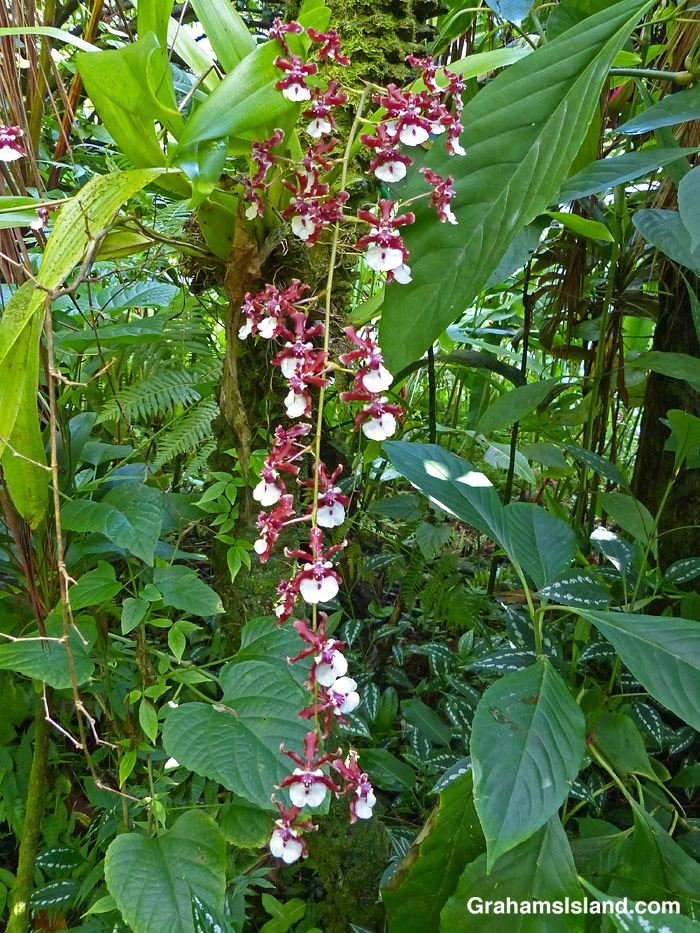
On my last walk around Hawai’i Tropical Bioreserve & Garden I saw this Oncidium Orchid, which goes by the name of Sharry Baby. I’ve seen this before, but this was the first time I’ve noted the feature it’s most renowned for, which is its strong chocolate scent. It was really quite remarkable, but I restrained myself from ripping the flowers off and chewing them there and then.
Posted for Becky’s Squares theme of “Walking” (See more responses here).
For more information about Hawai’i Tropical Bioreserve & Garden, go to htbg.com.
I like hiking and longer walks, but I’m equally happy staying closer to home and wandering around the yard here and at work. Here the sun peeks through the branches of an albizia tree.
Posted for Becky’s Squares theme of “Walking.” See more offerings here.
Many people collect plants, but some plants are collectors, too. On my last visit to Hawai’i Tropical Bioreserve & Garden it had recently rained. This bromeliad (above) and heliconia (below) had collected, not only water, but also an assortment of vegetation. There might even be a fish in there somewhere!
For more information about Hawai’i Tropical Bioreserve & Garden, go to htbg.com.
Posted for Becky’s Squares theme of “Walking” (See more responses here).
Yesterday, I posted about Aphis nerii aphids descending on a Hawaiian Crown Flower (Calotropis gigantea). After they were gone the plant continued to do well for a day or two. Then holes started to appear in the leaves and arcs along the edges.
Closer examination revealed a couple of tiny Monarch Butterfly caterpillars munching their way around the leaves. The Crown Flower is a favorite host for these caterpillars, so this wasn’t a surprise. We were also keen to provide an area for the Monarchs to thrive in. So we let the caterpillars be and monitored the situation.
What happened, not surprisingly, is that the caterpillars grew quickly. As they did so, the leaves of the plant diminished accordingly. I was gone for my weekend, and when I returned, the caterpillars had more than doubled in size. The plant though looked like someone had gone at it with a machete. We wondered if the caterpillars would devour the whole thing before they pupated.
When I returned to work after another weekend, the caterpillars were gone. As the Crown Flower was food for the caterpillars, so it appeared, the caterpillars were food for the numerous birds in the area.
The plant will likely recover from its ravishing and, once it’s bigger, it might be better able to accommodate the attentions of these caterpillars and in turn provide more cover for them from the birds. Or not! I will monitor the situation.
Posted for Becky’s Squares theme of “Walking” (see more responses here).
I like hiking, as indicated by my last few posts, but I’m equally happy with a walk around the yard, at home or at work.
Recently, we planted a Hawaiian Crown Flower (Calotropis gigantea) at work. This was a stick with two small leaves on top. The two leaves dried up and the stem turned brown. It looked doomed, but then new leaves popped out near the bottom and the plant took off. New leaves every day, steady growth.
Then one day these showed up, little yellow drops, like tiny lemon candies. Close examination revealed legs and heads. Aphids! I think these are Aphis nerii, otherwise known as the Oleander or Milkweed aphid. These little sap suckers can do a lot of damage so we hosed them off, though I doubt the ladybug in the bottom photo was best pleased since aphids are a tasty meal for them.
Still, with the aphids gone, the plant continued to thrive until … (to be continued)
Posted for Becky’s Squares theme of “Walking” (See more responses here).
A few days ago, I posted here an image from a recent walk along the coast to Hapuna beach. I thought I’d post more photos from that walk for this week’s Sunday Stills challenge theme of ‘Paths and Trails’ (more responses here), and for Becky’s Squares theme of “Walking” (more responses here).
A sign marks the trail.The trail along the coast.The trail passes through open areas.
The trail crosses beaches large and small.
Looking towards Mauna Kea Resort beach.A small beach on the trail.A sheltered cove along the trail.A view of Mauna Kea Resort beach.
Of course, besides the views I was on the alert for anything moving on the beach or in the air.
A Pallid Ghost crab on the beach.Nenes flying overhead.
Other parts pass through trees and other vegetation.
The trail passes through residential areas.Passing by a resident’s yard.Through the trees.Walking through the trees.Back to the park.
Becky’s Squares is back this month with a theme of “Walking.” See more responses here.
A walk I try to do two or three times each year is at Hawai’i Tropical Bioreserve & Garden. It’s not a long walk, but it winds through the garden where on each visit I find something new and interesting.
Osmoxylon Lineare comes from the Philippines and is also known as Miagos Bush or Green Aralia. At the garden, the sign calls it Eyelash Bush and the bottom photo gives a clue as to why that might be. To my mind though, the top photo suggest Eyeball Bush might be a better name.
For more information about Hawai’i Tropical Bioreserve & Garden, go to htbg.com.
A week ago, I posted (here) about a Wiliwili tree flowering at the foot of Pu’u Wa’a Wa’a. Wiliwili (Erythrina sandwicensis) is endemic to Hawaii and grows in dry forests on the leeward side of the island. Pu’u Wa’a Wa’a is one such place. While I’ve hiked here several times before, this is the first time I’ve seen a Wiliwili flowering.
Wiliwili is unusual for an Hawaiian tree in that it’s deciduous, dropping it’s leaves during summer droughts. It’s pollinated by birds, but on this day bees were the primary visitors.
Wiliwili seeds are easy to germinate and grow but, like many Hawaiian plants, it has been in decline, losing out to more robust non-native plants and to herbivores. The arrival in Hawaii of a a gall wasp, Quadrastichus erythrinae, greatly exacerbated the situation. However, biocontrol responses have been effective and the situation has been stabilized.