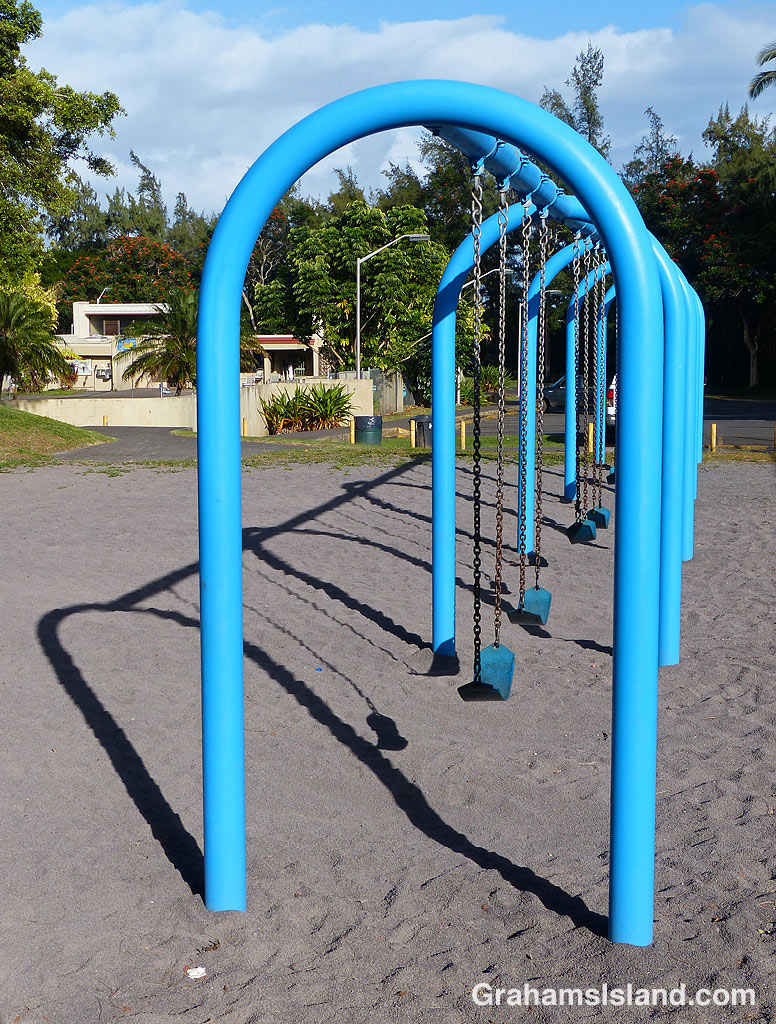
This week’s Sunday Stills challenge theme is ‘Shadows.’ See more offerings here.
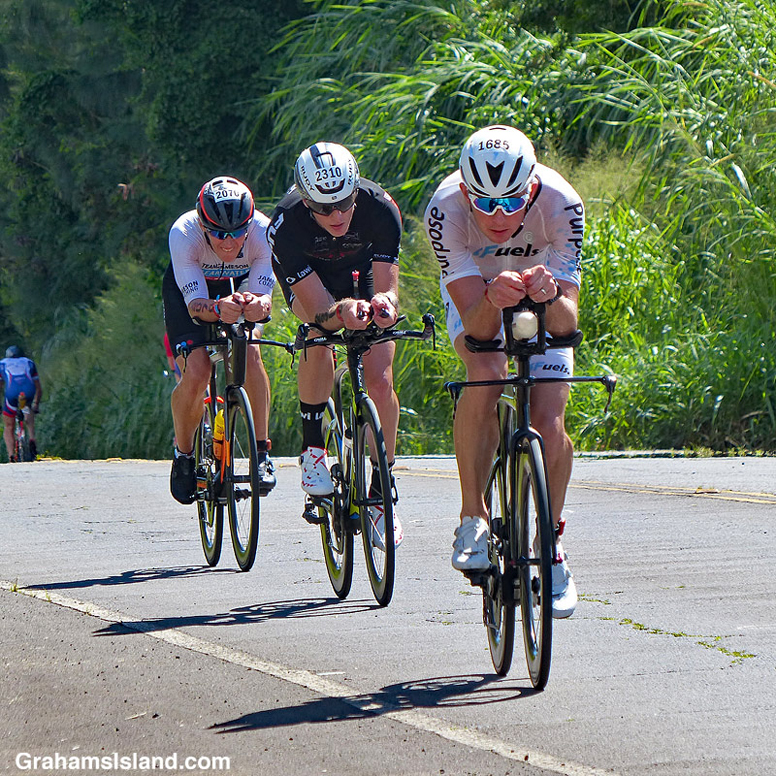
The top photo is a row of colorful playground swings at Kamehameha Park in Kapaau. Below are three cyclists in line, heading out of Hawi during an Ironman World Championship race.
Also posted as a second offering for this week’s Friendly Friday challenge theme of ‘All in a Row.’ (See more responses here.) My first post for this theme is here.
Kohanaiki Beach Park, north of Kailua Kona, is a favorite spot for surfers. But at the south end of the park, the focus switches to history.
There’s a hālau, Ka Hale Waʽa, which is used for teaching Hawaiian crafts and culture. There’s a garden which grows the same kind of plants brought over by the first Polynesian settlers. And there’s a Hawaiian star compass, a 17-foot diameter recreation showing how the Polynesians used to navigate the vast open spaces of the Pacific Ocean.
The top photo show shows the compass. The middle photo shows a plaque, which explains the basics of how it works, using the points of the compass, the sun, nighttime celestial bodies and the ocean swells. I won’t go into detail here, but more information can be found here, here, and here. Below, the setting of the compass, with a Pacific golden plover walking on it. I like this shot because the plover is said to be the reason Polynesians discovered Hawaii. Each year, plovers summer in Alaska and then fly south as far as New Zealand. It is said that the Polynesians noted this small bird’s annual journey back and forth and figured there must be land somewhere to the north, so they set out in their canoes to find it.
Posted in response to this week’s Sunday Stills challenge on the theme of ‘Round.’ See more offerings here.
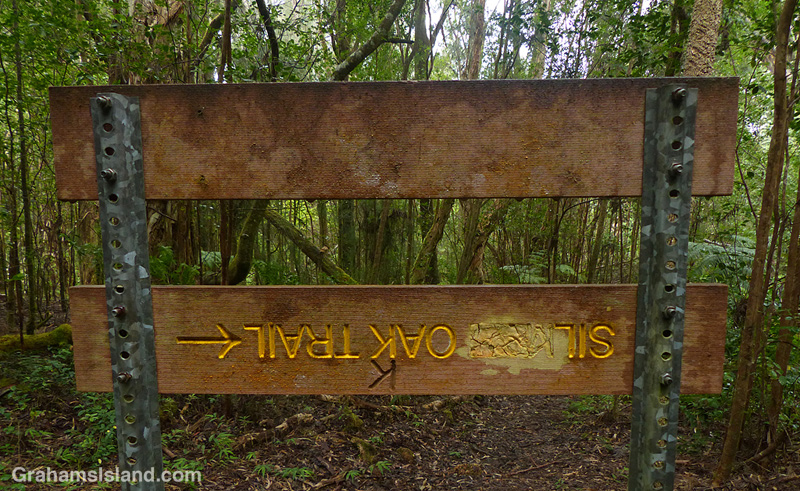
I was hiking in Kalopa Native Forest State Park when I came across the trail sign above. Nothing too remarkable about that, but I happened to notice the back side of the sign (middle), which showed that getting the sign right took a bit of practice.
On a subsequent visit, I noticed that the back of sign at the other end of the trail (bottom) had also seen a rejected first effort.
This week’s Friendly Friday challenge theme is ‘Future.’ (See more responses here.) Since this is Snow’s last time hosting the Friendly Friday challenge I thought I’d offer a personal interpretation of the theme.
Here is one of the beaches at Kekaha Kai Park. What does this have to do with ‘future?’ Well I hope such blue-green water, white sand, palm trees and sun are somewhere in your none-too-distant future, Snow. Thanks for hosting the challenge.
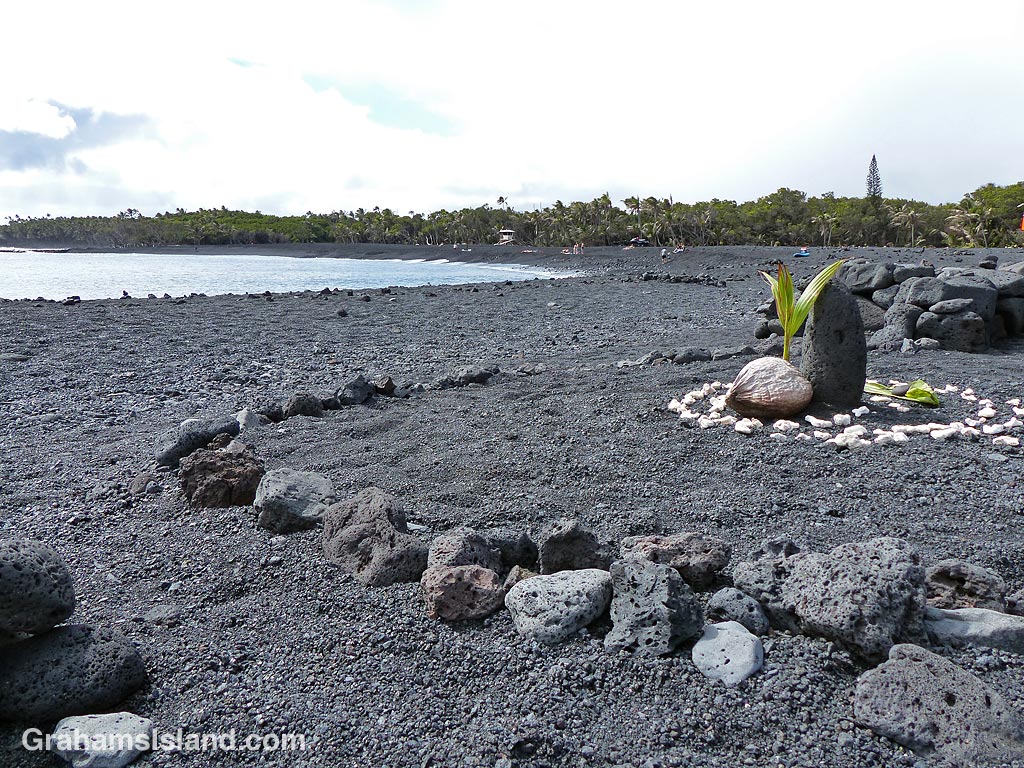
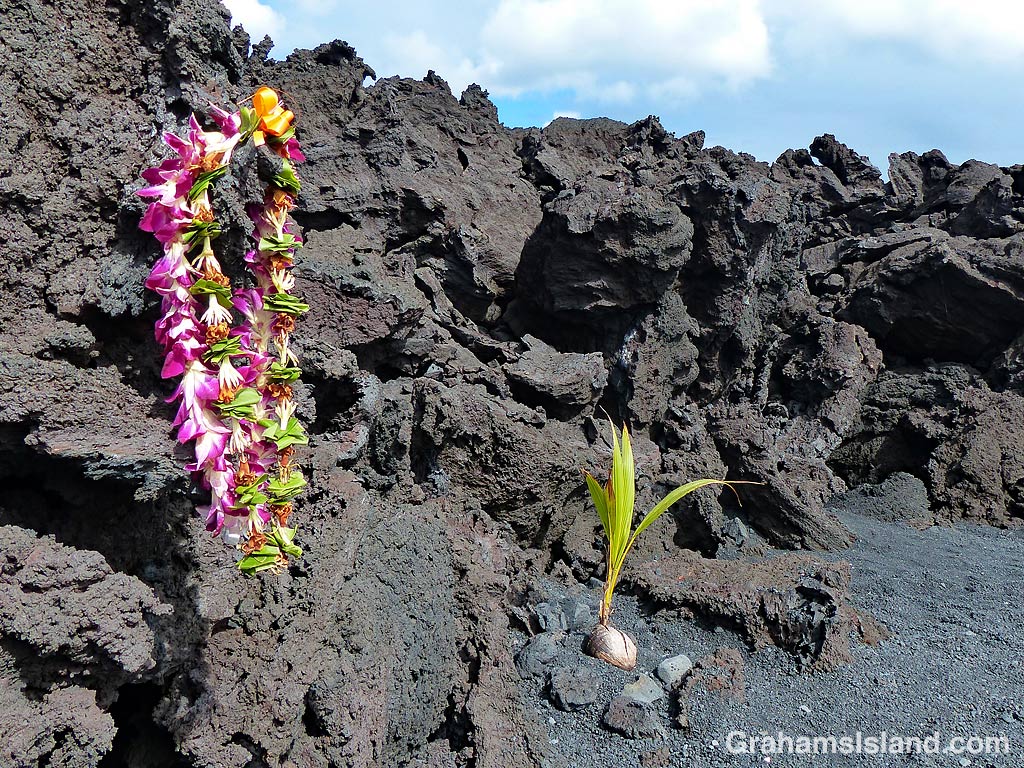
The Big Island’s newest black sand beach, at Pohoiki, was formed during last year’s eruption of Kilauea Volcano. Soon after its formation, offerings appeared at the beach and coconuts were planted.
For coconut planting, all that’s required is to plunk an unhusked coconut on the beach and wait. The coconut will sprout, as in these photos, but it can still be moved after it has sprouted as its roots are mostly fairly shallow. It’s tolerant of salinity, but likes regular rainfall, both of which are features of this location.
In several years, this somewhat stark black sand beach will become another scenic palm-lined tropical beach. That’s assuming the volcano doesn’t send another flow in this direction, in which case it might look more like the background of the bottom two photos.
This Pacific golden plover seemed unimpressed by the surfers going back and forth in the bay behind it. Instead, it focused on tidying its plumage and making sure everything was in order.
This week’s Friendly Friday challenge theme is ‘Dramatic.’ See more responses here.
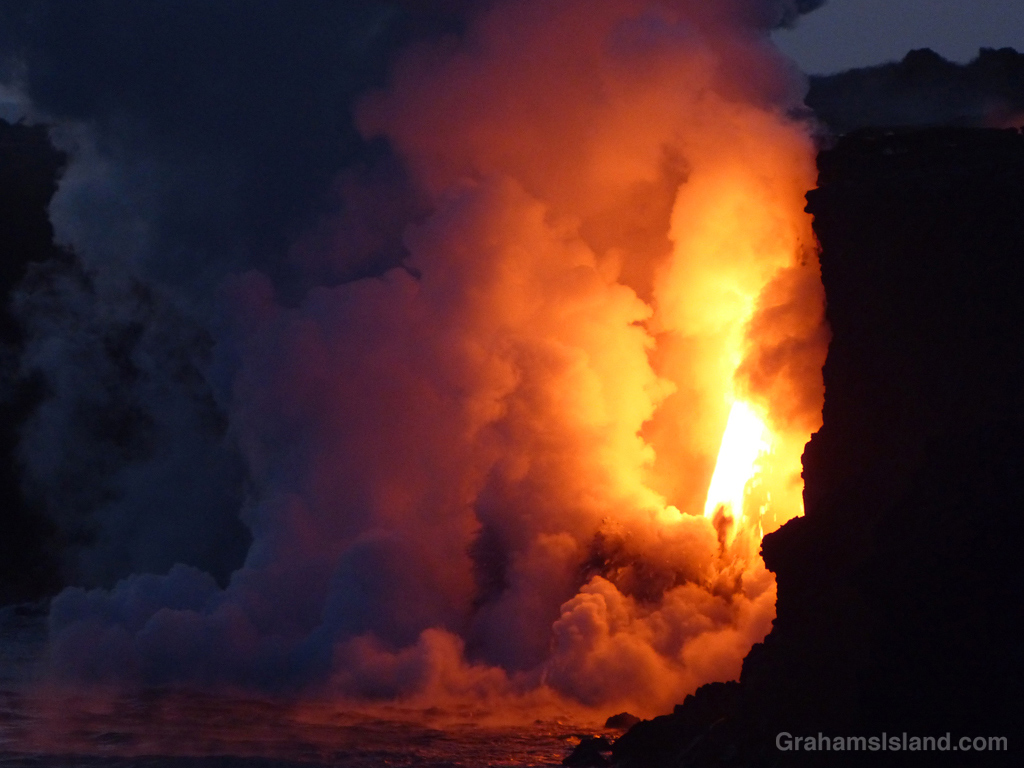
I’ve opted for a dip into the archives for this challenge. Two years ago, lava from Kilauea Volcano’s Pu’u O’o vent reached the ocean, tumbling down a cliff into the water. One day, the cliff collapsed, leaving the lava shooting out of a hole high up in the new cliff. This was called the firehose of lava because that’s what it looked like.
I first learned about it when I saw a video of the lava firehose on one of the news channels. What impressed me was that it was really hard to to see that it was a video. The flow was so strong and so consistent that it looked like a photograph. It was only by looking closely at the edges of the firehose that I could make out spatters of moving lava.
I headed down to the volcano, to take at look at this phenomenon, the day after I saw the video and was duly impressed by the dramatic scene. It was well worth the trip and well worth my quick visit. The following day another cliff collapse moved the firehose back and out of sight from the observation areas.
These are two photos from that visit. More photos can be seen in previous posts here, here, here, and here.








 Graham's Island