Category Archives: Places

Vireya rhododendron

Vireya Rhododendron

This week’s Sunday Stills challenge theme is ‘Thankful.’ (See more responses here.) I mulled a few options but decided to plump for this photo. It’s a vireya rhododendron at Hawaii Tropical Botanical Garden and I chose this for two reasons. First is that I’m thankful to be able to visit the gardens on a regular basis. There’s always something new to see there. I can happily spend an hour or two wandering around, peering into flowers, and snapping photos of geckos clambering over this, that, and the other.

The second reason is that I feel fortunate to see gorgeous flowers, such as this vireya rhododendron, on a frequent basis. Some I find in a garden setting and some are just blooming roadside. There’s so much variety on the Big Island that a drive of just a few miles can take me to a different climate zone and a whole new world of plants and animals.

For more information about Hawaii Tropical Botanical Garden, go to htbg.com.
Phalaenopsis orchid hybrid

Phalaenopsis Orchid blooms

Phalaenopsis Orchid hybridPhalaenopsis orchids are also known as moth orchids because the flower shape resembles a moth in flight. They’re very popular with growers because they’re relatively easy to care for and bloom for a long time. This popularity has also resulted in growers producing numerous hybrids of this orchid.

These blooms were at Hawaii Tropical Botanical Garden, near Hilo. For more information about Hawaii Tropical Botanical Garden, go to htbg.com.

I told you so

Mud covered car

This week’s Sunday Stills challenge theme is ‘On the road’ (more responses here), and I thought of this image.

One of my regular walks is a loop around Upolu Airport, at the northern tip of the Big Island. It’s a dirt road and rough in places, but excellent for walking, especially along the coast. There’s a spot where this loop reaches the coast where visitors, en route to Mo’okini Heiau and King Kamehameha’s Birthplace, pause to view the coast and get their bearings.

On this day, I ran into two older men in the car in the photo and they asked me about driving to the heiaus. I said it was possible (I’ve seen a Smart Car out there before), but there were two things to watch out for. The first was clearance. As you can see, their car didn’t have a lot of that and the dirt road is studded with rocks, some of them capable of disemboweling a vehicle. The second thing I mentioned was that the road could have significant mud puddles. I hadn’t been down that way in a while and so didn’t know the state of the large puddles that form when there’s rain. But I said they could drive down past the house and they’d see the first one. I cautioned that if there’s mud I wouldn’t recommend them driving through it. A Jeep would be OK, but not that car. The mud can be quite deep, which is bad enough for a low-clearance car, but that mud can also conceal those disemboweling rocks.

The two men thanked me for the information and drove off. I carried on with my walk.

About 45 minutes later I neared the parking lot and saw their car pulled over on the side of the road. My first thought was that the car looked as if it had been coated with chocolate. The brown layer across the front, top, and back, was perfectly smooth. The sides were more splattered, but it was clear that an impressive amount of mud had somehow been made to coat most of the car.

I had a momentary panic. Had I somehow forgotten to mention the rough road and the mud? Had I said, ‘Don’t worry about the conditions. Just go for it.’ One of the men I’d seen earlier was talking on a phone next to another car. The other was standing besides the muddied car. I walked up to him and before I could say a word he said, “Do you know what the four most satisfying words in the English language are?” I looked blank. “I told you so,” he said. I told him that wasn’t what I was thinking and that was true. I was more curious about what the heck had happened.

He said they’d come to the first mud puddle and his friend, who was driving, said the thing to do was to go through at speed. He’d urged caution, but they zoomed into the mud, disappeared from view, and emerged in a different color car. Oh, and then the car died. They got it going again and somehow coaxed it back to the paved road near where I found them. Quite how they managed this, I don’t know. It meant driving back through the mud and then easing along for another mile to the paved road. They did this very slowly. Once they reached this road, they sped up and the car promptly died again.

I looked into the engine compartment and it was as liberally coated with mud as the exterior. They’d removed the air filter because that was full of mud. Chances were that several other significant engine cavities were similarly choked.

I waited with them until a tow truck arrived and then left. I never learned how bad the car was damaged or how they explained it away. I didn’t really want to know. Instead, I preferred to remember the image of that chocolate-coated car and my image of the magnificent ride that made it that way.

Pu’u O’o vent

Pu'u O'o vent

Pu'u O'o vent and steamPu'u O'o vent from aboveThis week’s Sunday Stills challenge theme is ‘Time.’ (See more responses here.) I had a couple of thoughts about this. The first is that the state of Hawaii is a kind of geologic timepiece. The Hawaiian islands exist because a magma source known as the Hawaii hotspot generates volcanic activity. This creates underwater seamounts that eventually break the surface to form new islands. Such a process is currently taking place with Lōʻihi Seamount, off the southeast coast of the Big Island. It’s about 3,000 feet below the surface but, if it continues its present activity, it will rise above sea level in another 10,000 to 100,000 years.

But if Hawaii is on a volcanic hotspot, why doesn’t it produce one volcano that just gets bigger and bigger? Well, the tectonic plate on which Hawaii sits is in constant motion to the northwest. So the volcanic activity generates an island, but as the plate moves, that island edges away from its creative source and the volcanic activity ceases. What happens then is that the winds and waves begin a long process of erosion until that island is reduced to an atoll and finally disappears below the ocean’s surface. We’re not talking months here. We’re talking millions of years for this process to take place.

Look at a map and you’ll see this chain of Hawaiian Islands stretching away to the northwest, the islands or atolls becoming progressively smaller until they disappear and return to being below-surface seamounts. And while I say this is a slow process, it can also be speedy. In October of this year, Hurricane Walaka ripped through the French Frigate Shoals, part of the northwest Hawaiian chain. Its passage completely removed the second largest island in the group, East Island, from the map. Researchers had been working there before the hurricane struck. After its passage, it was gone (more info here).

So Hawaii is an example of the geologic passage of time. But there’s another aspect of our view of time that is illustrated here. The photos are of Kilauea’s Pu’u O’o vent. Kilauea is one of the planet’s most active volcanoes and the Pu’u O’o vent had been more-or-less continuously active since 1983. Then, in May of this year, the activity in this vent, and in the summit vent at Halema’uma’u Crater, ceased. The magma drained from these places and traveled down the east rift zone of the volcano before emerging in a residential subdivision, Leilani Estates, in the southeast corner of the island. This new eruption produced a lava flow that reached the ocean, destroying more than 700 structures en route, but adding hundreds of acres to the Big Island coastline.

What’s the time aspect of this? Well, it’s part of the geologic time process noted above. But there’s another way of looking at it. Kilauea has been erupting so long and so regularly that it’s been a little bit taken for granted. “Oh, lava’s flowing into the ocean? You know, I’m really busy right now. I’ll catch it later.” “The summit vent is spilling onto Halema’uma’u Crater’s floor? I’ll check that out next time I’m down that way.”

I consider myself fortunate that I got to see the firehose of lava entering the sea after a cliff collapse (here). Next day, following another cliff collapse, it was no longer visible. And in April of this year I went down to see the summit lava lake (here) bubbling up to the crater floor and visible from Jagger Museum. Two weeks later, the level had dropped a thousand feet. It continued to fall.

I might never see these things again in my lifetime, but at the time, there seemed to be lots of time to visit. But even events happening in a long, geologic timeframe might occur in the space of a week, a day, even an hour. It’s a reminder to me that each moment is something fleeting, perhaps something special, something to pay attention to.

These photos are of Pu’u O’o vent in late September of this year. No lava is visible in the vent, but it’s still hot enough that rainfall generates steam, which is what’s visible here. It was quite dramatic to pass over this vent, which for 35 years has pumped lava out onto the surrounding landscape.

Pu'u O'o vent steam

Army supply ship

Army LSV in Kawaihae Harbor

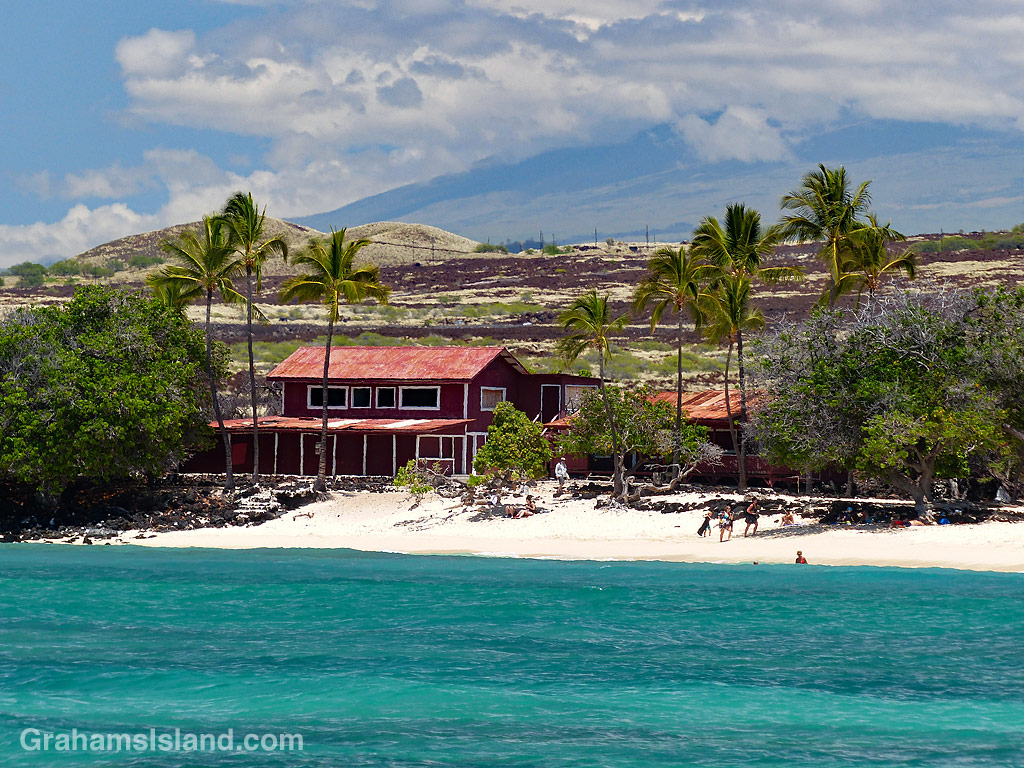
Army LSV supply shipThis is the ship that brings military troops and supplies from Oahu to Kawaihae Harbor en route to Pōhakuloa Training Area (PTA). I often see the ship going back and forth off the Big Island and had always assumed it to be a Navy vessel because, well, it’s a ship. But no, this is an Army LSV (Landing Ship, Vehicle) where they drop the ramp and roll the vehicles on or off.

These activities coexist with commercial shipping, pleasure craft, and locals enjoying the splendid beach and calm waters of the harbor, where I understand the snorkeling is pretty good. Got to try it out sometime soon.

Kites

Kite with tail

KitesOn one of my recent walks, I saw half a dozen kites soaring in the air and I realized it might be the first time I’ve seen kites around here. This is somewhat surprising since North Kohala is notoriously windy and seems like it would be a mecca for kite flying.

Kites are no longer simple diamond shapes on a wooden cross and these were by no means the most exotic kites available these days. But I did like the pterodactyl below and the others were also striking, particularly when they caught the sunlight.

Kite