Category Archives: Places

Signs: Water shortage

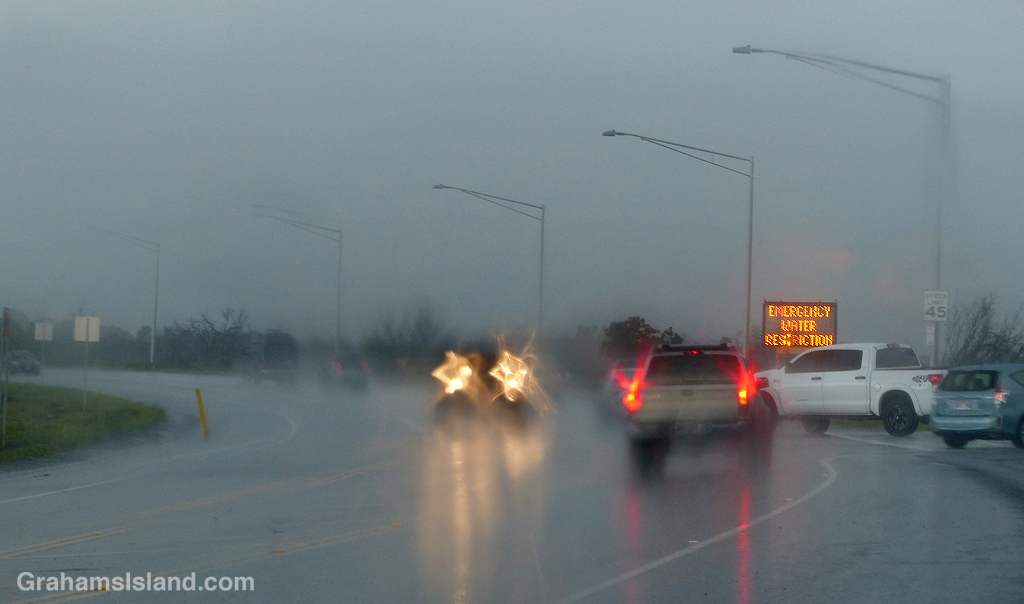
In Kailua Kona, this electronic sign flashes “Emergency Water Restriction” and “Stop Sprinkler Use.”In Kailua Kona, this electronic sign flashes “Emergency Water Restriction” and “Stop Sprinkler Use.”

I was in Kailua Kona recently when I saw this electronic sign flashing “Emergency Water Restriction” and “Stop Sprinkler Use.” The irony, of course, was that I saw the sign during the kind of tropical downpour that washes cars, trees, and houses away. The road I was on was a shallow river. Entering one store, I had to wade through water lapping at my calves.

Kona’s water supply has been in trouble for several weeks now, but it’s nothing to do with rainfall. The water supply comes from wells and several of the pumps have broken down. Most of the pumps are different so each has its own unique spare parts. The one, brand new, spare pump available proved to be defective.

How was such a situation allowed to happen? Well, that’s a good question and people in high places are concerned. Serious questions are being asked. New procedures are being drawn up. Those responsible will be held to account. Just kidding on that last one. That’s not really how things work here.


Very Long Baseline Array on Mauna Kea

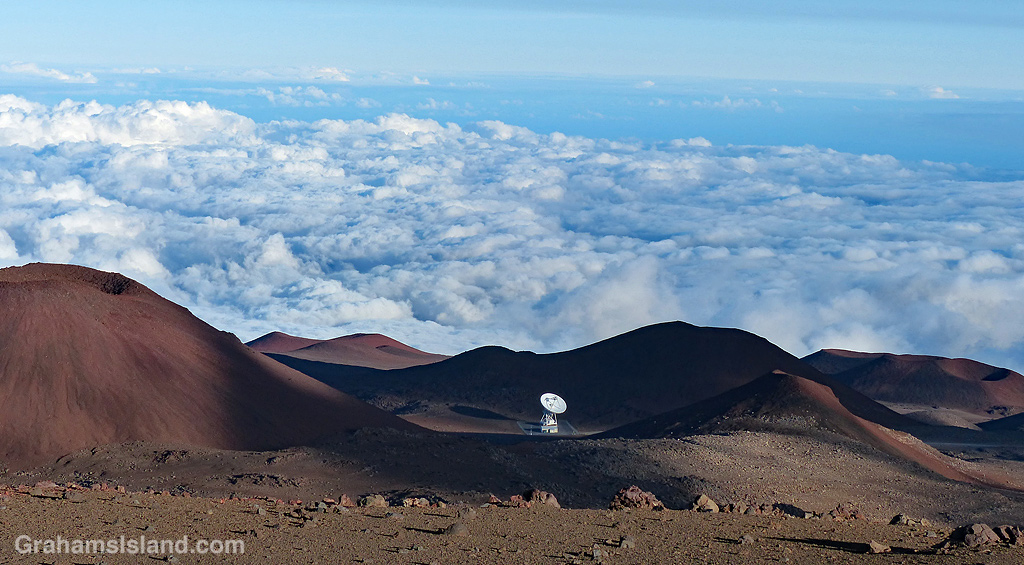
The very long baseline array on Mauna Kea is one of the ten radio telescopes that make up the Very Long Baseline Array (VLBA)Most of the telescopes on Mauna Kea are clustered together near the summit, but about halfway between the Mauna Kea Visitor Center and the summit is this lonely telescope. It’s one of the ten radio telescopes that make up the Very Long Baseline Array (VLBA), which began operating in 1993. Eight of the other telescopes are scattered around the U.S. mainland with the tenth at St. Croix in the Virgin Islands.

The Mauna Kea telescope, like the others, consists of a dish antenna 82 feet in diameter, and an unmanned control building. These ten telescopes are remotely operated from the Domenici Science Operations Center in Socorro, New Mexico.

For more information about the Very Long Baseline Array, go to https://public.lbo.us/.

Old Saddle Road

Old Saddle Road on the Big Island of Hawaii.

Saddle Road was first established during World War II as a rough and ready route for military vehicles to traverse the Big Island. After the war, the road was handed over to civilian authorities. The road got paved after a fashion, but it was never upgraded or maintained to normal civilian standards. Consequently, the two-lane highway was rife with poor paving, potholes, crumbling shoulders, sharp bends, and one lane bridges. Add to this that the upper parts of the road are often cloaked in thick cloud with minimal visibility and it’s no surprise to learn it was considered one of the most dangerous paved roads in the state. Until quite recently rental car companies wouldn’t allow their customers to drive the road.

A little more than 10 years ago, significant upgrading of the highway began. Since then, sections have been realigned, repaved, or newly constructed altogether. In 2013, this new, improved road was connected with Māmalahoa Highway on the western side. Later this year, the last new stretch on the eastern side should be completed.

In 2013, the highway was renamed the Daniel K. Inouye Highway, honoring the longtime senator from Hawaii, but it’s still referred to as Saddle Road by most people. And on the western side, around milepost 44, the old Saddle Road veers off to the north from the new highway, up this hill with its flat spots for the one-lane bridges. This part of the old road was repaved a few years back, but the eastern end is very much in the tradition of the old road. Pockmarked with ill-matching layers of asphalt, it’s a bumpy ride. There are several places where I’ve been unwise enough to pull to the side only to clunk through a deep gulley running beside the pavement.

So, considering all this, it should come as no surprise to hear that it’s one of my favorite stretches of road to drive on the island. The curves, the ups and downs are fun – when the weather’s good. It passes through beautiful pastureland. And it’s a great place to see pueos, the endemic Hawaiian short-eared owl, cruising over the fields, sitting on a post, and, wisely, staying out of traffic.

Abstracts: Yellow-spotted Amazon river turtles

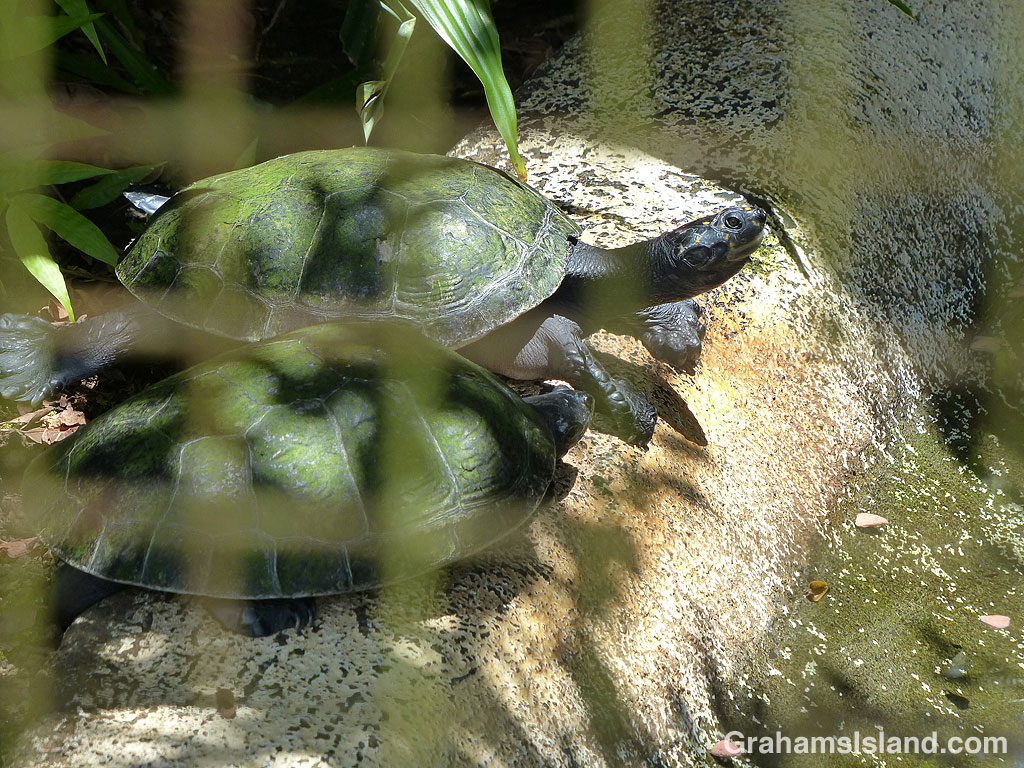
This pair of yellow-spotted Amazon river turtles were waiting for something at Pana‘ewa Rainforest Zoo & Gardens

This pair of yellow-spotted Amazon river turtles were waiting for something at Pana‘ewa Rainforest Zoo & Gardens. Perhaps they were plotting a breakout, figuring out how to cut through the mesh, before making a plod for it.

For more information about Pana‘ewa Rainforest Zoo & Gardens, go to hilozoo.org.