Category Archives: Places

The bench overlooking Honokane Nui Valley

The bench overlooking Honokane Nui Valley on the Big Island.
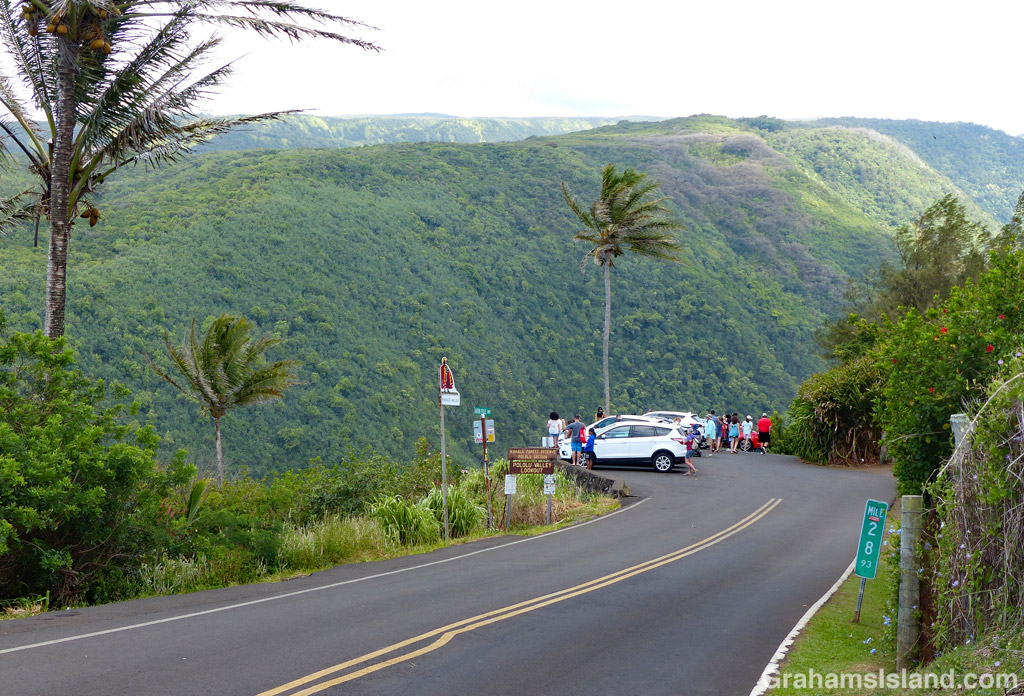
At the end of the highway in North Kohala is the Pololū Valley overlook. This is where most people park their cars (if they can find a space), snap a photo or three, and then climb back in and attempt to turn around and head back.

Quite a few people head down the steep, third-of-a-mile trail to the valley and beach below. Some walk the half-mile-long beach. Very few continue up the trail on the other side. There are good reasons for this. The trail is somewhat hidden. If it’s been raining, it can be even muddier and more treacherous than the trail down to the valley. If conditions are right, it can be alive with bugs. But for those that do press on for another a mile or so, this is the spot they will reach.

Overlooking Honokane Nui Valley, this bench is the perfect spot to experience some welcome solitude. Chances are it will be unoccupied. Chances are no one else will even pass by. I like to sit on the bench (rickety though it is currently) and enjoy the ocean stretching away on one side and the tropical jungle climbing the side of the Kohala Mountains on the other.

For more information about the trail go to bigislandhikes.com/pololu-valley/.

Kilauea Volcano’s firehose of lava

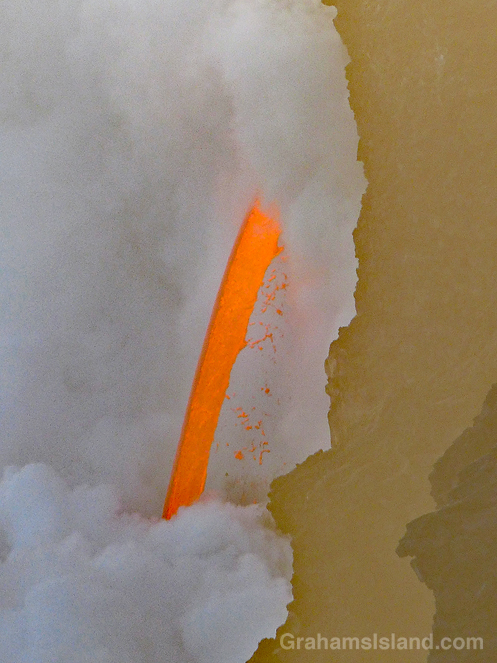
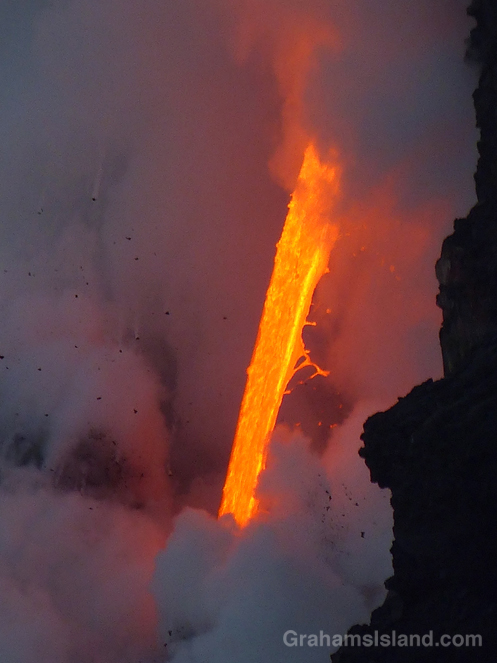
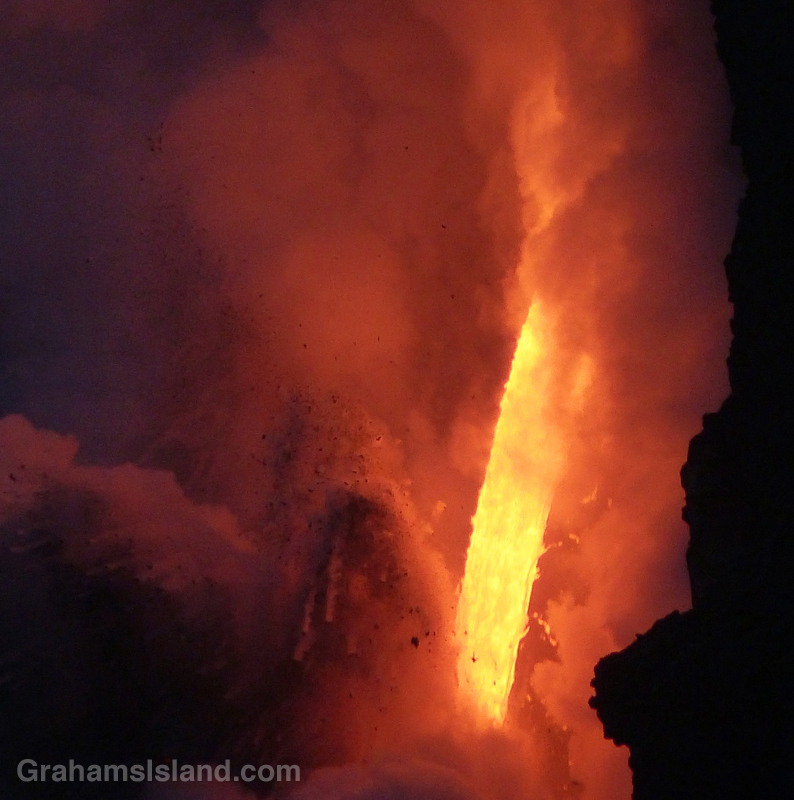
Lava from Kilauea Volcano’s Pu’u O’o vent enters the ocean as if from a firehose.Lava from Kilauea Volcano’s Pu’u O’o vent enters the ocean as if from a firehose.
I’ve posted before (here, here, here and here) about trips I’ve made to see the current lava flow from Kilauea Volcano’s Pu’u O’o vent. Lava first reached the coast on July 26, 2016 and has been pouring into the ocean ever since. However, on New Year’s Eve, much of the newly formed delta collapsed into the ocean taking with it a chunk of the older cliff. As a result, the lava tube carrying the active flow was suddenly left exposed and lava gushed out into the ocean as if from a firehose.

I was aware this was going on, but hadn’t really appreciated what it meant until this past Wednesday. Then, I read a report about the phenomenon, saw some photos, and realized this was something I had to see. Since the weather was favorable and it was early enough, I set out the same day.

After a three-hour drive and brisk hike I got to the viewing area, from the Kalapana side, around 5 p.m. These photos are from that trip. The top photo shows the firehose, lava gushing into the ocean in a constant, unwavering stream. When it hit the water, it generated a series of explosive reactions. The second photo shows the Lava Ocean tour boat nudging in toward the action as one of these explosions occurred. Below is a closer look at the stream with chunks of hot lava being hurled out into the water.

I stuck around until it got dark and then headed home – another hour-long hike and long drive – but it was so worth the effort. This was emphasized when, the next day, another cliff collapse caused the firehose to disappear from view. It might return, since the whole area is unstable, but it might also be gone for good.

I guess timing really is everything and I feel very fortunate that I was able to experience this phenomenon before it was gone.

For more information about Kilauea Volcano and it current eruption, go to hvo.wr.usgs.gov/activity/kilaueastatus.php.
Lava from Kilauea Volcano’s Pu’u O’o vent enters the ocean as if from a firehose.

Better Days: Gravesite

The old gravesite at Hawaii Tropical Botanical Garden on the Big Island.
In Hawaii Tropical Botanical Garden, north of Hilo, this gravesite sits close to the ocean, surrounded by tropical foliage. The wording on the sign reads:

Long ago, Onomea Bay was a fishing village, became a rough-water seaport in the 1800’s, and later was inhabited by Portuguese, Chinese, Japanese and Filipinos who came here to work in the sugar cane fields and to help build the Onomea Sugar Mill. In the early 1900’s, Onomea was deserted and vegetation grew so densely that few signs of habitation could be seen.

When our Founder and his tireless helpers were first clearing this area, they discovered this olden and dignified gravesite. We have never been able to authenticate the origin, although some old-timers believe the gravesite may have belonged to a caretaker’s family, since a cement-made gravesite would not have pre-dated the 1900’s.

Our commitment is to forever preserve this resting place with the utmost care and respect.

Hawaii Tropical Botanical Garden

For more information about Hawaii Tropical Botanical Garden, go to htbg.com.

Hawaiian Upland damselfly

A Hawaiian Upland damselfly (Megalagrion hawaiiense) on the Big Island
The Hawaiian Upland damselfly (Megalagrion hawaiiense) is endemic to the state. Hawaiians called dragonflies pinao and damselflies pinao ‘ula. I’ve never been sure what the difference between the two is but I have learned that, among other things, damselflies tend to be smaller, have eyes on the side of the head that are clearly separate, and can fold their wings behind them.

This one was on the Kaumana Trail off Saddle Road (officially the Daniel K. Inouye Highway) at an elevation just over 5,000 feet.