Category Archives: Volcanoes

Pu’u Wa’awa’a views

This week’s Sunday Stills challenge theme is ‘Great Outdoors.’ (See more responses here.) When I think of the great outdoors, I think of hiking, and one of my favorite hikes on the Big Island is up Pu’u Wa’awa’a. It’s an 8-mile round trip and tops out at just under 4,000 feet. On a good day, the hike offers great views, not only from the top, but also on the way up and down. And there are several benches where a person can rest and take in those views, including a couple on the summit.

The top photo shows the view north from around 3,500-feet elevation, with Tamaki Coral in the foreground and Kohala Mountain in the background. The bottom photo is a view from 100 feet or so below the summit looking east toward Mauna Kea.

The hike can also include many native trees and plants as well as a variety of wildlife. There are domestic sheep, cattle, and horses, as well as wild pigs and goats. When the trees are in bloom, they’re rich with insects and birds including several native varieties.

To top it off, most of the times I’ve visited, usually in the early morning, I’ve had the place to myself.

For more information about Pu’u Wa’awa’a and its trails, go to puuwaawaa.org.

Kilauea Iki Trail

This week’s Sunday Stills challenge theme is ‘Paths.’ (See more offerings here.)

Kilauea Iki Trail is one of the more popular trails in Hawaii Volcanoes National Park. But last year’s volcanic activity, with numerous earthquakes, resulted in the park being closed for several months. Even after it reopened in September 2018, many parts of the park remained closed because the areas were too unstable to be opened to the public.

The Kilauea Iki Trail was one of those areas along with Thurston Lava Tube and Jaggar Museum. The latter two locations are still closed and Jagger Museum may never be reopened, but the Kilauea Iki Trail is currently listed as mostly open. Given that this is a loop trail, it would be wise to check ahead and find out what ‘mostly open’ means.

These photos were taken during a hike I took a couple of years back. The top photo shows the view from the part of the trail that follows the rim of the crater before it descends to the crater floor. The second photo shows two hikers heading out across the crater floor. The dark hill in the background is Pu‘u Pua‘i where a 1959 eruption poured lava out into the crater. The third photo shows hikers near the center of the crater where the path winds through broken areas of the crater floor. Below, cairns mark the trail across a flat area of the crater that leads to the switchback trail which takes hikers back up to the crater rim.

For more information about Hawaii Volcanoes National Park, go to nps.gov/havo/.

Keck 1 and 2 telescopes

This week’s Friendly Friday challenge theme is ‘Twins.’ (See more responses here.)

These are the two telescopes of the W. M. Keck Observatory on Mauna Kea. Keck 1 began operation in November, 1990, while Keck 2 made its first observations in October 1996. Each telescope’s 10-meter primary mirror is made up of 36 segments, hexagonal in shape. Not that these segments are small themselves. Each one is 1.8 meters wide and weighs half a ton.

The telescopes can accommodate a wide variety of instruments, such as cameras and spectrometers, and are considered to be the most scientifically productive in the world.

For more information about the W. M. Keck Observatory, go to www.keckobservatory.org.

Green Lake

Green Lake was, until June 2 last year, Hawaii’s biggest freshwater lake. This isn’t a dramatic claim since freshwater lakes are in short supply in Hawaii. There are only two freshwater lakes on the Big Island, the other being Lake Waiau, near the summit of Mauna Kea. Green Lake had a surface area of about 2 acres and was no more than 20 feet deep in the center, but it was a popular spot with both locals and tourists who liked to swim and picnic there.

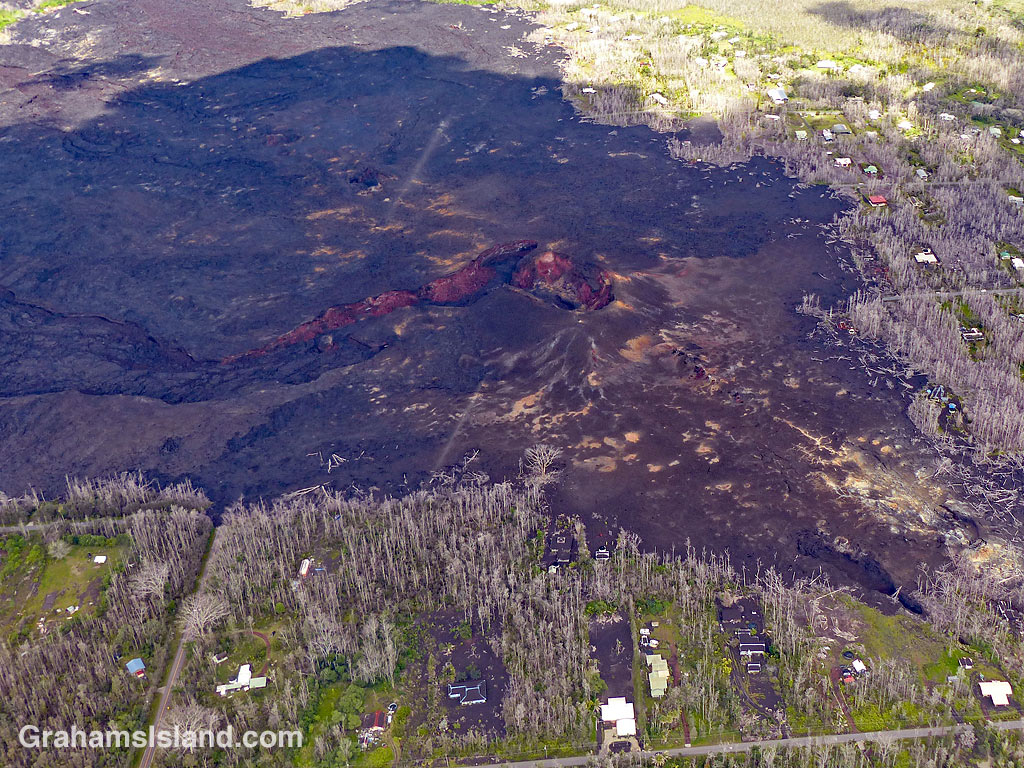
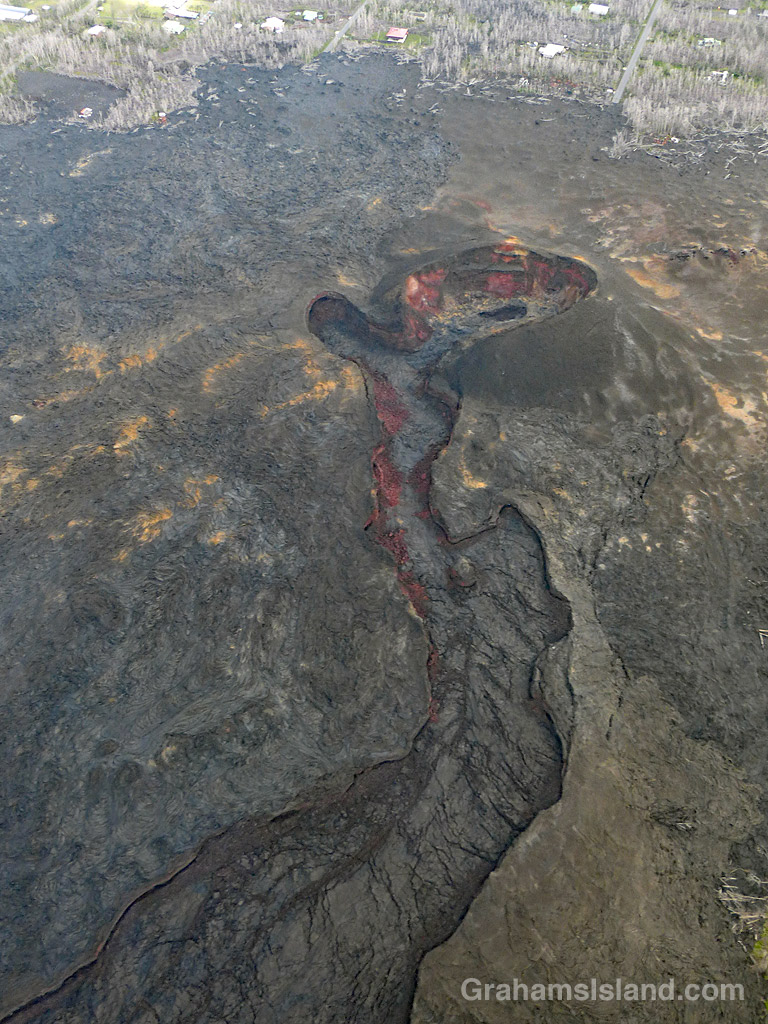
The lava flow from last year’s eruption in lower Puna at first curled around the pu’u, the center of which was Green Lake. But on June 2, the flow breeched the surrounds, boiled away the water and filled it with lava.

The top photo shows that pu’u that contained Green lake, now filled with lava. The bottom photo shows Green Lake in relation to the flow and the area around it. The lava came from the upper left of the photo. It flowed around the pu’u and entered the lake from the southeast. The photo also shows how the flow reached the coast. The area in the top right of the photo used to be Kapoho Bay and its surrounding housing. A white speck is visible on the edge of this flow, which is one of only three houses there that survived the flow’s destructive progress.

At the bottom of the lower photo is untouched land, including a road that runs into, and now terminates, at the flow’s edge.

Mauna Kea pu’us and shadows

This week’s Friendly Friday challenge theme is ‘Shadows.’ See more responses here.

This view was taken near the summit of Mauna Kea. Pu’us – little volcanic cinder cones – dot the landscape here, giving the area an otherworldly look. As the sun sets, the pu’us cast shadows on one another accentuating the slopes and craters.

Halema’uma’u Crater

This week’s Sunday Stills challenge theme is ‘Danger.’ (See more offerings here.) It seemed a suitable opportunity to post some photos reviewing on Kilauea Volcano’s last eruption, which began in May of last year.

The bottom photo, taken from the Jaggar Museum overlook, shows the scene on the morning of April 25, 2018. Lava in the active vent in Halema’uma’u Crater, at Kilauea’s summit, was just below the crater floor and had been overflowing into the crater in previous days. The overflow is the large dark area to the right of the glowing lava.

By early May, the lava level in the vent had dropped around 1,000 feet. This drop occurred at the same time that lava disappeared from Pu’u O’o vent. Not long afterwards, cracks opened in the ground at Leilani Estates, a housing subdivision in the southeastern part of the island. By the end of May, 24 fissures had opened in the area. The most prolific lava flow emanated from Fissure 8, which flowed to the ocean and created more than 800 acres of new land. However, more than 700 homes were destroyed by this eruption.

Meanwhile, back at the summit, the absence of lava in the vent in Halema’uma’u Crater resulted in a series of collapses of the crater floor. Each collapse triggered earthquakes and shot clouds of ash and toxic gas thousands of feet into the air.

The top photo shows Halema’uma’u Crater as it looks today. The crater is twice the size it was the year before and the floor, which was mostly flat, is now a huge cascading pit. In the upper left of the photo, the Jaggar Museum, where I stood to take the bottom photo, can just be seen. It was heavily damaged by the earthquakes, as were the parking lot and access road. It’s also much closer to the crater edge than it was. (Technically the crater edge is closer to it, since the museum hasn’t moved!)

The museum, along with the rest of the park, closed in May 2018, because of the eruption. While much of the rest of the park reopened in September, Jaggar Museum did not. There’s a good possibility it never will and that its fate will be the same as the portion of Crater Rim Drive in the middle photo. A significant length of that road, which used to encircle the whole summit caldera, was destroyed, including the section in the photo which slid, intact, into the crater.

Things have settled down since September 2018 and there has been no volcanic activity anywhere on the island since then. But Kilauea remains an active volcano and will undoubtedly erupt again. It’s just that no one knows exactly when or where that will happen.