Category Archives: Volcanoes

Puapo’o lava tube tour

The entrance to Puapo'o Lava Tube
The way in. No elevator here.
Ohia roots hang in the Puapo'o Lava Tube
Ohia trees on the surface send roots down into lava tubes. These roots take in water from the tube’s cool, moist air. In return they offer one of the few sources of organic material and are home to a kind of cricket.
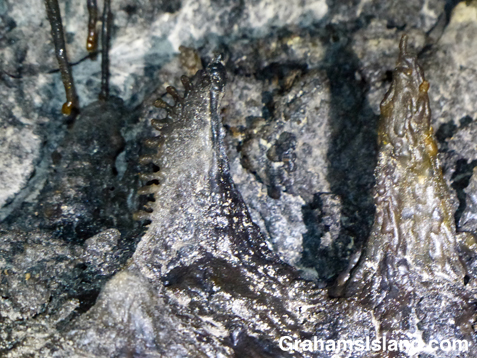
Lava formations in the PUapo'o lava tube
A puapo’o (literally ‘flower head’) lava formation. There’s still uncertainty about how these are formed. To the left are lava-sicles, the lava tube equivalent of stalactites.
A low section of Puapo'o lava tube
Mind your head. There’s a 25-foot-long low section.

As part of the National Park Service centennial celebration, Hawaii Volcanoes National Park has been offering a guided tour of Puapo’o lava tube. This tour has been offered in the past, but not for several years.

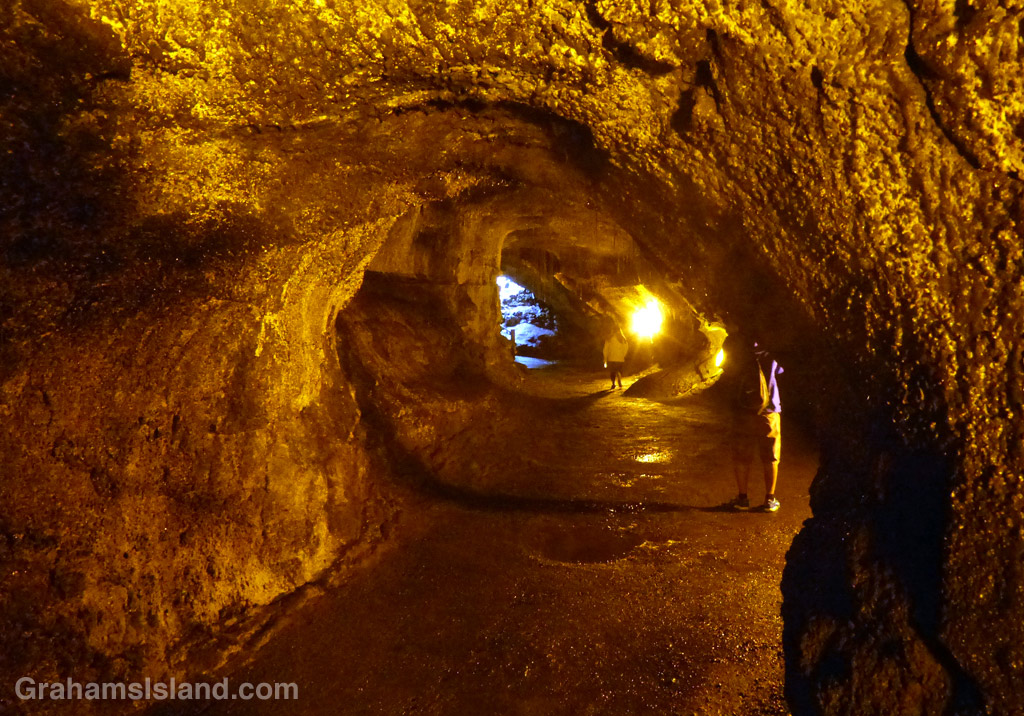
Puapo’o is a pristine lava tube meaning that its rock formations are intact and life in the tube is largely undisturbed. Contrast this with the park’s popular Thurston lava tube, where all the finer lava details have long since been broken off by visitors.

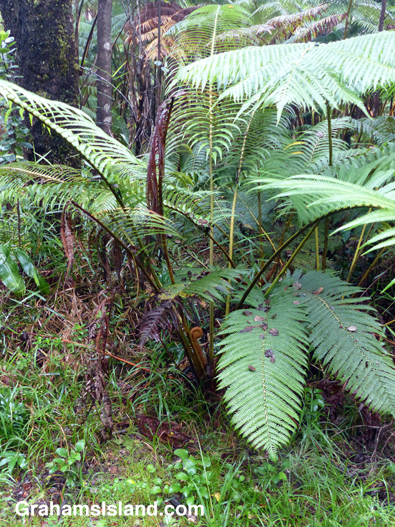
There’s a hike to the tube, which is deep within a forest rich in tree ferns.

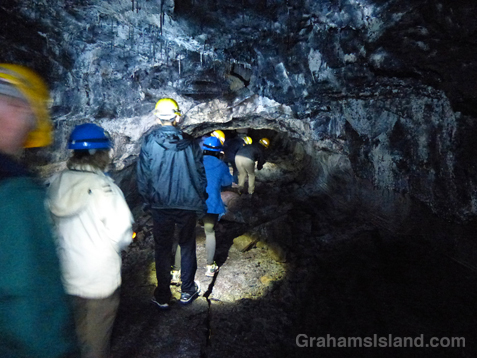
The tube entrance is accessed by a ladder and then it’s on into the dark. Whereas Thurston lava tube is well lit and has a mostly flat floor for easy walking, Puapo’o, which is about a mile long, was lit only by our headlamps and rocks littered the tube floor. It’s not a tour for the claustrophobic or nervous.

The exit from Puapo'o lava tube
The way out. Heading for the light.

Those rocks on the floor match recesses in the tube ceiling show where rock falls have happened. A month before, one of our rangers had been leading a tour when there was an earthquake, a common occurrence in the park. The group left the tube, but the next visit found a new rock fall.

We scrambled over rocks, and sat in the dark in a large, amphitheater-like part of the tube. As we progressed, the rangers pointed out different lava formations from lava-sicles to bathtub rings to puapo’os for which the tube is named. And even in this pitch dark place, there is life – moths, crickets, and spiders, one a huntsman and the other a tiny, near invisible thing that builds gossamer webs. Also, living on the tube walls, are unique microbial colonies, which are being studied for medical uses.

Eventually, we scrambled up a rocky slope and out through a narrow opening, back into the forest.

For more information about the Puapo’o lava tube tour, go to nps.gov/havo/planyourvisit/lava-tube-tour.htm.

Bathtub rings on the walls of Puapo'o lava tube
Ranger Dean points out bathtub rings on the tube wall. These indicate the level of the flow through the tube at different times.

James Clerk Maxwell Telescope

The JCMT from the outside with its huge Gore-Tex tarp curving up and in. The tarp protects the dish from wind and blown sand. It also reflects visible and near-infrared radiation which allows for daytime observations.
The dish of the James Clerk Maxwell Telescope on Mauna Kea.
The dish of the telescope. The shinier areas are where telescope staff experimented with cleaning the dish using Swiffer Sweepers. A little dirt on the dish doesn’t affect readings at the wavelengths where the JCMT operates.
The framework supporting the dish of the James Clerk Maxwell Telescope on Mauna Kea.
The framework which supports the telescope’s dish.

I posted here about a visit to the Canada-France-Hawaii-Telescope on Mauna Kea as part of the Kama‘āina Observatory Experience being offered by the island’s observatories. The other observatory visited during that tour was the James Clerk Maxwell Telescope (JCMT).

The JCMT began operation in 1987 and was funded by the United Kingdom, Canada and the Netherlands. However, the United Kingdom decided to improve how it handled its scientific funding and, as a result, early in 2015, the JCMT’s funding efficiently disappeared into deep space and was never seen again. Subesequently, as one of the guides on the tour said, they basically put the telescope on Craigslist and the East Asian Observatory (EAO) picked up the operation.

The telescope is the largest single-dish telescope in the world dedicated to detecting submillimetre radiation. Other telescopes on Mauna Kea operate at different wavelengths so they are complimentary each other rather than in direct competition. And where other telescopes on Mauna Kea are there because of the 300+ nights of clear skies, the JCMT is there for the lack of moisture in the air, which is critical to its operations.

Inside the James Clerk Maxwell Telescope on Mauna Kea.
The exterior of the structure rotates on wheels enclosed in yellow housings. Inside, the dish rotates independently.

As well as information about the telescope’s operations, the tour included a story about how the steel for telescope’s enclosure had to be sent from England on a small ship after the original freighter broke down. The steel was piled high on deck and was supposed to be headed direct to Hawaii. But the ship’s captain stopped first in Holland to take on a cargo of high explosives! Besides the delay this involved, it also presented problems when the ship arrived at the Panama Canal, for obvious reasons. More delays ensued before the ship disappeared to some port on the Pacific coast to offload the explosives. By the time it arrived in Hawaii, it was so far behind schedule that the penalties accrued for late delivery practically equaled the fee for delivery. However, the ship’s captain, in an apparently canny tactic, waited outside territorial waters and demanded full payment, threatening to dump the steel into the sea if he didn’t get it. This proved to be a bad move! The telescope’s operators took him to court and nailed him for piracy on the high seas. The U.S. Coastguard moved in, took over the ship, and guided it into port of Hilo.

Another story from the telescope’s beginnings concerned the opening ceremony. Several VIPs from the nations operating the telescope turned up, including Prince Philip. When the lever was pulled to start the telescope’s operation, nothing happened. Turned out one of the VIP’s was leaning against an emergency stop button.

For more information on the James Clerk Maxwell Telescope, go to eaobservatory.org/jcmt/about-jcmt/
For more information on the Kama’āina Observatory Experience, go to kamaainaobservatoryexperience.org/

Star formation images from the constellation of Orion from the James Clerk Maxwell Telescope on Mauna Kea.
Star formation images from the constellation of Orion.
The small mirror in the Cassegrain cabin of the James Clerk Maxwell Telescope on Mauna Kea.
The small mirror in the Cassegrain cabin, which directs incoming information to the appropriate instruments.

Canada-France-Hawaii-Telescope on Mauna Kea

A view from the Canada-France- Hawaii Telescope on Mauna Kea
From the CFHT catwalk, some of the other telescopes atop Mauna Kea. From left: CalTech Submillimeter Telescope, James Clerk Maxwell Telescope, Smithsonian Submillimeter Array, Suburu Telescope, W. M. Keck Observatory (I and II), and the NASA Infrared Telescope Facility.
The interior of the Canada-France- Hawaii Telescope
The steel arms attached to the giant horseshoe, which enable the telescope to pivot. The telescope itself is in the vertical plane, with the mirror in the circular enclosure at the bottom, surrounded by instruments.
The interior of the Canada-France- Hawaii Telescope
The huge steel arms which support the telescope.
Doug Simons, Executive Director of the CFHT, explains details of the telescope’s control room. Note the analog instruments, above and to the left of his head, which register conditions outside the building, a reflection the telescope’s late 1970’s roots.

The Kama‘āina Observatory Experience was introduced by President Obama at the White House Astronomy Night in October 2015. The idea is for people who live on the Big Island and elsewhere in the state, to have an opportunity to visit the telescopes and learn a bit about what they do, as well as learn about the natural history and cultural significance of Mauna Kea.

Last weekend, I got the opportunity to take part and the Canada-France-Hawaii-Telescope (CFHT) was the first telescope visited. The telescope dates back to 1979 as is seen in the massive steel arms of the telescope and some of the instrumentation in the control room – love those analog weather instruments in the top row.

The age of the telescope doesn’t mean it’s unsuitable for the modern era. CHFT is a 3.6 meter optical/infrared telescope, but while the mirror and its housing is old school, the supporting instruments are the latest in high tech. And nowadays, like most of the telescopes on the mountain, no one needs to be there overnight; they’re operated remotely.

While a good deal of the information went over my head, and out toward the stars, it was a thoroughly worthwhile experience. I’d recommend it to anyone, but you have to be kama‘āina, a Hawaii resident.

For more information on the Canada-France-Hawaii-Telescope, go to cfht.hawaii.edu/
For more information on the Kama’āina Observatory Experience, go to kamaainaobservatory
experience.org/

Reclaiming the lava

A shrub grows in a lava field
Lava flows make for a stark landscape, but I always find it fascinating to see how, even in such barren ground, nature regains a foothold. Here, a small shrub has taken hold in a crack in the lava. Just below and to the left of it, a fern grows under a ledge.

If there’s enough rainfall, as there is in this spot of the southeast coast of the Big Island, vegetation will begin to take hold in a fairly short while. That’s assuming that a new flow doesn’t happen along and put paid to the process.

Pu’u Wa’a Wa’a hike

Pu'u Wa'awa'a seen from the trailhead.

Pu’u Wa’awa’a seen from the trailhead over a sea of fountain grass.

This old quonset hut, at the foot of Pu'u Wa'awa'a, was probably an old ranch building.

This old quonset hut, at the foot of Pu’u Wa’awa’a, was probably an old ranch building.

Tamaki Corral was used by the old Pu'u Wa'awa'a Ranch.

Tamaki Corral was used by the old Pu’u Wa’awa’a Ranch. Hualalai is visible in the background, before clouds rolled in.

Pu’u Wa’a Wa’a means “many-furrowed hill.” It’s popularly known as ‘jello mold,’ and is the biggest of several cinder cones on the slopes of Hualalai volcano.

The land is a State Forest Reserve with about 8 miles of hiking trails. The main trail leads to the top of the cone and is about 3 miles each way. The first half follows an old road that passes through a mostly forested area. There’s a good deal of bird life here, more often heard than seen in my experience. The trail then heads up the side of the cone itself in open country, passing old ranch buildings and likely some cattle, horses, sheep and goats.

Once at the top, the views can be tremendous, but an early start is needed. Clouds build up on the slopes during the morning and by midday the view can be fading or gone.

For more information about Pu’u Wa’a Wa’a and its trails, go to puuwaawaa.org.

The smaller Pu'u Iki cone seem from the top of Pu'u Wa'awa'a.

The smaller Pu’u Iki cone seen from the top.

A Mamane tree atop Pu'u Wa'awa'a, with the coast in the distance.

A Mamane tree atop Pu’u Wa’awa’a, with the coast in the distance.