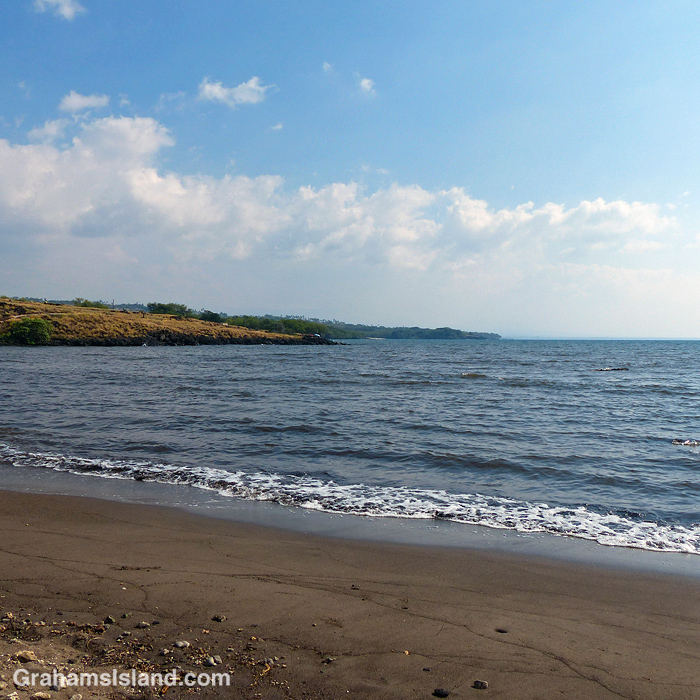
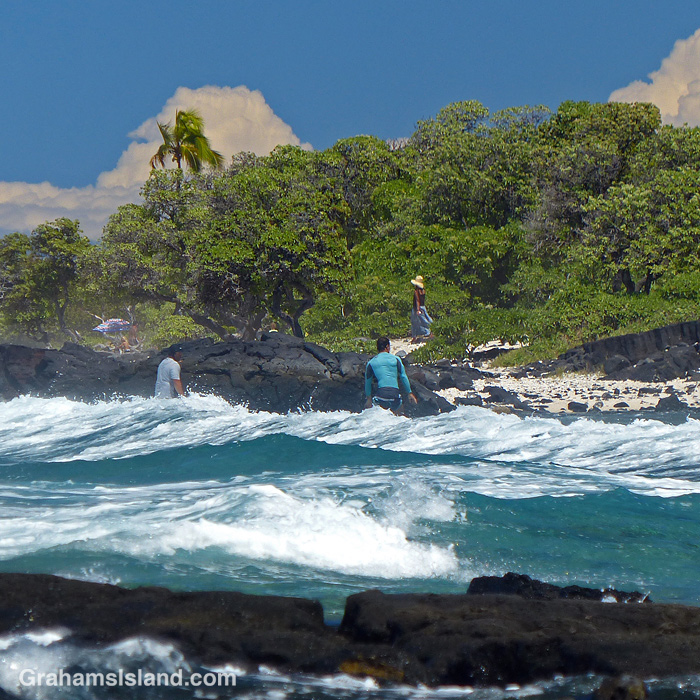
A few days ago, I posted about a heron encounter (here) when I didn’t have enough time to walk along the coast before going to work. I took this photo when I did have that time.
This is a view from Spencer Beach Park towards Kawaihae Harbor. The footprints are mine. There were no others. As a start to the day, it doesn’t get much better.
I took this photo earlier this month, a couple of days before the new moon. When I was processing it, I thought it had more impact as a black and white.
The easiest way to spot an octopus is to see it swimming (top photo). They’re not large creatures but they’re quite distinctive when they swim.
If they’re not swimming, one thing to look for is certain fish, such as goatfishes and jacks, just hanging around in a spot for no apparent reason. When these fish are hunting alone, they tend to be more active in probing the rocks and trying to disturb prey. But when they’re hunting with an octopus, they seem more content to let the octopus do the work and snapping up whatever emerges. I’ve found that goatfishes are particularly helpful as an octopus indicator.
A while back, there were videos online of an octopus apparently punching a goatfish. I wasn’t surprised by this. The octopuses I’ve seen don’t seem best pleased by the presence of goatfishes. Part of this might be down to feeling that the goatfishes are not pulling their weight in the hunt. But another factor might be that if goatfishes give away their position, for the octopus that can be fatal.
Octopus is a popular food in Hawaii and has long been so. If I’ve learned to look for goatfish as an indicator of their presence, then no doubt spear fishermen have too. These days, if I see an octopus when anyone’s spear fishing nearby, I don’t do anything to draw attention to it.
This week’s Sunday Stills challenge theme is ‘Going Back….’ See more responses here.
I was thinking about posting photos going back to my first visit to Hawaii, but in looking at them, I realized that I’d never posted photos from my tour of the Subaru Telescope, which I took a few months after moving here. At the time, the Subaru Telescope was the only one on the summit of Mauna Kea that offered tours to the general public, though the tours have been shut down by the current Covid situation.
I particularly remember the fabulous views from the walkway around the exterior of the telescope. The interior of the telescope was also interesting, though in the abstract way of a giant piece of equipment. This is not a telescope where one gets to put an eye to the lens to see what’s going on, though I was charmed to learn that when Princess Sayako of Japan dedicated the telescope in 1999, she was able to do just that because a special eyepiece had been constructed for that purpose!
The Subaru Telescope is a Ritchey-Chretien reflecting telescope. It has a large field of view which makes it ideal for wide-field sky surveys. For more information about the Subaru Telescope, visit https://subarutelescope.org/en/. The telescope’s live camera stream captured a cool video of last month’s Perseid Meteor Shower which can be seen here.
View from the Subaru Telescope toward Mauna Loa with the James Clerk Maxwell Telescope on the left.
The Smithsonian Submilimeter Array seen from the Subaru Telescope.
I was doing some cleanup work outside, when I noticed this bug on my hand. I headed in to where my camera was and the bug stayed in place the whole way. I got the camera organized and took a few photos before it finally flew off.
I knew I’d seen one of these before, but couldn’t remember where or what it was. A quick search revealed that this is a whitecrossed seed bug (Neacoryphus bicrucis), a resident of fields and meadows.
My previous sighting had occurred after a hike on Mauna Loa. It was on a water bottle I’d left in the cooler in my truck while I hiked. I suspect that one had inadvertently taken a day trip with me and was probably stunned to find itself at 11,000 feet, surrounded by barren lava!
I was driving home late one afternoon, when I saw a rainbow forming in front of the gloom enveloping Hawi. I thought about stopping, but at that point, getting a photo would have likely involved the camera getting wet and the results being not that great. I kept going.
But as I neared Hawi, the rainbow strengthened and the precipitation diminished and I was compelled to turn onto the road to Upolu Airport, pull over, and snap some photos of what was a lovely, bright rainbow, with a faint but definite echo just above it.