Tag Archives: Hiking

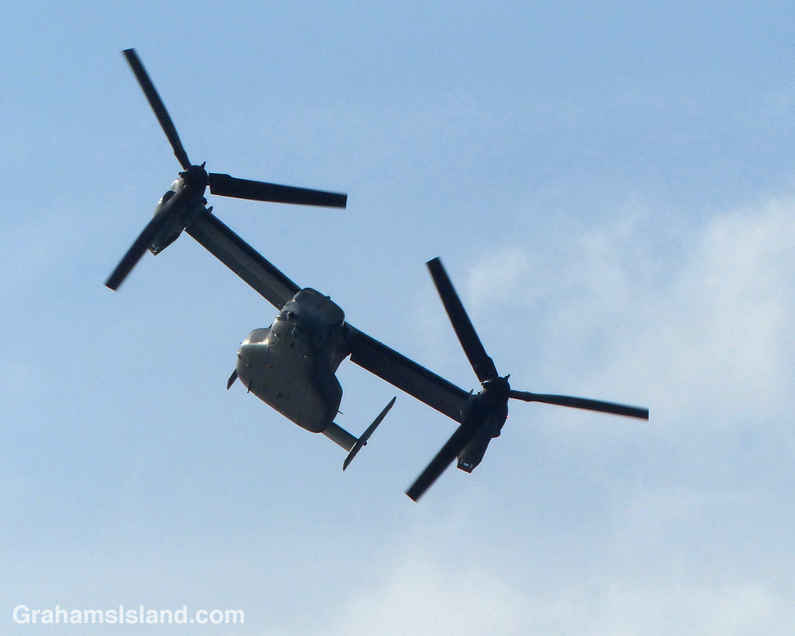
V-22 Osprey

A V-22 Osprey lands at Upolu Airport.A V-22 Osprey banks as it approaches Upolu Airport.
Returning from a walk around Upolu Airport, I was startled by a loud thumping noise close by. Through the trees I saw this peculiar-looking aircraft touching down. The plane is a V-22 Osprey, a tiltrotor aircraft used by the military, in this case, the U.S. Marine Corps.

The plane made several loops, out over ʻAlenuihāhā Channel and back around to the airport to land, then do it all over again. It was actually quite fascinating to see the engines rotate from horizontal to vertical while in flight.

Eventually, the plane headed out over the channel and kept going, probably back to its base on Oahu.

Kiawes – a thorn in the foot
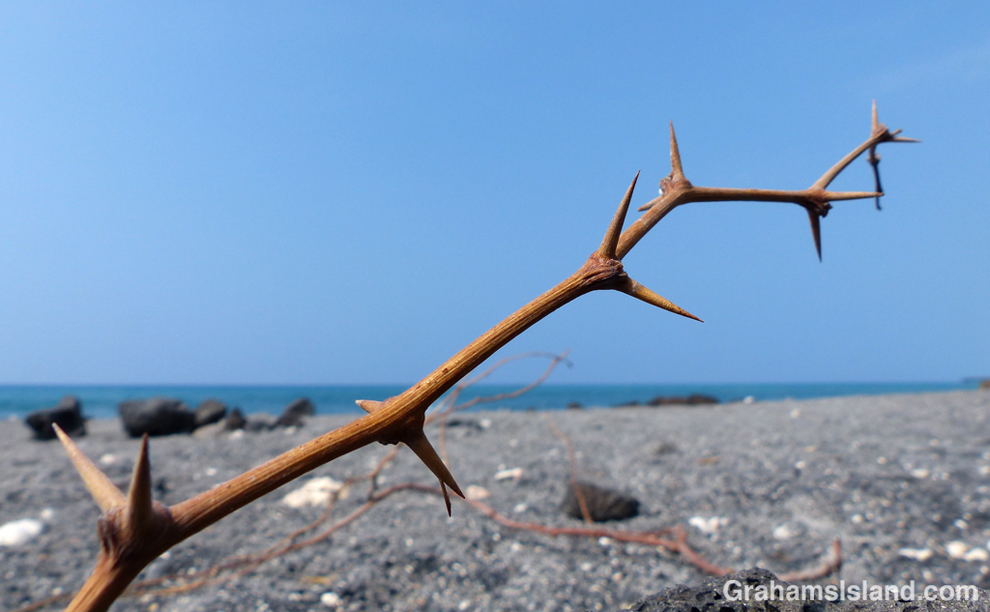
Kiawe thorns on a Big Island beach.

When twigs break off a kiawe, the thorns dry to hard, sharp spikes.
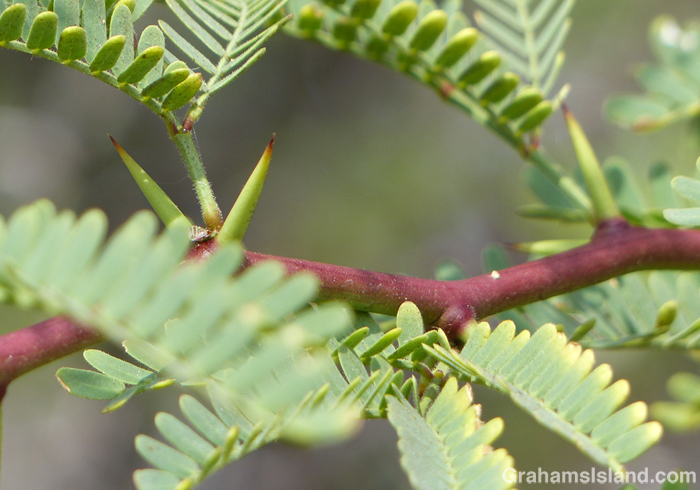
Kiawe thorns growing on a tree on the Big Island.

Kiawe thorns growing on the tree.

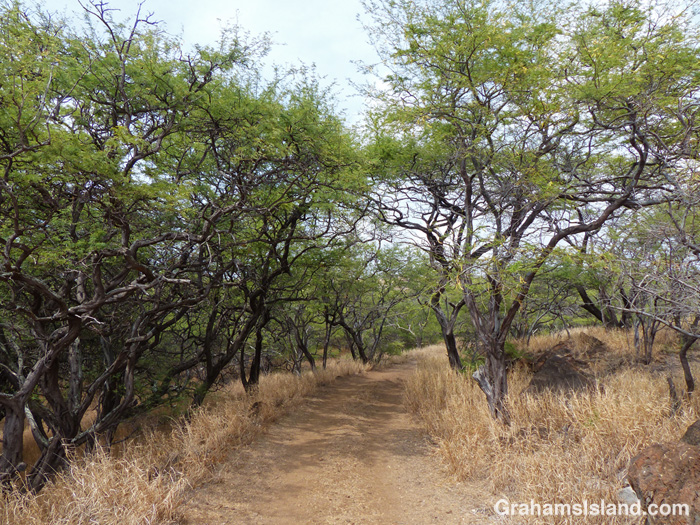
A stand of kiawe trees bordering a trail on the Big Island.

A stand of kiawe trees bordering a trail.

Hiking on the west side of the Big Island can be a hot and arid experience. The landscape is often barren lava or scrubby growth. If it’s scrubby growth, chances are that kiawe trees (Prosopis pallida) are prominent and if they are, it’s wise to tread carefully. That’s because kiawe trees produce long, tough thorns.

Hiking in slippahs (flip flops) is asking for trouble. A kiawe thorn will go through them like a knife through wet tissue. I’ve felt the jab of these thorns through my Tevas, which have robust soles of decent thickness. The first time I wore my new trail shoes, toward the end of the hike, crossing a kiawe-bordered beach, I felt a familiar prick in my foot. A thorn had buried itself in the ¾-inch thick sole and penetrated far enough to make itself felt. One of my routine tasks with my trail shoes, and the Tevas, is to examine the soles and extract any thorns with a pair of pliers. When a hike is over, it doesn’t mean the danger is past. Drive over one of these thorns and it can and does cause punctures.

But if all this makes it seem as if kiawes are reviled, that’s not the case. It’s widely used in smoking meats. The smell of burning kiawe is commonplace.

Kiawe isn’t a native tree; it originated in Peru. In fact, all Hawaii’s kiawes can trace their roots, as it were, back to a single seed planted by a priest in Honolulu in 1828.

Kahuku hike

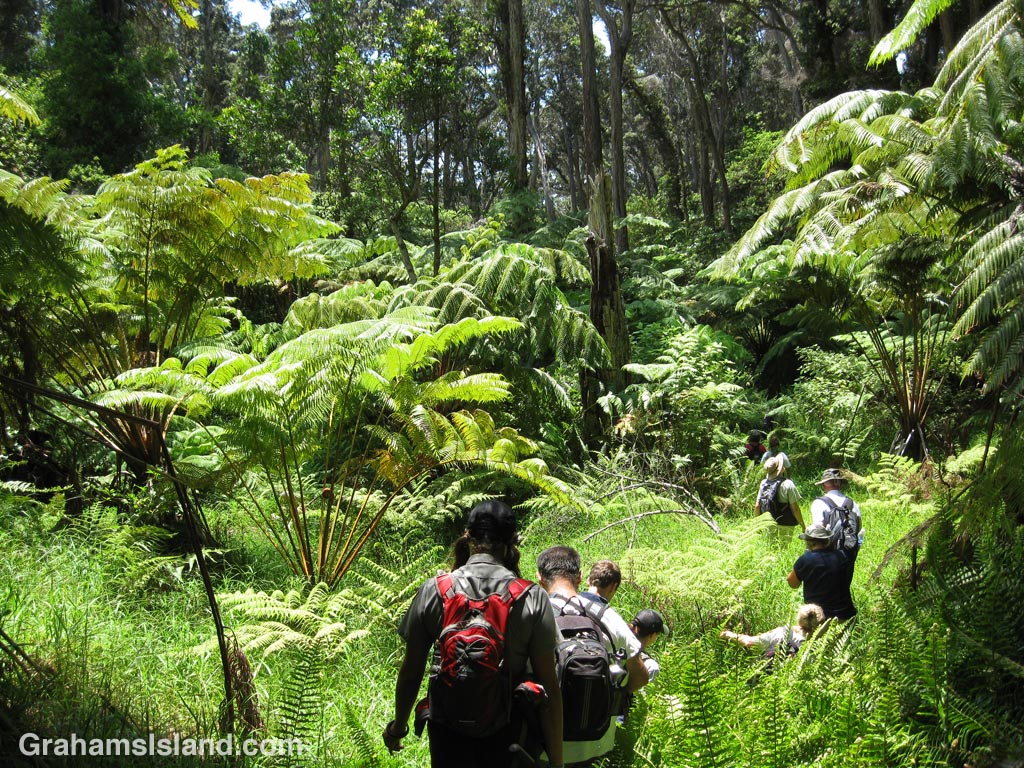
Hiking in KahukuHiking in Kahuku
Kahuku is part of Hawaii Volcanoes National Park. Its 116,000 acres was added to the park in 2003, an estate purchase of former ranch land. This purchase almost doubled the size of the park.

Not far from the southern tip of the Big Island, the entrance to Kahuku is about an hour’s drive from the main park entrance, but the two areas are contiguous, joined at the summit of Mauna Loa.

These photos are from a guided hike in Kahuku that I did a while back. The hike went through fairly dense old growth Hawaiian forest that had been spared because it was in a steep gully and thus not suitable for clearing for pasture. There was no real trail.

Currently this part of the park is closed because trees with Rapid ‘Ōhi’a Death (ROD) have been found in the lower part of the park and the goal is to prevent it spreading to other areas.

For more information on the Kahuku Unit of Hawaii Volcanoes National Park, go to nps.gov/havo/planyourvisit/kahuku-hikes.htm or bigislandhawaiitravelguide.com/places/puu-o-kahuku-at-hawaii-volcanoes-national-park.html
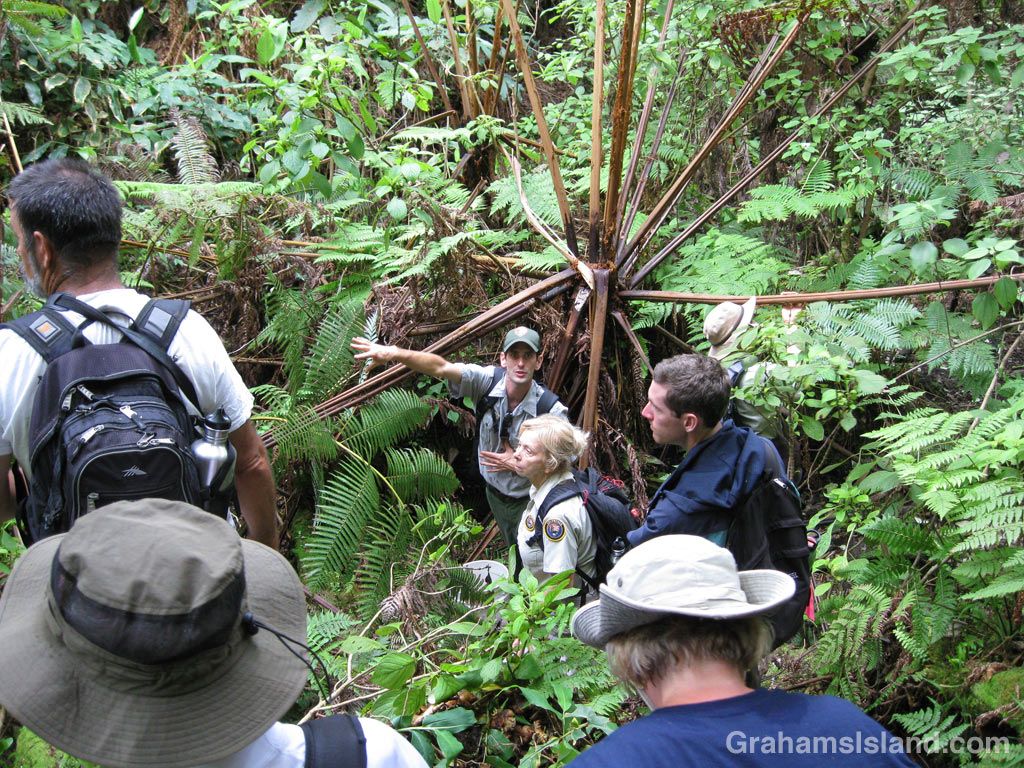
Hiking in Kahuku

A Bay to Keawaiki hike

The King's trail south of Waikoloa

The Ala Loa Trail (King’s Trail) south of Waikoloa.

Keawaiki Beach with its lone palm tree and Hualalai volcano in the background.

Keawaiki Beach with its lone palm tree and Hualalai volcano in the background.

This hike is a 7 mile loop directly north of the Keawaiki to Kiholo loop hike that I posted about here and here. One could combine the two, but it would make for a long, hot walk, though with several opportunities to take a cooling dip. I chose to start the loop at its northern end, heading south on the inland lava field before it got too hot. The return, along the coast, is still over lava, but usually features a cooling sea breeze.

A Bay is officially known as ʻAnaehoʻomalu Bay, but most people find A Bay easier to pronounce. There’s bathrooms and showers at the beach here so I find it a good place to start and finish.

From the parking area, head inland to pick up the old King’s Trail which is marked by a sign, though it’s obvious without it. The King’s Trail heads south in a ramrod straight line. Eventually, this trail intersects with a dirt road headed toward a cluster of palm trees on the coast. Follow this road down to the Brown estate, which is surrounded with barbed-wire. The trail goes down the side of this fence to Keawaiki Bay and its lone palm tree.

The Golden Pools of Keawaiki. The golden color is due to a unique algae.

The Golden Pools of Keawaiki (though they’re actually inland of the next beach down the coast). The golden color is due to a unique algae.

Heading north again, the next bay is Pueo Bay and a small trail inland from this leads to the Golden Pools of Keawaiki. The color of these pools is due to a unique algae that grows here. There’s no swimming in these pools, but further up the coast, after passing Weliweli Point, another lone palm tree marks Akahu Kaimu Bay. Just inland from the palm is a large freshwater pool which is perfect for a cooling dip. When I visited, there was no one else there, or indeed within a mile of the spot.

Heading north along the coast again, the lava transitions to the kind of sandy beaches that Hawaii is renowned for. The southernmost beaches are usually sparsely populated or just plain empty. These beaches lead back to A Bay and its welcome facilities.

For more information about this, and other hikes on the Big Island, go to bigislandhikes.com. (This hike is listed as Keawaiki Bay to ʻAnaehoʻomalu Bay (A Bay), starting from the southern end.)

The freshwater pool behind Akahu Kaimu beach

The freshwater pool behind Akahu Kaimu beach, marked by another lone palm tree. After a hot, dry walk, a dip in the pool was very refreshing.

A sandy beach at the south end of A Bay.

A sandy beach straight out of the brochures at the south end of A Bay.

Pu’u Wa’a Wa’a hike

Pu'u Wa'awa'a seen from the trailhead.

Pu’u Wa’awa’a seen from the trailhead over a sea of fountain grass.

This old quonset hut, at the foot of Pu'u Wa'awa'a, was probably an old ranch building.

This old quonset hut, at the foot of Pu’u Wa’awa’a, was probably an old ranch building.

Tamaki Corral was used by the old Pu'u Wa'awa'a Ranch.

Tamaki Corral was used by the old Pu’u Wa’awa’a Ranch. Hualalai is visible in the background, before clouds rolled in.

Pu’u Wa’a Wa’a means “many-furrowed hill.” It’s popularly known as ‘jello mold,’ and is the biggest of several cinder cones on the slopes of Hualalai volcano.

The land is a State Forest Reserve with about 8 miles of hiking trails. The main trail leads to the top of the cone and is about 3 miles each way. The first half follows an old road that passes through a mostly forested area. There’s a good deal of bird life here, more often heard than seen in my experience. The trail then heads up the side of the cone itself in open country, passing old ranch buildings and likely some cattle, horses, sheep and goats.

Once at the top, the views can be tremendous, but an early start is needed. Clouds build up on the slopes during the morning and by midday the view can be fading or gone.

For more information about Pu’u Wa’a Wa’a and its trails, go to puuwaawaa.org.

The smaller Pu'u Iki cone seem from the top of Pu'u Wa'awa'a.

The smaller Pu’u Iki cone seen from the top.

A Mamane tree atop Pu'u Wa'awa'a, with the coast in the distance.

A Mamane tree atop Pu’u Wa’awa’a, with the coast in the distance.

Hike to Kilauea’s lava flow

The Lava Ocean tour boat edges up to the new bench in the ocean, created by the flow from Kilauea volcano.

The Lava Ocean tour boat edges up to the new bench in the ocean, created by the flow.

A lava breakout from the Kilauea lava flow.

This photo was taken within a few seconds of this lava breakout beginning. The couple on the right hadn’t yet noticed it.

A lava breakout from the Kilauea lava flow.

The breakout spreads …

A lava breakout from the Kilauea lava flow.

… and extends toward the water. This was about as far as it got while I was there. All these people are standing on the active flow.

Last week, I posted twice (here and here) about a boat trip to see lava entering the ocean from Kilauea Volcano’s Pu’u O’o vent. Since then the ocean entry widened dramatically to more than 700 feet. With all that activity, I thought another hike to the flow was in order. This time, instead of hiking from the viewing area at Kalapana, I decided to go through Hawaii Volcanoes National Park.

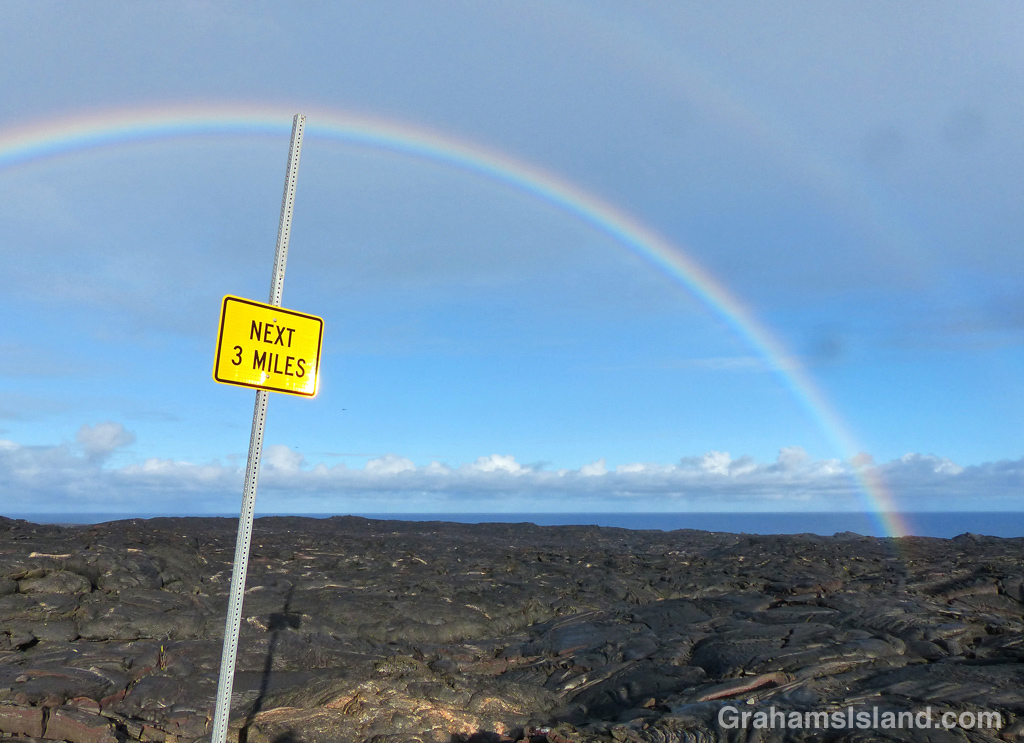
The hike starts on the coast, at the end of Chain of Craters Road. It’s about an 8.5 mile round trip, and follows the emergency gravel road constructed in 2014. While the whole area is a stark covering of old lava flows, I liked seeing ferns and the occasional shrub getting a toe hold in cracks and under ledges. And then, with late afternoon light slanting from behind and rain showers approaching from ahead, a brilliant rainbow lit up the sky.

Regarding the current flow, the USGS website notes that “the entire area presents a significant hazard to visitors.” It goes on to list dangers from toxic gasses, explosive events, and unstable ground. So it was with some surprise that when I arrived, I found the flow crawling with people. This wasn’t because it had suddenly stopped and cooled. At the edge, where it crossed the road, the red glow of active lava could be seen. I talked to one of the park rangers keeping an eye on things. He said all they could do was post signs and try and make people understand the dangers. They had roped off some areas and people just stepped over the ropes. It gave me a warm glow to know that, if someone was injured here, that person would understand it was their own fault and wouldn’t turn around and try to sue the park service for millions.

I wandered down the edge of the flow to the cliff where the new bench being formed by the lava could be seen. Then back to the road and I figured, if everyone else is doing it, it must be safe, right? Ha, ha. The thing is, standing next to the flow, the heat was significant, and stepping on to it, it got hotter still. My feet got distinctly toasty, so I took a couple of photos and turned around. A few minutes later, I happened to be looking in the direction of one of the clumps of people standing on a lump of lava. Suddenly, a river a red burst from near the base of the lump. A breakout, and a decent-sized one at that.

Naturally, the people nearest to the breakout quickly moved away from the danger. Ha, just kidding. People rushed toward the lava because, though the surface was obviously unstable and could turn to deadly, molten liquid at any moment, it probably wasn’t going to happen to the lump they stood on. Frankly, it was all a bit surreal.

Later, I saw the ranger I’d talked to earlier doing a brisk trade in fixing the detached soles of shoes – flat tires, he called them – where heat from the flow had melted the glue. As the light dimmed, numerous glowing red patches of lava showed up, speckled with white and yellow flashlights as people meandered through the dark.

It was time to go before someone out there misstepped. I had a three hour drive ahead of me and I didn’t want their screams ringing in my ears.

For more information about Kilauea Volcano and it current eruption, go to hvo.wr.usgs.gov/activity/kilaueastatus.php.
For more information about boat trips to see the lava, go to lavaocean.com.

A rainbow rises over the road to the flow from Kilauea Volcano.

A rainbow rises over the road to the flow.