Tag Archives: Kohala

An old abandoned anchor

Sunken Anchor

Sunken Anchor and chainThis week’s Sunday Stills challenge theme is ‘Objects over 100 years old.’ (See more responses here.)

I can’t say for certain that this anchor and chain is more than 100 years old, but it almost certainly is. In the late 1800s and early 1900s, North Kohala was the center of the sugar industry with many plantations and several mills. This anchor likely dates from that time. It’s located in the bay where sugar used to be loaded onto ships.

I suspect the anchor isn’t lost from a ship, since it’s located in shallow water close to shore, with the chain leading out to deeper water – the opposite arrangement of how a ship would normally anchor. Instead, I think the anchor and chain were part of an offshore anchoring system used at the harbor. A ship would drop its anchor from the bow in deep water and attach to the anchoring system from the stern. This would keep the ship fairly stable and make the transfer of cargo, from small boats, easier.

After the sugar industry shut down, a lot of buildings and equipment were abandoned, and in the water, the anchoring system was left to rust.

Rainbows on the water

Rainbow on the water

During a recent swim, I was lucky enough to see this gorgeous double rainbow. I took several photos and this one is actually a composite. In the best rainbow photo the water looked a bit flat, but in photos that gave a glimpse below the water’s surface the rainbow wasn’t as good. So I combined the best of both and it came out pretty good I think, especially given my rudimentary skills in my Photoshop Elements.

Monk seals resting

Monk Seals Resting

I’m posting this photo in response to this week’s Sunday Stills challenge on the theme of ‘Friend’ (see more responses here), though it would be equally suitable for next week’s ‘Lazy Days.’

Monk seals are solitary animals, the main exception being the six weeks or so a mother spends with her new pup, teaching it the tricks of the trade, before leaving it to fend for itself. But for a three month period in late 2016, these two monk seals spent a lot of time together.

The top seal is I05, a male, affectionately known as Igor. He’s a Big Island seal and appears to spend his time on the Kohala and Kona coast. The other is B00, a female, affectionately known as Boo. She was born in Kauai and had previously been seen on Molokai and Maui, but now appears to spend much of her time on the Kona coast. Whereas not too much had been known about B00, I05 was regularly seen and was a notorious loner. So his ongoing liaison was quite out of character.

They seemed very relaxed and content in each other’s company, and here are resting ashore, as monk seals do, before heading back into the water to feed.

Tenting for termites

Tented for termites

No, it’s not the circus come to town. These tents are for a more macabre purpose, the termination of termites.

As in most warm climates, termites are a problem here. Houses, especially older ones, are easily colonized. Without treatment, the occupying termites will consume wood from the inside, leaving a thin membrane as protection. Infested wood might look fine, but a gentle push on the surface will go right through two or three layers of paint to the termites’ cavern inside.

Besides leaning against a wall and going right through, a prime indicator of termites is small mounds of little round pellets below a pinprick hole in a wall or piece of furniture. These are termite fecal pellets, which the worker termites clear out of the nest from time to time.

Another indicator of the presence of termites is to turn a light on and find a horde of them flying around the room. Around here, May is the prime time for this activity. These flying termites are fertile males and females, leaving the nest they grew up in to find a place of their own and start a new colony.

As unpleasant as it is to find a room full of flying termites, it’s even worse to wake up and see countertops littered with discarded wings, a sure sign that these fertile termites have moved in to a new spot.

So tenting for termites is common practice here. The structure is covered with nylon sheeting until it is completely sealed and then a fumigant is pumped in. The tent usually remains on overnight. After the tent is removed, the house has to sit empty a while for the gas to dissipate. It’s not wise to go back in too early or one could find oneself joining the termites. Typically it can be two or three days before a home can be reoccupied.

Tenting for termites is effective but it has downsides. It works for drywood termites, but not subterranean termites since they live outside the house and just dine inside. There are also environmental concerns about the process. And while fumigation works, there’s no guarantee that a new colony of termites won’t move in just as soon as the gas has cleared.

Tenting for termites

Wind turbines crank out the power

Wind turbines Hawi and Mauna Kea

This week’s Sunday Stills challenge is ‘Drunk with .…’ I thought about a photo of my liquor cabinet, but settled instead for ‘Drunk with Power,’ a reasonable choice in these turbulent times.

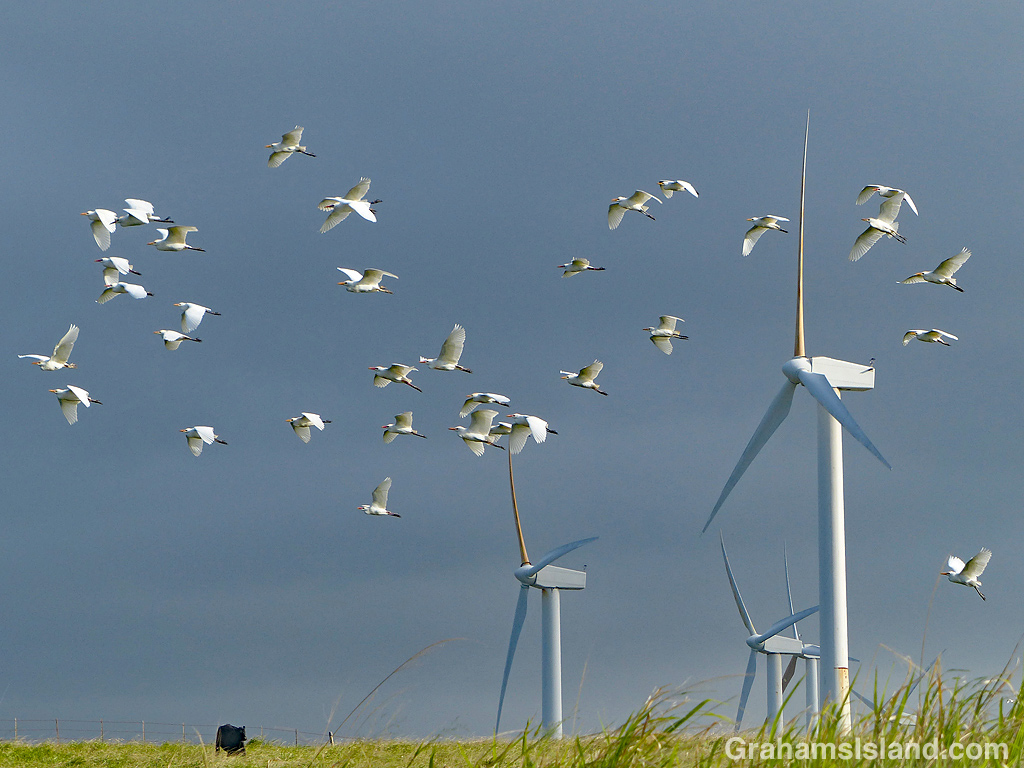
Hawi Wind Farm began operations in 2006 and has 16 turbines churning out 10.56 MW. This power is supplied to Hawaii Electric Light Company, which runs the power grid on the island.

My interest in the wind farm is mostly visual. I like the patterns that the turbines make, and every once in a while the telescopes of Mauna Kea can be seen in the distance.

See more Sunday Stills responses here.

Wind turbines Hawi

Two nene having lunch

Nene eating

Two NeneI came across this pair of nene, the Hawaiian goose, on one of my walks. They didn’t seem too bothered by my arrival in the vicinity and continued to graze.

And in a shameless bit of self-promotion, the second image is my Photo of the Week for this week (7-23-18 to 7-30-18). Check out my shop for more details here.