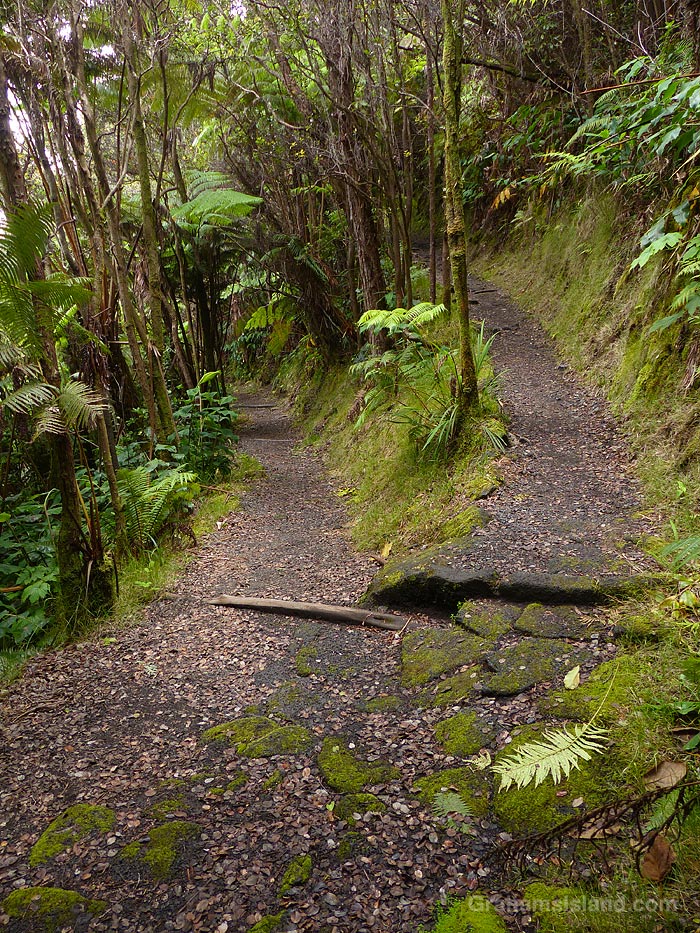
The Kilauea Iki Trail in Hawaii Volcanoes National Park is one of the most popular in the park, but I’ve never found it crowded when I’ve been there. It features two very different environments, the walk around the heavily wooded crater rim and the crossing of the barren lava on the crater floor, about 400 feet below.
Since the trail is a loop, one has to descend the steep crater wall at one end and climb up the equally steep crater wall at the other. At both ends, the trail is heavily switchbacked to make this possible. For the hiker, the positives of this are that the trail is less steep than a straight shot would be, and the switchbacks are good spots to take a break and get a variety of views.
For more information about Hawaii Volcanoes National Park, go to nps.gov/havo/. Posted for Becky’s Squares theme of “Walking” (See more responses here).
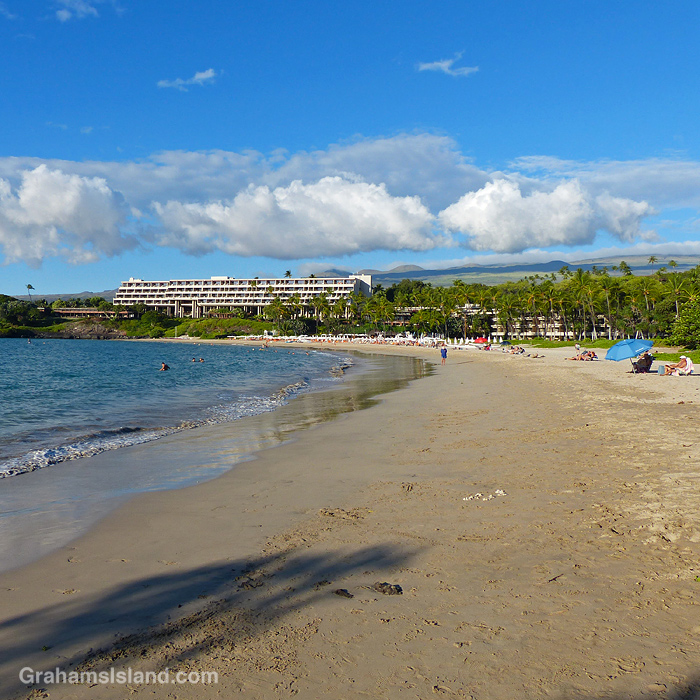
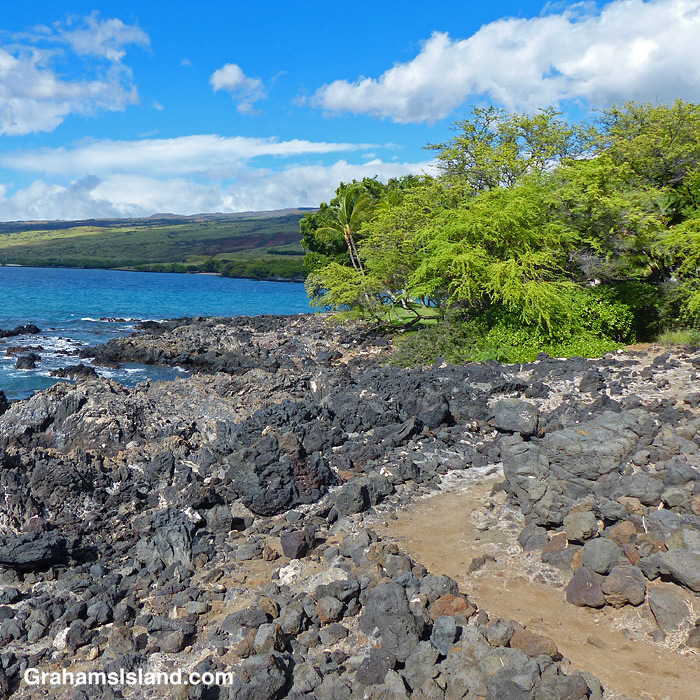
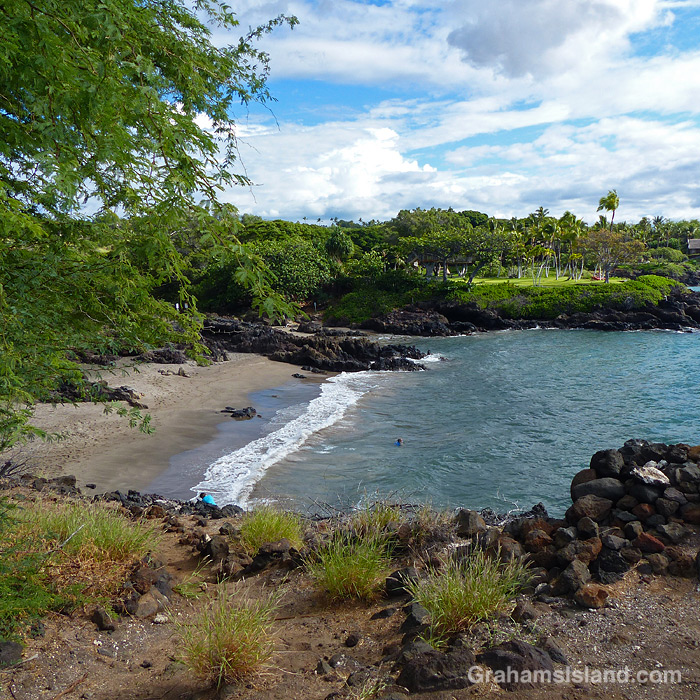
A few days ago, I posted here an image from a recent walk along the coast to Hapuna beach. I thought I’d post more photos from that walk for this week’s Sunday Stills challenge theme of ‘Paths and Trails’ (more responses here), and for Becky’s Squares theme of “Walking” (more responses here).
A sign marks the trail.The trail along the coast.The trail passes through open areas.
The trail crosses beaches large and small.
Looking towards Mauna Kea Resort beach.A small beach on the trail.A sheltered cove along the trail.A view of Mauna Kea Resort beach.
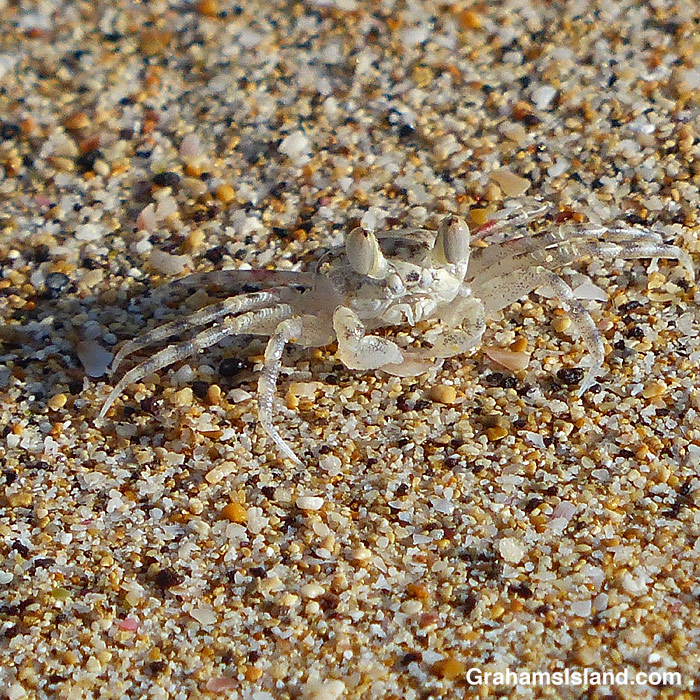
Of course, besides the views I was on the alert for anything moving on the beach or in the air.
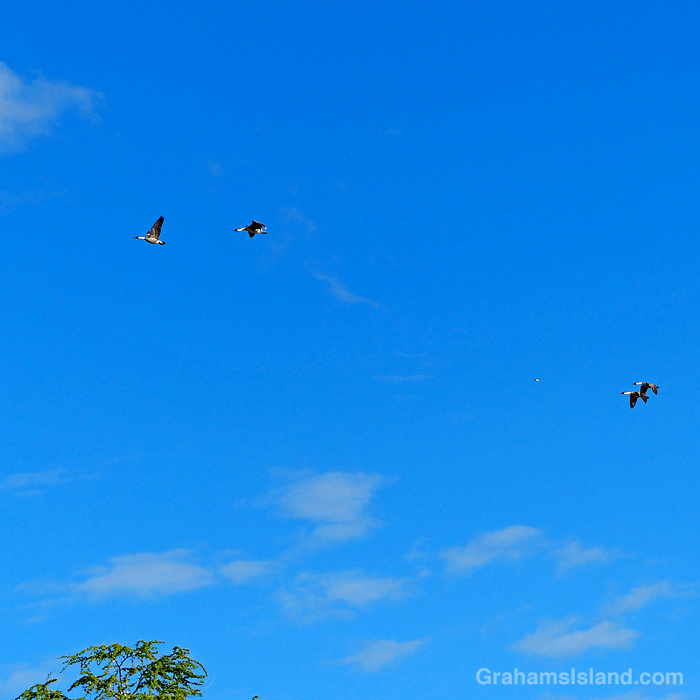
A Pallid Ghost crab on the beach.Nenes flying overhead.
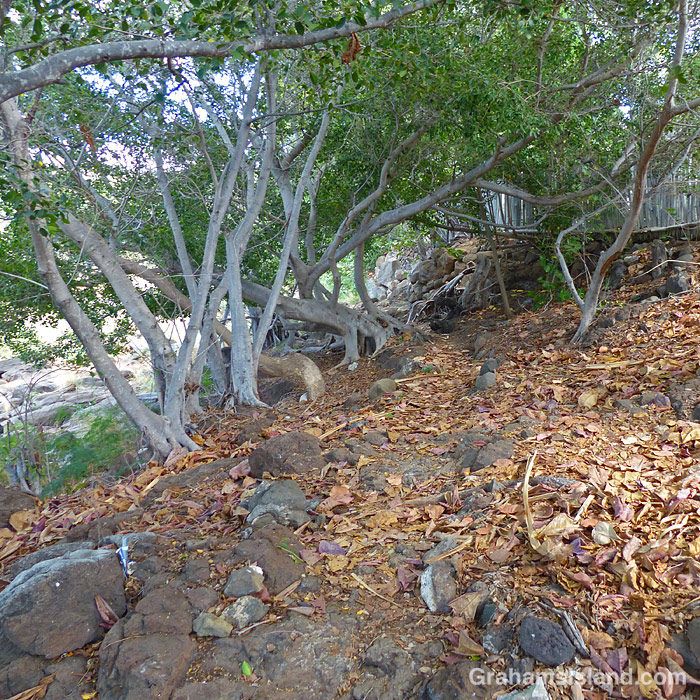
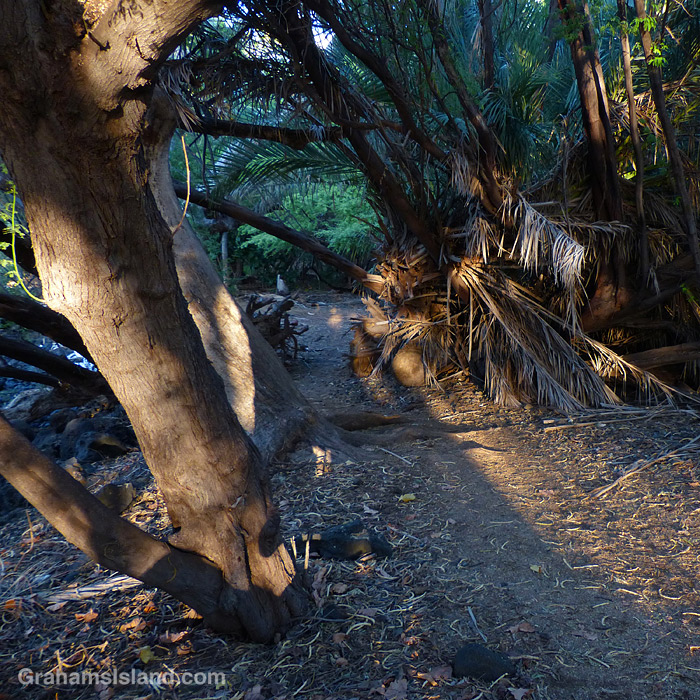
Other parts pass through trees and other vegetation.
The trail passes through residential areas.Passing by a resident’s yard.Through the trees.Walking through the trees.Back to the park.
Pololu Beach is a popular spot for visitors and locals. The trail down to the beach can be bustling with people and the beach itself is often well-populated. But behind the beach, this trail through the trees always seems quiet. It leads to a gully that, in turn, guides the few who venture up there, to a bench overlooking Honokane Nui Valley. (Read about that here.)
Posted for Becky’s Squares with a theme of “Walking.” See more responses here.
Becky’s Squares is back this month with a theme of “Walking.” See more responses here.
A walk I try to do two or three times each year is at Hawai’i Tropical Bioreserve & Garden. It’s not a long walk, but it winds through the garden where on each visit I find something new and interesting.
Osmoxylon Lineare comes from the Philippines and is also known as Miagos Bush or Green Aralia. At the garden, the sign calls it Eyelash Bush and the bottom photo gives a clue as to why that might be. To my mind though, the top photo suggest Eyeball Bush might be a better name.
For more information about Hawai’i Tropical Bioreserve & Garden, go to htbg.com.
A couple of days ago, I hiked south from Spencer Beach Park to Hapuna and back. My main reason for doing this was that I’d heard Hapuna State Park was closed because of a broken water line. People were still allowed to get in the water there, but not stay on the beach or gather anywhere – a sort of return to Covid restrictions. I wanted to see how much difference this made.
When I got down there, the beach wasn’t deserted, but was pretty quiet, especially for a Saturday afternoon. Normally, there would be large gatherings and barbecues. Mind you, the beach in front of Hapuna Resort, at the top of this photo, wasn’t especially crowded either. Perhaps it was just a slow weekend.
Recently, I’ve been seeing more Hawaiian Silversides, though not as many as in 2020. Still, there have been big enough schools of these little fish that sometimes I’ve found myself engulfed by them, zipping around in that wonderfully coordinated way that fish have.
A week ago, I posted (here) about a Wiliwili tree flowering at the foot of Pu’u Wa’a Wa’a. Wiliwili (Erythrina sandwicensis) is endemic to Hawaii and grows in dry forests on the leeward side of the island. Pu’u Wa’a Wa’a is one such place. While I’ve hiked here several times before, this is the first time I’ve seen a Wiliwili flowering.
Wiliwili is unusual for an Hawaiian tree in that it’s deciduous, dropping it’s leaves during summer droughts. It’s pollinated by birds, but on this day bees were the primary visitors.
Wiliwili seeds are easy to germinate and grow but, like many Hawaiian plants, it has been in decline, losing out to more robust non-native plants and to herbivores. The arrival in Hawaii of a a gall wasp, Quadrastichus erythrinae, greatly exacerbated the situation. However, biocontrol responses have been effective and the situation has been stabilized.
Pu’u Wa’a Wa’a is a cinder cone on the slopes of Hualalai volcano. The name means “many-furrowed hill,” and it’s a place I like to walk at least once a year, but it had been a while since I was up there. Usually, I go there in the spring when Jacarandas and other flowers are blooming. I also try to go in the early morning, since the area tends to cloud up during the day and the wonderful views become obscured.
A couple of weeks ago I made a late decision to do the hike again since the weather looked unusually good. I got there around 2pm and it will come as no surprise that I spent the first 15 minutes of the hike taking photos of Williwilli flowers on a tree about 20 feet from where I parked! (More of those in a few days.)
The trail follows an old road up the hill past Silk Oak trees, at the tail end of their flowering and sporting a deep red hue I hadn’t seen before. Turn around, and there are good views of Maui to be had. The old road peters out near an old blockhouse, now lacking doors and windows, which offers shelter to livestock on the ranch here. Off to one side is an old quarry, which cuts into the side of the hill. Usually there are goats in this area, but I didn’t see any on this day. Farther up is what’s left of Tamaki Corral, which dates back around 100 years.
Not far after the corral, the trail climbs steeply toward the top. This was where I found a change in the trail. Whereas before the trail was an out-and-back up a steep slope to the top, now a loop has been created. I took this new option to the top where, on this remarkably clear late afternoon, I had great views of Maui, Kohala Mountain, Mauna Kea, Mauna Loa, and Hualalai. A new sign at the top welcomes hikers to the nearly 4,000 foot summit, and there’s a survey marker at the top riddled with holes, not from gunfire, but to let the wind blow through. There are also a couple of benches where one can sit a while enjoying the views (weather permitting). The hike is steep in places, but not difficult, though not everyone makes it back alive!
I followed the old trail back down and ran into several sheep, which have the run of the land up here, as the sun dipped behind the ridge.
One other difference I noticed with this afternoon hike was the proliferation of birds. There were large numbers of finches, mostly Saffron Finches flitting about, preparing to roost for the evening. Yellow-fronted Canaries were all over the tree tobacco flowers. I also saw, and heard, several Erckel’s Francolins doing their usual fine job of blending in with the vegetation.
And as I walked back down the hill towards my car, the late afternoon sun still shone, illuminating grasses alongside the trail.