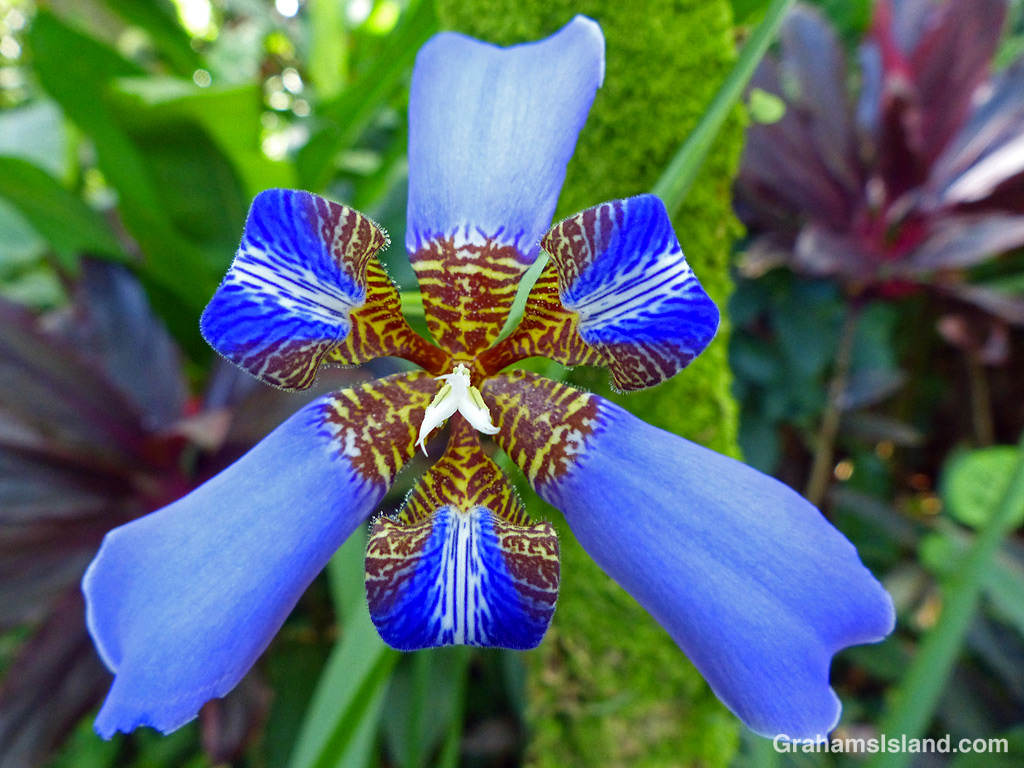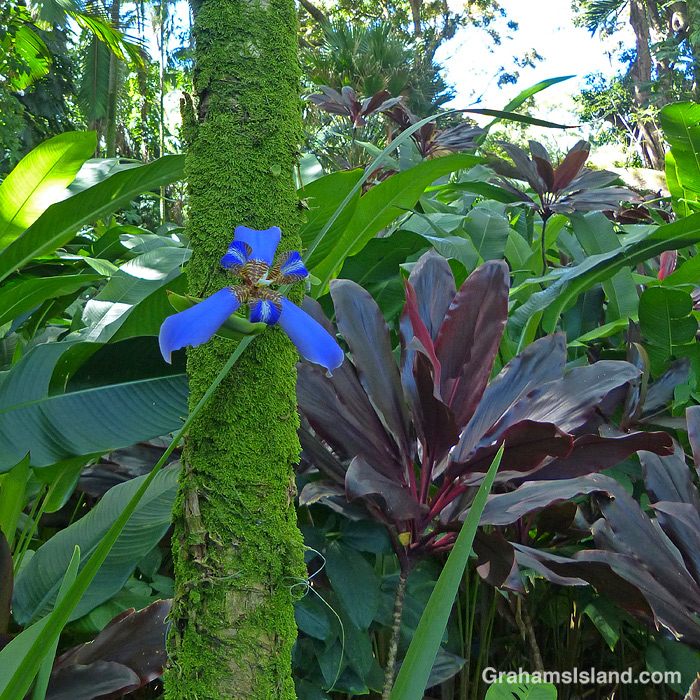
Brownea Coccinea is a native of Colombia, Ecuador and Venezuela, which is why it’s also known as the Rose of Venezuela amongst other names. The tree is a small evergreen, but the flowers are large, showy, and really quite rose-like.
This one was at Hawai’i Tropical Bioreserve & Garden. For more information about Hawai’i Tropical Bioreserve & Garden, go to htbg.com.
I had to go back more than a week to find my last photo for Bushboy’s Last on the Card photo challenge (see more responses here). It might not be the last photo I took, but it is the last I saved, and I’d already processed it for posting later this week. There’s really not much difference between the original (above) and the adjusted version (below). I cropped the photo a bit and lightened the shadows a bit to bring out the anole more, but it works pretty well even without that.
This week’s Sunday Stills challenge theme is ‘Fresh.’ See more responses here.
Here’s a weekly ritual of mine these days. There are two tangerine trees on the property and they constantly churn out fruit. I rarely see the flowers, though I did eventually notice that they do exist (here).
Each week, I pick a small bucket of ripe fruit. Often I can just reach up an pick enough for my needs. Sometimes I use a ladder and rake to snag the higher fruits. Then I take my bounty inside and juice it. I use a hand juicer; I tried a powered one, but it didn’t really work for me. It doesn’t take long to fill my jar. This time I used 29 tangerines, but the number varies from week to week depending on how ripe they are and how juicy.
I could juice them daily for truly fresh juice, but this still tastes pretty good to me.
Also posted in response to this month’s Becky’s Squares challenge theme of ‘Odd.’ See more responses here.
This Milo tree was planted at Upolu Airport several years ago to provide shade for those visiting the area. The picnic table was positioned around the same time and chained to the tree so that no one would nick it!
Fast forward a few years, and the tree has grown and does provide shade, but it’s not what one might think of as a typical shade tree. The robust trade winds that blow here have given the tree its odd shape, a 90° bend not being typical of Milo trees growth. However, it still produces the most lovely blooms that I’ve posted about before here.
It will be interesting to see what it looks like in another five years. Probably a somewhat larger version of this photo, unless the winds get the better of it.
Posted in response to this month’s Becky’s Squares challenge theme of ‘Odd.’ See more responses here.
This week’s Sunday Stills color challenge theme is ‘Amethyst.’ See more responses here.
With no immediate ideas for this challenge, I plumped for some odds and ends from my flower folders. First up is a ‘vase’ of vincas followed by a Doritaenopsis orchis (Yu Pin Dream Girl). Then we have the leaves of a Persian Shield plant and finally a water lily surrounded by reflections.
Also posted in response to this month’s Becky’s Squares challenge theme of ‘Odd.’ See more responses here.
False Kamani (Terminalia catappa) is believed to have been introduced to Hawaii before 1800 and is now widespread here, particularly on beaches and shorelines. This one was at Spencer Beach Park and was heavy with green almond-shaped fruits as well as riper deep pink ones.
What caught my eye was that the ripe fruits had been gathered and used to ornament the battlements of a sandcastle below the tree. I thought they gave it an odd but distinctive look.
Posted in response to this month’s Becky’s Squares challenge theme of ‘Odd.’ see more responses here.
This week’s Sunday Stills challenge theme is ‘Feed the Birds.’ (See more responses here.) We don’t put bird feeders out here so I was going to go with a selection of birds feeding out and about. But a few days ago, I was reminded that, while we don’t put out bird feeders, it doesn’t mean we don’t have them around.
Right now, the cane grass bordering the property has gone to seed and has been attracting birds. Seeing them is one thing; getting photos another. The cane grass is up to 10 feet high and the little birds that feed on them are notoriously skittish and will take off in an instant. I’ve found my bathroom window to be a good spot for photography – as long as it’s clean! The window looks out at the level of a lot of seed heads, but they’re usually in motion because of the wind and the little birds working them over. And other stalks of cane grass swish back and forth, obscuring my view of the birds and playing havoc with my focusing.
However, I was lucky enough to get photos of two recent visitors. The top trio of photos show a Common Waxbill stripping a seed head that was nicely illuminated and in an open spot right across from the window. The bottom three show a Nutmeg Mannikin. This one hopped around more, but stayed long enough that I was able to get several photos.
Both waxbills and mannikins generally travel in small flocks. This waxbill was the only one I saw clearly, but I saw others flitting about and could hear them in the vicinity. The odd thing about the mannikin was that it was the only one I saw or heard. Also, as the sun went down, I went outside to see if I could get better shots from a different angle. This bird did not seem bothered by my presence. Normally, mannikins would disappear at my appearance (I don’t take it personally!). I suspect this one was a juvenile that was, hopefully temporarily, separated from the flock and hadn’t learned about the many dangers facing it.
Also posted in response to this month’s Becky’s Squares challenge theme of ‘Odd.’ See more responses here.
I was taken by how different these cane grass seed heads look to those bordering my yard, but there are many different varieties of cane grass so such variety should be expected.