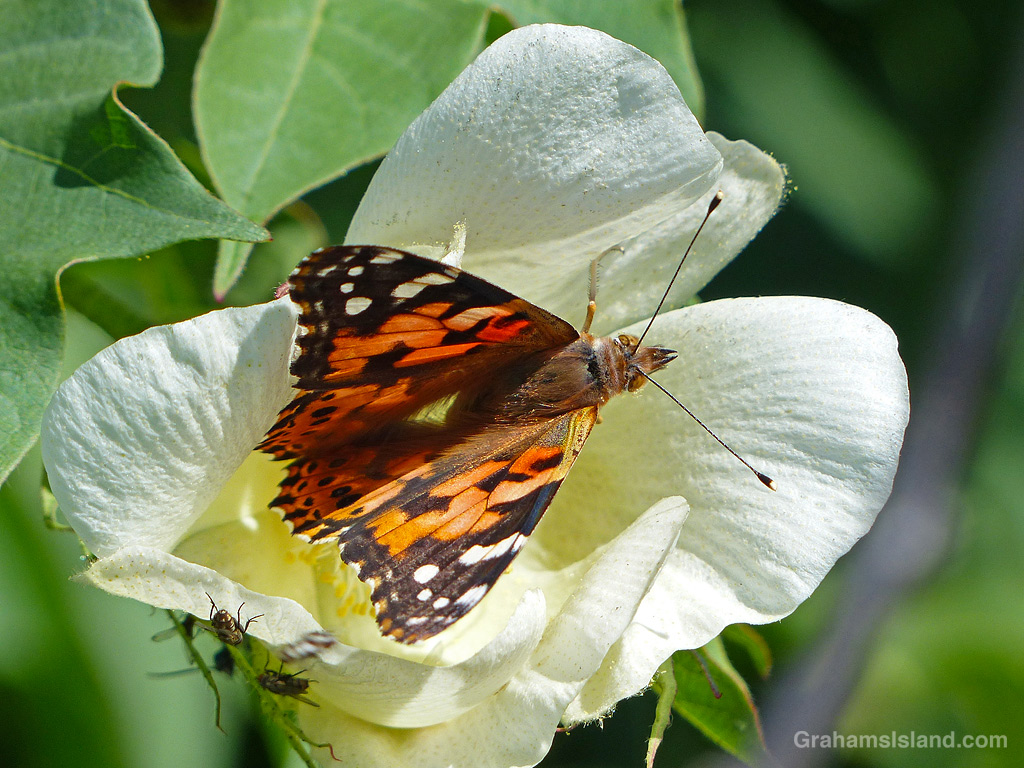
These photos were taken at Lapakahi State Historical Park. This year, North Kohala was awash with Painted Lady Butterflies and the park was no exception. The butterflies were all over the Ma’o flowers and pretty much anything else that came into bloom.
This week’s Sunday Stills challenge theme is ‘Historical.’ See more responses here.
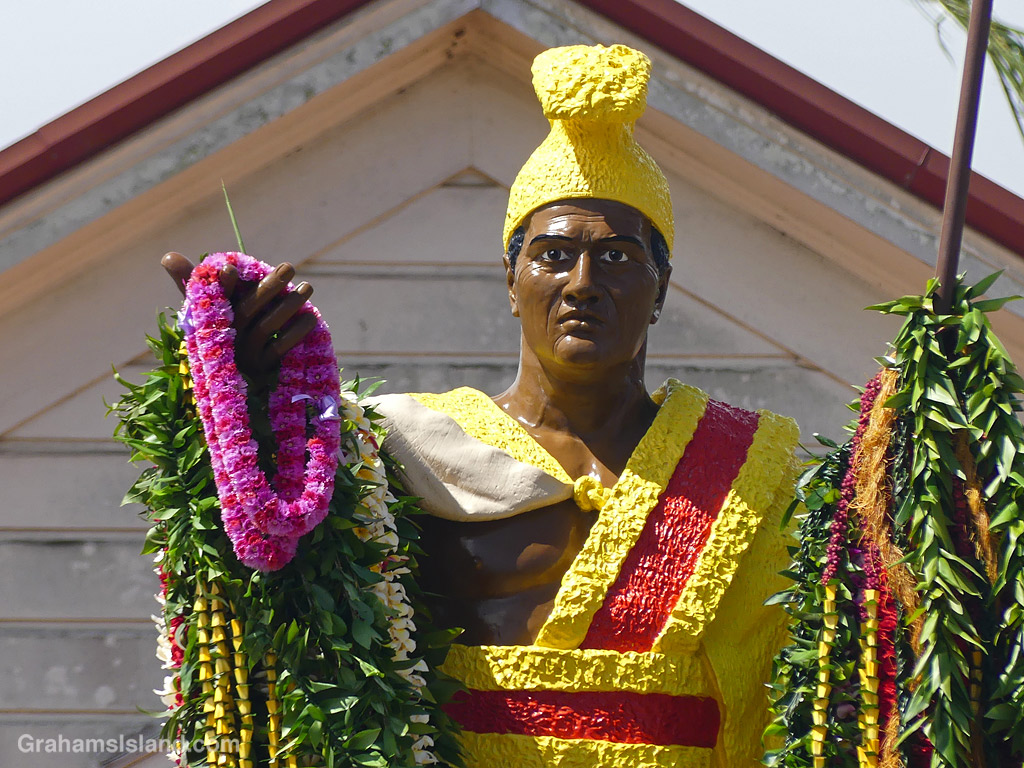
Here are a few more photos from this year’s celebrations commemorating the birthday of King Kamehameha I, the king who united the Hawaiian islands. The ceremony began with a welcome blown on conch shells.
The procession was led by the four Royal Societies in Hawaii. They are descendants of Hawaiian Ali’i including King Kamehameha I himself. Ali’i were the ruling class who were seen as the link between the people and the gods.
Hula dances were performed honoring the king. Hula was created by early Hawaiian settlers. It is often accompanied by chants and the movements are a visual representation of those chants. The subject matter can be anything from light entertainment to a sacred honoring of a god or goddess. Western missionaries disapproved of hula and encouraged Hawaiian rulers to ban it, but while there were some restrictions it was never driven completely underground as happened with some other traditional Hawaiian activities.
See more photos from the Kamehameha Day celebrations here.
Yesterday was the birthday of King Kamehameha I, the first king to unite all the Hawaiian islands under one leader. He was born in North Kohala, and every year the community celebrates his birthday with ceremonies at his statue in Kapaau and with a parade.
The parade features Pa’u riders representing all the main Hawaiian islands. Each island has an official color and flower. Maui’s flower is the Lokelani rose and its color is pink.
Hawaiian men and women started riding horses, soon after their introduction to the islands in the early 1800s. Sidesaddle riding was common for women in those days, but it was never introduced here. Women learned to ride the same way as men. They wore a Pa’u skirt, 12 yards of colored cloth wrapped in such a way as to preserve their modesty and dignity while riding astride their horse.
The ceremonies include draping leis over the arms of the statue. These leis are made as a mark of respect, by groups and organizations. It can be a tricky business getting the leis into place, especially when there’s a good breeze blowing as there was yesterday.
Posted for this week’s Sunday Stills color challenge theme of ‘Pink.’ See more responses here.
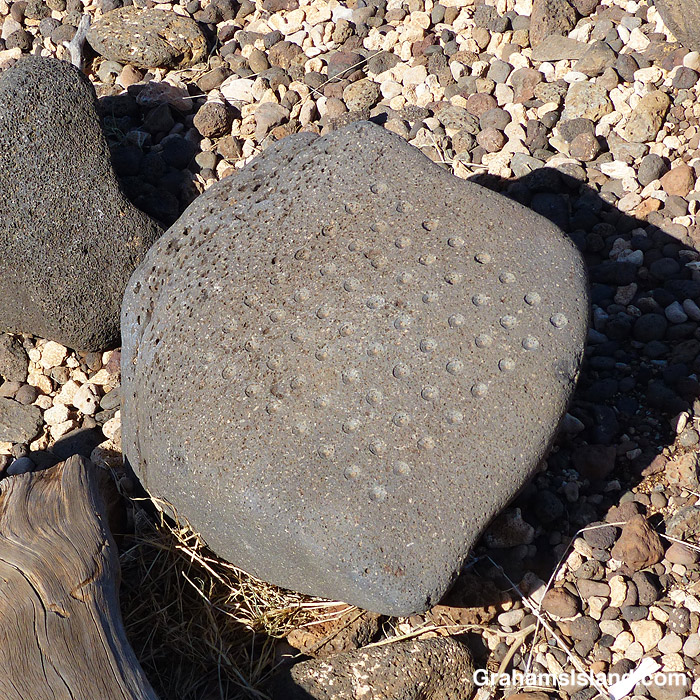
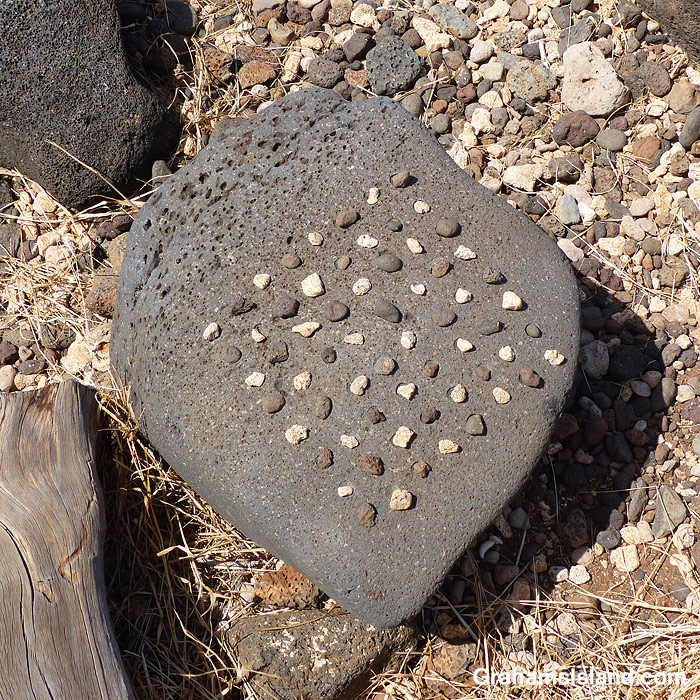
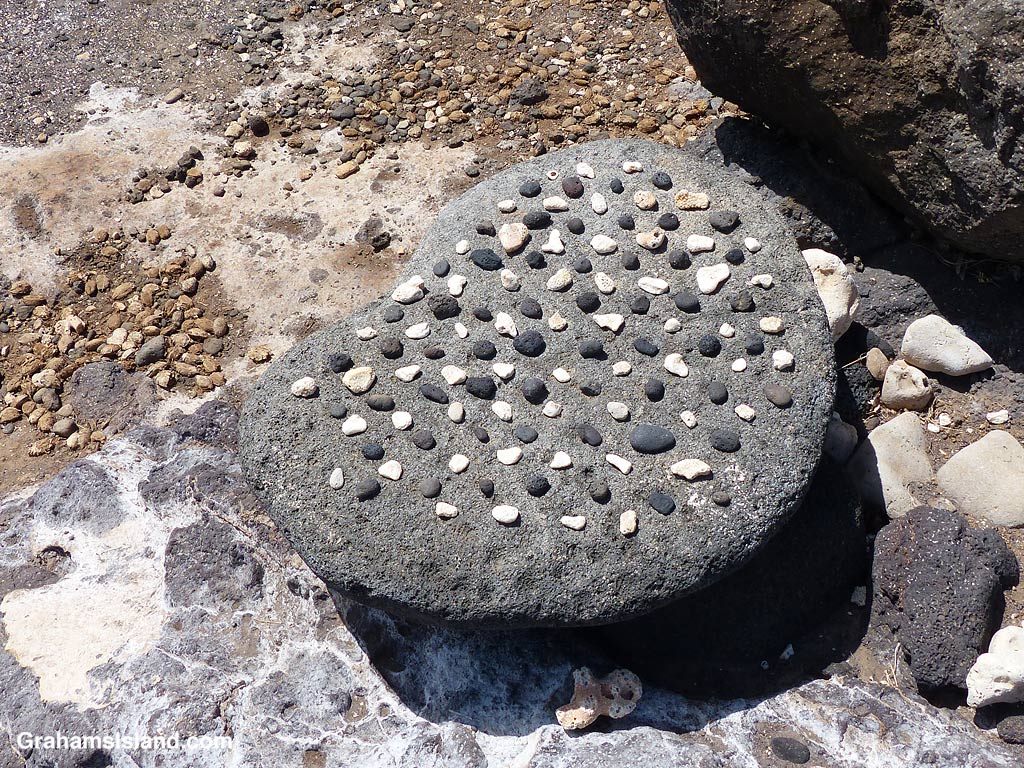
Kōnane is an old Hawaiian game with similarities to checkers or draughts but with more complications. It’s played on a board, or papamū, which can vary in size and material.
Older boards were often made in suitable rocks by creating hollows for the pieces to sit in. Sizes varied with most being rectangular with sizes such as a 14 by 17 configuration. The bigger the board, the longer the game. Game pieces were small pebbles of black lava and white coral. These days, wooden boards are common and some are made of cloth for portability. Square boards are more usual now such as an 8 by 8 configuration.
These photos were taken at Lapakahi State Historical Park, which was the location of an old Hawaiian village. The papamū in the top photo and the slider was probably made relatively recently judging by the smooth hollows for the pieces, but the board in the bottom photo was probably used by inhabitants of the village and show that boards weren’t necessarily a regular shape. Such irregularities only added to the challenge of the game.
To play kōnane, the board is set up as in the photos with black and white pieces on alternating squares. A correctly set up board should show all one color pieces on a diagonal line. After colors are chosen and the first two pieces removed, players alternate turns in jumping over the other player’s piece or pieces, removing those that have been jumped. Moves can be made up, down, or to the side, but not on the diagonal or around corners. The object of the game is to be the last player to make a move.
Kōnane was hugely popular in Hawaii, but was frowned on by missionaries who disapproved of the unproductive time spent playing and the rampant gambling on games. These days, it’s becoming more popular again, with tournaments and online games being held.
For more information about kōnane, go to hawaiiancheckers.com.
This week’s Sunday Stills challenge theme is ‘Churches, Temples, and Spiritual Centers.’ See more responses here.
Here’s a few of the churches that can be found in this part of the island.
Kalāhikiola Congregational Church (top photo) is located east of Kapaau, where rainfall is plentiful and the foliage lush. It was built in 1855, though previous versions had existed for some years before this. The church was badly damaged by an earthquake in 2006, but rebuilt in the winter of 2009/2010.
St. Augustine’s Episcopal Church (second photo) was founded in 1884 in Kapaau, and expanded in 1913. It sits on a small hill by the main highway.
Sacred Heart Catholic Church (third photo) was founded in Hawi in 1905, but this structure was built in 1925 and continues to be used daily to this day.
Kohala Baptist Church (bottom photo) is located on the road to Pololu at Makapala. It can’t be seen from the road, but there is a sign by the highway pointing out the way. Currently, the church is undergoing some renovations and services are held in the area below the Royal Poinciana tree on the grounds.
‘Akala (Rubus macraei) is a native Hawaiian raspberry. It’s unusual for its large edible berries and slightly thorny stems. Most Hawaiian native plants didn’t need such lures or defenses because there were no grazing animals in Hawaii until their introduction by humans.
The berries are larger than non-native blackberries, but less sweet, and their juice was used as a dye in days gone by.
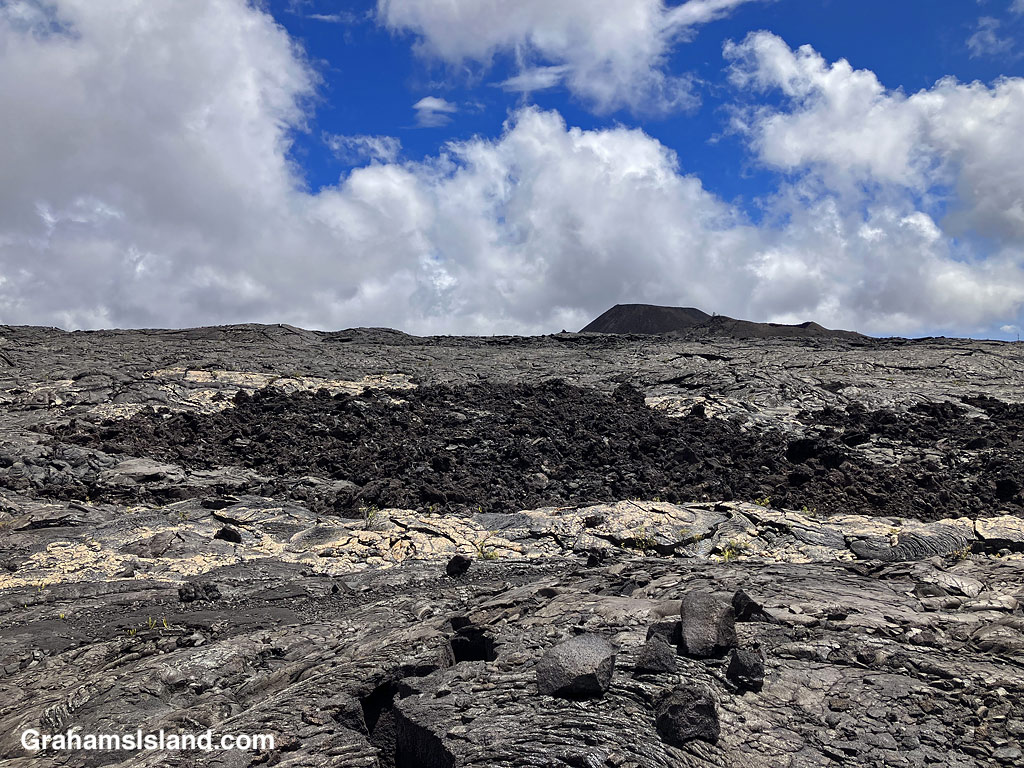
My lunch spot with a view of the Kamakai’a Hills and various kinds and colors of lava.
This week’s Sunday Stills challenge theme is ‘I’d Rather Be…’ See more responses here.
It had been a while since I went hiking, for various reasons, and it’s something I was missing, something I’d rather be doing. So last week, I headed down to Hawaii Volcanoes National Park to try the Ka’u Desert Trail. This backcountry trail has been on my list for a long time, but I had never done it before. For one thing, it’s about as far from my house as one can get on the island. For another, it’s directly downwind from Kilauea Volcano, so when the volcano is active and the trade winds are blowing, gasses blow across the length of the trail.
The latest eruption of Kilauea is currently either paused or over, so gas emissions are much reduced, and last week, the trade winds had given way to winds from the southwest. So off I went.
Signs explain the rich history and geology of the area.Tenacious Ohia trees grow in the lava.Ohia flowers are a magnet for bees……as are the native Ulei flowers.
The trailhead is several miles west of the main entrance to the park, with a strip of parking along the highway. The first mile of the hike is also known at the Footprints Trail. It’s a sort of paved path that threads through ohias to a small building that houses footprints left by early Hawaiians in volcanic mud and ash. Alas, I couldn’t identify any footprints in the display. Shortly after the footprints, the path breaks out of the vegetation into open lava fields. This isn’t a tropical Hawaii walk, this a bleak hellscape Hawaii walk. Or is it?
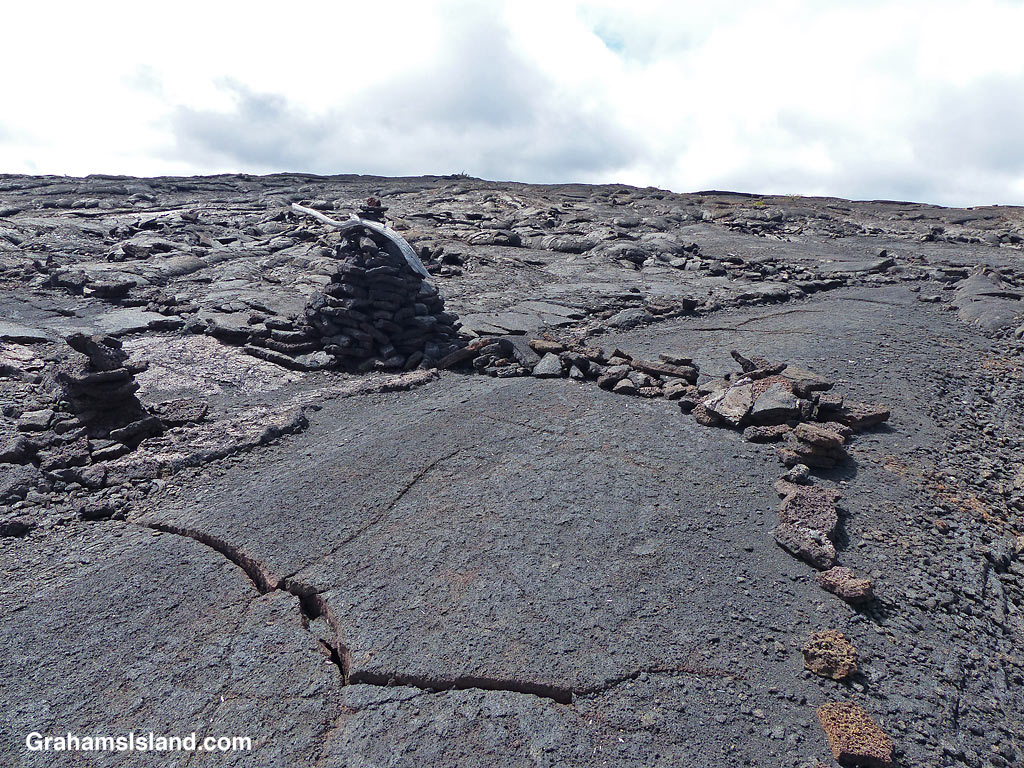
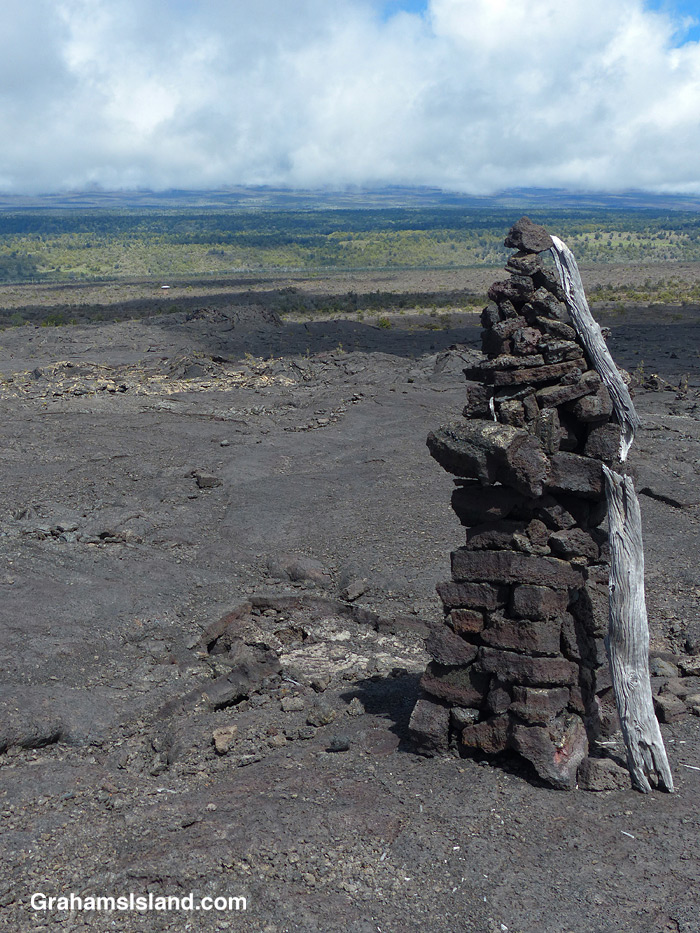
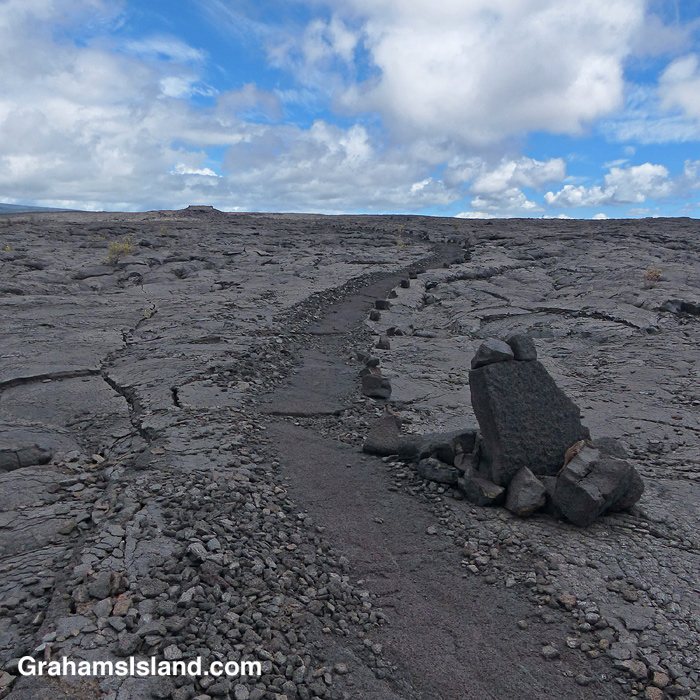
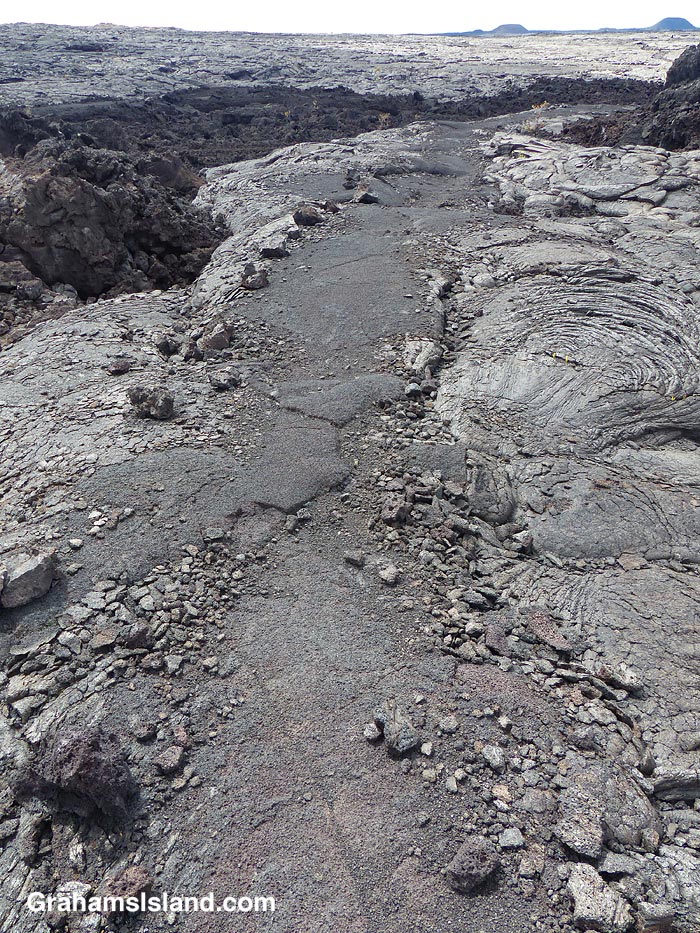
A view of the Kamakai’a Hills from the trail junction.The trail was rerouted here, from its previous path, for reasons unknown.Cairns mark the trail, some bigger than others.Walking on the trail removes the top, crumbly layer of pahoehoe lava.
The trail ascends gently to the only junction for miles around, at Mauna Iki. To the left is a trail back towards the heart of the park. The Ka’u Desert Trail heads to the right and into backcountry wilderness. Mauna Iki was the site of an eruption in 1919 and the trail traverses the lava fields from this eruption.
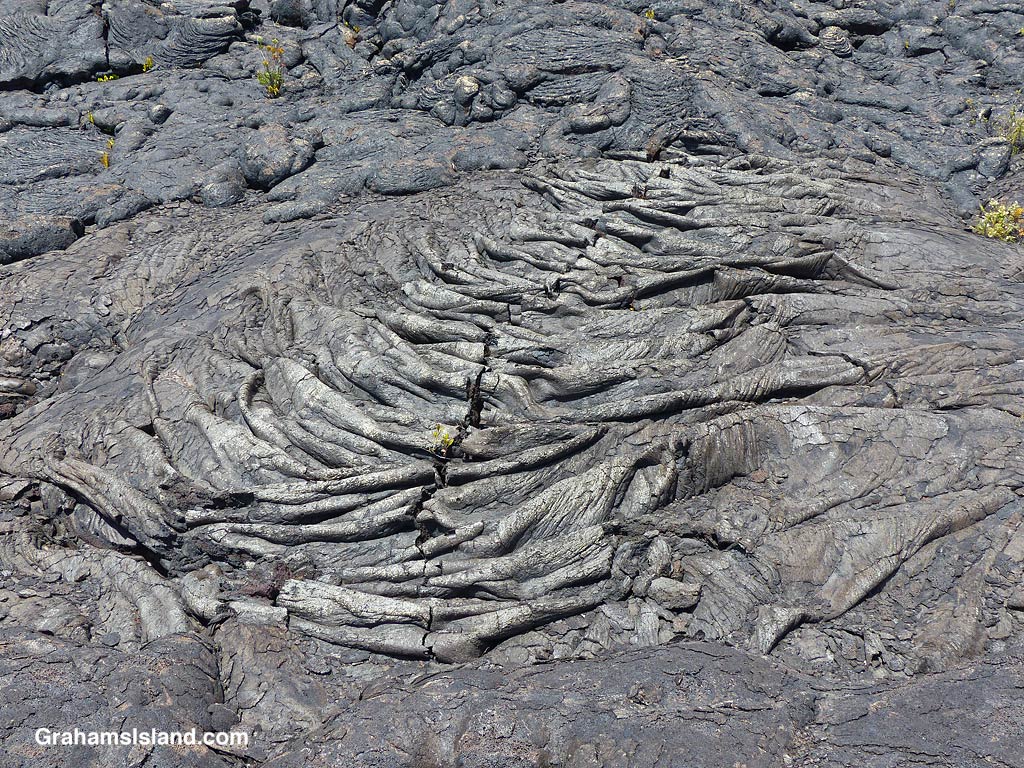
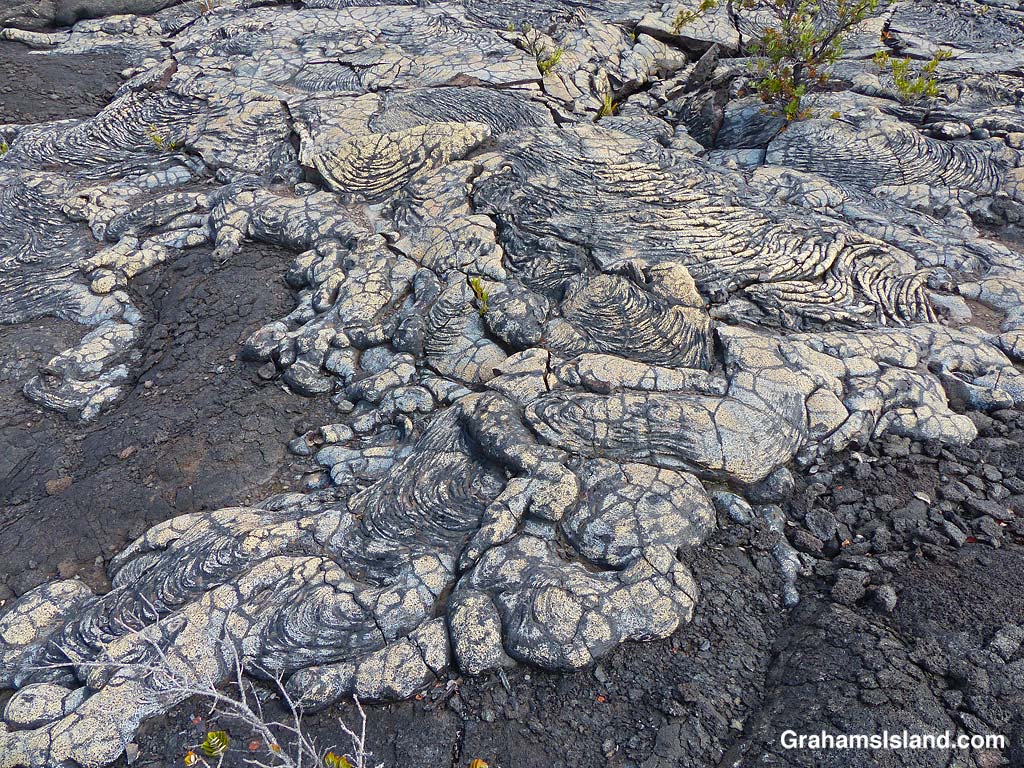
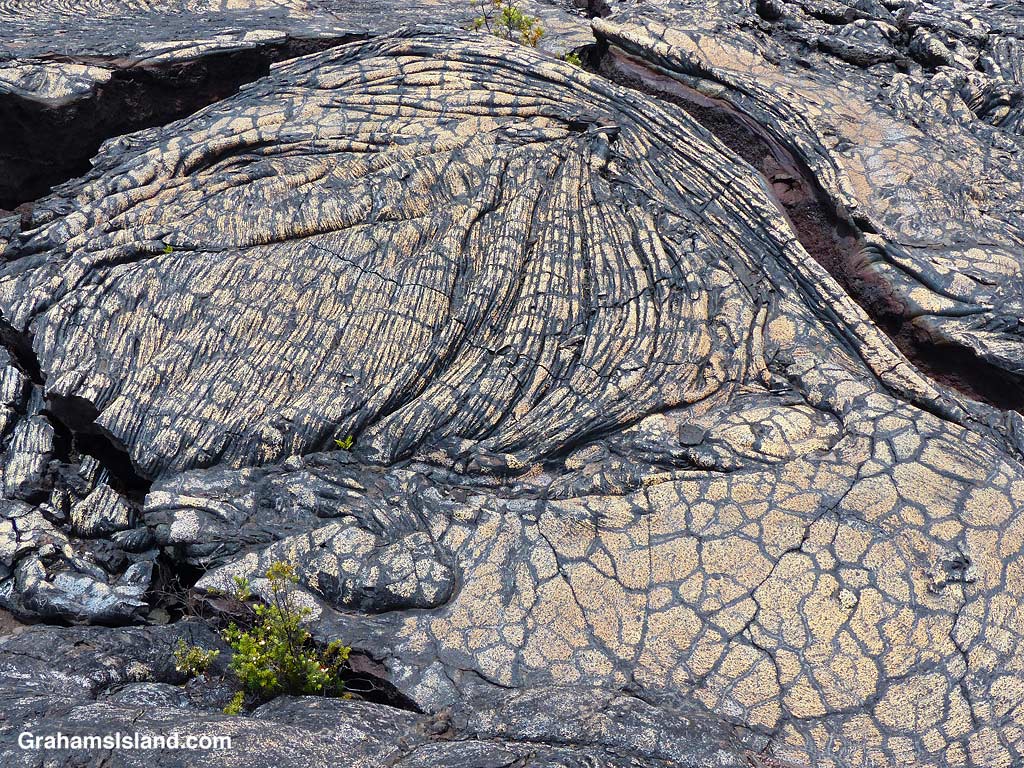
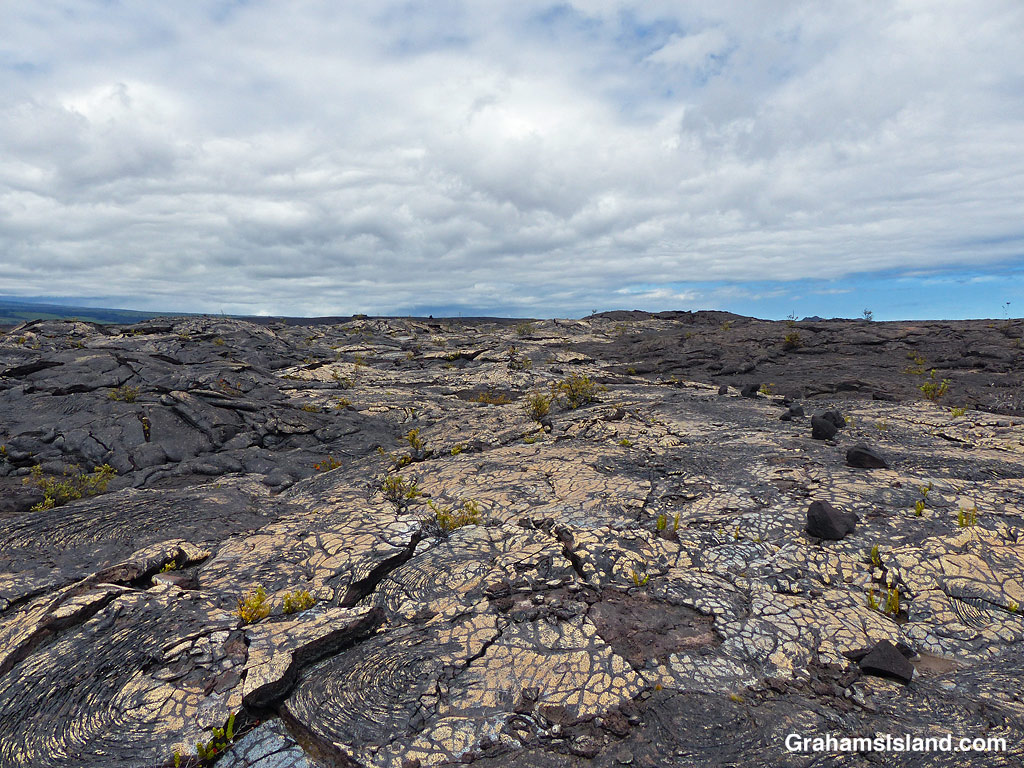
A’a and pahoehoe lava flows can be seen side by side.Gold colored ropey pahoehoe lava makes it look even more like ropes!The lava has many weird and wonderful folds and shapes.
Much of the trail is over pahoehoe lava, which is rounded and much easier to walk on than jagged a’a lava. The trail is marked by cairns and single rocks placed alongside it. It’s pretty easy to follow with just one or two parts where attention has to be paid to make sure one doesn’t stray.
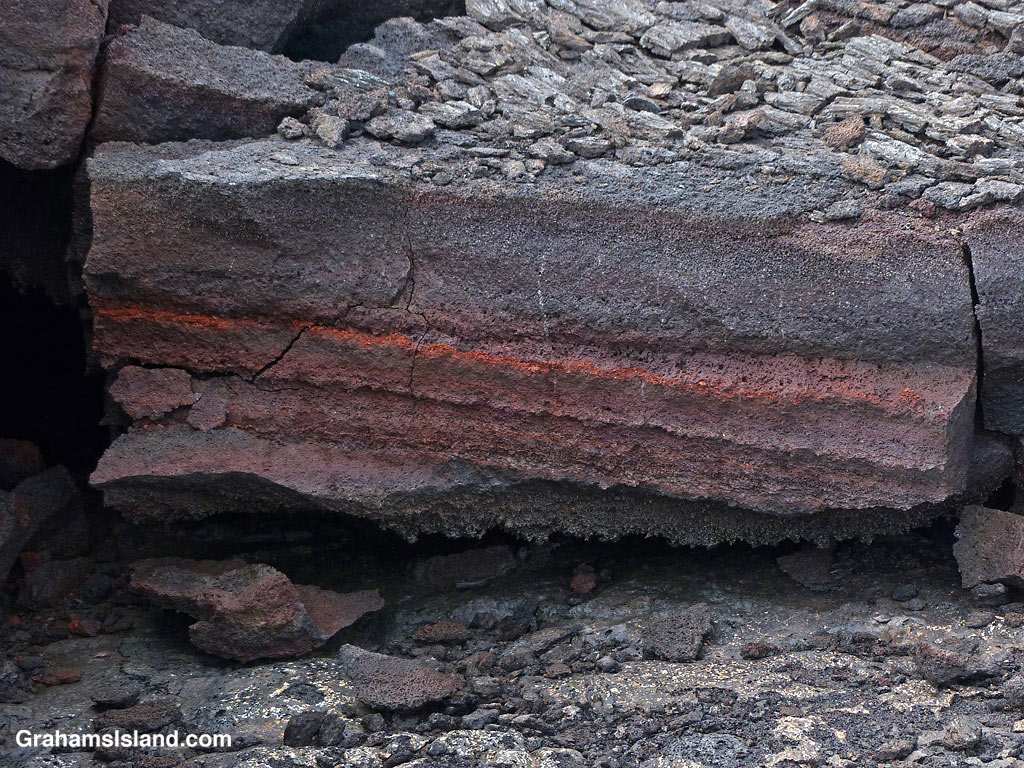
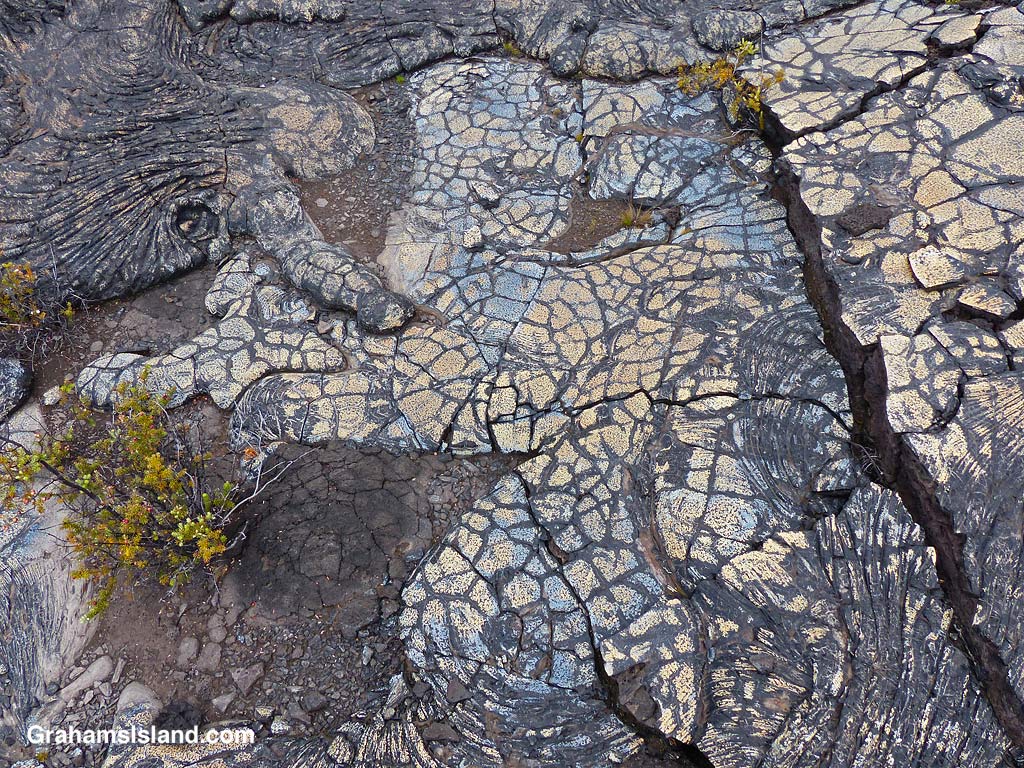
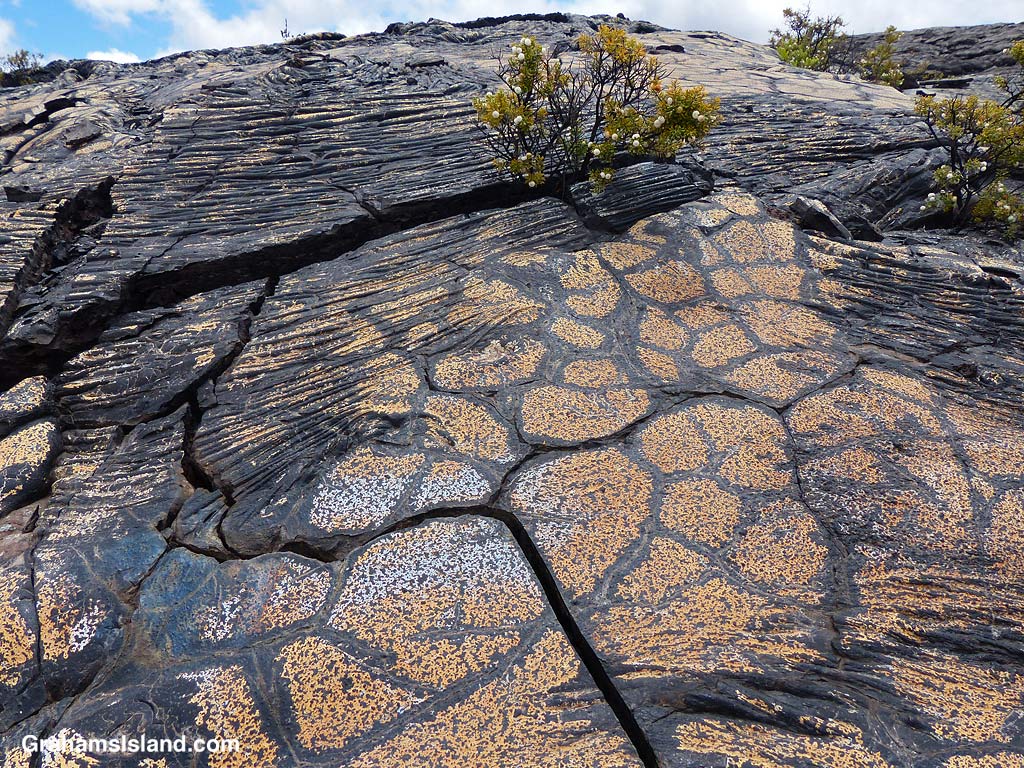
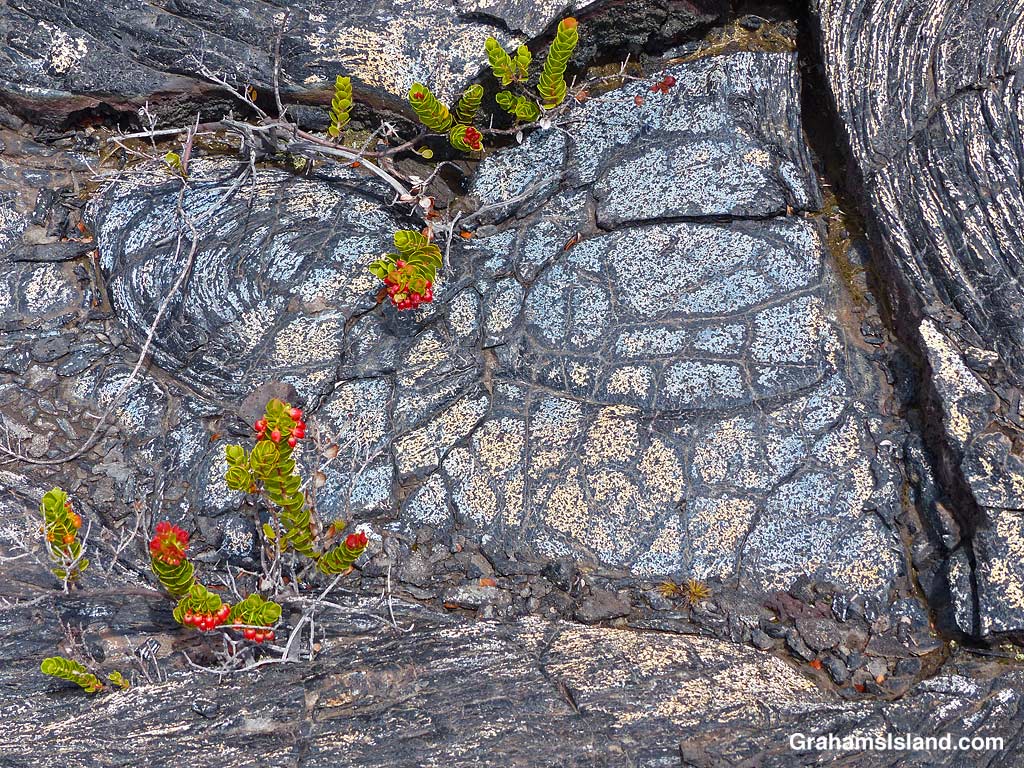
Bronze colored lava.Bands of red in the lava.A crack in the trail……revels shades of orange within.Blue and gold lava flow.Colorful and dramatic, but slowly nature returns.Colorful ropey pahoehoe lava next to smooth.Blue lava!The patterns and colors reminded me of Roman mosaic floors.Bold color and markings.Plants gain a toehold in the cracks and provide a splash of different colors.Don’t stray off the trail. There are holes and thin spots everywhere.Bright colors and bold shapes can be seen along a lot of the trail.
It wasn’t far along this part of the trail that I first encountered blue lava. That’s right, blue lava. Who knew? But not just blue. There’s bronze, pink, red, orange, gold, and who knows what. I’ve seen colorful lava on the Puna Coast Trail, but this was more varied and quite wonderful. In places the trail crossed this colorful lava and I felt bad for walking on it, though as I hiked I could see many more patches of color out in the lava fields. It’s not wise to leave the trail since there are many lava tubes, some with very thin ceilings.
This is an out and back trail and I turned around once I reached the Kamakai’a Hills, after about 5 miles. It’s another 2 or 3 miles to the next junction where there is a small cabin.
Also posted for Jo’s Monday Walk. See more responses here.
The trail crosses one of the fields of colorful lava.
Not exactly a mine, but this was how early Hawaiian settlers got their salt. Suitably cupped rocks were filled with saltwater. The hot sun evaporated the water leaving behind salt crusts on the rocks. In this instance, the water in the bowls is probably rainwater, hence the lack of any salt residue.
These rocks were at Lapakahi State Historical Park, which contains the remains of an old Hawaiian fishing village.



















 Graham's Island